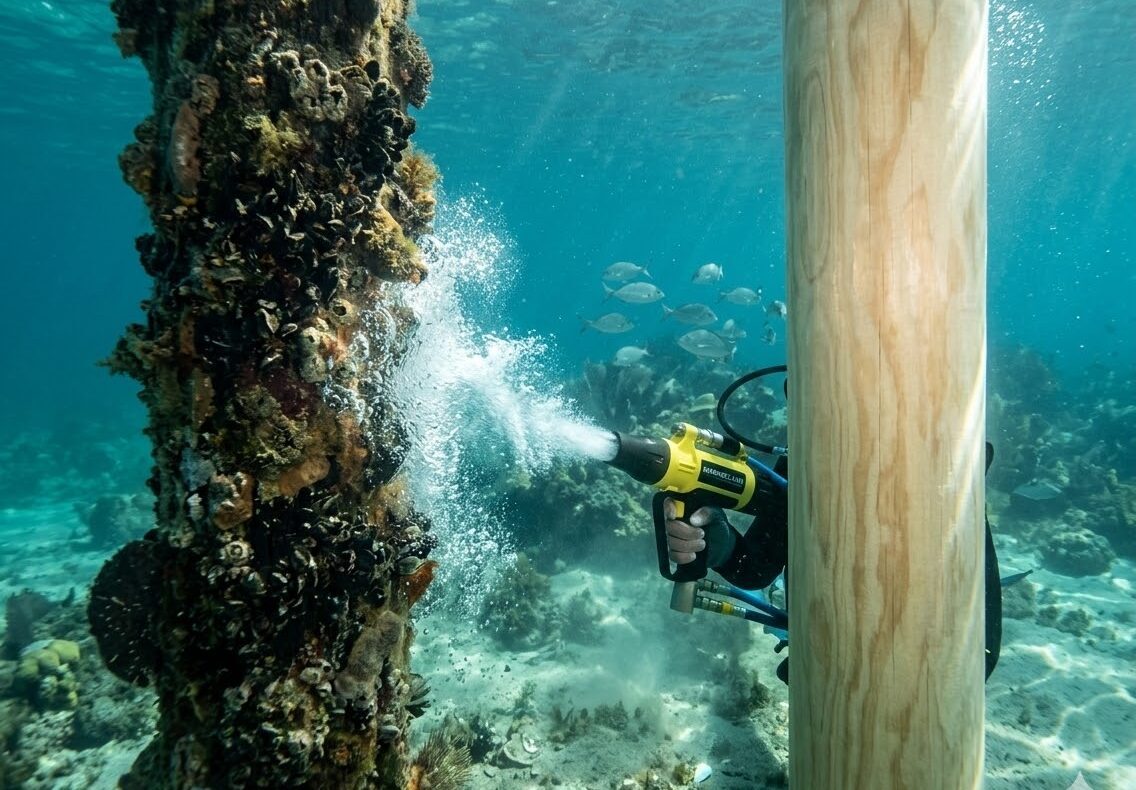
The marine maintenance industry is undergoing a quiet revolution — and it starts below the waterline. For decades, dock piling cleaning meant physical scraping, pressure washing, and abrasive brushing. While those methods still have their place, a new generation of technology is changing what is possible when it comes to removing marine growth, biofouling, barnacles, and biological films from dock pilings without causing surface damage. Cavitation dock piling cleaning and ultrasonic technology represent the most significant leap forward in marine maintenance in recent memory. These innovations clean more deeply, more efficiently, and more gently than any traditional method — and in 2025–2026, they are becoming increasingly accessible to commercial and residential dock owners alike. In this article, we explain exactly how these technologies work, why they outperform conventional methods, and what dock owners should know before investing in these cutting-edge cleaning solutions.
What Is Cavitation and How Does It Apply to Dock Piling Cleaning?
Cavitation is a naturally occurring physical phenomenon in which rapid changes in liquid pressure cause the formation and violent collapse of microscopic vapor bubbles. While cavitation is sometimes considered a problem in industrial settings — causing damage to pump impellers and propellers, for example — when it is precisely controlled and directed, it becomes one of the most powerful and effective cleaning forces known to science.
In the context of cavitation dock piling cleaning, this phenomenon is deliberately induced using specialized equipment either above or below the waterline. The process works as follows: a device generates rapid pressure oscillations in the surrounding water. During low-pressure phases, microscopic vapor bubbles form throughout the liquid. When the pressure returns to high, these bubbles collapse almost instantaneously — releasing intense localized shockwaves, high-velocity microjets of water, and bursts of heat. These energy releases are incredibly small individually, but collectively and repeatedly across millions of collapsing bubbles per second, they produce a cleaning force powerful enough to dislodge barnacles, algae, biofilm, and even heavily encrusted marine growth from piling surfaces — without any physical contact or abrasive scrubbing.
The result is a cleaning method that reaches into surface micro-crevices, biological film layers, and irregular piling textures that brushes and pressure washers simply cannot access effectively. It is thorough at a microscopic level, non-abrasive to the underlying piling material, and significantly faster than traditional manual cleaning methods.
Ultrasonic Technology: The Science Behind the Innovation
Ultrasonic cleaning uses high-frequency sound waves — typically between 20 kHz and 100 kHz — that are far above the range of human hearing but powerful enough to produce profound physical effects in liquids. When these sound waves are transmitted into water or a water-based solution, they create the alternating compression and decompression cycles that drive acoustic cavitation.
Piezoelectric transducers — devices that convert electrical energy into mechanical vibrations — are the core components of ultrasonic cleaning systems. These transducers emit sound energy into the surrounding water, creating a cavitation field throughout the liquid. Every surface that comes into contact with this cavitation field is effectively cleaned at the microscopic level, with millions of imploding bubbles working simultaneously across the entire submerged piling surface.
One of the most significant advantages of ultrasonic cavitation in marine applications is its ability to clean complex, irregular, and textured surfaces that are impossible to address uniformly with brushes or pressure jets. Rough concrete pilings, barnacle-scarred timber, and corroded steel surfaces all present irregular geometries that traditional cleaning tools either miss or damage. Ultrasonic cavitation reaches every recess, crack, and surface irregularity with equal intensity — delivering a uniformly clean result across the entire piling profile.
How Cavitation Dock Piling Cleaning Differs from Traditional Methods
To appreciate the true innovation that cavitation and ultrasonic technology represent, it helps to compare them directly against the conventional approaches that dock maintenance teams have relied on for generations.
| Cleaning Method | Surface Contact | Reaches Micro-Crevices | Risk of Surface Damage | Removes Biofilm | Environmental Impact | Cleaning Speed |
|---|---|---|---|---|---|---|
| Manual Scraping / Brushing | Yes — direct abrasive | No | Moderate to High | Partial | Growth dispersal into water | Slow |
| High-Pressure Water Jetting | Yes — water impact | Limited | Moderate | Partial | Disperses growth | Moderate |
| Cavitation Water Jet | Contactless | Yes | Low | Yes | Improved — less dispersal | Fast |
| Ultrasonic Cavitation | Contactless | Yes — microscopic level | Very Low | Yes — highly effective | Minimal chemical use | Very Fast |
The contrast is significant. Traditional scraping and brushing physically abrade the piling surface, which over time can damage protective coatings, widen existing cracks, and accelerate surface deterioration. High-pressure water jetting is more powerful but still involves direct impact force and tends to disperse biological growth into the surrounding water rather than truly removing it from the environment.
Cavitation and ultrasonic methods, by contrast, are entirely contactless from a mechanical perspective. The cleaning action is carried out by the energy of collapsing bubbles rather than by physical tools making contact with the piling surface. This means that coatings, anti-fouling treatments, encapsulation wraps, and protective jackets are preserved rather than degraded — a critical advantage for dock owners who have invested in protective piling treatments.
Cavitation Water Jet Cleaning for Dock Pilings
Cavitation water jet technology represents one of the most promising underwater applications of controlled cavitation for marine structure maintenance. Rather than relying purely on pressure to dislodge marine growth, cavitation water jet systems generate a precisely engineered jet that intentionally produces a cavitation cloud at its leading edge. When this cloud makes contact with the piling surface, the collapsing bubbles deliver the cleaning energy — not the mechanical force of the water jet itself.
Specialized portable devices used by certified commercial divers can generate acoustic pressure shock waves capable of delivering compressive pressures in excess of 100 MPa at the piling surface, followed by strong tensile negative pressures that generate large cavitation bubbles during their collapse. The combined effect is described by researchers as two synergistic phase effects working simultaneously — making this one of the most powerful contactless cleaning methods available for underwater structures today.
Cavitation water jet cleaning is particularly effective for:
- Heavily barnacled concrete and steel pilings where growth has hardened and calcified over multiple seasons
- Pilings with anti-fouling coatings that need deep fouling removed without compromising the coating layer itself
- Large commercial dock structures where manual cleaning would be prohibitively time-consuming
- Post-storm emergency cleaning where accelerated biofouling accumulation has occurred
- Pilings in high-salinity environments where calcium carbonate barnacle attachment is especially aggressive
Ultrasonic Antifouling Systems: Prevention Through Continuous Cavitation
One of the most exciting emerging applications of ultrasonic technology in dock piling maintenance is not cleaning after fouling has occurred — it is preventing fouling from establishing in the first place. Ultrasonic antifouling systems are permanently mounted devices that emit continuous low-power ultrasonic pulses into dock pilings and surrounding water, creating a persistent cavitation environment at the piling surface.
Marine organisms that cause biofouling — barnacles, mussels, algae, tube worms, and slime bacteria — rely on being able to attach their larvae or root structures to a stable surface. The continuous micro-disturbance created by ultrasonic antifouling systems prevents this initial adhesion, effectively making the piling surface inhospitable to settlement without any chemical treatment whatsoever.
These systems are particularly well-suited for:
- New pilings or recently replaced pilings where preventing initial fouling establishment is the priority
- Pilings in high-fouling environments such as warm tropical or subtropical coastal waters
- Marina berths and dock structures adjacent to ecologically sensitive marine areas where chemical anti-fouling treatments are restricted
- Steel and aluminum pilings where surface coating preservation is critical
- Commercial dock facilities where downtime for cleaning represents significant operational costs
Ultrasonic antifouling is increasingly recognized by marine environmental agencies as a preferred alternative to biocide-based anti-fouling coatings, which can have harmful effects on non-target marine organisms. The U.S. Environmental Protection Agency’s Safer Choice program actively encourages the adoption of non-chemical marine maintenance alternatives — a category that ultrasonic antifouling systems fit squarely within.
Environmental Advantages of Cavitation and Ultrasonic Piling Cleaning
Beyond their superior cleaning performance, cavitation and ultrasonic technologies offer compelling environmental advantages that are increasingly important to dock owners, marina operators, and regulatory bodies in 2025–2026.
Reduced Chemical Dependency
Traditional dock piling cleaning often relies on chemical biocides, detergents, and algaecides to break down biological growth before or after mechanical removal. These chemicals enter the surrounding water and can harm marine ecosystems, particularly in enclosed marina environments with limited water exchange. Ultrasonic and cavitation cleaning systems dramatically reduce or completely eliminate the need for chemical cleaning agents, relying instead on pure physical energy to achieve the same or superior results.
Minimized Biological Dispersal
Conventional scraping and brushing releases large volumes of dislodged marine organisms directly into the surrounding water. This biological dispersal can introduce invasive species from one location to another — a recognized environmental concern in marina ecosystems worldwide. Cavitation and ultrasonic systems, when paired with collection or containment systems, minimize this dispersal by breaking down biological material more completely at the point of contact rather than detaching it in large viable fragments.
No Surface Coating Damage
Anti-fouling coatings and protective treatments applied to dock pilings serve an important environmental function — they reduce the frequency with which chemical re-treatment is required. When aggressive mechanical cleaning methods damage these coatings, they must be reapplied more frequently, increasing the environmental load. Ultrasonic and cavitation cleaning methods preserve coating integrity, reducing the long-term use of protective chemicals.
What to Expect From a Professional Cavitation Dock Piling Cleaning Service
For dock owners considering professional cavitation or ultrasonic cleaning services, understanding what the process involves helps set accurate expectations and ensures the best possible results.
Pre-Cleaning Underwater Inspection
Before any cleaning begins, a thorough underwater inspection is performed by a certified diver. This establishes the baseline condition of each piling, identifies any structural concerns that should be addressed before cleaning, and determines the type and density of biofouling present. This inspection data is also essential for measuring the effectiveness of the cleaning treatment after completion.
Equipment Deployment and Cleaning Process
Depending on the specific cavitation or ultrasonic technology being used, the diver deploys purpose-built equipment at and below the waterline. Cavitation water jet devices are typically handheld and operated by the diver at close range to the piling surface. Ultrasonic transducer arrays may be temporarily mounted directly to the piling or operated in close proximity. The diver systematically works from the mud line upward, ensuring complete coverage of every section of each piling.
Post-Cleaning Inspection and Documentation
After cleaning is completed, a post-cleaning underwater inspection documents the results, confirms that all growth has been removed to specification, and checks for any surface conditions that were concealed by the previous fouling layer. Photographic or video documentation provides dock owners with a clear record of work completed and the condition of their pilings.
Maintenance Schedule Recommendation
A professional marine maintenance team will provide a recommended cleaning frequency based on the local marine environment, water temperature, salinity, seasonal fouling patterns, and the type of pilings present. In high-fouling environments, quarterly cleaning may be recommended. In cooler or lower-salinity waters, biannual treatment may be sufficient to maintain optimal piling condition.
Combining Cavitation Cleaning With Zinc Anode Protection
For steel, aluminum, and metal-fitted dock pilings, cavitation cleaning pairs exceptionally well with zinc anode cathodic protection systems. When marine growth and fouling are removed effectively through cavitation or ultrasonic treatment, the condition and depletion status of zinc anodes becomes clearly visible to the inspecting diver. This allows for same-session zinc anode assessment and replacement, combining two critical maintenance tasks into a single efficient service call.
Zinc anodes protect metal piling components from galvanic corrosion — an electrochemical process that can cause rapid structural deterioration in saltwater environments. As sacrificial anodes, they corrode in place of the protected metal. Once depleted beyond approximately 50% of their original mass, they should be replaced to maintain effective protection. Pairing cavitation cleaning with zinc inspection and replacement is considered best practice by marine maintenance professionals for any dock with metal components.
For further guidance on responsible marine cleaning and environmental stewardship, the NOAA Ocean Service provides comprehensive resources on biofouling management and its ecological significance in coastal marine environments.
Frequently Asked Questions About Cavitation Dock Piling Cleaning
Is cavitation cleaning safe for all types of dock pilings?
Cavitation and ultrasonic cleaning are considered safe for the vast majority of dock piling materials including wood, concrete, steel, fiberglass, and composite pilings. Because the cleaning action is contactless and non-abrasive, it does not physically damage piling surfaces or protective coatings the way mechanical scraping can. However, pilings with advanced structural deterioration should always be professionally inspected before any cleaning method is applied, as aggressive cleaning on a severely weakened piling could accelerate damage.
How often should cavitation dock piling cleaning be performed?
Recommended frequency depends on several environmental factors including water temperature, salinity, light penetration, and local marine biology. In warm, tropical, or subtropical saltwater environments — where biofouling growth is most aggressive — professional cleaning every three to four months is common. In cooler or less biologically active waters, every six months may be sufficient. Your marine maintenance provider will recommend a schedule based on a site-specific assessment of your dock’s environment and piling condition.
Can ultrasonic antifouling systems fully replace regular dock piling cleaning?
Ultrasonic antifouling systems significantly reduce the rate and density of biofouling accumulation on dock pilings, which extends the intervals between cleaning requirements considerably. However, they are generally most effective as a prevention and reduction tool rather than a complete replacement for periodic professional cleaning. Some fouling may still accumulate — particularly during periods of high biological activity or in areas with strong larval settlement pressure. Regular professional inspection remains essential regardless of antifouling system installation.
What is the difference between cavitation water jet cleaning and ultrasonic cleaning for dock pilings?
Cavitation water jet cleaning uses a directed jet of water engineered to produce a cavitation cloud at the piling surface, delivering powerful contactless cleaning energy. It is typically used as an active cleaning treatment performed by a diver. Ultrasonic cleaning uses submerged transducers that emit continuous high-frequency sound waves into the surrounding water, generating a field of acoustic cavitation across the entire piling surface simultaneously. Ultrasonic systems can be used both for active treatment sessions and as permanently installed antifouling prevention systems. Both use the same fundamental cavitation physics but differ in how the energy is generated and delivered.
Conclusion: The Future of Dock Piling Cleaning Is Here
Cavitation dock piling cleaning and ultrasonic technology represent a genuine step change in what marine maintenance can achieve. Compared to traditional scraping, brushing, and pressure washing, these innovations clean more thoroughly, protect piling surfaces more effectively, reduce environmental impact dramatically, and deliver results that last longer between service intervals. Whether deployed as an active cleaning treatment or as a continuously operating antifouling prevention system, cavitation and ultrasonic solutions are setting a new standard for dock piling maintenance in 2025–2026 and beyond.
For dock owners, marina operators, and waterfront property managers, the message is clear: embracing these technologies is not just about keeping pilings looking clean — it is about maximizing the structural lifespan of your entire dock investment, reducing long-term maintenance requirements, and operating in a way that respects the marine environment your dock depends on. The combination of professional underwater inspection, precision cavitation cleaning, and proactive protective treatments is the most advanced and effective dock maintenance strategy available today.
Ready to experience the difference that professional cavitation cleaning can make for your dock pilings? Contact our certified marine team today — we deliver expert Cavitation Cleaning services that protect your dock’s structure and extend its life for years to come.