Walk into any marina supply store, browse any dock maintenance forum, or ask any waterfront contractor for a recommendation on piling protection and you will encounter two camps with strong opinions on opposite sides of a debate that dock owners have been navigating for decades. On one side: piling wraps — physical barrier systems that encase your pilings in durable materials to block biological attack and moisture from the outside. On the other: professional cleaning — regular removal of the marine growth that threatens piling surfaces, combined with structural inspection that keeps problems from developing unseen below the waterline. The question of dock piling wraps vs. cleaning is one of the most consequential maintenance decisions a waterfront property owner makes — and the honest answer is neither a simple victory for one method nor a dismissal of the other. It is a nuanced assessment of what each approach delivers, what each one cannot do, where they fail without the other, and why the most structurally successful and financially efficient dock protection programs in 2025–2026 combine both rather than choosing between them. This complete guide gives you the full, unvarnished comparison — so you can make the right decision for your specific dock, environment, and budget.
Understanding What Each Method Actually Does
Before comparing dock piling wraps and professional cleaning directly, it is essential to establish a precise understanding of what each approach is designed to accomplish — because much of the confusion in the wraps-vs-cleaning debate stems from comparing two tools that are not actually designed to do the same job.
What Dock Piling Wraps Do
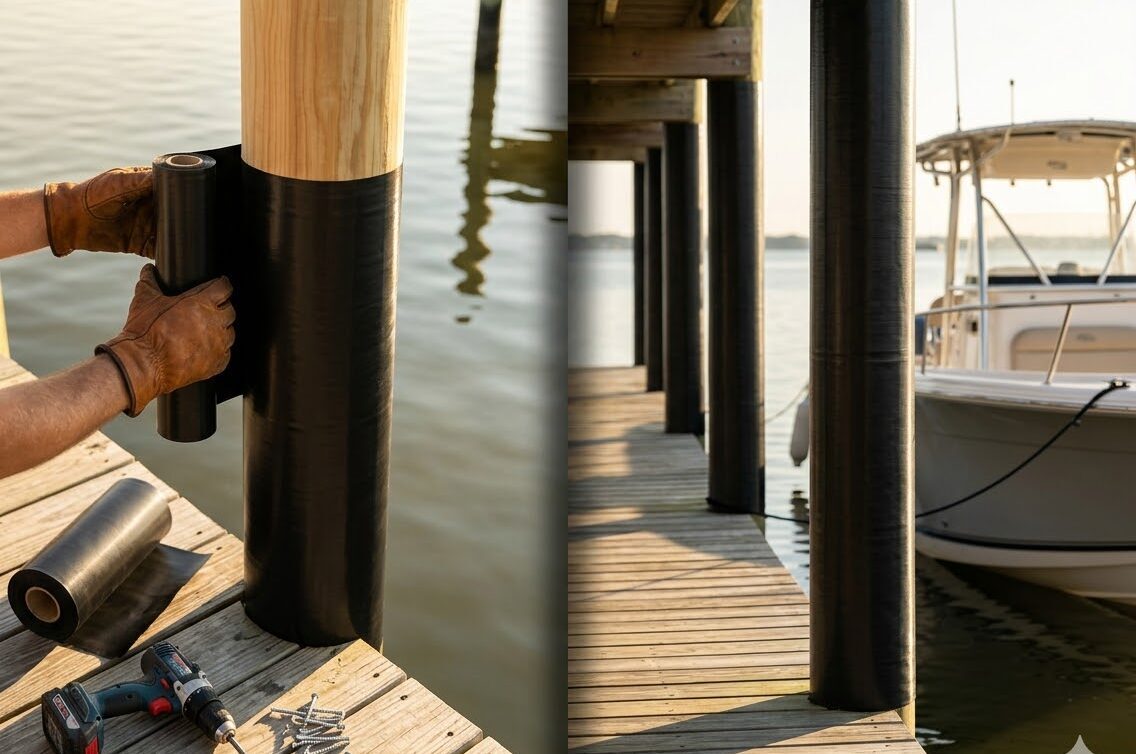
Dock piling wraps are physical barrier systems — protective coverings made from durable marine-grade materials including high-density polyethylene (HDPE), PVC, vinyl, polyester composite, and fiberglass — that are installed around the exterior of dock pilings to create a physical separation between the piling material and the marine environment. Dock piling wraps and jackets are protective systems installed around pilings to shield them from marine growth, moisture intrusion, corrosion, and physical damage.
The protection they provide is fundamentally preventive and passive. Pile wrap protects against marine organisms, UV rays, rot, and decay, and it can lengthen the life of your piles. By physically denying marine borers, barnacle larvae, algae, and moisture direct access to the piling material beneath, wraps prevent the biological and chemical attack mechanisms that degrade pilings from establishing contact with the vulnerable wood, concrete, or metal surface they are designed to protect. They do not remove existing growth. They do not assess structural condition. They do not protect the sections of the piling outside their coverage area. And once installed, they require their own maintenance to remain effective.
What Professional Piling Cleaning Does
Professional piling cleaning — particularly cavitation-based cleaning performed by certified commercial divers — is an active intervention that removes established marine growth from piling surfaces across their full submerged length, reveals the true structural condition of piling surfaces beneath the growth, enables post-removal structural inspection, and preserves or restores the protective coating surfaces that slow fouling reestablishment between cleaning sessions.
Professional cleaning is fundamentally reactive and active — it addresses fouling that has already established, rather than preventing establishment in the first place. Its structural protection value is delivered through two mechanisms: the direct removal of the biological communities that accelerate piling deterioration, and the inspection that each cleaning visit enables by exposing surfaces that were previously concealed by growth. It does not create a physical barrier against future fouling. It does not physically repair structural damage it reveals. But it provides information about piling condition that wraps alone can never deliver — and it addresses the full piling length including sections that wraps may not cover.
The Case for Dock Piling Wraps: What They Do Exceptionally Well
Piling wraps have earned their place in the dock protection toolkit through decades of demonstrated performance against some of the most destructive threats that dock pilings face. Understanding their genuine strengths — and the specific scenarios where they provide irreplaceable value — is essential for making an informed wraps-vs-cleaning decision.
Marine Borer Protection: The Wrap’s Greatest Strength
The single most compelling case for dock piling wraps is their effectiveness against marine borers — particularly shipworms — in wood piling applications. Without protection, dock pilings are vulnerable to wood-boring creatures like shipworms and gribbles, which thrive in warm, wet climates and brackish waters, creating the perfect conditions for marine life to flourish. Shipworms require direct contact with an unprotected wood surface to initiate their boring entry — and a properly installed piling wrap that creates a complete, sealed barrier from below the mud line to above the high-water mark physically denies them that access point.
No amount of cleaning, however regular and professionally performed, can stop an active marine borer infestation once it has established inside a piling. Cleaning removes surface growth — it does not penetrate the interior of the piling to address tunneling organisms already at work within the wood. This is the critical advantage that wraps hold over cleaning in wood piling marine borer environments: they prevent the infestation from establishing in the first place. Installing piling wraps on your dock can save you countless dollars and headaches in the future — particularly in high-salinity, warm-water environments where shipworm pressure is most aggressive and where the interior structural damage they cause can progress from undetectable to critical faster than annual inspection intervals can reliably catch it.
Long-Term Passive Protection: Set and Monitor
In terms of lifespan, dock piling wrap has shown to be highly durable, with some manufacturers offering warranties of up to 20 years. Manufactured pile wraps will last approximately 10 to 15 years without any maintenance or inspections under normal conditions — providing a decade or more of passive biological barrier protection without requiring the recurring service visits that professional cleaning programs involve. For dock owners in locations where regular professional cleaning access is logistically challenging, or for pilings in high-marine-borer environments where biological attack pressure is too aggressive for cleaning alone to manage, this long-term passive protection profile is a significant practical advantage.
Moisture Barrier and Rot Prevention in Wood Pilings
For wood pilings, moisture infiltration is the primary driver of fungal rot — and wraps that create a sealed moisture barrier around the piling from below the mud line upward dramatically reduce the moisture exposure that drives rot progression. Piling wraps act as armor, keeping marine invaders at bay while also preventing moisture from seeping into the wood and causing rot. This moisture barrier function is particularly valuable in the waterline zone — where the alternating wet-dry tidal cycle concentrates moisture stress and rot conditions most aggressively — and at the mud-line transition where anaerobic rot organisms are most active.
Structural Reinforcement in Damaged Pilings
Certain wrap systems — particularly the SnapJacket system and fiberglass jacket approaches — provide more than biological protection. They also deliver structural reinforcement to pilings that have already sustained some level of deterioration. SnapJacket involves snapping plastic wraps around a pile and then sealing the wrap with concrete, which can fortify decayed or eroded wood and provide structural support. For pilings in mid-stage deterioration where replacement is not yet required but structural reserve has been reduced, this combined barrier and reinforcement function makes wrap systems the appropriate professional response — one that cleaning alone cannot deliver.
The Limitations of Dock Piling Wraps: Where They Fall Short
The genuine strengths of dock piling wraps should not obscure their equally genuine limitations — because these limitations are what make professional cleaning not an alternative to wraps but a necessary complement to them in any complete piling protection program.
Installation Must Follow Professional Cleaning — Not Replace It
The single most critical limitation of dock piling wraps is that their protective function is entirely dependent on the condition of the piling surface at the time of installation — which means that professional cleaning and structural inspection must always precede wrap installation, never follow it. Pilings must be thoroughly cleaned and inspected before installation to ensure proper fit and adhesion. Improper sealing allows water intrusion that can trap moisture and worsen deterioration instead of preventing it.
A wrap installed over a piling with active marine borer infestation does not stop the infestation — it seals the borers inside the piling with an uninterrupted food source and no natural termination to their activity. A wrap installed over a piling with active rot traps moisture against the decaying wood rather than excluding it. A wrap installed over a piling with developing cracks or structural compromise conceals those conditions from any subsequent inspection while the deterioration continues beneath the protected surface. Wrap has to be installed properly with the correct number of fasteners, correct overlap, going below the mud line, and proper cleaning of existing piles. Professional cleaning and inspection before installation is not a preparatory nicety — it is the structural prerequisite that determines whether the wrap will protect or inadvertently accelerate the deterioration it was intended to prevent.
Wraps Cannot Inspect What They Cover
Once installed, a piling wrap creates a physical barrier that is equally opaque to structural assessment as the biological growth it replaces. Even protected pilings require periodic inspection to ensure continued effectiveness. A wrapped piling that has sustained impact damage, developed internal rot progression, or experienced marine borer entry through a compromised wrap seam will continue to deteriorate beneath the wrap without any external indication — precisely the hidden damage scenario that makes professional underwater inspection so critical for all dock pilings regardless of whether they carry protective wraps or not.
Wraps Do Not Cover All Vulnerable Sections
Pile wrap must be installed on cleaned piles and consists of black vinyl sheeting that is wrapped around the piles and secured, stretching from just below the mud line to just above the high water mark. This coverage zone — mud line to above the high-water mark — addresses the most biologically active section of the piling but does not cover the full above-waterline section that faces UV degradation, insect boring, and weathering. Without piling caps, the end grain of wooden pilings is directly exposed to rain, UV rays, and bird droppings, which creates a perfect environment for rot, fungi, and structural decay. The sections of the piling above the wrap’s upper edge — and particularly the top of the piling — remain exposed to the above-waterline deterioration mechanisms that piling caps and above-waterline maintenance must address separately.
Wrap Seams Are Vulnerability Points for Marine Borer Entry
One of the most important practical limitations of piling wraps in high-marine-borer environments is that their seams, edges, and fastener holes represent potential entry points for the very organisms they are designed to exclude. Wraps significantly reduce attachment but may still require occasional cleaning at seams or edges. Boat impacts and debris can puncture piling wraps, and over time, barnacles can grow along the seams, allowing marine borers inside. This means that professional inspection of wrap integrity — checking seals, edges, and any areas of potential damage — must be part of the ongoing maintenance program for wrapped pilings, and any compromise in wrap integrity must be addressed promptly before marine borer access through the breach point establishes.
The Case for Professional Cleaning: What It Delivers That Wraps Cannot
Professional cleaning’s role in dock piling protection goes far beyond simply removing the biological growth that wraps prevent from establishing. It delivers structural information, coating preservation, cathodic protection coordination, and full-piling-length maintenance that no passive barrier system can replicate.
Structural Assessment: The Information That Protects Your Investment
Every professional cleaning visit by a certified commercial diver is simultaneously a structural assessment opportunity. The clean piling surfaces revealed after professional growth removal allow the inspecting diver to physically probe for soft spots, identify cracks and splits, check hardware connections for corrosion and mechanical integrity, assess mud-line stability and scour conditions, and verify the condition of any wraps or protective systems installed on the piling. This structural information is what enables repair decisions to be made at the earliest, most affordable stage — before developing problems reach the threshold where repair yields to replacement.
Wrapped pilings that are never professionally inspected and cleaned lose the benefit of this information entirely. The wrap provides physical protection but creates a structurally blind zone — a section of the piling whose internal and surface condition is unknown and potentially deteriorating without detection. Professional cleaning visits that include wrap integrity inspection resolve this limitation by confirming that the protection the wrap is designed to provide is actually being delivered.
Full Piling Length Coverage Including Above and Below Wrap Zones
Professional cleaning by certified divers addresses the full piling length — from above the waterline through the wrap zone and down to the mud-line base — including all sections that wrap systems do not cover. The above-waterline section above the wrap’s upper edge, the piling top, and any sections where wrap coverage is incomplete are all addressed during professional cleaning visits. This full-length coverage ensures that no section of the piling is maintained in isolation — the complete structural picture is assessed at every service event.
Coating Preservation and Cathodic Protection Coordination
For pilings with anti-fouling coatings and for all dock structures with metal hardware components, professional cleaning coordinates the maintenance of multiple protective systems simultaneously. Anti-fouling coating condition is assessed at each cleaning visit and reapplication scheduled when coating thickness falls below effective protection threshold. Zinc anode condition on all metal components is checked and depleted anodes replaced — ensuring that cathodic protection is maintained continuously rather than allowed to lapse between infrequent inspection visits. This coordinated multi-system maintenance approach is only possible through regular professional service visits that address the complete piling in its full structural context.
Dock Piling Wraps vs. Cleaning: Direct Comparison
| Protection Criteria | Piling Wraps | Professional Cleaning | Combined Approach |
|---|---|---|---|
| Marine Borer Prevention | Excellent — physical barrier denies access | Limited — cannot stop active infestation; cleans surface only | Maximum — wrap prevents entry; cleaning monitors seam integrity |
| Biofouling Management | Good — reduces surface fouling attachment rate | Excellent — removes all established growth completely | Maximum — wrap slows establishment; cleaning removes what establishes at seams |
| Structural Assessment | None — wrap conceals piling surface | Excellent — reveals full piling condition at every visit | Excellent — cleaning assesses wrap integrity and uncovered piling sections |
| Moisture Barrier | Excellent — sealed barrier excludes moisture from wood | None — does not create physical moisture barrier | Maximum — wrap provides moisture exclusion; cleaning maintains seal integrity |
| Corrosion Management | Limited — does not address metal hardware | Excellent — includes zinc anode inspection and replacement | Maximum — cleaning addresses all metal component protection |
| Above-Waterline Protection | Partial — covers to above high-water mark only | Yes — full length including above-waterline sections | Maximum — wrap covers submerged zone; cleaning addresses full length |
| Structural Reinforcement | Yes — certain systems (SnapJacket, fiberglass jackets) provide reinforcement | None — does not physically reinforce piling | Wrap provides reinforcement; cleaning detects where reinforcement is needed |
| Long-Term Passive Protection | Excellent — 10–25 years with proper installation | None — requires recurring service visits | Wrap provides passive protection; cleaning maintains and verifies it |
| Post-Storm Damage Assessment | None — cannot self-assess | Excellent — professional diver assesses all zones after storm | Cleaning provides post-storm assessment of wrap and piling condition |
| Environmental Impact | Low — no chemical input required | Minimal with cavitation method — no chemicals | Minimal — both methods have low environmental footprint when properly executed |
The Honest Answer: Wraps and Cleaning Are Complementary, Not Competing
The dock piling wraps vs. cleaning debate is ultimately a false choice — framed as a competition between two approaches that are actually designed to address different aspects of piling protection and that deliver their maximum value only when used together. The BoatUS Foundation recommends combining protective systems with regular inspections for maximum dock longevity.
Piling wraps excel at what professional cleaning cannot do: creating a physical barrier that prevents marine borer entry, excluding moisture from wood piling material, and providing decades of passive biological protection between service events. Professional cleaning excels at what wraps cannot do: removing established growth, revealing structural condition, coordinating multi-system protective maintenance, and providing the structural information that enables informed repair and replacement decisions before they become emergency situations.
A dock owner who installs piling wraps without maintaining a professional cleaning and inspection program has passive physical protection with no structural visibility — a wrapped piling that is failing internally without any mechanism for detection. A dock owner who maintains professional cleaning without installing piling wraps in a high-marine-borer environment has excellent structural visibility with no physical barrier against the most destructive biological threat to wood pilings. The combination of both delivers what neither achieves alone: physical protection against biological attack, active management of the fouling that establishes despite that protection, and regular structural assessment that confirms the entire protection system is performing as designed.
When to Prioritize Wraps, When to Prioritize Cleaning, and When to Use Both
Prioritize Wraps When:
- You have new or relatively new wood pilings in a high-salinity saltwater environment where marine borer pressure is aggressive — install wraps before biological attack establishes rather than after
- You have existing wood pilings in mid-stage deterioration where a combination of cleaning, inspection, and wrap installation can halt deterioration progression and add significant service life
- Regular professional cleaning access is logistically challenging due to location, water depth, or service availability — wraps provide passive protection during extended intervals between cleaning visits
- You are in a warm-water tropical or subtropical environment where shipworm pressure is year-round and aggressive — wrap installation is the most reliable available defense against a biological threat that operates on a timeline too fast for cleaning alone to manage
Prioritize Professional Cleaning When:
- Your pilings are concrete, steel, or composite materials where marine borer attack is not a concern but biofouling accumulation and corrosion management are the primary maintenance objectives
- Existing wraps are in place and require seam integrity monitoring, edge cleaning, and above-waterline section maintenance that wrapped pilings still require
- You need structural condition assessment — whether for maintenance planning, insurance documentation, property sale preparation, or post-storm damage evaluation — that only professional underwater cleaning and inspection can provide
- Metal hardware components and zinc anode systems require coordination with cleaning visits for cathodic protection maintenance
Use Both When:
- You have wood pilings in saltwater environments where both marine borer prevention and biofouling management are active maintenance requirements
- You want to maximize piling service life and minimize total lifecycle maintenance cost — the combination delivers the longest achievable service life for any piling type
- You are in a marina environment where insurance documentation, environmental compliance, and property value protection all benefit from comprehensive professional maintenance records
- You want the most structurally and financially responsible dock maintenance program available — which is always the combination approach
According to the NOAA Ocean Service, the most effective marine structure protection programs combine physical barrier systems with regular professional maintenance and inspection — with neither approach sufficient as a standalone strategy in biologically active saltwater environments. The U.S. Environmental Protection Agency’s Safer Choice program endorses integrated marine maintenance approaches that minimize chemical use, reduce biological dispersal, and combine passive protection with active monitoring — a description that precisely characterizes the professional cleaning and wrap combination program.
The Installation Sequence That Makes the Difference
For dock owners who decide — correctly — to use both piling wraps and professional cleaning as part of an integrated protection program, the sequence of these interventions matters enormously to their effectiveness.
The correct sequence is always: professional cleaning first, professional structural inspection second, any required structural repair third, and wrap installation fourth. The process involves inspecting the pilings before installation and can start by probing them — once the inspection is complete, the process begins to remove marine hard growth from the pile surface, power washing dock pilings all the way down to the sea level with a high-pressure power wash to thoroughly remove all the marine hard growth and all marine borers before the skilled team carefully applies the chosen pile wrap. Installing wraps on uncleaned, uninspected pilings — as sometimes occurs when installation is treated as a DIY project or when cost pressure leads to skipping the professional cleaning prerequisite — creates the trap-and-conceal scenario described earlier, where the wrap protects against external biological attack while the conditions for internal deterioration are sealed inside rather than addressed before protection begins.
Frequently Asked Questions About Dock Piling Wraps vs. Cleaning
Can I install piling wraps myself or does it require a professional?
The simplicity benefits of dock piling wrap are evident in its process and quick setup — with clear instructions provided, even those without prior experience can easily apply the wrap to their dock pilings. However, while the physical wrap installation may be manageable as a DIY project for accessible above-waterline piling sections, the professional cleaning, underwater inspection, and below-waterline wrap installation that create the conditions for effective wrap performance are not DIY tasks. Pile wrap should be professionally installed by a reputable dock contractor for best results. The cost of professional installation — which includes the prerequisite cleaning and inspection — is a small fraction of the cost of the piling replacement that improper installation or installation over uncleaned, uninspected pilings can necessitate.
How long do piling wraps actually last in saltwater environments?
In terms of lifespan, dock piling wrap has shown to be highly durable, with some manufacturers offering warranties of up to 20 years. Manufactured pile wraps will last approximately 10 to 15 years without any maintenance or inspections. Actual lifespan in service varies significantly based on installation quality, environmental exposure, vessel impact frequency, and the regularity of professional inspection that catches seam compromises and physical damage before they allow biological infiltration. Wraps installed correctly by professionals following proper cleaning and inspection, maintained with annual professional inspection, and protected from repeated vessel impact consistently achieve the upper range of their specified service life.
Do I still need professional cleaning if my pilings are wrapped?
Yes — for several important reasons. Wrap seams, edges, and any areas of physical damage are vulnerability points where barnacles establish, marine borers can potentially gain entry, and moisture infiltration can occur — all requiring periodic professional cleaning and inspection to maintain. The sections of the piling above the wrap’s upper coverage limit remain exposed to above-waterline deterioration mechanisms that professional cleaning and above-waterline inspection address. Metal hardware components and zinc anodes on wrapped docks require professional maintenance coordination that cleaning visits provide. And the structural assessment that professional underwater inspection delivers — confirming that wrapped pilings are performing as intended and that no deterioration is developing beneath the wrap — is only available through professional service visits that include both cleaning and inspection components.
Which piling wrap type is best for my dock?
The appropriate wrap type depends on your piling material, environmental conditions, existing piling condition, and protection objectives. Different wrapping materials such as vinyl sleeves, polyethylene wraps, fiberglass coatings, rubber casings, and PVC covers offer various levels of protection against moisture, decay, and impact. For new wood pilings in aggressive marine borer environments, full-encapsulation polyethylene or HDPE wrap systems installed from below the mud line to above the high-water mark provide the most comprehensive biological barrier. For pilings with existing deterioration requiring both protection and structural reinforcement, SnapJacket or fiberglass jacket systems are the appropriate choice. For concrete and steel pilings, fiberglass jackets and carbon fiber wrap systems address the specific deterioration mechanisms — spalling, corrosion — those materials face. Professional consultation following underwater inspection is the most reliable way to identify the appropriate system for your specific pilings.
Conclusion: The Best Protection Uses Both — In the Right Order
The dock piling wraps vs. cleaning debate resolves cleanly when both tools are understood for what they actually are: complementary components of a complete piling protection program rather than competing alternatives to each other. Wraps provide what cleaning cannot — a physical barrier that prevents marine borer entry, moisture infiltration, and direct biological contact with vulnerable piling material across the most structurally critical submerged zone. Professional cleaning provides what wraps cannot — active removal of established growth, structural visibility into piling condition, full-length maintenance coverage, and coordinated protection of all the ancillary systems — coatings, anodes, hardware — that contribute to the dock’s total structural health.
The dock owners whose pilings achieve and exceed their designed service life are those who treat wraps and cleaning not as alternatives but as sequential and ongoing partners in a protection program that is greater than the sum of its parts. Install wraps on properly cleaned and inspected pilings. Maintain regular professional cleaning visits that monitor wrap integrity, address above-wrap piling sections, and provide the structural assessment that wrapped pilings still require. Replace depleted zinc anodes at each cleaning visit. And schedule professional underwater inspection annually to confirm that the complete protection system — wrap, coating, cathodic protection, and structural integrity — is performing as designed.
That is not a wraps-vs-cleaning decision. That is a complete piling protection program — and it is the one that actually works.
Contact our certified marine team today to schedule professional Cavitation Cleaning and a complete underwater inspection — the essential first step before any wrap installation and the ongoing foundation of every piling protection program that delivers real results.