A marina is not simply a collection of docks. It is a commercial operation whose entire value proposition — the safety of the vessels it shelters, the confidence of the boaters it serves, the regulatory standing it maintains, and the long-term financial performance it delivers to its owners — rests on the structural integrity of its pilings. Every slip, every berth, every floating dock section, and every finger pier in a marina depends on pilings that are structurally sound, biologically managed, and regularly assessed by professionals who can see what the waterline hides. A marina dock piling cleaning program is not a maintenance luxury — it is the operational foundation that makes everything else a marina promises to its clients possible. In 2025–2026, as regulatory standards tighten, insurance requirements evolve, and boaters become increasingly informed about the structural quality of the facilities they trust with their vessels, marinas that operate without a documented, regular professional piling cleaning and inspection program are managing a structural liability that compounds with every season it goes unaddressed. This comprehensive guide explains exactly why a regular dock piling cleaning program is not optional for any marina that takes its structural responsibility, commercial reputation, and financial sustainability seriously — and what a properly structured program looks like in practice.
The Scale of the Marina Piling Maintenance Challenge
The scope of the piling maintenance challenge facing marina operators is fundamentally different from the challenge facing private dock owners — not just in scale but in complexity. A marina with one hundred boat slips may have three hundred or more individual pilings, each one submerged in the same biologically active saltwater environment, each one facing the same simultaneous assault from marine borers, barnacles, mussels, algae, galvanic corrosion, and storm loading. But each one also serves a different structural function, carries a different load profile depending on the size and mooring characteristics of the vessel it serves, and may be at a different stage of biological fouling and structural deterioration depending on its location within the marina basin, its age, its material, and its maintenance history.
A marina that does not have a systematic, documented piling cleaning and inspection program is effectively operating without visibility into the structural condition of its most critical infrastructure. Dock pilings are a crucial part of your waterfront property or marina, supporting docks and providing the foundation for a safe and functional environment — and over time, these pilings can accumulate marine growth like barnacles, algae, and other organisms that compromise their integrity. When that accumulation occurs across hundreds of pilings simultaneously — as it does in every marine environment without regular intervention — the cumulative structural risk becomes a genuine operational and financial threat that no amount of above-waterline observation can adequately monitor.
The commercial marina environment also introduces specific biological pressures that private docks do not face to the same degree. The constant movement of vessels from different geographic origins into and out of marina berths introduces continuous biological material from diverse marine environments — dramatically increasing the invasive species settlement pressure on marina pilings compared to a private dock that primarily hosts a single vessel. The higher density of vessels in a marina basin concentrates the propeller wash, mooring line chafe, and vessel impact that accelerate piling surface deterioration. And the higher density of shore power connections in a marina environment increases the stray current corrosion risk that can cause catastrophic structural loss in steel piling components far faster than natural galvanic corrosion alone.
Reason 1: Structural Safety Is a Marina’s Legal and Moral Responsibility
The most fundamental reason a marina needs a regular dock piling cleaning program is also the most straightforward: marina operators have a legal and moral duty of care to the boaters, guests, and staff who use their facility. A structural failure resulting from neglected piling maintenance — a dock section collapse, a piling failure under a vessel, a gangway failure caused by a compromised piling connection — is not simply a property damage event. It is a potential personal injury incident with liability consequences that can threaten the financial viability of the entire marina operation.
Regular check-ups and maintenance ensure the foundations still stand firm under the deck — particular damage may affect the piles’ stability, causing the structure to move along with the waves or when you walk on it. For a marina operator, a dock that moves unexpectedly underfoot is not a maintenance concern that can wait for the next scheduled service visit — it is an active safety hazard affecting every person who walks that section of dock and every vessel that is moored to it. The only responsible response is immediate professional assessment — and the only responsible operating practice is a regular cleaning and inspection program that prevents unknown structural conditions from developing in the first place.
The documentation that a professional cleaning and inspection program generates — regular inspection reports, structural findings, maintenance records — is also the legal protection that establishes a marina’s due diligence in the event of an incident. A marina with documented evidence of consistent professional maintenance is in a fundamentally different legal position following a structural incident than one that cannot demonstrate any systematic maintenance program. The cleaning program is not just structural protection — it is legal protection.
Reason 2: Marine Growth at Marina Scale Creates Compounding Structural Risk
The biological processes that make individual dock pilings structurally vulnerable operate at dramatically higher aggregate intensity in a marina environment. A marina basin concentrates the biological material — larval organisms, nutrients, biological detritus — that drives fouling establishment rates, creating a microenvironment where settlement pressure on piling surfaces can be significantly higher than in surrounding open water.
Marine organisms such as barnacles, algae, and mussels naturally attach themselves to submerged surfaces like dock pilings — and while this growth is a part of the marine ecosystem, it can cause serious problems for dock structures. Excessive growth can weaken pilings, leading to deterioration over time — barnacles and mussels may erode the materials, especially wood, and create vulnerabilities that can lead to costly repairs or replacements. When this process operates simultaneously across hundreds of pilings in a single marina basin — each one at a slightly different stage of fouling development, each one potentially concealing a different stage of the underlying structural deterioration that fouling accelerates — the cumulative structural risk profile of the marina becomes genuinely complex and genuinely dangerous without a systematic program to monitor and manage it.
The compounding nature of this risk is what makes the marina-scale cleaning program qualitatively different from individual piling maintenance. A single heavily fouled piling in a marina that is otherwise well maintained represents a localized, identifiable, addressable risk. Hundreds of pilings in various unknown stages of fouling-driven deterioration, with no systematic inspection program to establish their condition, represents a systemic structural liability whose full extent is unknown — and unknowable without the professional cleaning and inspection program that would reveal it.
Reason 3: Clean Pilings Protect the Vessels Marina Clients Trust You With
The vessels that berth in a marina represent some of the most significant financial assets their owners possess. A well-maintained, high-quality sailboat or powerboat can represent hundreds of thousands of dollars — and the marina operator that clients trust with these assets has an implicit responsibility to maintain the physical environment those assets occupy in a condition that does not endanger them.
Fouled dock pilings create direct threats to vessels moored against them. Dense barnacle and oyster colonies on pilings create highly abrasive surfaces that cause hull damage to vessels whose lines, fenders, or hulls make contact with the growth — particularly during storm surge or strong tidal movement that presses vessels against fouled piling surfaces repeatedly. Marine growth increases the wear and tear on dock equipment, boat lines, and any mooring systems attached to the dock. Dock lines wrapped around heavily fouled pilings are subject to accelerated chafe from sharp barnacle edges — a process that can weaken and eventually part mooring lines, leaving vessels inadequately secured in conditions that demand reliable mooring.
Marinas that maintain clean, professionally managed pilings protect their clients’ vessels from these physical threats — and the protection they provide is a genuine competitive differentiator in markets where boaters have choices about where they berth. For waterfront properties or marinas catering to yachts and high-end boats, maintaining a clean and well-kept appearance is essential. The aesthetic signal of clean, well-maintained pilings is not merely cosmetic — it communicates to prospective and existing clients that the marina takes the physical condition of its infrastructure seriously, which is directly relevant to the trust those clients place in the operator with their vessels.
Reason 4: Regulatory Compliance and Clean Marina Certification
The regulatory environment governing marina operations in coastal jurisdictions is evolving rapidly in 2025–2026, with environmental compliance requirements becoming more specific, more stringent, and more actively enforced. A regular professional piling cleaning program is increasingly a component of the compliance framework that marina operators must demonstrate to maintain their operating permits and pursue voluntary certification programs that carry meaningful commercial advantages.
The Clean Marina Program is a voluntary certification program allowing marinas to demonstrate their environmental stewardship through implementation of Best Management Practices. The Michigan Clean Marina Program celebrates its 20th anniversary in 2025, having grown to become a national model demonstrating how partnerships, innovation, and commitment to best practices yield powerful results for both the environment and the boating industry — with 104 certified clean marinas across the state. These programs — operating in Florida, Michigan, Georgia, Oklahoma, and dozens of other coastal and Great Lakes states — recognize regular professional maintenance including piling cleaning and inspection as a core Best Management Practice that distinguishes responsible marina operations from those that treat environmental and structural stewardship as secondary concerns.
The commercial advantages of Clean Marina certification are substantial and growing. Certified marinas are eligible to fly the Georgia Clean Marina flag and use the logo in their advertising and promotional materials, signaling to potential clients their commitment to protecting coastal waterways. In markets where environmentally conscious boaters are an increasingly significant customer segment, this certification signal is a genuine competitive differentiator — attracting clients who actively seek facilities that operate to documented environmental standards. A regular professional piling cleaning program using environmentally responsible methods — particularly cavitation-based cleaning that avoids chemical dispersal and minimizes biological release — is one of the clearest practical demonstrations of the environmental commitment that Clean Marina certification recognizes.
Reason 5: Insurance Requirements and Documentation
Marina insurance providers are increasingly requiring documented evidence of systematic structural maintenance as a condition of coverage — and the absence of professional maintenance records can affect both the availability of coverage and the outcome of claims arising from structural incidents. A marina that cannot demonstrate a documented history of regular professional piling inspection and cleaning is in a significantly more difficult position when a structural claim arises than one with comprehensive professional maintenance records showing consistent attention to piling condition across the full service life of the facility.
The specific documentation that a professional piling cleaning program generates — dated inspection reports, photographic records of piling condition before and after cleaning, structural findings documented per piling, repair recommendations and follow-up actions — is precisely the evidence that insurance providers require to confirm that a marina was operating its infrastructure responsibly. This documentation is also the foundation for demonstrating that a specific structural failure was a sudden, unforeseeable event rather than a predictable consequence of neglected maintenance — a distinction that can determine whether a claim is honored or disputed.
For marinas in states with active regulatory oversight of marina operations, the same documentation that satisfies insurance requirements also provides the evidence of regulatory compliance that permitting authorities increasingly require. A marina with a professional cleaning and inspection program has a documented maintenance record. A marina without one has a gap in its operational evidence that regulators, insurers, and litigants can characterize as negligence.
Reason 6: Protecting Infrastructure Investment and Extending Asset Life
Marina infrastructure is a capital-intensive investment — and the pilings that support that infrastructure represent a significant portion of the total facility value. A marina with three hundred pilings that require replacement due to neglected maintenance faces a reconstruction project whose scope and disruption to operations dwarfs the entire cost of the cleaning program that would have prevented it.
Regular check-ups and maintenance ensure the foundations still stand firm — proper maintenance and repair offer significant benefits to submerged piles by retaining structure stability. The financial return on investment of a systematic marina piling cleaning program is not theoretical — it is the direct and measurable difference between pilings that achieve their designed service life and pilings that fail years or decades before that point, forcing replacement on a timeline driven by structural necessity rather than planned capital investment cycles.
The timing dimension of this ROI calculation is particularly important for marina operators managing capital budgets. Pilings that are maintained proactively fail on a predictable schedule — when they approach the end of their designed service life after achieving that life fully. Pilings that are neglected fail on an unpredictable schedule — when the accumulation of unchecked biological and chemical deterioration reaches a critical threshold. Unplanned piling replacement forced by structural failure is almost always more expensive than planned replacement because it demands emergency contractor availability, immediate permitting response, and operational disruption that planned replacement can be scheduled to minimize. The cleaning program pays for itself not just in extended piling life but in the predictability of capital expenditure timing that proper maintenance makes possible.
Reason 7: Competitive Differentiation in a Quality-Conscious Boating Market
The recreational boating market in 2025–2026 is increasingly quality-conscious and information-rich. Boaters seeking berths for their vessels — particularly owners of higher-value vessels who represent the premium client segment that most marina operators target — research their options carefully and distinguish between facilities on criteria that go well beyond slip availability and basic amenity provision. The physical condition of dock infrastructure is increasingly one of those criteria.
A marina with visibly clean, well-maintained pilings and a documented professional maintenance program signals quality, responsibility, and operational professionalism to prospective clients. It demonstrates that the facility takes the physical environment it provides for vessels seriously — not just the amenities above the waterline. This quality signal is increasingly a differentiator in markets where multiple competing marina facilities offer similar slip availability at similar price points, and where the tiebreaker between facilities is the confidence that clients have in the operator’s maintenance standards.
Conversely, a marina with visibly fouled, deteriorating, or structurally questionable pilings signals poor maintenance culture across the entire operation — raising questions about what other aspects of the facility’s infrastructure and service delivery may be receiving the same level of attention. In an era where online reviews, boating community word-of-mouth, and social media documentation of marina conditions travel quickly, the reputation consequences of visibly neglected piling maintenance are not confined to the clients who observe them directly.
What a Professional Marina Dock Piling Cleaning Program Actually Looks Like
A properly structured marina dock piling cleaning program is not simply a recurring cleaning appointment — it is a systematic, documented maintenance system that integrates professional cleaning, structural assessment, protective treatment management, and cathodic protection coordination into a single operational framework.
Program Component 1: Systematic Piling Inventory and Condition Baseline
Every effective marina piling cleaning program begins with a complete inventory of all pilings in the facility — documented by location, material type, age, previous maintenance history, and baseline structural condition established through a comprehensive initial professional underwater inspection. This baseline inventory is the reference against which all subsequent cleaning and inspection findings are compared, enabling trend analysis that identifies developing structural concerns before they reach critical stages. Each piling should be numbered or otherwise permanently identified so that inspection records can be maintained on a per-piling basis across multiple service visits and multiple seasons.
Program Component 2: Scheduled Professional Cleaning by Certified Divers
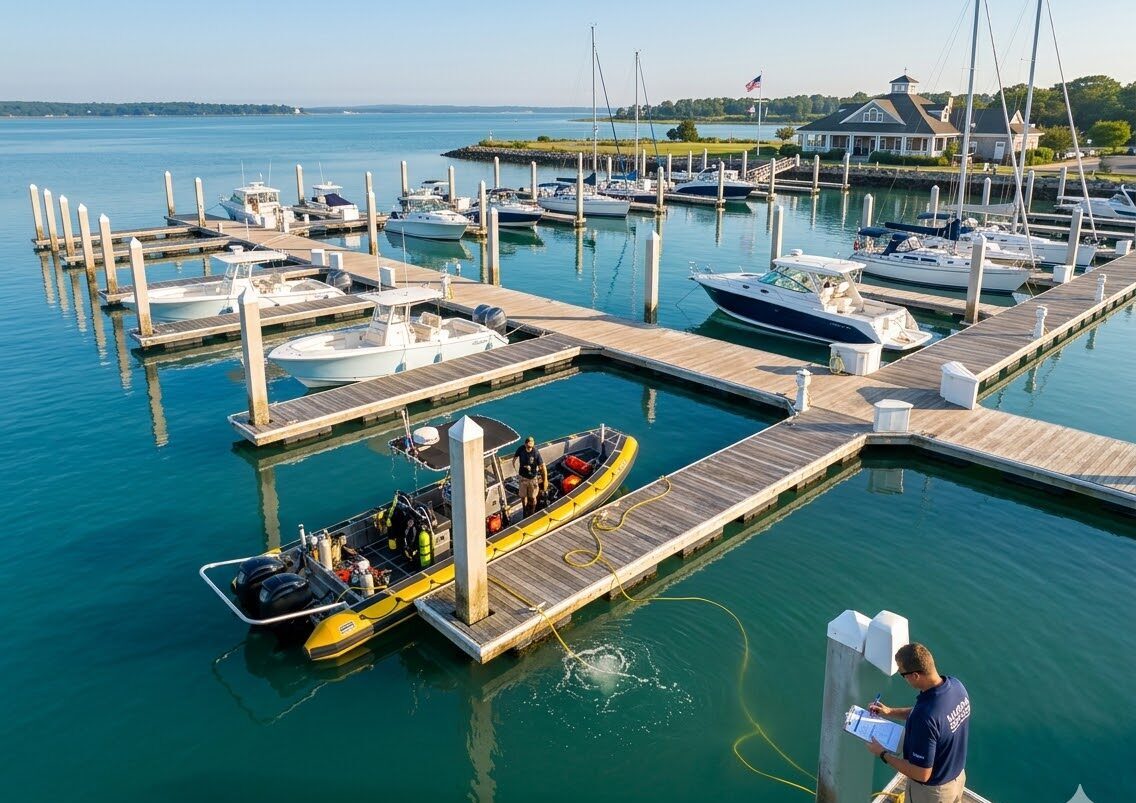
The cleaning schedule for a marina piling program should be calibrated to the specific biological environment of the marina — water temperature, salinity, tidal range, biological activity level, and proximity to nutrient sources all influence the appropriate cleaning frequency. In high-biological-activity saltwater marina environments, quarterly professional cleaning of all piling surfaces using cavitation methods is the standard baseline. In lower-activity environments, biannual cleaning may be sufficient for some piling sections — though high-traffic berths and pilings in the most biologically active zones of the marina basin may still require quarterly attention. Every cleaning session should address the full piling length from above the waterline to the mud-line zone — not just the visible above-waterline sections that basic surface maintenance can reach.
Program Component 3: Post-Cleaning Structural Inspection and Reporting
Every professional cleaning session should be followed immediately by a systematic structural inspection of all cleaned piling surfaces — conducted by the cleaning diver while piling surfaces are clean and structurally assessable. Inspection findings should be documented per piling in a written report that identifies any structural concerns found, classifies their severity and recommended response timeline, and provides photographic documentation of all areas of concern. This report is the core documentation asset of the cleaning program — it is the evidence of due diligence that protects the marina operator legally and provides the data that drives maintenance planning decisions.
Program Component 4: Zinc Anode Management
Every marina cleaning visit should include inspection of all zinc anodes on metal piling components, boat lift structures, and submerged hardware throughout the cleaned area. Depleted anodes — those reduced to fifty percent or less of their original mass — should be replaced at the same service visit rather than deferred to a subsequent appointment. In high-stray-current marina environments, anode depletion rates should be assessed against expected rates, with accelerated depletion flagging the presence of stray current conditions that require separate electrical investigation. Maintaining continuous cathodic protection across all metal components in the marina is a parallel structural protection objective to biofouling management — and coordinating both through the cleaning program visits is the most operationally efficient approach.
Program Component 5: Environmental Compliance Documentation
For marinas pursuing Clean Marina certification or operating in jurisdictions with specific in-water cleaning method requirements, the cleaning program documentation should include explicit records of the cleaning methods used, any containment measures applied during cleaning, and confirmation of compliance with applicable environmental regulations. Professional cavitation cleaning — which eliminates chemical input and minimizes biological dispersal — is the method most easily documented as environmentally compliant across the widest range of jurisdictional requirements. This documentation supports both ongoing permit compliance and the certification applications that deliver competitive marketing advantages.
Marina Dock Piling Cleaning Program: Recommended Schedule by Environment
| Marina Environment Type | Cleaning Frequency | Inspection Frequency | Zinc Anode Check | Full Structural Assessment |
|---|---|---|---|---|
| Tropical / Subtropical Saltwater Marina | Every 6–8 weeks | Every cleaning visit | Every cleaning visit | Annually — full facility |
| Temperate Open Saltwater Marina | Quarterly | Every cleaning visit | Every cleaning visit | Annually — full facility |
| Brackish / Estuarine Marina | Every 4–6 months | Every cleaning visit | Semi-annually | Annually — full facility |
| High-Traffic Commercial Marina | Quarterly minimum | Every cleaning visit | Every cleaning visit | Semi-annually — high-use zones |
| Freshwater Marina | Biannually | Every cleaning visit | Annually | Annually — full facility |
| Post-Storm — All Environments | Unscheduled — after any significant storm | Required — post-storm assessment | Check after storm events | Full assessment before reopening if storm was severe |
The ROI of a Marina Dock Piling Cleaning Program
Marina operators who question the financial justification for a systematic professional piling cleaning program are typically comparing the program cost against a zero-cost alternative of doing nothing — rather than against the realistic cost of the outcomes that doing nothing produces. The genuine financial comparison is between the total cost of the cleaning program over a piling’s service life and the total cost of the accelerated repair, emergency replacement, operational disruption, liability exposure, and insurance complications that deferred maintenance generates.
The financial return on a properly structured marina piling cleaning program operates across multiple dimensions simultaneously. Pilings that are maintained to their designed service life avoid the premature replacement cost that neglected pilings force. Structural problems identified early through regular post-cleaning inspection are addressed at repair cost rather than replacement cost. Vessels protected from hull damage by clean pilings remain satisfied clients rather than generating damage claims. Insurance coverage is maintained and claims are supported by documentation rather than complicated by the absence of a maintenance record. And the competitive differentiation of a visibly well-maintained facility with documented professional maintenance practices attracts and retains the premium client segment whose vessel values and berthing expectations align with the quality standards the program demonstrates.
According to the NOAA Ocean Service, proactive biofouling management through regular professional cleaning is the highest-return structural maintenance investment available for submerged marine infrastructure — with the commercial marina environment representing the setting where the compounding benefits of systematic cleaning are most significant given the scale of infrastructure involved. The U.S. Environmental Protection Agency’s Safer Choice program and state-level Clean Marina programs across the country recognize regular professional maintenance as a core component of responsible marina operations — with documented compliance providing both regulatory standing and commercial marketing advantages that directly enhance the financial performance of participating facilities.
Frequently Asked Questions About Marina Dock Piling Cleaning Programs
How is a marina piling cleaning program different from residential dock maintenance?
A marina piling cleaning program differs from residential dock maintenance in scale, documentation requirements, regulatory context, and risk profile. The hundreds of pilings in a commercial marina facility require systematic inventory management, per-piling documentation, and scheduled service coordination that individual residential docks do not need. The commercial liability exposure of a marina operation — with multiple client vessels and personnel present daily — creates a documentation and due diligence requirement that residential dock owners do not face to the same degree. And the regulatory compliance dimension — Clean Marina programs, environmental permits, insurance requirements — adds an operational layer to marina piling maintenance that makes the professional program structure not merely best practice but operational necessity.
Can marina staff perform piling cleaning in-house or is professional service always required?
Above-waterline basic maintenance — rinsing, light surface brushing, visual inspection documentation — can appropriately be performed by marina staff as a supplement to professional service. However, the underwater cleaning and structural inspection that constitute the core of an effective piling maintenance program require certified commercial divers with appropriate equipment, professional training, and documented qualifications. Cleaning dock pilings is more complex than simply scraping off surface growth — it requires expert divers who inspect pilings before and after cleaning to assess the extent of growth and any potential damage. The liability implications of in-house underwater work by untrained personnel — both in terms of diver safety and in terms of the quality and reliability of structural assessments performed — make certified professional service the only appropriate approach for the inspection and cleaning components that carry structural and legal significance.
How does a marina communicate its piling cleaning program to clients as a marketing advantage?
The most effective communication channels for marina piling cleaning programs as a client-facing differentiator include facility website content that describes the maintenance program and its frequency, visible displays of Clean Marina certification where applicable, direct communication in marina newsletters or slip holder communications about the cleaning schedule and what it means for vessel protection, and the simple visible evidence of professionally maintained pilings that clients observe in their daily dock use. For premium vessel clients, the availability of professional inspection records demonstrating systematic structural maintenance can be offered as documentation support for vessels whose insurance coverage includes marina facility condition as a rating factor.
What is the minimum cleaning program that a marina should have in place?
The absolute minimum responsible piling cleaning program for any saltwater marina operation includes professional underwater cleaning by certified divers at minimum twice per year — spring and fall — covering every piling in the facility from above-waterline to mud-line, with post-cleaning structural inspection and written documentation of all findings at each service event. Zinc anode inspection and replacement should be performed at each cleaning visit for all metal components. A full structural assessment of the entire facility should be completed annually, and post-storm professional inspection should be performed following any significant weather event before the marina is returned to normal operations. This minimum program is significantly below what tropical and subtropical marinas with high biological activity should actually operate — but it represents the baseline below which no responsible marina should fall regardless of environment type or operational scale.
Conclusion: A Marina Without a Piling Cleaning Program Is Operating on Borrowed Time
The marine environment does not pause its biological assault on marina pilings because a cleaning program has been deferred. Barnacles continue settling. Marine borers continue tunneling. Galvanic corrosion continues consuming metal hardware. Biofouling continues accelerating every underlying deterioration mechanism it contacts — simultaneously, continuously, and at increasing rates as the unchecked biological community establishes deeper, denser, and more structurally damaging colonies with each season that passes without professional intervention.
A marina without a regular dock piling cleaning program is not saving the cost of that program. It is deferring and compounding it — transforming routine maintenance expenditure into accelerated structural deterioration, premature replacement timelines, liability exposure, insurance complications, regulatory risk, and the competitive disadvantage of a facility that visibly signals to quality-conscious clients that its maintenance standards fall short of what their vessels and their expectations deserve.
The marinas that lead their markets in client retention, facility reputation, regulatory standing, and long-term financial performance are consistently those that treat their piling infrastructure with the systematic professional maintenance it requires — understanding that the cleaning program is not a cost of operation but an investment in everything that makes the marina worth operating.
Contact our certified marine team today to build a professional Cavitation Cleaning program tailored to your marina — systematic, documented, environmentally responsible piling maintenance that protects your infrastructure, your clients, and your commercial reputation for the long term.