Every dock piling submerged in saltwater, brackish water, or even freshwater is under continuous biological siege. From the moment a piling enters the water, marine organisms begin the process of colonization — attaching, feeding, reproducing, and establishing the complex biological communities collectively known as biofouling. Marine growth on dock pilings is not a single problem with a single cause — it is a layered ecosystem of organisms, each with its own attachment mechanism, its own deterioration effect, and its own removal challenge. Understanding exactly what is growing on your dock pilings, what each organism does to the piling material beneath it, and what removal method is most appropriate for each type of growth is the foundation of an effective, structurally protective dock maintenance program. In this complete guide, we identify every major type of marine growth found on dock pilings, explain in precise terms what structural and biological danger each one represents, and walk through the most effective professional removal solutions available in 2025–2026 — so dock owners and marina operators can make informed, targeted maintenance decisions that protect their waterfront investments for the long term.
Why Marine Growth on Dock Pilings Is Inevitable — And Why It Cannot Be Ignored
The marine environment is one of the most biologically productive on earth — and every submerged surface within it is a potential habitat. Marine organisms such as barnacles, algae, and mussels naturally attach themselves to submerged surfaces like dock pilings — and while this growth is a part of the marine ecosystem, it can cause serious problems for dock structures. No piling material is immune. Wood, concrete, steel, fiberglass, and composite pilings all experience biological colonization within days of submersion, with the specific organism community that establishes varying by water temperature, salinity, light availability, nutrient levels, and the physical and chemical characteristics of the piling surface itself.
There is absolutely no such thing as no marine growth in saltwater — anything stationary in the water will collect biological colonization, and the only variables are the rate of establishment and the density of the community that forms. This biological inevitability means that the question for dock owners is never whether marine growth will develop — it is how quickly it will develop, how much structural damage it will cause if left unmanaged, and what removal approach will most effectively address each specific type of growth without damaging the piling surfaces it covers.
Marine growth on dock pilings is more than just an eyesore — over time, unchecked marine growth can weaken structures, reduce safety, and shorten the lifespan of dock pilings significantly. Knowing precisely what is growing on your pilings is the essential first step in addressing those consequences before they compound into structural emergencies.
The Biological Foundation: How Marine Growth Establishes on Dock Pilings
Marine growth does not establish randomly or all at once. It follows a predictable ecological succession pattern that begins within hours of piling submersion and continues through increasingly complex biological communities over subsequent weeks and months. Understanding this succession process helps dock owners understand why early intervention is so much more effective and less costly than allowing growth to reach advanced stages before addressing it.
Stage 1: Primary Biofilm Formation
Within hours of submersion, dissolved organic molecules from the surrounding water adsorb onto the piling surface, creating a conditioning film that alters the surface chemistry. Within twelve to twenty-four hours, pioneer bacteria colonize this film and begin forming the primary biofilm — a thin, complex community of microorganisms embedded in a self-produced matrix of polysaccharides and proteins. This biofilm layer is largely invisible to the naked eye but is critically important as the settlement substrate for every subsequent fouling organism. It releases chemical signals that actively attract the larvae of barnacles, mussels, tube worms, and other fouling organisms — triggering larval settlement that would not otherwise occur on the bare piling surface.
Stage 2: Macroalgae and Soft Fouling Establishment
Within one to three weeks of piling submersion, unicellular algae begin colonizing the biofilm surface, followed by the settlement of soft fouling organisms including hydroids, bryozoans, and colonial tunicates. Filamentous green and brown algae establish on surfaces with sufficient light penetration. This soft fouling layer creates additional physical structure on the piling surface that further enhances larval settlement conditions for the hard fouling organisms — barnacles and mussels — that represent the most mechanically challenging and structurally damaging components of a mature marine growth community.
Stage 3: Hard Fouling Community Establishment
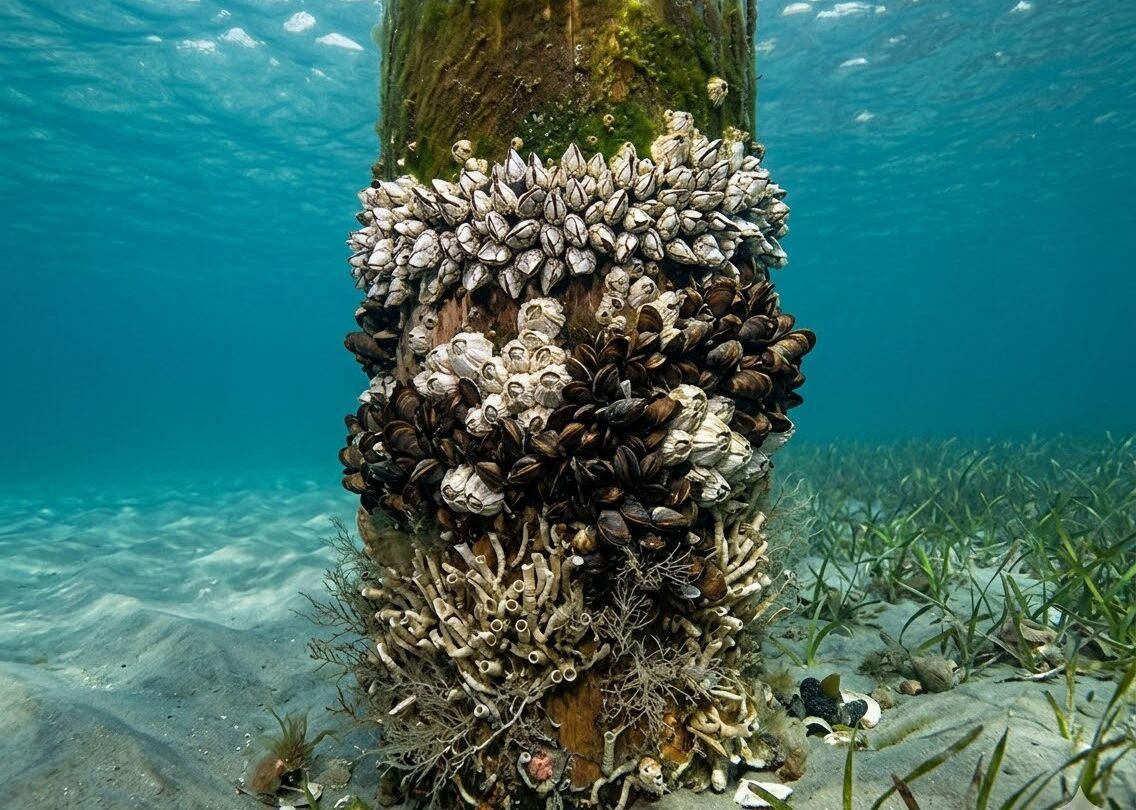
Barnacle larvae and mussel larvae respond to the chemical settlement cues released by the established biofilm and soft fouling community. Once hard fouling organisms begin settling, colony growth accelerates rapidly — particularly during warm-water peak settlement seasons. A piling that receives its first barnacle settlers in early spring can carry a structurally significant barnacle colony by midsummer. Mussel colonies grow in layers, with each generation settling on top of established shells, building dense three-dimensional biological structures that can add significant weight to piling surfaces and create the moisture-retaining, corrosion-accelerating microenvironment that drives accelerated structural deterioration.
Types of Marine Growth on Dock Pilings: A Complete Identification Guide
Type 1: Barnacles
Barnacles are the most recognized and most structurally damaging of all marine growth types found on dock pilings. They are crustaceans — more closely related to crabs and shrimp than to mollusks — that permanently cement themselves to submerged surfaces using one of the most powerful biological adhesives known to science. Adult barnacles build conical calcium carbonate shells around themselves, with a hinged opening at the top through which feathery feeding appendages sweep the water for plankton during high tide.
In the context of dock piling damage, barnacles cause harm through multiple simultaneous mechanisms. Their adhesive cement penetrates the micro-texture of piling surfaces — wood fiber, concrete micro-cracks, and metal surface pitting — creating a mechanical bond that is extremely difficult to break without applying force to the underlying surface. The calcium carbonate shells they build are hard, sharp, and abrasive — creating physical hazards for dock users and accelerating wear on dock lines, fenders, and boat hulls that contact fouled pilings. Excessive growth can weaken pilings, leading to deterioration over time — barnacles and mussels may erode the materials, especially wood, and create vulnerabilities that can lead to costly repairs or replacements. Dense multi-season barnacle colonies add substantial weight to piling surfaces and retain continuous moisture against the material beneath them — maintaining the wet conditions that accelerate rot in wood and corrosion in metal year-round.
Barnacles are found in every marine and brackish water environment globally, with peak settlement occurring in spring and summer in temperate regions and year-round in tropical and subtropical waters. Their presence on dock pilings is universal in saltwater environments and they are almost always the primary target of professional piling cleaning programs.
Type 2: Mussels
Marine mussels — particularly species in the Mytilus family in temperate waters and Perna species in tropical regions — are bivalve mollusks that attach to dock pilings using byssal threads: strong, flexible protein fibers secreted by a specialized gland at the mussel’s foot. Unlike barnacles, mussels can reattach after being dislodged by repositioning their byssal threads — making them particularly persistent once a colony establishes on a piling surface.
Mussel colonies on dock pilings grow in dense, layered aggregations that can cover entire piling sections from the mud line to above the waterline. The biological mass of a mature mussel colony is substantially heavier than an equivalent barnacle colony of the same surface coverage — with dense mussel beds adding hundreds of pounds of wet biological material to multi-piling dock structures. Barnacles, algae, mussels, and seaweed not only make pilings unsightly but can also trap moisture and accelerate deterioration — and mussel colonies are particularly effective moisture traps, maintaining persistently wet conditions against piling surfaces even during tidal exposure periods that would otherwise allow partial drying.
Mussel colonies also provide habitat and attachment substrate for secondary fouling organisms — bryozoans, hydroids, smaller crustaceans, and additional algae species establish within the three-dimensional structure of mussel aggregations, creating a complex biological community that is significantly more difficult to remove thoroughly than single-species growth.
Type 3: Marine Algae
Algae represent the most diverse category of marine growth found on dock pilings, encompassing hundreds of species ranging from microscopic unicellular forms to large macroalgae with structures reaching several feet in length. The primary algae types found on dock pilings include green algae (Chlorophyta), brown algae (Phaeophyta), red algae (Rhodophyta), and the blue-green algae or cyanobacteria that form the visible slime films on waterline and splash zone piling surfaces.
Above the waterline and in the splash zone, algae growth creates the slippery green film that is the most immediate safety hazard associated with marine growth on dock pilings — a slick surface that significantly increases the risk of slipping accidents for dock users. Below the waterline, macroalgae — filamentous green algae, kelp species, and sea lettuce — create a physical canopy over the piling surface that retains moisture, reduces water circulation, and provides attachment substrate for hard fouling organisms that establish more rapidly in sheltered biological microenvironments than on exposed surfaces.
Algae growth is driven primarily by nutrient availability and light penetration, making it most aggressive in shallower, nutrient-enriched waters near stormwater discharge points, marina fueling areas, and other anthropogenic nutrient sources. Seasonal algae blooms — driven by elevated water temperatures, increased sunlight, and nutrient input from seasonal rainfall — can produce dramatic growth surges that require professional cleaning response even at docks where fouling pressure is generally moderate.
Type 4: Marine Borers — Shipworms and Gribbles
Marine borers represent a categorically different type of marine growth threat from surface fouling organisms — rather than attaching to the piling surface, they actively bore into and consume wood piling material from within. Shipworms are mollusks that attack from the intertidal zone to the mudline and are undeterred by pressure-treated wood in concentrations below the highest available marine treatment retention levels. The two primary marine borer species attacking dock pilings are Teredo navalis — the shipworm — and Limnoria species, commonly called gribbles.
Shipworms are actually bivalve mollusks that use a specialized rasping shell to bore deep cylindrical tunnels into wood, growing up to twelve inches or more in length inside the piling while the entry hole at the surface remains barely the diameter of a pencil. A single piling can host dozens of simultaneously active shipworms, with their tunnels collectively removing the structural interior of the piling while the exterior appears largely intact. Gribbles work differently — they are small isopod crustaceans that erode the outer wood surface layer by layer, creating the characteristic hourglass narrowing at the waterline zone that is one of the most reliable visual indicators of active marine borer damage.
Marine borer infestation is the single most structurally devastating form of marine growth affecting dock pilings because its damage is almost entirely invisible until it has reached an advanced, often irreversible stage. The concealment provided by surface fouling communities — barnacle and mussel colonies covering piling surfaces where borer entry holes would otherwise be detectable — is one of the most dangerous ways in which marine growth compounds its own structural impact.
Type 5: Tube Worms and Hydroids
Tube worms — including serpulid polychaetes and sabellid worms — are marine invertebrates that build hard, calcareous or parchment-like tubes attached to submerged piling surfaces, from which they extend feathery feeding tentacles into the water column. They are frequently found as secondary settlers within established barnacle and mussel communities, filling available surface space between larger organisms and adding to the overall weight and biological complexity of the fouling community.
Hydroids are colonial cnidarians — closely related to jellyfish — that form branching, plant-like colonies on piling surfaces, particularly in cooler and deeper water zones below the main barnacle and mussel settlement band. While hydroids are not as structurally damaging as barnacles or marine borers, they contribute to the overall biofouling load and — importantly — their hair-like tentacles can cause painful stings to marine maintenance personnel working with bare skin in fouled environments, making appropriate personal protective equipment essential for all professional underwater piling work.
Type 6: Bioslime and Primary Biofilm
The primary biofilm that forms on all submerged piling surfaces within hours of submersion — and the visible bioslime layer that develops over it as the biofilm community matures — is the least visually dramatic but arguably the most functionally important component of the marine growth community on dock pilings. It is the foundation on which every other fouling organism depends for establishment, the driver of microbiologically influenced corrosion on metal piling surfaces, and the component of marine growth that most directly determines how quickly a cleaned piling surface becomes available for fouling recolonization.
On steel and metal piling components, established biofilm communities create differential oxygen conditions between the biofilm-covered surface and the surrounding oxygenated water — and this differential oxygen concentration is a primary driver of the microbially influenced corrosion that can cause metal loss at rates significantly higher than abiotic corrosion in clean water. Professional cleaning methods that remove the primary biofilm layer along with the visible fouling growth — rather than merely dislodging the surface organisms while leaving the biofilm substrate intact — provide the most durable clean baseline and the slowest subsequent fouling reestablishment rate.
Type 7: Oysters and Calcareous Encrusters
In many coastal environments — particularly along the Gulf Coast, Atlantic seaboard, and Pacific Northwest — oysters and other calcareous encrusting organisms represent a significant marine growth challenge on dock pilings that is distinct from barnacle colonization in both its physical characteristics and its removal requirements. You can use the claw of a hammer, spade shovel, or a heavy-duty taping knife to remove oysters and barnacles from accessible above-waterline surfaces — but the irregular, sharp-edged shell structure of oyster clusters makes removal from complex surface geometries particularly challenging, and their adhesive bond to wood and concrete substrates is exceptionally strong.
Oyster and calcareous encrustation communities are often associated with shoreline and intertidal environments rather than deeper open-water dock pilings, but in harbors, bays, and estuarine environments with active wild oyster populations, their colonization of dock pilings can be aggressive and rapid. The weight of dense oyster clusters is substantially higher than equivalent barnacle growth, and their irregular shell edges create physical abrasion hazards for dock lines and boat hulls that contact fouled pilings.
The Structural Dangers of Marine Growth on Dock Pilings
| Marine Growth Type | Primary Piling Materials Affected | Main Structural Danger | Secondary Danger | Danger Level if Unmanaged | Detectability Without Cleaning |
|---|---|---|---|---|---|
| Barnacles | Wood, Concrete, Steel, All types | Surface penetration, moisture retention, weight loading | Conceals cracks and developing damage | High | Visible but damage beneath hidden |
| Mussels | All piling materials | Excessive weight loading, continuous moisture retention | Habitat for secondary damaging organisms | High | Visible but conceals underlying surface |
| Marine Algae | All piling materials | Moisture retention, slip hazard at waterline | Settlement substrate for hard fouling | Moderate | Visible above waterline; less visible below |
| Marine Borers (Shipworm/Gribble) | Wood pilings only | Internal structural hollowing, complete cross-section loss | Entry concealed by surface fouling | Critical | Almost entirely invisible without cleaning and probing |
| Tube Worms and Hydroids | All piling materials | Additional biofouling load; sting hazard for maintenance personnel | Surface complexity increase | Low to Moderate | Partially visible |
| Bioslime and Biofilm | Steel, Metal hardware especially | Microbiologically influenced corrosion on metal surfaces | Settlement trigger for all subsequent fouling | High on metal; Moderate on others | Largely invisible — requires professional assessment |
| Oysters and Calcareous Encrusters | Wood, Concrete, Steel | Extreme weight loading, abrasion of dock lines and hulls | Very strong adhesion makes removal invasive | Moderate to High | Visible but removal without surface damage requires professional technique |
How Marine Growth Types Interact and Compound Each Other’s Damage
One of the most important — and most underappreciated — aspects of marine growth on dock pilings is that the different organism types do not simply coexist as separate independent threats. They interact with each other in ways that multiply the overall structural damage rate beyond what any single type of growth would cause operating alone.
The biofilm layer that forms first creates the chemical settlement environment that attracts barnacle and mussel larvae. The barnacle and mussel colonies that establish then create the three-dimensional biological structure that harbors hydroids, tube worms, and secondary colonizers while simultaneously concealing the piling surface from inspection and creating the moisture-retaining microenvironment that drives wood rot and metal corrosion. The surface micro-damage created by barnacle adhesion — the tiny penetrations into wood fiber and concrete — creates exactly the type of entry point that marine borer larvae require for initial penetration into wood piling material. And the marine borer damage, once established inside the piling, creates internal moisture reservoirs and structural voids that accelerate rot from the inside while the external fouling community continues its work on the outside.
Marine growth increases the wear and tear on dock equipment, boat lines, and any mooring systems attached to the dock, and may also affect the water quality in the immediate area by increasing debris and attracting pests. Every organism in the fouling community contributes something to a system that is more damaging in combination than the sum of its individual parts — which is why managing marine growth on dock pilings effectively requires addressing the entire biological community, not just the most visible surface organisms.
Professional Marine Growth Removal Methods for Dock Pilings
Cavitation Cleaning: The Gold Standard for Marine Growth Removal
Cavitation cleaning is the most technologically advanced and most structurally protective professional removal method available for marine growth on dock pilings. For more delicate or advanced cleaning needs, cavitation employs air bubbles and water pressure to gently yet thoroughly remove marine buildup — and once cleaning is complete, pilings are rechecked for any signs of structural issues such as cracks or erosion that could require repair or further attention.
The cavitation mechanism generates microscopic vapor bubbles in the surrounding water that implode with sufficient energy to break the adhesive bonds of barnacles, mussels, and calcareous encrusters — removing them completely including their adhesive base plates — without any physical contact between a cleaning tool and the piling surface. This contactless mechanism means that anti-fouling coatings, protective wraps, fiberglass jackets, and all piling surface materials are fully preserved rather than abraded with each cleaning cycle. Critically, cavitation cleaning also removes the primary biofilm layer that manual scraping and high-pressure jetting leave intact — eliminating the settlement trigger that drives rapid fouling reestablishment and extending the interval before the next cleaning session is required.
Cavitation cleaning is performed by certified commercial divers who address the full piling length from above the waterline to the mud-line zone — treating every section of the piling that manual above-water maintenance cannot access and where the most structurally damaging biological communities establish.
Professional Diver Manual Cleaning with Post-Removal Inspection
For certain growth types and piling conditions — particularly light to moderate established growth on robust piling surfaces without protective coatings — professional diver manual cleaning using appropriate low-abrasion tools and technique remains an effective and widely used approach. Before diving in, the expert team inspects the pilings to assess the extent of the growth and any potential damage — this helps plan the best approach for cleaning while ensuring the piling’s structural integrity is not disturbed.
The critical differentiator between professional diver manual cleaning and DIY above-waterline scraping is not simply the method — it is the access and the expertise applied. Professional divers address every section of the piling including the fully submerged zones, apply appropriate technique that minimizes surface disruption, and perform the post-removal structural assessment that converts each cleaning visit into a combined maintenance and assessment event. Light marine growth can often be handled by dock owners, but heavy infestations require specialized tools and training — and professional services are especially recommended for older docks, commercial properties, or environmentally sensitive areas.
High-Pressure Water Cleaning for Specific Applications
For certain pilings, high-pressure water jets can safely remove algae, barnacles, and other growths without damaging the piling itself when applied at appropriate pressure settings by trained professionals who understand the pressure tolerance of the specific piling material being cleaned. High-pressure water jetting is most appropriate for concrete pilings with heavy calcareous encrustation where the surface robustness of the concrete can tolerate higher impact forces, and for above-waterline piling sections where algae and lighter growth can be addressed efficiently without the surface damage risk that high-pressure underwater application carries.
High-pressure water cleaning is generally not recommended as the primary method for wood pilings, coated pilings, or pilings with protective wrap or repair systems — where the surface impact force risks damaging exactly the protective elements that professional maintenance is intended to preserve. It should always be applied by professionals familiar with the appropriate pressure settings for each piling material and growth type.
The Post-Removal Inspection: Turning Cleaning Into Structural Assessment
Professional removal of marine growth from dock pilings delivers its maximum value not at the moment the growth is removed — but in the structural assessment that the removal makes possible. Pilings can look like new from the surface, but below, marine growth can hide severe damage from view — it is necessary to remove the growth in order to properly inspect for any damage. The clean piling surfaces revealed after professional growth removal allow the inspecting diver to identify cracks, soft spots, marine borer entry points, corrosion pitting, concrete spalling, and hardware corrosion that were completely concealed by the biological growth layer during every previous observation.
With the pilings and bracings clean, look for damage to hardware and signs of marine borer activity — tiny holes from burrowing invertebrates. Hardware should be checked for tightness, corrosion, and to ensure that there are no missing or protruding fasteners. Every structural connection is also a prime location to observe for marine borer activity. This combined cleaning-and-inspection approach is what separates professional marine growth removal from purely cosmetic maintenance — it provides actionable structural information at each service visit that allows developing problems to be identified and addressed at the stage where intervention is most affordable and most effective.
According to the NOAA Ocean Service, marine biofouling management through regular professional removal is one of the highest-return maintenance strategies available for extending the service life of submerged marine structures — with the combination of removal method quality and post-removal inspection thoroughness being the primary determinants of how effectively the program protects long-term structural performance. The U.S. Environmental Protection Agency’s Safer Choice program recommends non-chemical and low-impact removal methods as the preferred approach for managing marine growth in environmentally sensitive coastal areas — a recommendation that aligns directly with professional cavitation cleaning as the removal method of choice for dock pilings in 2025–2026.
Prevention: Slowing Marine Growth Establishment Between Removal Sessions
Professional removal of marine growth from dock pilings is most effective when combined with prevention strategies that slow the rate of biological reestablishment between cleaning sessions — extending the interval before the next professional cleaning is required and reducing the density of growth that accumulates in that interval.
- Anti-fouling coatings: Marine-grade anti-fouling treatments applied to piling surfaces after professional cleaning create a chemically inhospitable environment for larval settlement, reducing establishment rates and growth density between cleaning cycles. Their effectiveness depends on maintaining coating integrity — which requires non-abrasive cleaning methods that preserve rather than degrade coating surfaces.
- Piling wraps and sleeves: Physical wrapping of pilings — particularly wood pilings in high-marine-borer environments — creates a barrier that denies surface fouling organisms access to the underlying piling material. Wrap is an inexpensive way to protect timber pilings but still requires light maintenance — boat impacts and debris can puncture the wrap, and over time, barnacles can grow along the seams, allowing marine borers inside. Seam maintenance during regular professional cleaning sessions prevents this bypass mechanism from developing.
- Ultrasonic antifouling systems: Permanently installed ultrasonic transducers emit continuous low-power pulses that create a persistent cavitation field at the piling surface, preventing the initial larval adhesion that all fouling establishment depends on — without chemicals and without surface contact.
- Zinc anode maintenance: For steel and metal piling components, maintaining effective zinc anode cathodic protection reduces the galvanic corrosion that roughens metal surfaces and creates the physical texture that accelerates biological colonization — making zinc anode maintenance an indirect biofouling management tool as well as a direct corrosion protection measure.
Frequently Asked Questions About Marine Growth on Dock Pilings
Which type of marine growth causes the most structural damage to dock pilings?
Marine borers — particularly shipworms — cause the most catastrophically structural damage to wood dock pilings because they operate invisibly inside the piling, destroying structural cross-section without any external warning until failure is imminent. Among surface fouling organisms, barnacles and mussels are the most damaging because of their strong adhesive attachment, moisture retention effects, weight loading, and role in concealing developing structural problems from visual inspection. The most dangerous scenario is the combination of surface barnacle growth concealing marine borer entry points on a wood piling — allowing both external and internal deterioration to advance simultaneously without detection.
Can marine growth be permanently prevented on dock pilings?
There is absolutely no such thing as no marine growth in saltwater — anything stationary in the water will collect biological colonization, and the only variables are the rate of establishment and the density of the community that forms. Prevention strategies — anti-fouling coatings, physical wrapping systems, and ultrasonic antifouling devices — can significantly reduce establishment rates and growth density, extending cleaning intervals and reducing the structural impact of the fouling that does establish. But none of these approaches eliminates the need for periodic professional removal entirely. The most effective strategy is always a combination of prevention systems that slow establishment and regular professional cleaning that removes growth before it reaches structural damage density.
How do I know if marine growth on my dock pilings is concealing structural damage?
You cannot determine this reliably through above-water visual inspection alone — which is precisely the most important insight about marine growth on dock pilings. The piling conditions that are most dangerous to structural integrity are specifically those that are concealed by the biological growth covering them. The only reliable method for assessing what is beneath established marine growth is professional cleaning by certified commercial divers followed by thorough physical probing and visual inspection of every revealed piling surface — including the fully submerged sections below the waterline that above-water inspection cannot access. A routine inspection should be conducted annually to record the condition of pilings, stringers, and hardware — forming a baseline against which deterioration can be monitored and maintenance can be performed in a timely manner.
How quickly does marine growth reestablish after professional cleaning?
The rate of reestablishment depends primarily on water temperature, salinity, seasonal larval settlement pressure, and the condition of the piling surface after cleaning. In warm tropical and subtropical saltwater environments during peak biological activity seasons, primary biofilm begins reestablishing within hours and visible algae within one to two weeks. In temperate environments, reestablishment rates are significantly slower during cooler months. Professional cavitation cleaning produces the slowest reestablishment rates because it removes the primary biofilm layer that manual methods leave intact — eliminating the chemical settlement trigger that accelerates larval colonization of freshly cleaned surfaces. Anti-fouling coating application immediately after professional cleaning further extends the interval before dense reestablishment requires the next cleaning session.
Conclusion: Know What Is Growing on Your Pilings and Act Before It Costs You
Marine growth on dock pilings is not one problem — it is seven distinct biological threats operating simultaneously, interacting and compounding each other’s structural damage effects in ways that make the combined impact far greater than any individual organism would produce alone. Barnacles penetrating and weakening surfaces. Mussels loading pilings with weight and retaining moisture. Algae creating slip hazards and settlement substrate. Marine borers hollowing interiors invisibly. Biofilm driving corrosion on metal components. Oysters encrusting with extreme adhesion. And the entire community conspiring to conceal what is happening to the piling material beneath it from every form of observation short of professional underwater inspection and cleaning.
The dock owners who successfully protect their piling investment against these biological threats are the ones who understand what they are dealing with, who schedule regular professional cleaning before growth reaches structural damage density, who insist on post-removal structural inspection at each service visit, and who combine professional removal with the prevention systems that slow reestablishment between sessions. Every season of unmanaged marine growth is a season during which all of these biological mechanisms operate without interruption — and the compounding damage they produce grows harder and more expensive to address with each season that passes.
Contact our certified marine team today to schedule professional Cavitation Cleaning for your dock pilings — the most complete, surface-safe, and structurally protective marine growth removal solution available for your waterfront investment.