Most dock owners think about cleaning their pilings only after something looks obviously wrong — a piling so encrusted with barnacles it has turned grey and lumpy, or a waterline zone so thick with algae that the wood beneath has completely disappeared from view. By that point, the marine growth has already been doing its structural damage for months, and the window for the most cost-effective professional intervention has narrowed significantly. Knowing the real signs that your dock pilings need professional cleaning — including the subtle early indicators that most owners walk past without noticing — is the difference between a routine maintenance visit and an emergency repair call. In this complete guide, we walk through every significant warning sign that your dock pilings are overdue for professional cleaning attention, explain what each sign means structurally, and help you understand when above-waterline observation alone is not enough and professional underwater assessment is the only responsible next step.
Why Recognizing Cleaning Signals Early Matters So Much
The relationship between marine growth and dock piling structural damage is not linear — it is compounding. Each week that biofouling remains established on piling surfaces, it accelerates the underlying deterioration mechanisms that shorten piling service life. Barnacles retain moisture that drives rot in wood and corrosion in metal. Biofilm layers beneath visible growth drive microbiologically influenced corrosion on steel components. Dense mussel and barnacle colonies conceal developing cracks, soft spots, and marine borer entry holes from visual inspection. And the longer growth remains, the deeper its biological and physical penetration into piling surface materials becomes — making removal more intensive, more expensive, and more potentially disruptive to the surface it covers.
The most serious structural issues typically begin below the waterline — constant exposure to marine growth, corrosion, wood-boring organisms, and tidal movement can weaken dock pilings without visible warning signs above the surface. This means that the signs dock owners can observe from above the waterline are often late-stage indicators of problems that have been developing for months below. Catching the earlier, subtler signals — and responding with professional cleaning and inspection before growth reaches structural damage density — is what separates proactive dock ownership from reactive emergency management.
Above-Waterline Warning Signs Your Dock Pilings Need Professional Cleaning
The section of each dock piling visible above the waterline provides important maintenance signals that are accessible to any dock owner willing to look carefully. These above-waterline indicators range from obvious growth accumulation to subtle structural signals that growth-driven deterioration is already advanced in the submerged zones below.
Sign 1: Visible Algae Growth at and Above the Waterline
Green, brown, or black algae coating the waterline zone and splash area of dock pilings is one of the earliest and most reliable visual signals that professional cleaning is due. Algae at the waterline is not merely cosmetic — it is the visible surface expression of a biological community that extends well below the waterline and that is actively creating the moisture-retaining, deterioration-accelerating conditions that drive piling decay from the outside in.
The waterline zone is the most biologically aggressive section of any dock piling, experiencing continuous alternation between wet and dry conditions with every tidal cycle — conditions that concentrate biological activity and chemical deterioration simultaneously. Persistent wet spots, mildew, or unusual algae growth on wooden surfaces often indicate deeper water infiltration that extends well beyond what the surface appearance suggests. When algae at the waterline has been present long enough to form a thick, dark, layered coating rather than a thin green film, the growth has been in place long enough that underlying deterioration processes have had a meaningful head start — and professional cleaning is overdue rather than merely due.
Sign 2: Barnacle Encrustation Extending Above the Waterline
Barnacles visible at and above the waterline zone — particularly barnacle colonies that have begun to calcify into hard, tightly packed clusters rather than remaining as individual organisms with space between them — are a strong indicator that professional cleaning has been deferred beyond the optimal maintenance interval. Dense barnacle encrustation above the waterline represents the surface expression of a fouling community that is typically far more extensive in the fully submerged sections below, where the biological environment is more consistently favorable for settlement and growth.
Marine life such as barnacles or wood-boring pests can cause significant damage by eating away at the structural integrity of the pilings — and the barnacles visible from the dock deck are only the most accessible fraction of the total fouling community affecting the piling. Every visible barnacle above the waterline should prompt the question: what is happening on the fully submerged sections below, where growth conditions are more consistently favorable and where professional cleaning is the only way to find out?
Sign 3: Slippery Surfaces on Dock Decking Adjacent to Pilings
A dock deck surface that has become noticeably slippery near piling locations — particularly in the splash zone and areas where water regularly contacts the deck surface — is a direct safety hazard that also signals biological activity on the adjacent piling surfaces. The same algae and biofilm organisms that create the slippery condition on deck surfaces are establishing simultaneously on the pilings those surfaces surround, often at a more advanced stage in the submerged sections below the deck level where moisture is continuous rather than intermittent.
Proper maintenance protects against algae buildup, making dock surfaces slippery and hazardous — and when slippery conditions have developed on deck surfaces, it is a reliable indicator that the biological growth program on adjacent pilings has progressed beyond the early stage where routine maintenance could have managed it easily. Professional cleaning that addresses both the deck surface growth and the piling growth that feeds it is the appropriate response.
Sign 4: Rust Staining Running Down From Hardware Connections
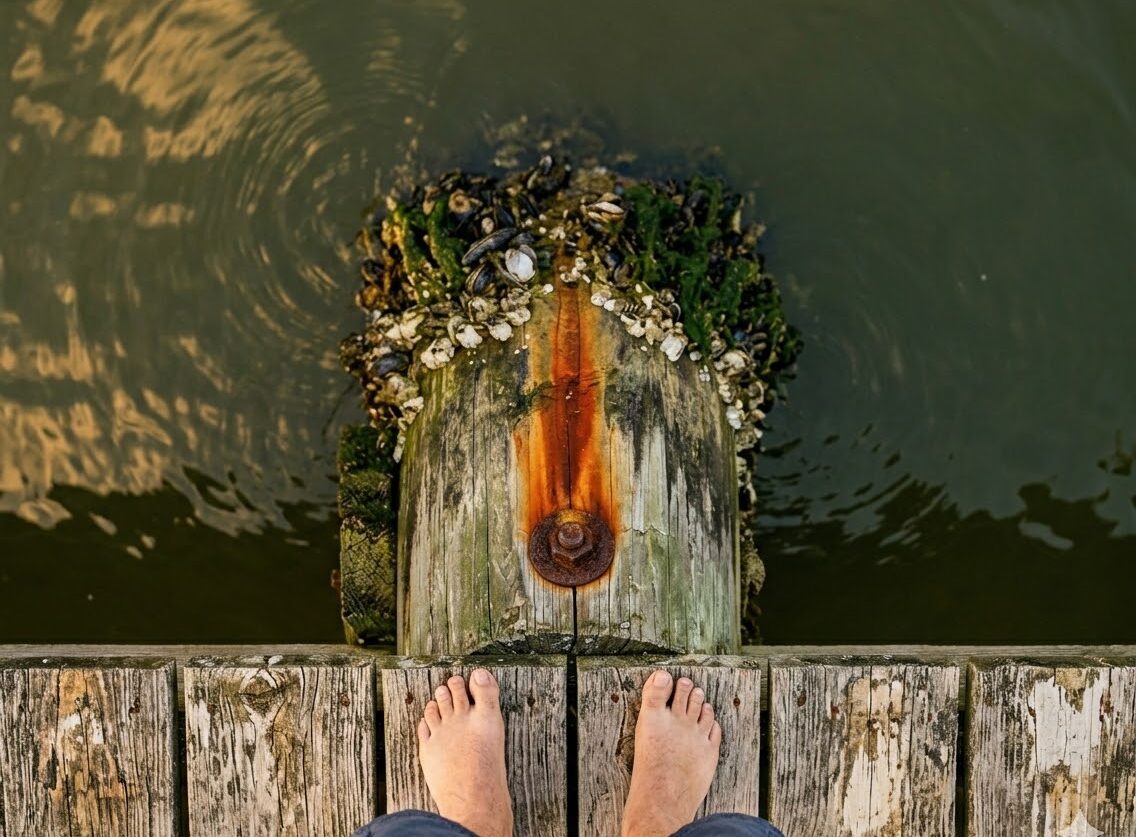
Orange-brown rust streaking running down piling surfaces from bolt holes, bracket connections, or pile cap hardware is a highly significant cleaning and inspection signal that is easy to misread as a purely cosmetic issue. Rust staining visible above the waterline indicates that corrosion is actively occurring at the hardware connection point — and in most cases, the most aggressive corrosion is taking place in the submerged sections of the same hardware below the waterline, where saltwater exposure is continuous rather than intermittent.
Rusty or loose bolts, screws, and brackets can weaken your dock’s structure, leading to dangerous situations — and the visible rust stain above the waterline is often the trailing indicator of corrosion that has already progressed significantly in the submerged zone. Professional cleaning that removes the biofouling concealing submerged hardware allows proper assessment of actual corrosion extent — which is almost always more advanced than the above-waterline staining alone suggests.
Sign 5: Visible Soft Spots, Discoloration, or Texture Change at the Waterline
Soft or spongy spots are one of the first indicators of rotting wood — if the wood feels weak or starts to show signs of decay, it is often a result of prolonged moisture exposure and can quickly become dangerous. On dock pilings, any softening, discoloration, or texture change visible at or just above the waterline zone is an urgent cleaning and inspection signal — because these surface-visible symptoms indicate that deterioration has already progressed significantly in the submerged sections directly below, where the same biological and chemical processes operate at greater intensity with continuous moisture exposure.
Discoloration at the waterline — darkening of wood that does not correspond to normal waterline staining, greyish bleaching of wood surface, or unusual dark patching on concrete — can indicate fungal activity, accelerated biological breakdown, or early-stage spalling that professional cleaning will reveal more completely. Any piling showing these characteristics at the waterline should be treated as requiring urgent professional cleaning and structural inspection rather than routine scheduled maintenance.
Sign 6: New or Increasing Lean in Any Piling
A piling that has visibly shifted from its previously vertical orientation — or that appears to be leaning further than it did during a previous observation — is an urgent indicator that requires immediate professional response. Pilings that lean or appear misaligned can signify foundational shifts that need immediate attention. While lean is primarily a structural concern rather than a cleaning indicator, biofouling is frequently a contributing factor — the weight loading of dense barnacle and mussel colonies concentrated on specific piling sections can contribute to the differential loading that initiates or accelerates lean, particularly in older pilings with reduced structural reserve.
A leaning piling also requires professional underwater inspection to determine whether the cause is mud-line scour, below-waterline rot, submerged hardware failure, or impact damage — none of which are visible from the dock surface and all of which are only detectable through professional diver assessment of the fully submerged sections that cleaning exposes for proper evaluation.
The Six-Month Visual Test: A Practical Self-Assessment Protocol
A simple, systematic above-waterline self-assessment performed every six months gives dock owners a practical baseline for tracking biological growth development and identifying when professional cleaning has become urgent rather than merely scheduled. Walk the full length of your dock and assess each piling against the following criteria, documenting findings with photographs that allow comparison across assessment periods:
| Assessment Criterion | Acceptable Condition | Cleaning Due Soon | Professional Cleaning Urgent |
|---|---|---|---|
| Algae at Waterline | Thin, light green film — easily wiped | Visible dark green to brown coating with texture | Thick, layered, black-green encrustation; slippery to touch |
| Barnacle Coverage | Scattered individual barnacles | Partial surface coverage with defined clusters | Dense calcified coverage across piling surface; growth above waterline |
| Mussel Colonies | None or isolated individuals | Small defined patches at waterline | Multi-layer colonies with visible weight loading on piling |
| Hardware Rust Staining | None or minimal light surface staining | Visible staining tracks from hardware points | Heavy staining with apparent hardware corrosion; loose or visibly corroded fittings |
| Wood Surface Condition | Firm, consistent surface texture and color | Minor discoloration at waterline; surface slightly rough | Soft spots, dark discoloration, unusual texture change, or visible cracking |
| Piling Alignment | Vertical — consistent with previous observation | Minor apparent lean — consistent with previous observation | New or increasing lean since last observation — immediate professional assessment required |
| Deck Movement Underfoot | Firm, consistent response to footfall | Minor increase in flex since last assessment | Noticeable new bounce, sway, or movement — professional inspection required before use |
Below-Waterline Warning Signs That Only Professional Cleaning Reveals
The most consequential warning signs that dock pilings need professional cleaning are not visible from above the waterline at all. They exist in the fully submerged sections of each piling — the zones where biological activity is most persistent, where the most structurally damaging deterioration mechanisms operate, and where the dense growth concealing them can only be removed through professional underwater cleaning by certified commercial divers.
Dense Submerged Fouling Concealing Structural Surface
The single most reliable indicator that dock pilings need professional cleaning is time. A routine inspection should be conducted annually to record the condition of pilings, stringers, and hardware — by forming a baseline, deterioration can be monitored and maintenance can be performed in a timely manner. In high-biological-activity saltwater environments, six months without professional cleaning is sufficient time for dense, structurally impactful fouling to establish on fully submerged piling sections. In tropical and subtropical environments, the interval is even shorter. Any dock that has not received professional underwater cleaning within the recommended interval for its environment type should be considered overdue regardless of what the above-waterline appearance suggests — because the submerged sections are operating on a biological timeline that above-water observation simply cannot track.
Marine Borer Entry Evidence Concealed by Surface Growth
With the pilings and bracings clean, look for damage to hardware and signs of marine borer activity — tiny holes from burrowing invertebrates. Hardware should be checked for tightness, corrosion, and to ensure that there are no missing or protruding fasteners. Every structural connection is also a prime location to observe for marine borer activity. The critical phrase here is “with the pilings clean” — marine borer entry holes, which are often no larger than a pencil tip on the piling surface, are completely invisible beneath established barnacle and biofouling growth. Professional cleaning that removes this concealment layer is literally the only way to detect active or historical marine borer infestation at an early enough stage to allow repair rather than replacement. Pilings that have not been professionally cleaned and inspected in over a year — particularly wood pilings in saltwater environments — should be treated as potentially harboring marine borer activity that has had time to establish without detection.
Submerged Hardware Corrosion and Connection Loosening
The through-bolts, cross-brace connectors, and pile guides that hold the dock structure together are all located in the fully submerged zone — and their condition can only be assessed by a professional diver who physically touches and tests each connection. Visible cracks or structural damage are a clear sign that a professional inspection is necessary — and fixing cracks is a crucial part of taking care of docks and seawalls, stopping more damage and ensuring they last a long time. Submerged hardware that has corroded beyond safe service capacity will not announce itself with above-waterline visible failure until it has reached complete structural breach — by which point the connection is already compromised and the dock section it was holding together is already less stable than it appears from the deck above.
Mud-Line Deterioration and Scour
The mud-line zone — where pilings transition from open water into the seabed — is the most aggressive deterioration environment along the entire piling length and the zone farthest from any possibility of above-water observation. Scour, rot, and corrosion at the mud line are genuinely invisible without a diver physically probing the piling base and the surrounding sediment. While above-water damage is easy to spot, the most serious structural issues typically begin below the waterline — professional underwater dock piling inspection helps identify hidden problems early, avoiding costly repairs and ensuring long-term dock safety. Any dock that has experienced significant storm surge, strong tidal currents, or heavy vessel traffic — all of which accelerate mud-line scour — should have professional underwater cleaning and inspection performed regardless of above-waterline appearance.
Environment-Specific Cleaning Signals: What Your Location Tells You
The threshold at which the warning signs described above indicate urgent professional cleaning varies by environment — because biological growth rates and deterioration processes operate at very different intensities in different water conditions. Knowing the baseline cleaning expectation for your specific environment type helps calibrate how seriously to treat the signs you observe.
Tropical and Subtropical Saltwater Docks
In warm, high-salinity tropical and subtropical coastal environments, biofouling establishes at the highest rates of any water type. Any visible barnacle clustering, algae growth beyond a thin surface film, or mussel presence on above-waterline piling sections indicates that fully submerged sections are carrying significantly denser growth that has been in place long enough to be accelerating underlying deterioration. Professional cleaning every six to eight weeks is standard in these environments — and any piling showing visible above-waterline growth accumulation beyond the baseline expected between scheduled sessions should prompt an unscheduled professional cleaning visit.
Temperate Open Saltwater Docks
In temperate saltwater environments with seasonal biological activity variation, visible barnacle encrustation and algae growth are reliable seasonal cleaning signals that should not be deferred past the season in which they develop. Dense barnacle colonies that have been in place for a full season — visible as tightly packed, calcified grey clusters rather than individual organisms — indicate that professional cleaning is urgently overdue and that submerged sections are carrying growth of sufficient density to be actively accelerating structural deterioration.
Brackish and Estuarine Docks
Brackish and estuarine environments typically support lower marine borer pressure than fully saline waters but maintain significant algae, barnacle, and mussel fouling pressure. In these environments, visible algae growth at the waterline and early barnacle clustering are earlier-stage cleaning indicators than they would be in higher-salinity environments — because the lower overall biological pressure means that visible growth has been establishing for a proportionally longer period before reaching visual threshold. Professional cleaning at minimum twice per year is appropriate for most brackish environments.
When Self-Assessment Is Not Enough: The Professional Underwater Inspection Threshold
There is an important distinction between identifying signs that dock pilings need professional cleaning and identifying signs that dock pilings require professional underwater inspection in addition to cleaning. Certain indicators cross a threshold where cleaning alone — even professional cleaning — is not a sufficient response without a concurrent structural assessment by a certified marine diver.
Professional underwater inspection should be scheduled alongside cleaning — not deferred to a future visit — when any of the following conditions are present:
- Any piling showing new or increasing lean since the last observation, regardless of how minor the change appears
- Any piling that moves, rocks, or feels loose when pushed laterally from the dock
- Visible soft spots, dark discoloration, or texture change at or just above the waterline on any wood piling
- Heavy rust staining from multiple hardware connection points on any piling section
- Any dock that has not received professional underwater inspection within the past twelve months
- Any dock that has experienced a significant storm, vessel impact, or unusual loading event since its last inspection
- Any dock where above-waterline observation reveals a significant change from baseline condition documented at the previous inspection
- Any wood piling dock in a saltwater environment that has been in service for more than five years without professional underwater inspection and cleaning
Certain warning signs indicate that an underwater dock piling inspection should not be delayed — and professional inspections provide reliable data needed for maintenance planning and insurance or marina compliance. The documentation provided by professional underwater inspection also serves a practical purpose beyond structural protection — it creates the maintenance record that insurance providers and potential property buyers increasingly require as evidence of responsible dock ownership and structural stewardship.
According to the NOAA Ocean Service, proactive biofouling management through regular professional inspection and cleaning is the most consistently effective strategy for identifying structural concerns at the earliest addressable stage — which is also the stage at which intervention is most affordable and least disruptive. The U.S. Environmental Protection Agency’s Safer Choice program recommends non-chemical professional cleaning methods as the preferred approach for managing marine growth in environmentally sensitive coastal areas — making professional cavitation cleaning not just structurally but environmentally the responsible choice.
What Happens During a Professional Cleaning and Inspection Visit
Understanding what a professional cleaning and inspection visit involves helps dock owners recognize the full value of the service and set accurate expectations for what it delivers beyond simply removing visible growth.
A complete professional cleaning and inspection visit begins with an above-waterline condition assessment documenting the current state of each piling before cleaning. The certified commercial diver then enters the water and works systematically from the mud line upward on each piling, removing all biological growth from the full piling length using appropriate professional cleaning methods. In some cases, light cleaning is performed to expose the piling surface and accurately assess its condition — measurements of damage depth, corrosion loss, or cracks are recorded and often documented with photos or video, and inspectors may apply controlled pressure to evaluate piling stability and detect abnormal movement.
Following cleaning, the diver physically probes each revealed piling surface for soft spots, cracks, borer entry holes, and corrosion indicators. All submerged hardware connections are checked for mechanical integrity and corrosion extent. Zinc anodes on metal components are assessed for remaining mass and replaced if depleted. The mud-line zone around each piling base is probed for scour depth and foundation stability. All findings are documented photographically for the property owner’s records and a written report identifies any concerns requiring follow-up repair or monitoring.
Frequently Asked Questions About Dock Piling Cleaning Warning Signs
How long can I leave barnacles on my dock pilings before they cause structural damage?
The answer depends on your water environment — but in saltwater environments, barnacle colonies that have been in place for a full season are already accelerating underlying deterioration through moisture retention, surface penetration, and concealment of developing structural problems. There is no safe universal deferral period — the structural damage from barnacle growth is a continuous process that begins from the moment of settlement, not a threshold event that occurs after a specific time. The financially and structurally correct approach is professional cleaning before dense, calcified colonies establish — not after. Implementing a regular maintenance schedule is essential to prolong the life of dock pilings — a proactive maintenance approach can significantly reduce the risk of severe damage and costly repairs in the future.
Can I tell from above the water whether my submerged pilings need cleaning?
You can identify signals that professional cleaning is likely overdue from above-waterline observation — visible algae, barnacle clustering, rust staining, and surface condition changes at the waterline are all meaningful indicators. But you cannot determine the actual condition of the fully submerged piling sections through above-waterline observation alone. While dock owners can perform basic surface checks, a full underwater dock piling inspection requires specialized skills and equipment — professional inspections provide reliable data needed for maintenance planning. The most important cleaning signals are often those that cannot be seen at all from the dock surface — which is why regular professional underwater cleaning and inspection on a scheduled basis is always preferable to waiting for above-waterline warning signs to become obvious.
My dock looks clean above the water. Does that mean it does not need professional cleaning?
Not necessarily — and this is one of the most important misunderstandings about dock piling maintenance. A dock piling can appear relatively clean at and above the waterline while carrying dense, structurally damaging fouling in its fully submerged sections. The biological conditions that support the most aggressive growth are most consistently present below the waterline — where light is lower, moisture is continuous, and the physical disturbance from wave action and tidal exposure that slows above-waterline growth is absent. A dock that looks clean above the water may still be overdue for professional cleaning in the submerged zones where it matters most structurally.
What is the most important single sign that dock pilings urgently need professional cleaning and inspection?
Any new or increasing lean in a piling since the last observation is the single most urgent signal requiring immediate professional response — because piling lean indicates a structural foundation or connection issue that cleaning alone cannot diagnose or resolve. Beyond that, visible soft spots or dark discoloration at the waterline zone on wood pilings are the next most urgent indicators, as they represent surface-visible evidence of deterioration that is typically far more advanced in the submerged sections directly below. Any dock showing either of these signs should not be dismissed as a routine cleaning matter — it requires professional underwater inspection alongside professional cleaning to understand and address what is actually happening below the waterline.
Conclusion: The Signs Are There — Are You Looking for Them?
Dock pilings communicate their maintenance needs through a consistent set of signals — from the early, subtle indicators of developing biological growth to the urgent structural warning signs that demand immediate professional response. The dock owners who protect their piling investment most effectively are the ones who know these signals, look for them systematically, and respond with professional cleaning and inspection at the stage where intervention is most affordable and most effective.
Do not wait for a piling to lean dramatically, a deck section to feel unsafe underfoot, or an emergency situation to force the call for professional services. The warning signs that dock pilings need professional cleaning appear long before structural emergencies develop — and every one of them is an opportunity to intervene at the most cost-effective point in the deterioration timeline. When the pilings and cross bracings are neglected, excessive marine growth, physical impact, and marine borer infestation can cause thousands of dollars in damage — a dock inspection, cleaning, and bottom survey can identify issues early and protect your investment.
Your dock is telling you what it needs. The question is whether you are listening early enough to act on it.
Contact our certified marine team today to schedule a professional Underwater Inspection — we will assess every piling from surface to mud line and tell you exactly what is happening below your waterline before small problems become expensive emergencies.