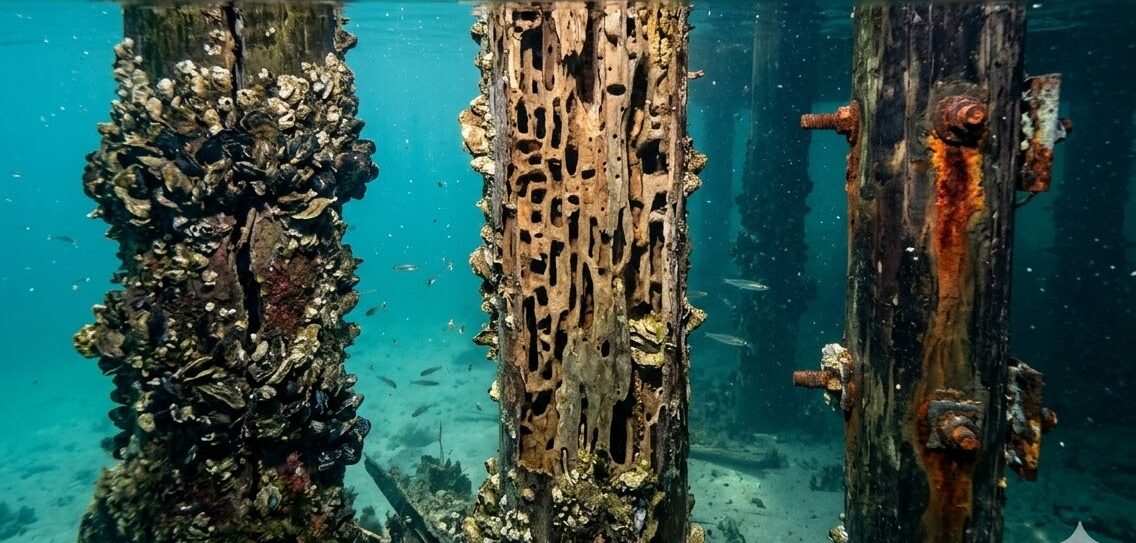
Your dock looks perfectly fine from the surface. The deck boards are solid, the cleats hold steady, and nothing seems out of place when you walk it every morning. But what is happening below the waterline is an entirely different story — and for most dock owners, that story goes completely unread until something catastrophic forces the issue. Hidden underwater dock damage is the leading cause of unexpected dock failures, costly emergency repairs, and preventable safety accidents at waterfront properties across the country. The most destructive forces attacking your dock structure are invisible from above: marine borers tunneling silently through piling cores, galvanic corrosion eating through submerged metal fittings, biofouling accumulation placing excessive stress on structural joints, and mud-line deterioration that can cause complete piling failure with no visible above-water warning. In this comprehensive guide, we reveal exactly what is hiding below your waterline, why it is so easy to miss, and what professional underwater inspection and maintenance services can do to protect your dock before damage becomes disaster.
Why Hidden Underwater Dock Damage Is So Dangerous
The fundamental challenge with underwater dock damage is that the most structurally critical zones of any dock — the lower piling sections, the mud-line connections, the submerged cross-bracing, and all metal hardware below the surface — are completely inaccessible to normal visual inspection. A dock owner walking their structure sees roughly the top third of their dock’s anatomy. The remaining two-thirds exist in an environment of limited visibility, constant biological activity, and relentless chemical and physical stress.
This creates a dangerous gap between how a dock looks and how a dock actually performs structurally. A piling that appears sound at the waterline can be almost entirely hollow six inches below the surface, hollowed out by shipworm activity over years of undetected infestation. A metal bracket that looks rusty but solid above water may have corroded completely through its load-bearing section below the mud line. Biofouling that appears to be a cosmetic surface issue may be accelerating rot and corrosion in the piling material beneath it at a rate the owner has no awareness of.
The consequences of missing these problems range from accelerated structural deterioration and expensive repair bills to sudden, catastrophic dock section collapse — which can cause serious injury to anyone on or near the structure at the time. Understanding the specific types of hidden underwater dock damage that most commonly go undetected is the first and most important step toward protecting your investment and the safety of everyone who uses your waterfront.
The 8 Most Common Types of Hidden Underwater Dock Damage
1. Internal Marine Borer Infestation
Of all the forms of hidden underwater dock damage, marine borer infestation is arguably the most deceptive and the most destructive. Two primary organisms are responsible for the vast majority of marine borer damage to wooden dock pilings worldwide: Teredo navalis, commonly known as the shipworm, and Limnoria species, commonly known as gribbles.
Shipworms are not actually worms — they are a species of saltwater clam that uses a specially adapted shell to bore into wood, creating long cylindrical tunnels as they feed. A single mature shipworm can be over a foot long, yet the entry hole at the piling surface is often no larger than the head of a nail. Multiple shipworms boring simultaneously through a single piling can reduce its entire interior to a network of hollow tunnels while the exterior surface appears completely intact. By the time the piling surface begins to show the soft, spongy texture that indicates advanced internal decay, the piling may have lost more than half of its structural load-bearing capacity.
Gribbles work differently — they feed on the surface layers of wood from the outside, creating a characteristic hourglass-shaped erosion pattern near the waterline zone. While their damage is more externally visible than shipworm damage, it still progresses far faster than casual above-water observation can track, and it accelerates dramatically in the highly active biological zone between the tidal low and high water marks.
2. Mud-Line Corrosion and Rot
The mud-line zone — where a dock piling transitions from open water into the seabed sediment — is one of the most aggressive deterioration environments that exists for any structural material. For wood pilings, the combination of anaerobic bacteria in the sediment, physical abrasion from shifting sediment particles, and fluctuating oxygen levels creates conditions that can cause rapid, deep rot at the base of a piling without any above-water indication whatsoever.
For steel pilings and metal dock hardware, the mud-line zone represents the most intense galvanic corrosion environment along the entire piling length. Differential oxygen concentration between the sediment and open water creates electrochemical activity that accelerates metal loss at the transition point. Steel pilings have been found with their wall thickness reduced to near zero at the mud line while appearing structurally sound along their visible above-water section.
This type of hidden underwater dock damage is particularly dangerous because the mud line is the point at which the piling transfers all load to the earth. A piling that has failed at or below the mud line offers no resistance to lateral forces — it can be knocked loose or topple unexpectedly under load conditions that the dock has handled without issue for years.
3. Submerged Hardware Failure
Every dock relies on a network of submerged hardware — bolts, through-rods, brackets, pile guides, cross-brace connectors, and lag screws — to tie its structural components together. In saltwater environments, every piece of this hardware is under continuous corrosive attack, and much of it is located in zones that are impossible to inspect without a diver.
Galvanic corrosion is the primary threat to submerged dock hardware. When two dissimilar metals are in contact in an electrolytic solution such as saltwater, electrochemical current flows between them, causing the less noble metal to corrode at an accelerated rate. In practice, this means that hardware installed at the time a dock was built — often not specified for long-term saltwater immersion — may have corroded through entirely while looking merely rusty from the deck above.
A through-bolt that has corroded to 20% of its original diameter is providing only a fraction of its design-rated holding force. When multiple hardware connections on the same dock section are in this condition simultaneously — which is common in docks that have not had underwater inspections — the cumulative loss of structural connection strength creates a genuine collapse risk that the above-waterline appearance of the dock gives no warning of.
4. Biofouling Stress and Hidden Piling Damage Beneath Growth
Biofouling — the accumulation of barnacles, mussels, algae, tube worms, hydroids, and biological slime films on submerged dock surfaces — is widely understood as a maintenance issue that affects dock aesthetics and piling longevity. What is less widely understood is the role that dense biofouling plays as a concealment layer for hidden underwater dock damage of far greater seriousness.
A heavily fouled piling presents an opaque biological shell to the outside world. Cracks, splits, shipworm entry holes, areas of wood softening, and early-stage surface erosion are completely invisible beneath a thick barnacle and mussel colony. In some cases, the biological growth itself provides a degree of false mechanical integrity — holding cracked or fragmented piling sections together — until it is removed, at which point the true extent of the underlying damage becomes apparent.
This is a critical reason why professional piling cleaning must always be paired with a thorough structural inspection of the surfaces revealed. Cleaning that simply removes growth without assessing what is underneath misses the most important information that the cleaning process makes available.
5. Scour and Sediment Undermining
Scour refers to the erosion of seabed sediment from around and beneath dock pilings due to current flow, tidal action, wave energy, and propeller wash from passing vessels. When sediment is scoured away from around the base of a piling, the effective embedment depth of that piling is reduced — meaning the piling is anchored less deeply in the seabed than it was designed to be, with significantly reduced resistance to lateral and uplift forces.
Scour is entirely invisible from above the waterline and can only be detected by a diver physically probing the sediment around each piling base. In environments with regular boat traffic, strong tidal currents, or storm surge exposure, significant scour can develop relatively quickly. A dock that has experienced even moderate scour around multiple pilings may appear completely stable above water while actually being in a structurally vulnerable condition that could result in failure under storm loading or heavy vessel impact.
6. Delamination and Cracking in Concrete Pilings
Concrete dock pilings present a specific form of hidden underwater damage that is particularly common in saltwater environments — internal rebar corrosion driving surface spalling and delamination. When saltwater penetrates the outer concrete cover and reaches the steel reinforcing bars inside, those bars begin to rust. Rust occupies a greater volume than the steel it replaces, so as the rebar corrodes, it expands and generates internal pressure that cracks and eventually detonates the surrounding concrete outward in a process called spalling.
The early stages of this process are entirely invisible on the submerged piling surface. The concrete may look solid and intact while the rebar within is actively corroding and the internal pressure is building. By the time surface cracking or spalling becomes visible, the process is already advanced — and in many cases, the damage extends further than the visible surface evidence suggests. Underwater inspection using physical probing and percussion testing — tapping the surface to identify hollow or delaminated sections — is the only reliable method for detecting this type of damage in its early stages.
7. Galvanic Corrosion on Metal Pilings and Fittings
In saltwater marina and dock environments, galvanic corrosion can cause shockingly rapid metal loss on steel and aluminum pilings, dock frames, and all submerged metal hardware. The rate of galvanic corrosion depends on the specific metals in contact, the conductivity of the surrounding water, water temperature, and the presence of stray electrical current from marina shore power systems — a phenomenon known as stray current corrosion or electrolytic corrosion, which can be dramatically more aggressive than natural galvanic activity.
Stray current corrosion from poorly bonded marina electrical systems is one of the most serious and least recognized sources of hidden underwater dock damage. It can cause steel pilings to lose significant wall thickness in months rather than decades, and it produces no visible above-water evidence until the damage is already severe. Any dock located in a marina or in proximity to other boats with shore power connections should be assessed for stray current exposure as part of every professional underwater inspection.
8. Impact Damage from Vessel Strike
Vessel impact is a frequently overlooked source of hidden underwater dock damage. While major collisions that leave visible above-water damage are usually addressed promptly, the repeated low-energy impacts of boats docking, lines pulling under load, and fenders transferring compressive forces to pilings over time can cause cumulative structural damage below the waterline that accumulates invisibly.
Cracks and splits initiated at or below the waterline by impact forces propagate slowly outward over subsequent months, opening pathways for water infiltration, marine borer entry, and accelerated biological and chemical deterioration. A piling that absorbed a moderate vessel impact two seasons ago may now have a concealed crack running longitudinally below the surface that has been slowly worsening ever since — and will continue to do so until a professional inspection reveals it.
Damage Type Reference: What Hides Below Your Waterline
| Damage Type | Primary Piling Material Affected | Visible Above Waterline? | Detection Method | Risk Level if Missed |
|---|---|---|---|---|
| Marine Borer Infestation | Wood | Rarely — exterior often intact | Diver probing, internal sounding | Critical |
| Mud-Line Rot / Corrosion | Wood, Steel | No | Diver physical inspection at mud line | Critical |
| Submerged Hardware Failure | All types | Rarely | Diver visual and tactile inspection | High |
| Damage Concealed by Biofouling | All types | No — concealed by growth | Professional cleaning followed by inspection | High |
| Scour and Sediment Undermining | All types | No | Diver sediment probing at base | High |
| Concrete Spalling / Rebar Corrosion | Concrete | Rarely in early stage | Percussion testing, diver inspection | High |
| Galvanic / Stray Current Corrosion | Steel, Aluminum | No | Diver inspection, electrical testing | Critical |
| Subsurface Impact Cracking | Wood, Concrete | Rarely | Diver visual and probing inspection | Moderate to High |
Why Standard Above-Water Inspection Always Misses the Most Critical Damage
Many dock owners believe that if they walk their dock regularly and look for signs of trouble, they are staying ahead of problems. This assumption is understandable but structurally dangerous. Above-water inspection can identify deck board deterioration, visible hardware rust, surface cracking above the waterline, and signs of structural movement — all genuinely useful information. But it cannot access the zones where the most serious and most costly damage originates.
The critical zone for most forms of hidden underwater dock damage lies between one foot above the water surface and one foot below the mud line. This zone encompasses the waterline splash zone, the most biologically active section of the submerged piling, and the all-important mud-line transition. It is the section of a dock piling that faces the greatest combined biological, chemical, and physical stress — and it is completely invisible without a trained diver conducting a hands-on inspection.
Professional underwater dock inspections by certified marine divers provide physical probing and tapping of every accessible piling surface, visual assessment of all submerged hardware and structural connections, measurement of remaining piling cross-section where deterioration is detected, and photographic or video documentation of all findings for the property owner’s records. This is information that simply cannot be obtained any other way — and according to NOAA’s Ocean Service, biological activity in coastal marine environments is intensifying in many regions due to changing ocean temperatures, making proactive underwater inspections more critical than ever before.
How Biofouling Accelerates Every Other Form of Hidden Dock Damage
Biofouling deserves special attention in any discussion of hidden underwater dock damage because it does not merely represent a standalone problem — it actively accelerates every other form of underwater deterioration simultaneously. Understanding this compounding relationship explains why regular professional piling cleaning is not just a cosmetic maintenance task but a core structural protection strategy.
When barnacles and mussels attach to a wooden piling surface, their attachment structures penetrate the outer wood layers, creating micro-entry points for moisture and marine borer larvae. The biological mass they form retains moisture against the piling surface continuously, accelerating the rot processes that thrive in persistently wet wood. On concrete pilings, barnacle adhesion generates localized tensile stresses on the concrete surface as organisms grow, which can initiate or widen micro-cracks that then allow saltwater to penetrate to the rebar layer.
On steel pilings and hardware, the biological slime layer that forms beneath barnacle and algae colonies creates a differential oxygen environment between the slime-covered surface and the surrounding water — and differential oxygen concentration is a primary driver of galvanic and microbially influenced corrosion. In practical terms, a heavily fouled steel piling corrodes significantly faster in the fouled zones than in the zones where growth has been kept under control through regular professional cleaning.
The relationship is cumulative and self-reinforcing: fouling grows, fouling accelerates underlying damage, underlying damage creates more surface irregularity that harbors more fouling, and the cycle continues to compound with each season that passes without professional intervention. This is why the U.S. Environmental Protection Agency’s Safer Choice program recognizes proactive marine biofouling management as a critical component of responsible waterfront property maintenance.
Warning Signs Above the Waterline That Suggest Hidden Underwater Problems
While the most serious hidden underwater dock damage cannot be detected by surface observation alone, certain above-waterline indicators can suggest that underwater problems may already be developing. If you observe any of the following, a professional underwater inspection should be scheduled without delay:
- Unexplained deck movement or bounce: A deck surface that flexes more than usual when walked, or that has developed a new bounce or sway, may indicate that one or more pilings below are losing structural integrity at the waterline or mud line.
- New or worsening lean in any piling: Any piling that has visibly shifted from vertical since your last observation warrants immediate underwater investigation. Lean indicates either scour at the base, mud-line failure, or impact damage that has compromised the piling’s foundation connection.
- Rust streaking or staining on deck boards: Rust stains running down from hardware connections or piling tops often indicate that corrosion has progressed beyond the surface level and may be actively compromising submerged bolt or bracket connections below.
- Soft or discolored wood at the waterline: Any discoloration, softening, or unusual texture at or just above the waterline on a wood piling is a strong indicator that deterioration is already advanced in the submerged section directly below.
- Unusual sounds during boat docking: Creaking, cracking, or movement sounds that occur when boats tie up and place load on dock cleats and pilings can indicate that structural connections below the waterline are no longer performing as designed.
- After any major storm event: Storm surge, high winds, and wave action can cause or rapidly accelerate hidden underwater damage. A professional inspection after any significant weather event is essential regardless of whether above-water damage is visible.
The Professional Underwater Inspection Process
A thorough professional underwater inspection is the only reliable method for detecting and documenting hidden underwater dock damage before it reaches a critical stage. Here is what a properly conducted professional inspection involves:
Pre-Dive Assessment
Before entering the water, the inspection diver reviews the dock’s construction history if available, notes any above-waterline indicators of concern, and establishes a systematic inspection plan covering every piling and submerged structural element. Water visibility conditions are assessed to determine whether supplemental lighting or underwater camera equipment is required.
Piling-by-Piling Physical Inspection
The diver works methodically from the mud line upward on each piling, using hands and specialized probing tools to physically assess piling surface condition, detect soft spots and voids, identify borer entry holes and damage extent, and check all submerged hardware connections for corrosion and mechanical integrity. Each piling is assessed across its full circumference — not just the most accessible face.
Mud-Line and Base Assessment
At the base of each piling, the diver probes the surrounding sediment to assess scour depth, checks the piling’s stability and embedment, and evaluates the condition of any submerged pile caps, cross-bracing connections, or base hardware present.
Documentation and Reporting
All findings are photographically or video documented underwater. Following the dive, the property owner receives a comprehensive written report identifying every area of concern found, the severity and estimated progression rate of each issue, and specific recommendations for cleaning, repair, or replacement as appropriate to address the hidden underwater dock damage identified.
Frequently Asked Questions About Hidden Underwater Dock Damage
How would I know if my dock pilings have hidden marine borer damage?
In most cases, you would not know from surface observation alone. Marine borer damage is specifically characterized by an intact or near-intact piling exterior that conceals a heavily tunneled or completely hollow interior. The only reliable detection method is physical probing by a trained diver, who can feel the reduced resistance that hollow or softened areas present compared to structurally sound wood. A professional underwater inspection is essential for any wood piling dock in a saltwater environment — ideally conducted annually.
Can heavy biofouling cause structural damage to dock pilings on its own?
Yes — though the more significant risk is that dense biofouling conceals and accelerates other forms of structural damage rather than causing immediate structural failure by itself. Heavy barnacle and mussel colonies add significant weight to pilings, place continuous tensile stress on concrete surfaces, retain moisture that promotes rot in wood pilings, and create corrosion-accelerating conditions on metal surfaces. Professional piling cleaning combined with structural inspection is the correct response to significant biofouling accumulation.
How often should professional underwater dock inspections be performed?
For residential docks in active saltwater environments, professional underwater inspection is recommended at a minimum of once per year, ideally at the end of the active boating season when a full season’s worth of biological activity and wear can be assessed. Docks in high-biological-activity waters, docks with older pilings, commercial or high-traffic dock facilities, and any dock that has experienced significant weather events should be inspected twice per year. An inspection is also strongly advisable any time unusual above-waterline signs — new lean, unusual movement, rust staining, or soft wood at the waterline — are observed.
Is it possible for a dock to look completely fine above water while having serious structural damage below?
Absolutely — and this scenario is far more common than most dock owners realize. Marine borer infestation, mud-line corrosion, submerged hardware failure, scour undermining, and internal concrete deterioration are all forms of hidden underwater dock damage that can progress to a critical structural stage with no visible above-waterline evidence whatsoever. This is the core reason why professional underwater inspection is not optional for responsible dock ownership — it is the only tool available for seeing what the waterline hides.
Conclusion: What You Cannot See Can Hurt You — And Your Dock
Hidden underwater dock damage is not a rare edge case or a worst-scenario concern reserved for neglected, aging structures. It is an active, ongoing reality for virtually every dock operating in saltwater or biologically active freshwater environments. Marine borers, galvanic corrosion, biofouling acceleration, mud-line deterioration, submerged hardware failure, and scour undermining work continuously and silently below the waterline — and none of them send visible above-water warning signals until the damage is already serious.
The dock owners who avoid emergency repairs, unexpected structural failures, and the significant financial and safety consequences that accompany them are the ones who understand this reality and act on it. Annual professional underwater inspections, regular expert piling cleaning to remove biofouling and expose true piling condition, proactive zinc anode maintenance for all metal components, and prompt action on any findings identified are the pillars of a dock maintenance strategy that protects your investment, your structure, and everyone who uses it.
Do not wait for a visible problem to force your hand — by the time hidden underwater dock damage becomes visible, the most affordable repair windows have already closed.
Contact our certified marine team today to schedule a professional Underwater Inspection — and see exactly what is hiding below your waterline before it becomes a costly emergency.
