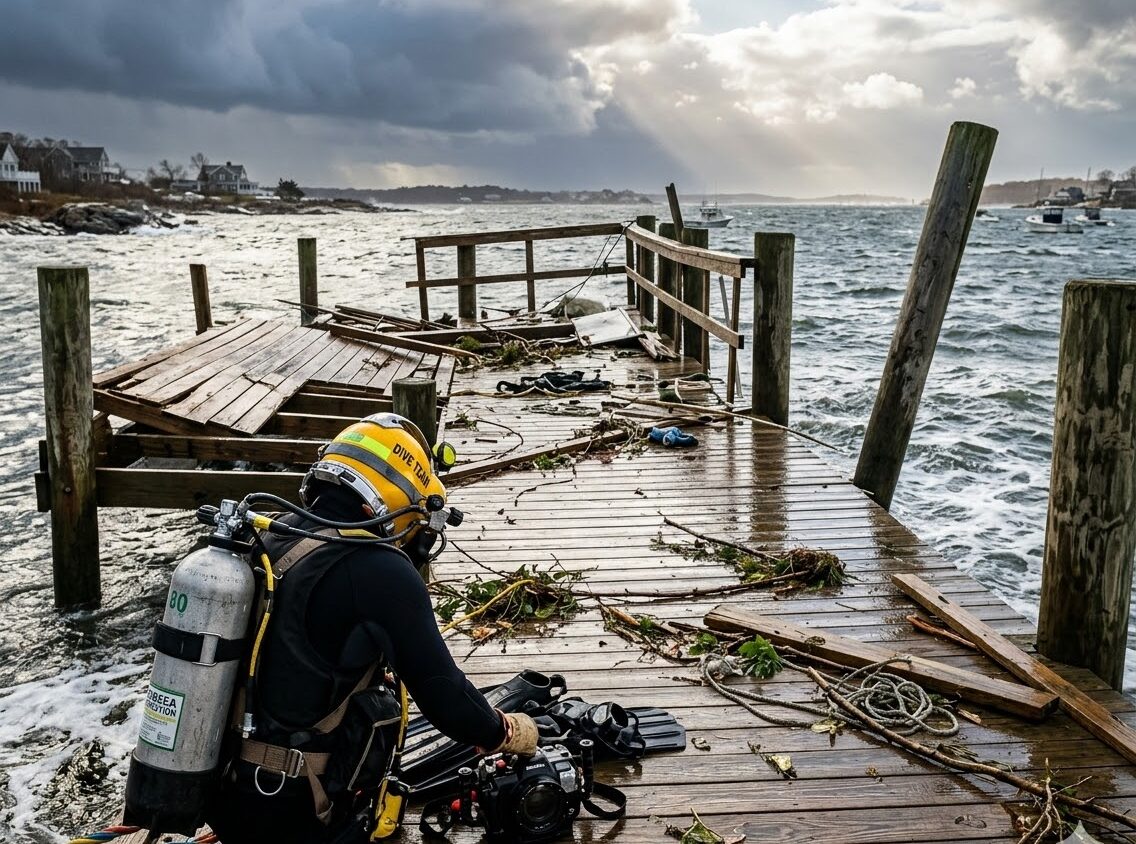
A storm passes through overnight and by morning the sky is clear, the water looks calm, and your dock appears to be standing exactly where you left it. For most dock owners, that visual confirmation is enough — they walk out, check that the cleats are still attached, and assume everything is fine. This assumption is one of the most common and costly mistakes a waterfront property owner can make. The truth is that a thorough post-storm dock inspection goes far beyond what the eye can see from the deck surface. Storm surge, wave action, high winds, debris impact, and rapidly changing water levels inflict damage on dock structures in ways that are almost entirely invisible from above — particularly on the pilings, submerged hardware, and structural connections that bear the entire load of your dock system. In this complete guide, we walk you through every step of a professional-grade post-storm dock inspection, from the first safe approach to the dock all the way down to the mud-line zone beneath the waterline — so you know exactly what to look for, what it means, and when to call in the professionals.
Why a Post-Storm Dock Inspection Is Non-Negotiable
Storms do not damage dock structures the way most owners expect. The catastrophic, immediately visible failures — a section of decking washed away, a piling knocked completely sideways, a gangway floating in the harbor — are actually the minority of storm-related dock damage events. The far more common scenario is one in which a storm inflicts serious structural damage that is entirely concealed at the surface level: a piling cracked below the waterline by wave surge, a through-bolt sheared by storm loading that still looks intact from above, a cross-brace connection loosened at the mud line by scour, or a piling knocked fractionally off its foundation alignment in a way that significantly reduces its load-bearing capacity without being visibly out of plumb to the casual observer.
These hidden storm impacts do not announce themselves immediately. Instead, they create structural vulnerabilities that compound over subsequent weeks and months — accelerating deterioration, inviting biological infiltration through new cracks and splits, and reducing the dock’s ability to withstand the next weather event. The dock that survived the storm technically intact may actually be in a significantly more fragile structural state than it was before the storm — and without a proper post-storm dock inspection, that fragility goes completely undetected until a second, lesser storm or a routine load event causes a failure that should never have happened.
A proper post-storm dock inspection is not just about identifying what broke — it is about identifying what was weakened, what was shifted, what was newly exposed to accelerated damage, and what requires professional assessment before the dock is returned to normal use.
Before You Step Onto the Dock: Safety First
The first and most critical rule of any post-storm dock inspection is this: do not step onto the dock until you have performed a safe approach assessment from the shore. A dock that has sustained structural damage may be unable to safely support your weight — and there will be no obvious visual indicator from a distance that this is the case. Before approaching, observe the following from the shore or from a safe elevated position:
- Check that the dock is still connected to the shore access point — gangways and access ramps can detach during storm surge and may not be visible from a distance if they have sunk or drifted
- Look for any visible piling lean, deck sagging, or section misalignment that was not present before the storm
- Observe the waterline along the dock — any section sitting lower in the water than adjacent sections indicates potential structural compromise below
- Check that no live electrical cables, shore power pedestals, or electrical connections appear damaged or are in contact with water
- Look for large debris items — logs, vessels, or floating material — that may still be in contact with or lodged against the dock structure
- Listen for any unusual creaking, movement sounds, or structural noise when wind or wave action applies force to the dock
If any of these observations raise concern, do not proceed onto the dock without professional assessment. The risk of a secondary collapse injury from a structurally compromised dock is real and serious. When in doubt, wait for a professional marine inspector before putting weight on the structure.
The Complete Post-Storm Dock Inspection Checklist
The following checklist is organized by zone — working from the shore access point outward and from the deck surface downward to the submerged structural elements. Work through each section systematically, documenting findings with photographs as you go. This documentation is valuable not only for planning repairs but also for insurance claims, which typically require documented evidence of storm-related damage.
Zone 1: Shore Connection and Access Structure
The shore connection is the first structural element to inspect and often one of the most vulnerable to storm damage. This zone includes the gangway or access ramp, the shore anchor points, and the transition hardware between the fixed structure and the floating or fixed dock section.
- Confirm the gangway or access ramp is still securely attached at both the shore end and the dock end
- Check all shore anchor bolts, hinges, and pins for signs of bending, shearing, or pulling out from the substrate
- Walk the gangway slowly, testing for unusual flex, bounce, or lateral movement that was not present before the storm
- Inspect the non-slip surface of the gangway for displacement, bubbling, or areas that have been scoured away by debris impact
- Check the gangway rollers or glide pads on the dock end for damage, displacement, or wear caused by storm surge movement
- Inspect shore power pedestal connections and electrical conduit runs for physical damage, water infiltration indicators, or displacement
Zone 2: Deck Surface and Above-Water Structure
The deck surface is the most visible part of the dock and the area most dock owners focus on during a post-storm inspection — but it is important not to stop here. Deck-level findings are valuable as indicators of what may be happening in the structural zones below.
- Walk the entire deck slowly, noting any sections that flex, bounce, or feel different underfoot than before the storm — this can indicate damaged or displaced piling connections below
- Check all deck boards for cracking, splitting, displacement, or boards that have been lifted and dropped back down out of alignment
- Inspect all cleats, dock hardware, and mooring fittings — look for bent cleats, pulled fasteners, or backing plates that have shifted under storm load
- Check all deck-to-stringer connections — look for fastener withdrawal, gapping between deck boards and stringers, and any areas where the deck has separated from its support structure
- Inspect all railing systems for damage, deformation, loose posts, or sections that have been displaced or removed by wave or wind action
- Look for waterline debris lines on vertical dock elements — these indicate the maximum surge height reached during the storm and help identify which zones experienced the greatest hydraulic force
- Check utility connections — water lines, electrical conduits, and fuel lines — for physical damage, displacement, or signs of breach
Zone 3: Visible Piling Inspection Above the Waterline
Piling inspection is the heart of any thorough post-storm dock inspection. Even the above-waterline piling section — the minority of the piling’s total length — can reveal important clues about what storm forces were applied and what structural consequences may have occurred below the surface.
- Sight down the line of pilings from the shore end — any piling that has shifted out of alignment with its neighbors should be flagged for professional underwater assessment immediately
- Check each piling individually for new cracks or splits — pay particular attention to the zone just above the waterline, which experiences the greatest repeated wave impact loading
- Look for new impact damage on any piling face — storm-driven debris can cause significant localized damage that initiates cracks extending below the waterline
- Push laterally against each piling with both hands — any piling that moves, rocks, or feels loose at its connection point to the dock framing requires underwater inspection before the dock is returned to use
- Check all piling-to-stringer and piling-to-cap beam connections — look for bolt withdrawal, cracked connection hardware, and gapping that indicates storm loading has shifted these connections
- Inspect all pile guides and piling wraps for displacement, tearing, or sections that have been pulled loose by surge action
- Check for new rust staining or discoloration running down from hardware connections — this can indicate that storm loading has sheared fasteners or cracked protective coatings on metal hardware below the waterline
Zone 4: Floating Dock Components (If Applicable)
Floating docks present specific post-storm inspection requirements because their components experience different forces than fixed dock structures during storm events. Surge and wave action can cause floating dock sections to ride up over their guide pilings, collide with adjacent sections, or twist under torsional loading in ways that damage connection hardware and float bodies.
- Check that all float sections are still properly seated on their guide pilings and have not ridden up over their stop collars during surge
- Inspect all float-to-float connection hardware — hinges, shackles, and connection pins — for bending, cracking, or withdrawal
- Check the freeboard of each float section — a section sitting lower in the water than its neighbors may have sustained hull damage or water infiltration into the float body
- Inspect the undersides of float edges where they contact guide pilings — storm surge movement can abrade or crack the float material at these contact points
- Check all dock lines, spring lines, and mooring systems for chafe damage, parted sections, or cleats that have been loaded beyond their designed capacity
Zone 5: Below-Waterline and Underwater Structural Assessment
This zone is the most critical section of any post-storm dock inspection — and the one that requires professional underwater inspection by a certified commercial diver to complete properly. The submerged piling sections, cross-bracing, mud-line connections, and underwater hardware are where the most serious storm-induced structural damage occurs and where it is least likely to be detected by above-water observation alone.
- Schedule a professional underwater inspection with a certified marine diver as part of every post-storm dock inspection — this is not optional for any dock that has experienced significant storm loading
- Request that the diver physically probe each piling for new soft spots, cracks, and surface damage that may have been initiated by storm wave impact below the waterline
- Have the diver assess the mud-line zone around each piling base for scour — storm surge and wave-driven currents can remove significant sediment from around piling bases, reducing embedment depth and lateral stability
- Request inspection of all submerged hardware connections — through-bolts, cross-brace connectors, pile guides, and underwater brackets — for bending, cracking, or shearing caused by storm loading
- Have the diver check for any new piling lean or displacement at and below the mud line — surface observation of piling alignment can miss subtle mud-line shifts that have major structural implications
- Request assessment of any recently installed piling wraps, fiberglass jackets, or repair systems to confirm storm action has not compromised these protective treatments
- Have zinc anodes on all metal components inspected — storm surge can dislodge or damage anode installations, leaving metal hardware temporarily unprotected
Post-Storm Dock Inspection Quick Reference Checklist
| Inspection Zone | Key Items to Check | Warning Signs Requiring Immediate Action | Professional Inspection Required? |
|---|---|---|---|
| Shore Connection | Gangway attachment, shore anchor bolts, shore power connections | Detached gangway, bent anchor hardware, electrical damage near water | If anchor hardware damaged |
| Deck Surface | Board integrity, cleat and fitting security, deck-to-stringer connections | Unusual flex underfoot, displaced deck sections, pulled cleats | If unusual deck movement detected |
| Above-Water Pilings | Piling alignment, new cracks, connection hardware, piling movement | Any piling lean, movement when pushed, new splits at waterline | Yes — for any piling showing movement |
| Floating Dock Components | Guide piling seating, float-to-float connections, freeboard levels | Float section riding high or low, cracked connection hardware | If freeboard change detected |
| Below Waterline | Submerged piling condition, scour, hardware integrity, mud-line stability | Any storm of significant intensity — always inspect below waterline post-storm | Always — certified diver required |
Documenting Your Post-Storm Dock Inspection
Thorough documentation during your post-storm dock inspection is essential for three reasons: it creates a baseline record of storm-induced changes, it supports insurance claims with dated photographic evidence, and it provides your marine maintenance contractor with the information needed to prioritize and plan repairs efficiently.
For every item of damage or concern identified during your inspection, document the following: a clear photograph showing the damage in context and a close-up of the specific area of concern, the location of the damage identified by piling number or dock section, a brief written description of what was observed and how it differs from the pre-storm condition, and a preliminary assessment of urgency — whether it requires immediate action before the dock is used, professional assessment within days, or monitoring over the coming weeks.
If you performed a pre-storm photographic documentation of your dock — which is strongly recommended as part of annual dock maintenance practice — comparing pre-storm and post-storm images of the same structural elements is one of the most effective ways to identify subtle changes in piling alignment, connection hardware condition, and deck surface integrity that might otherwise be missed.
Storm Intensity and Inspection Scope: Matching Your Response to the Event
Not every storm demands the same scope of post-storm dock inspection. Calibrating your inspection response to the intensity and characteristics of the weather event that passed through helps prioritize resources and ensures that the most serious damage scenarios are addressed with appropriate urgency.
| Storm Type | Primary Dock Risks | Minimum Inspection Scope | Underwater Inspection Priority |
|---|---|---|---|
| Moderate Wind Event (under 45 mph) | Deck hardware loosening, floating dock connection stress | Zones 1–4 above-water inspection | Recommended within 2 weeks |
| Strong Wind Event (45–75 mph) | Piling impact damage, wave loading on connections, debris strike | Full above-water inspection, all zones | Required within 72 hours |
| Tropical Storm / Hurricane Force | Scour, piling displacement, hardware shearing, surge flooding of structure | Full above-water and professional underwater inspection | Required before dock is used again |
| Significant Flooding Event | Debris impact, sediment deposit, current scour, electrical system flooding | Full inspection plus electrical system assessment | Required — sediment and scour assessment essential |
| Significant Ice or Freeze Event | Ice pressure on pilings, freeze-thaw cracking, hardware damage | Full above-water inspection focusing on waterline zone | Required — waterline crack inspection critical |
What Storms Do to Dock Pilings That You Cannot See From the Surface
Understanding the specific mechanisms by which storm events damage dock pilings below the waterline helps dock owners appreciate why the underwater component of a post-storm dock inspection is so critical — and why it cannot be substituted by more careful or more thorough above-water observation.
Wave Impact Loading and Subsurface Cracking
Repeated wave impacts during a storm apply cyclic loading to dock pilings at a rate and intensity far exceeding anything the structure experiences during normal use. This cyclic loading concentrates stress at points of existing weakness — a micro-crack that was stable under normal conditions can propagate rapidly under storm wave loading, creating a new structural crack that runs below the waterline where it is invisible from the deck. The piling may absorb the storm successfully in a structural sense but emerge from the event with damage that will continue to develop and weaken the piling over subsequent months.
Scour at the Mud Line
Storm surge generates powerful horizontal and vertical water currents around dock pilings that can mobilize and transport significant volumes of seabed sediment in a matter of hours. This scour removes the soil that provides lateral and vertical support for piling foundations — potentially reducing the embedment depth of a piling by several inches or more during a single storm event. A piling that experienced even moderate scour during a storm is less laterally stable than it was before the event, even though its above-water appearance is completely unchanged.
Hardware Loading and Connection Failure
Storm surge and wave loading apply forces to dock hardware — through-bolts, cross-brace connectors, pile cap connections — at angles and magnitudes that normal operational loading does not produce. Hardware that was near the end of its service life may shear, bend, or pull free from its substrate entirely during storm loading, while appearing intact from the deck above. A connection that has been mechanically compromised but not completely failed under storm load is in a far more precarious state than it was before the storm — and represents a genuine safety risk that requires professional identification and replacement.
The Importance of Professional Underwater Inspection After Any Significant Storm
The single most important action a dock owner can take following any significant storm event is scheduling a professional underwater inspection with a certified commercial diver. No above-water checklist, however thorough, can substitute for hands-on physical assessment of the submerged structural zones where the most consequential storm damage occurs.
A professional post-storm underwater inspection provides physical probing of every piling across its full submerged length, assessment of all mud-line connections and scour conditions, inspection of all submerged hardware for storm-induced damage, photographic documentation of all findings for the property owner’s records, and specific repair or monitoring recommendations based on what the inspection reveals. This documentation is also increasingly recognized by marine insurers as important evidence in storm damage claims — a professional underwater inspection report that identifies storm-specific damage to submerged components provides the documented basis for claiming repair costs that above-water inspection alone could never establish.
According to NOAA’s National Ocean Service, coastal storm frequency and intensity are increasing across many regions of the United States — making systematic post-storm dock inspection and professional underwater assessment more important than ever for waterfront property owners seeking to protect their structures over the long term.
Post-Storm Piling Cleaning: Why It Matters More Than You Think
One post-storm maintenance action that many dock owners overlook is professional piling cleaning performed in the aftermath of a significant weather event. Storm surge and wave action dramatically accelerate biofouling recolonization on piling surfaces by dislodging established growth colonies and redistributing larvae and biological material across piling surfaces. The disturbed biological environment following a storm creates ideal conditions for aggressive new fouling establishment — particularly if any protective coatings or anti-fouling treatments have been disrupted by storm-driven debris impact or wave abrasion.
Professional piling cleaning performed as part of a post-storm dock inspection and maintenance response serves a dual function: it removes freshly accelerated biofouling growth before it establishes deeply, and it exposes the true condition of piling surfaces immediately below that growth — allowing any new storm-induced surface damage to be identified and addressed before it is concealed again by the next wave of biological colonization.
For docks where zinc anodes have been installed on metal components, post-storm inspection should always include anode condition assessment by a diver. Storm surge can physically dislodge anode installations or damage the electrical connections that make them effective — leaving metal hardware temporarily without the cathodic protection it depends on in saltwater environments. The U.S. Environmental Protection Agency’s Safer Choice program recommends combining structural inspections with environmentally responsible maintenance practices — including proper anode management — as part of responsible waterfront property stewardship.
Frequently Asked Questions About Post-Storm Dock Inspection
How soon after a storm should I inspect my dock?
Above-water inspection should be performed as soon as it is safe to approach the dock following the storm — typically within 24 hours once wind and sea conditions have settled sufficiently to make access safe. Professional underwater inspection should follow as quickly as possible thereafter — within 24 to 72 hours for any storm of significant intensity, and before the dock is returned to normal use following a major storm or hurricane event. The faster hidden structural damage is identified, the more repair options are available and the lower the ultimate repair cost will be.
Can I perform a post-storm dock inspection myself or do I need a professional?
The above-water portions of a post-storm dock inspection — deck surface, visible piling assessment, hardware checks, shore connection inspection — can and should be performed by the dock owner as the first response step. However, the underwater component, which covers the most structurally critical zones of the dock, requires a certified commercial diver with the equipment, training, and experience to conduct a proper below-waterline structural assessment. Attempting to assess underwater piling conditions from above the surface — or by snorkeling without professional training and probing tools — will miss the most important damage indicators reliably detected only through professional inspection.
What should I do if I find damage during my post-storm dock inspection?
Document everything with photographs before touching or moving anything, then assess the severity. Any finding that involves piling movement, significant structural connection damage, deck sections that feel unsafe underfoot, or visible piling displacement should result in restricting dock access until professional marine inspection and repair assessment has been completed. Less severe findings — minor deck board damage, surface piling cracking, loose hardware — should be documented and addressed by a qualified marine contractor within a reasonable timeframe. Never simply defer damage findings without a documented follow-up plan and timeline.
Does my dock insurance cover storm damage found during underwater inspection?
Most dock and waterfront property insurance policies cover storm-related structural damage, including damage identified in underwater structural zones, provided that damage is documented and attributed to a specific storm event. The key requirement in virtually all cases is professional documentation — a certified inspector or marine contractor’s written report identifying specific damage findings, the likely storm-related cause, and recommended repair scope. This is another critical reason why professional underwater post-storm dock inspection should be scheduled promptly — the documentation it produces is often essential for successful insurance claim processing. Always review your specific policy terms and notify your insurer promptly after any storm event regardless of whether damage is immediately apparent.
Conclusion: A Post-Storm Dock Inspection Is Your First Line of Defense
The storm has passed and the water is calm — but your work as a responsible dock owner is just beginning. A thorough post-storm dock inspection, performed systematically from the shore connection to the underwater piling base, is the single most effective action you can take to protect your dock investment, ensure the safety of everyone who uses your structure, and catch storm-induced damage at the earliest possible stage when repair options are most affordable and most effective.
The dock owners who avoid emergency failures, major structural repairs, and preventable safety incidents are invariably the ones who treat post-storm inspection as a non-negotiable protocol — not an optional activity for when something obviously looks wrong. Most storm damage does not look obviously wrong from the surface. That is precisely the point. Use this checklist after every significant weather event, document everything you find, and partner with professional marine inspection and maintenance specialists to cover the underwater zones where the most consequential damage hides.
Your dock’s ability to survive the next storm depends heavily on what you do in the days following this one.
Contact our certified marine team today to schedule a professional post-storm Underwater Inspection — we will assess every submerged piling, connection, and structural zone so you know exactly what the storm left behind before it becomes a costly emergency.
