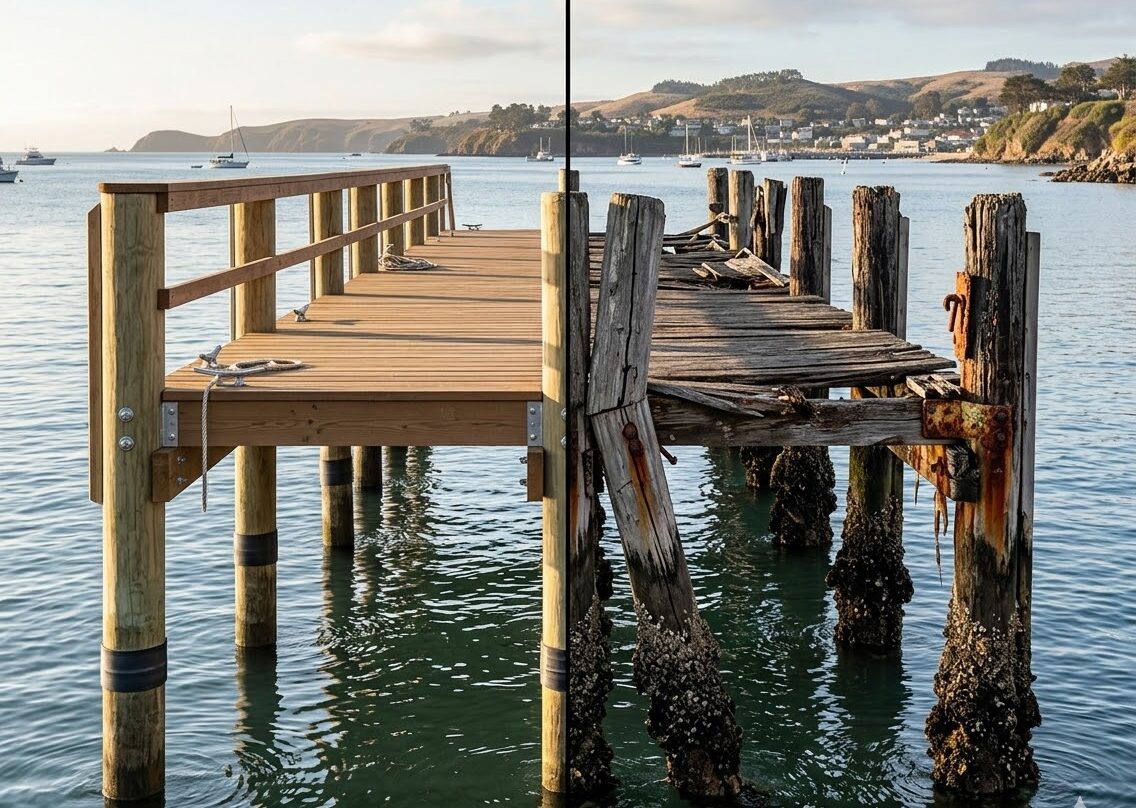
It starts with a decision that feels entirely reasonable at the time. The dock looks fine, the season is busy, and spending money on maintenance for something that is not visibly broken seems unnecessary. So the professional cleaning gets pushed to next season. The underwater inspection gets deferred again. The zinc anodes that were supposed to be replaced last year stay on the to-do list. And the dock keeps standing — for now — reinforcing the sense that the deferred maintenance was never really urgent to begin with. This is precisely how the cost of ignoring dock piling maintenance accumulates: not in one dramatic moment, but in a slow, compounding progression of invisible deterioration that builds silently below the waterline until the day it forces a reckoning that is exponentially more expensive than everything that was deferred to avoid it. In this guide, we break down exactly what deferred dock piling maintenance costs in real terms — structurally, financially, legally, and in terms of property value — and explain in clear numbers why proactive maintenance is not an expense but one of the most reliable financial decisions a waterfront property owner can make.
The Financial Logic of Dock Piling Maintenance — And What Happens When It Breaks Down
The financial case for regular dock piling maintenance rests on a straightforward principle: problems that are identified and addressed in their early stages are dramatically cheaper to resolve than the same problems identified after years of unchecked progression. This principle holds true across virtually every maintenance domain, but it is especially pronounced in the marine environment — where the deterioration processes attacking dock pilings are biological, chemical, and physical simultaneously, and where they operate year-round without pause.
What makes the cost of ignoring dock piling maintenance particularly damaging is the compounding dynamic that drives it. Each deterioration mechanism — marine borer activity, biofouling accumulation, galvanic corrosion, waterline rot — does not simply continue at its existing rate when maintenance is deferred. It accelerates, because the surface conditions and structural vulnerabilities created by one unchecked mechanism make every other mechanism more aggressive. A fouled piling corrodes faster. A corroded piling develops surface irregularities that harbor more fouling. A cracked piling admits marine borer larvae that hollow its interior. A hollow piling loses the structural reserve that would allow it to absorb storm loading without initiating new surface damage. The cycle is self-reinforcing, and every year of deferred maintenance moves the dock further along it.
Without proper maintenance, a problem that starts as a straightforward repair can escalate into a full replacement project, with the financial consequences scaling accordingly. Understanding exactly where those escalation points occur — and what they cost — is the essential financial literacy every dock owner needs.
Stage-by-Stage: How Deferred Maintenance Escalates Dock Piling Costs
Stage 1 — The Maintenance Window: Lowest Cost, Highest Impact
In the early stages of dock piling deterioration, when biological fouling is beginning to accumulate, surface treatments are showing their first signs of wear, and minor surface growth is present but not yet entrenched, the cost of intervention is at its absolute lowest — and the impact of that intervention on long-term piling health is at its absolute highest. Professional cleaning at this stage removes growth before it has established the deep biological matrix that makes later cleaning more intensive. Inspection at this stage reveals any developing concerns at a point where simple, non-invasive treatments are sufficient to address them.
Dock owners who invest in regular professional cleaning and annual underwater inspection at this stage are making the most financially efficient maintenance decision available to them. The intervention is routine, the findings are manageable, and the piling surfaces being maintained are still fundamentally sound. Every subsequent stage of deferred maintenance progressively closes the window for low-cost intervention and opens the door to escalating repair and replacement costs.
Stage 2 — The Repair Window: Moderate Cost, Still Manageable
When dock piling maintenance has been deferred long enough for moderate deterioration to develop — biofouling that has been in place long enough to begin accelerating underlying surface damage, early to mid-stage marine borer activity, developing waterline zone rot, or initial surface corrosion on metal components — the intervention has escalated from routine maintenance to professional repair. This stage still represents a financially manageable scenario. Underwater repair options including fiberglass jacketing, epoxy injection, vinyl encapsulation, and targeted protective treatments can address moderate damage effectively and restore meaningful additional service life to the piling.
A boat dock lasts ten to twenty-five years on average when properly maintained, with annual cleaning and inspection proven to prolong dock lifespan significantly. Docks that receive professional maintenance consistently within this window reliably achieve and often exceed their expected service life. Those that do not begin to approach the repair-to-replacement boundary at which the financial calculus shifts decisively.
Stage 3 — The Replacement Threshold: High Cost, Limited Options
When deferred dock piling maintenance has allowed deterioration to progress to an advanced stage — significant structural cross-section loss from marine borer infestation, advanced mud-line rot or corrosion, severely compromised hardware connections, or concrete pilings with exposed and actively corroding rebar — the options narrow sharply and the financial consequences escalate dramatically. At this point, repair may still be technically possible for individual pilings, but the cost-effectiveness calculation has shifted. A useful rule of thumb widely applied in the marine industry is the fifty percent rule: if the cost of repair exceeds fifty percent of the cost to replace the dock, replacement is almost always the better long-term financial decision.
What makes this stage particularly expensive is not just the cost of individual piling repair or replacement — it is the systemic nature of the problem. Pilings installed at the same time, in the same environment, and maintained with the same level of neglect tend to reach the threshold of serious deterioration within a similar timeframe. When multiple pilings reach a critical stage simultaneously, the scope of required work escalates rapidly — often requiring not targeted piling repairs but comprehensive dock reconstruction, with the financial consequences scaling accordingly.
Stage 4 — Emergency and Total Failure: Maximum Cost, No Options
The final and most costly stage of deferred dock piling maintenance is structural failure — the point at which one or more pilings can no longer safely carry the loads imposed on them and the dock structure becomes imminently dangerous or collapses entirely. This stage represents not just the maximum financial cost of the deferred maintenance program but also a cascade of additional expenses that extend well beyond the cost of dock reconstruction itself.
Having a professional dock inspection every year and after major storms can save significant money long-term — because regular maintenance costs far less than extensive repair, and getting rid of algae buildup or replacing corroded hardware typically costs only a fraction of what foundation repair demands. The dock owner who reaches structural failure without this foundation of proactive maintenance faces a reconstruction bill, a potential liability exposure, an insurance claim process, a property valuation impact, and a permitting requirement — all simultaneously, and all on an emergency timeline that removes the pricing leverage of competitive bidding and scheduled contractor availability.
The Hidden Costs That Make Deferred Maintenance Even More Expensive
The direct structural repair and replacement costs of deferred dock piling maintenance are significant enough on their own. But the true total cost of ignoring dock piling maintenance extends into several additional financial domains that are rarely accounted for in the simple calculation of maintenance savings versus repair costs.
Property Value Impact
A dock is a significant value driver for any waterfront property — and its condition has a directly proportional impact on the property’s marketability and appraised value. A well-built dock with structurally sound pilings can add significant value to a waterfront property, with dock piling installation offering a return on investment of sixty to eighty percent on average. Conversely, a dock with visibly deteriorated pilings, structural concerns, or documented deferred maintenance history reduces the property’s appeal to buyers and its supportable appraised value by a commensurate amount.
In competitive waterfront real estate markets, a dock that requires significant structural remediation can reduce the achievable sale price of a property by an amount that dwarfs the cumulative cost of the maintenance program that would have prevented the deterioration. Buyers and their inspectors increasingly include underwater dock assessments in their due diligence process — meaning that below-waterline piling condition that might have gone unnoticed in previous market conditions is now being identified, documented, and priced into offers at the seller’s expense.
Insurance Complications and Claim Denials
Waterfront property insurance policies typically cover sudden and accidental dock damage — storm damage, vessel impact, and similar events. What they generally do not cover is damage resulting from deferred maintenance or gradual deterioration. When a dock suffers structural failure that a professional inspection would have identified as a developing condition during regular maintenance intervals, insurers may deny claims on the basis that the failure was a foreseeable consequence of documented neglect rather than a sudden covered event.
Even where claims are not denied outright, a dock with a history of deferred maintenance and resulting structural failure creates a difficult claims environment. The burden of demonstrating that a specific failure was storm-related rather than maintenance-related falls on the property owner — and without the regular professional inspection records and maintenance documentation that a proper maintenance program generates, making that case is significantly harder than it should be.
Liability Exposure from Structural Failure
A dock that has suffered structural failure due to deferred piling maintenance creates personal liability exposure that extends beyond property damage into personal injury territory. Family members, guests, marina neighbors, or members of the public who sustain injuries as a result of dock structural failure caused by owner negligence — which deferred maintenance on a known-deteriorating structure can constitute — may have grounds for personal injury claims. The financial exposure from a single serious injury incident on a structurally compromised dock can exceed the cost of a complete dock reconstruction many times over.
Dock owners who cannot demonstrate a history of regular professional inspection and maintenance are in a significantly more difficult position in any liability proceeding than those who can show documented evidence of proactive structural stewardship. Regular professional inspection and maintenance records are not just good maintenance practice — they are legal protection.
Emergency Contractor Premiums
Dock structural failures rarely occur at convenient times. They tend to happen during peak boating season — when dock use is highest, when structural loads are greatest, and when marine contractors are most heavily booked. Emergency structural repairs performed on a rushed timeline, outside the normal contractor scheduling cycle, and with limited opportunity for competitive bidding consistently cost significantly more than the same work performed proactively through a planned maintenance program. The premium for emergency marine repair services over scheduled maintenance work is a real and substantial financial cost of the deferred maintenance approach that dock owners rarely account for when they defer routine care to save money in the short term.
Permitting and Regulatory Compliance Costs
Major dock repairs and reconstruction projects in most coastal and waterfront jurisdictions require permits from local, state, and sometimes federal authorities. Permit fees for dock piling projects range from a couple hundred to several thousand dollars depending on location and environmental factors — and securing permits may take several weeks to months, with environmental regulations adding time and cost for structures near wetlands or protected habitats. When dock reconstruction is forced by structural failure rather than planned as part of a proactive upgrade, the permitting timeline and associated costs are unavoidable additions to the overall expense that could have been deferred indefinitely through a maintenance program that prevented the failure requiring reconstruction.
What Proactive Dock Piling Maintenance Actually Involves
Understanding the cost of ignoring dock piling maintenance is only valuable if it motivates a clear, practical understanding of what proactive maintenance actually consists of and what it delivers. A complete proactive dock piling maintenance program has four core components, each of which addresses specific deterioration mechanisms and contributes to the overall financial efficiency of dock ownership.
Regular Professional Piling Cleaning
Professional piling cleaning by certified divers removes biofouling accumulation — barnacles, algae, mussels, tube worms, and biological slime films — before it establishes the deep biological matrix that accelerates underlying deterioration on every piling material type. In high-biological-activity saltwater environments, professional cleaning every three to six months is standard. In lower-activity waters, biannual cleaning may be sufficient. The critical point is that each cleaning session also serves as a surface inspection opportunity — revealing piling conditions beneath the fouling layer that would otherwise remain hidden until deterioration had progressed significantly further.
Annual Professional Underwater Inspection
A professional underwater inspection by a certified commercial diver is the only reliable method for assessing the structural condition of dock pilings across their full length — from the deck level to one foot below the mud line. Annual inspection provides the data needed to identify developing problems before they escalate to expensive repairs, document piling condition for insurance and property value purposes, and verify that protective treatments and repair systems installed in previous maintenance cycles remain effective. A professional dock inspection after each major storm and at the end of each active season allows developing issues to be addressed before they become more serious and significantly more costly to fix.
Zinc Anode Inspection and Replacement
For all docks with metal components — steel or aluminum pilings, through-bolts, brackets, pile guides, and hardware fittings — zinc anode cathodic protection is an essential maintenance element. Zinc anodes are sacrificial metal blocks that corrode in place of the protected metal, preventing the galvanic corrosion that would otherwise attack structural steel and hardware in saltwater environments. Anodes should be inspected annually by a diver and replaced when they have depleted to approximately fifty percent of their original mass. Allowing anodes to deplete fully without replacement leaves metal hardware temporarily unprotected — accelerating corrosion in the precise zones where it is most structurally consequential.
Protective Treatment Maintenance
Piling wraps, fiberglass jackets, anti-fouling coatings, and pile caps all require periodic inspection and maintenance to remain effective. Wraps and jackets should be checked annually for seal integrity, edge lifting, and any breach points that might allow water or biological infiltration. Anti-fouling coatings should be reapplied according to the manufacturer’s recommended schedule for the specific marine environment. Pile caps should be checked for displacement or cracking that allows moisture infiltration into the piling end grain. These are minor, low-cost interventions when performed proactively — and expensive reconstruction requirements when they are not.
The Maintenance Investment vs. Neglect Outcome: A Clear Comparison
| Scenario | Maintenance Approach | Typical Piling Lifespan Achieved | Structural Outcome | Long-Term Financial Result |
|---|---|---|---|---|
| Proactive and Consistent | Regular professional cleaning, annual underwater inspection, zinc anode maintenance, protective treatment upkeep | Full expected lifespan or beyond | Stable, safe, documented condition | Lowest total cost of ownership over dock lifetime |
| Occasional and Reactive | Cleaning and inspection performed only when visible problems appear | 60–75% of expected lifespan | Moderate deterioration discovered in mid-stage, repair required | Moderate repair costs plus accelerated replacement timeline |
| Neglected | No regular cleaning, inspection, or protective treatment maintenance | 40–60% of expected lifespan | Advanced deterioration, multiple piling failures, potential collapse risk | Emergency repair or full reconstruction, liability exposure, insurance complications, property value impact |
| Completely Deferred | No maintenance of any kind from installation | 30–50% of expected lifespan | Structural failure, potential sudden collapse | Maximum financial exposure across all cost categories simultaneously |
Why the Cost Comparison Is Never Truly Apples-to-Apples
Dock owners who defer maintenance to save money in the short term are not actually comparing the cost of maintenance against the cost of doing nothing. They are comparing the cost of maintenance against the cost of doing nothing yet — an entirely different calculation. The deterioration processes attacking their dock pilings do not pause during the period of deferred maintenance. They continue accumulating biological, chemical, and physical damage every day, at increasing rates as the damage compounds, until an intervention is eventually forced by structural necessity. By that point, the financial comparison is between the cumulative cost of the maintenance program that was deferred and the total cost of the emergency response it prevented — a comparison that consistently and decisively favors the maintenance investment.
The dock owner who defers three years of professional cleaning and annual inspection to avoid what might feel like an unnecessary expense does not eliminate that expense. They defer and compound it, ensuring that when the reckoning arrives it arrives at a higher total cost, with fewer repair options available, on an emergency timeline that removes pricing leverage, at a point in the piling’s service life when the biological and structural damage has progressed far enough to potentially render the most cost-effective repair methods no longer viable.
According to the NOAA Ocean Service, biofouling-driven deterioration of marine structures is one of the most economically significant maintenance challenges facing waterfront infrastructure globally — with proactive biofouling management consistently identified as the highest-return intervention available for extending marine structure service life and reducing long-term maintenance expenditure.
Dock Piling Maintenance and Environmental Responsibility
The financial costs of deferred dock piling maintenance are compounded by environmental consequences that responsible waterfront property owners should also consider. Deteriorating dock pilings leach degraded treatment chemicals, rust particles, and biological breakdown products into the surrounding water in quantities that well-maintained pilings do not. Failed pilings that require emergency demolition and disposal create environmental disturbance and waste that planned maintenance and proactive replacement cycles avoid. The U.S. Environmental Protection Agency’s Safer Choice program explicitly recognizes proactive marine structure maintenance using environmentally responsible methods as a key strategy for reducing both the economic and environmental footprint of waterfront property ownership — and lists regular professional cleaning and inspection as foundational practices of responsible waterfront stewardship.
Frequently Asked Questions About the Cost of Ignoring Dock Piling Maintenance
At what point does deferred dock piling maintenance become too expensive to recover from?
The financial tipping point varies depending on the number of pilings affected, the material type, and the specific deterioration mechanisms at work — but the general structural industry threshold is when repair costs approach fifty percent of full replacement cost. Beyond this point, investing in repairs that extend a heavily deteriorated dock’s life by a fraction of a new structure’s lifespan rarely makes financial sense. The most important insight is that this threshold arrives far sooner than most dock owners expect when maintenance has been consistently deferred — because the compounding nature of marine deterioration accelerates the timeline dramatically compared to what straightforward linear degradation would suggest.
How does biofouling neglect specifically increase dock piling repair costs?
Biofouling neglect increases dock piling repair costs through several simultaneous mechanisms. It accelerates surface deterioration on every piling material type, shortening the window during which low-cost protective treatments can prevent structural damage. It conceals developing structural problems — cracks, soft spots, borer entry points — until those problems have progressed to a more advanced and more expensive stage. It creates corrosion-accelerating biological environments on metal surfaces that increase the rate of galvanic and microbiologically influenced corrosion. And it adds physical weight and moisture retention to pilings that compounds other deterioration mechanisms. Every season of unmanaged biofouling is a season during which all of these cost-escalating effects operate without interruption.
Can a neglected dock’s pilings be brought back to full service life through aggressive maintenance catch-up?
In some cases, yes — but the answer depends entirely on the type of damage and how far it has progressed. Surface deterioration that has been accelerated by biofouling neglect but has not yet reached structural compromise can often be addressed through intensive professional cleaning, protective treatment application, and targeted repairs that extend remaining service life significantly. However, internal damage from marine borer infestation, advanced mud-line rot, or structural cross-section loss from corrosion cannot be reversed by cleaning and treatment — these conditions require professional repair or replacement. The single most important step for a dock owner who has deferred maintenance is scheduling a professional underwater inspection immediately, to establish precisely what the current structural condition actually is and what options remain available.
Does neglecting dock piling maintenance affect my property’s resale value?
Significantly and directly. A dock in documented good structural condition — with professional inspection records, regular maintenance history, and no outstanding structural concerns — is a property value asset that commands a premium in waterfront real estate markets. A dock with deferred maintenance, visible deterioration, or outstanding structural issues is a liability that sophisticated buyers will price into their offers at a discount that typically exceeds the cumulative cost of the maintenance program that would have prevented the condition. In competitive waterfront markets where buyers increasingly include professional underwater dock inspections in their due diligence, below-waterline piling condition that was previously invisible to buyers is now being identified and factored into pricing — making the financial argument for proactive maintenance even more compelling than it has historically been.
Conclusion: The Most Expensive Decision Is the One You Keep Deferring
The real cost of ignoring dock piling maintenance is not paid all at once — it is paid in installments, each one larger than the last, accumulating interest in the form of accelerating deterioration, compounding repair complexity, narrowing intervention options, and ultimately forcing a financial reckoning that is exponentially more expensive than the proactive maintenance program that deferred it. Every season without professional cleaning is a season during which biofouling accelerates every other deterioration mechanism simultaneously. Every year without a professional underwater inspection is a year during which developing structural problems progress undetected toward the threshold where repair yields to replacement. Every depleted zinc anode left unreplaced is a period during which metal hardware corrodes without the protection it was installed to provide.
The dock owners who face the lowest lifetime cost of dock ownership are not the ones who spend the least in any given year — they are the ones who spend consistently, proactively, and on the right interventions at the right time. Professional cleaning, annual underwater inspection, zinc anode maintenance, and protective treatment upkeep are not expenses that compete with your dock’s long-term value. They are the investments that protect it.
The compounding math of marine deterioration does not work in favor of the dock owner who waits. It works relentlessly against them — until they choose to interrupt it with professional maintenance, or until the dock itself forces that choice at maximum cost.
Contact our certified marine team today to schedule a professional Hull Cleaning service — and start the proactive maintenance program that protects your dock’s structural integrity, your property value, and your peace of mind for years to come.
