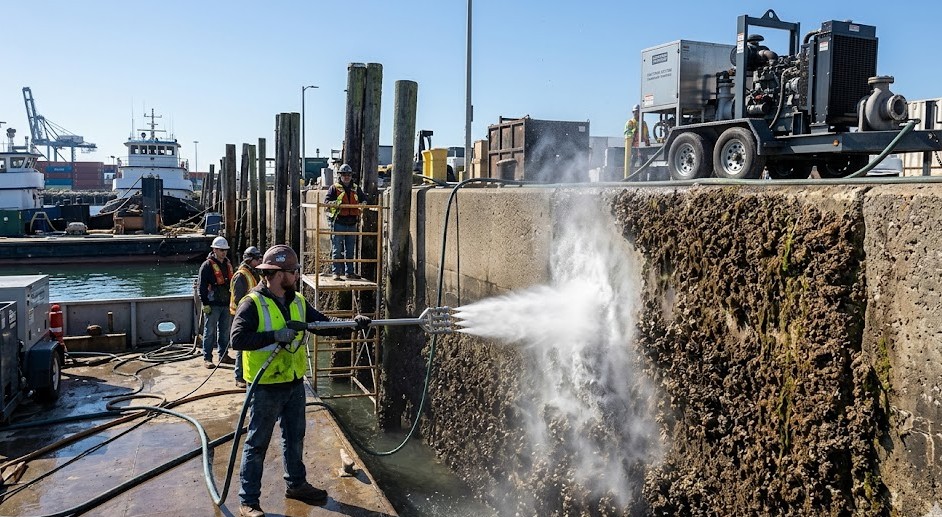
Commercial seawalls play a critical role in protecting waterfront infrastructure, marinas, ports, industrial facilities, and coastal properties from erosion and wave action. However, constant exposure to saltwater creates ideal conditions for marine growth, biofouling, staining, and surface contamination that can accelerate deterioration and complicate inspections.
For decades, sandblasting was considered a standard method for cleaning heavily fouled marine structures. While effective at removing surface buildup, sandblasting often introduces concerns regarding substrate damage, environmental impacts, coating loss, and repair costs.
Today, many marine contractors, engineers, and property managers are turning to cavitation seawall cleaning as a safer and more efficient alternative. By harnessing the energy released by collapsing vapor bubbles, cavitation cleaning systems can remove marine growth while minimizing damage to concrete, coatings, and structural surfaces.
Understanding the differences between these cleaning methods helps facility managers make informed decisions when planning seawall restoration and maintenance projects.
What Is Cavitation Seawall Cleaning?
Cavitation seawall cleaning utilizes controlled cavitation technology to remove marine growth, biofouling, algae, barnacles, and contaminants from submerged and splash-zone surfaces.
The process works by generating microscopic vapor bubbles within water. As these bubbles collapse, they release concentrated energy that disrupts the attachment of marine organisms and deposits.
Unlike abrasive cleaning methods, cavitation relies on hydrodynamic forces rather than physical grinding or blasting media.
This allows operators to remove unwanted growth while preserving the integrity of the underlying structure.
Why Marine Growth Becomes a Problem on Seawalls
Marine environments naturally encourage the accumulation of biological growth.
Common fouling organisms include:
- Barnacles
- Algae
- Mussels
- Tubeworms
- Marine slime
- Biofilm layers
Over time, these organisms can obscure structural defects, accelerate deterioration, increase maintenance requirements, and complicate inspections.
For commercial facilities, excessive growth can also create safety concerns and hinder asset management programs.
Understanding Sandblasting vs Cavitation Marine Cleaning
The debate surrounding sandblasting vs cavitation marine cleaning methods often centers on effectiveness, substrate protection, environmental impact, and long-term maintenance costs.
While both methods can remove marine growth, they do so in fundamentally different ways.
| Feature | Sandblasting | Cavitation Cleaning |
|---|---|---|
| Cleaning Mechanism | Abrasive media impact | Bubble implosion energy |
| Surface Contact | Direct abrasion | Minimal physical contact |
| Coating Preservation | Often removes coatings | Can preserve sound coatings |
| Concrete Surface Impact | Potential erosion | Lower risk when properly controlled |
| Environmental Debris | Higher | Lower |
| Inspection Preparation | Effective | Effective |
For many restoration projects, the ability to clean effectively without unnecessary material removal makes cavitation an attractive option.
How Cavitation Guns Remove Marine Growth
Cavitation cleaning equipment generates localized pressure variations within flowing water.
These pressure changes create vapor-filled bubbles that rapidly collapse near the surface being cleaned.
The resulting energy helps:
- Break adhesion bonds
- Remove biofilms
- Dislodge barnacles
- Lift algae deposits
- Clean irregular surfaces
Because the cleaning action occurs at a microscopic level, cavitation can target growth without relying on aggressive abrasive contact.
The NASA Glenn Research Center and fluid dynamics researchers have extensively documented the forces generated by cavitation phenomena in liquids.
The Advantages of Non Destructive Seawall Washing
One of the most significant benefits of cavitation technology is its role in non destructive seawall washing.
Commercial seawalls often contain:
- Reinforced concrete
- Protective coatings
- Repair materials
- Structural overlays
- Specialized marine finishes
Excessive abrasion can damage these surfaces and create additional maintenance expenses.
By minimizing physical wear, cavitation cleaning supports preservation-focused maintenance strategies.
Why Commercial Seawall Growth Removal Requires Precision
Not all marine growth removal projects are the same.
Commercial facilities frequently require cleaning methods that balance effectiveness with asset protection.
Effective commercial seawall growth removal often serves several purposes:
- Preparing for inspections
- Supporting engineering assessments
- Improving appearance
- Reducing biological accumulation
- Maintaining waterfront infrastructure
When cleaning methods damage structural surfaces, the resulting repairs can outweigh the benefits of the cleaning process itself.
How Cavitation Supports Structural Inspections
Marine growth can conceal critical structural issues.
Engineers and inspectors often need clear visibility to evaluate:
- Concrete cracking
- Spalling
- Exposed reinforcement
- Surface deterioration
- Joint conditions
- Previous repairs
Proper cavitation seawall cleaning helps expose these areas while preserving the evidence inspectors need to assess structural condition accurately.
Environmental Considerations in Marine Cleaning
Environmental stewardship has become increasingly important in marine infrastructure maintenance.
Many property owners seek cleaning methods that reduce unnecessary debris generation and substrate disturbance.
The U.S. Environmental Protection Agency (EPA) emphasizes the importance of minimizing environmental impacts during maintenance activities in sensitive aquatic environments.
Cavitation systems can help support these goals by reducing reliance on abrasive blasting materials.
Applications Beyond Seawalls
Although widely used for seawall maintenance, cavitation cleaning technology is also applied to:
- Dock structures
- Pier supports
- Bridge pilings
- Marina infrastructure
- Bulkheads
- Waterfront retaining walls
Its versatility makes it valuable across a broad range of marine maintenance applications.
Common Misconceptions About Cavitation Cleaning
It Is Simply High-Pressure Washing
Cavitation cleaning relies on vapor bubble collapse rather than pressure alone, making it fundamentally different from conventional washing systems.
Sandblasting Always Cleans Better
While sandblasting can be highly effective, it often removes material along with contaminants. Cavitation focuses on detaching growth while preserving surfaces.
It Only Works on Light Fouling
Modern cavitation systems are capable of addressing substantial marine growth when operated correctly.
It Eliminates the Need for Maintenance
No cleaning method replaces routine inspections and preventive maintenance programs.
Comparing Long-Term Costs
Maintenance decisions should consider both immediate cleaning results and long-term asset preservation.
| Cost Factor | Sandblasting | Cavitation Cleaning |
|---|---|---|
| Surface Repair Risk | Higher | Lower |
| Coating Replacement | More likely | Less likely |
| Cleaning Effectiveness | High | High |
| Asset Preservation | Variable | Strong advantage |
| Inspection Readiness | Excellent | Excellent |
For many facility managers, preserving structural assets is just as important as achieving immediate cleaning results.
Best Practices for Seawall Maintenance
Regardless of the cleaning method selected, proactive maintenance remains essential.
- Schedule regular inspections
- Remove marine growth before it becomes excessive
- Monitor concrete condition
- Address cracks promptly
- Evaluate coating performance
- Document maintenance activities
Preventive maintenance often reduces lifecycle costs and extends structural service life.
Frequently Asked Questions
What is cavitation seawall cleaning?
Cavitation seawall cleaning uses controlled vapor bubble collapse to remove marine growth and contaminants from seawall surfaces without relying on abrasive blasting media.
How does sandblasting vs cavitation marine cleaning compare?
Sandblasting removes growth through abrasive impact, while cavitation cleaning uses hydrodynamic energy from collapsing bubbles. Cavitation generally offers greater surface preservation.
Is cavitation considered non destructive seawall washing?
When properly performed, cavitation cleaning is widely regarded as a non destructive seawall washing method because it minimizes abrasion to underlying surfaces.
Can cavitation remove heavy marine growth?
Yes. Modern cavitation systems are capable of removing a wide range of biofouling, including algae, barnacles, and slime accumulations.
Why is commercial seawall growth removal important?
Growth removal improves inspections, supports maintenance planning, enhances appearance, and helps identify structural issues that may otherwise remain hidden.
Does cavitation cleaning damage concrete?
Properly controlled cavitation cleaning is designed to remove growth while minimizing damage to concrete, coatings, and other structural surfaces.
Conclusion
As waterfront infrastructure ages and maintenance priorities evolve, many property owners are reevaluating traditional cleaning methods. Cavitation seawall cleaning offers a compelling alternative to abrasive blasting by delivering effective marine growth removal while supporting long-term asset preservation.
When comparing sandblasting vs cavitation marine cleaning approaches, the ability to perform non destructive seawall washing often becomes a decisive advantage. For organizations focused on protecting valuable infrastructure, improving inspection access, and reducing unnecessary surface damage, cavitation technology has become an increasingly preferred solution for commercial seawall growth removal.
Schedule Professional Seawall Cleaning and Inspection Services
If your seawall, dock system, marina, or waterfront structure is affected by marine growth, professional cavitation cleaning can help restore visibility and support long-term maintenance goals. Contact an experienced marine infrastructure specialist today to schedule a seawall inspection and learn how advanced cavitation cleaning technology can help protect your waterfront investment.
