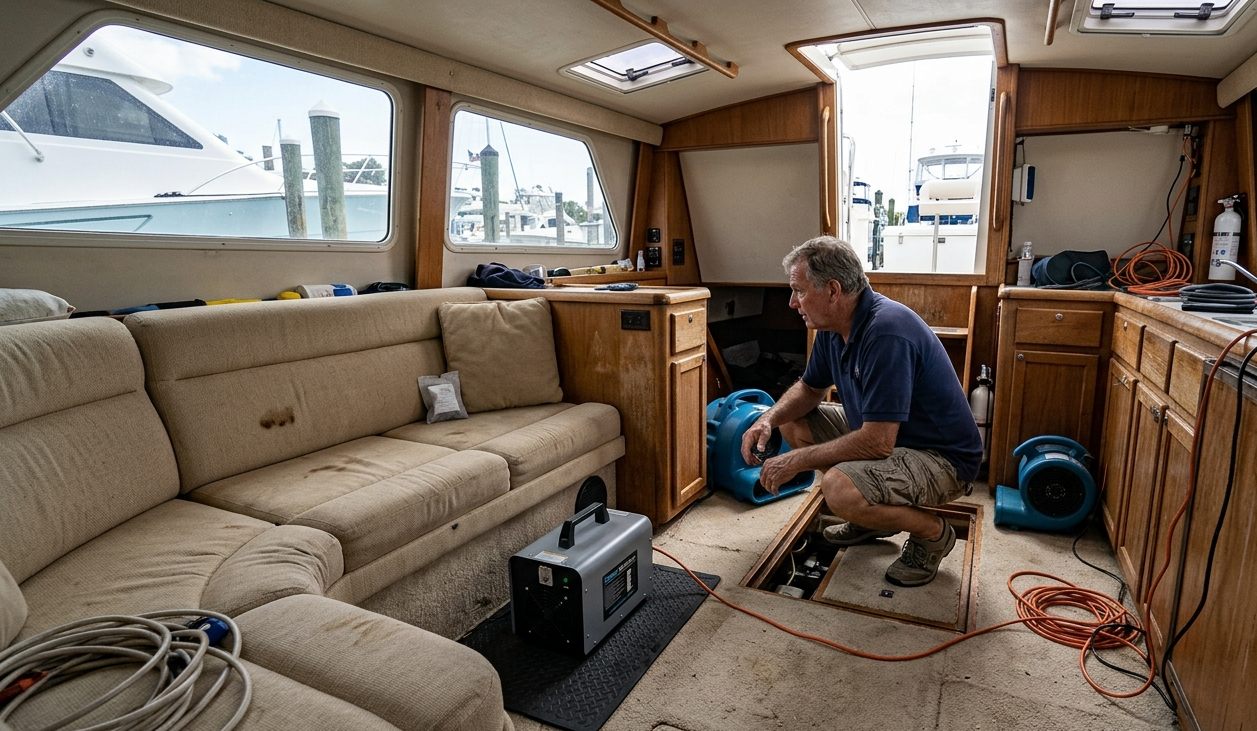
A stubborn smell inside a boat cabin can be surprisingly difficult to eliminate. You clean the upholstery, open the hatches, run the air conditioning, and maybe even replace the cabin filters—yet the mildew smell boat owners know so well can return as soon as the cabin is closed again. Odors can come from damp fabrics, stagnant bilge areas, waste systems, food residue, mold, or other hidden sources.
Boat cabin odor removal sometimes includes ozone treatment as part of a controlled, unoccupied-space deodorizing process. However, ozone is not a substitute for finding and removing the source of the odor. The U.S. Environmental Protection Agency (EPA) specifically warns that ozone generators should not be used in occupied spaces and that ozone at concentrations within public-health standards is generally ineffective at controlling indoor air pollution. EPA guidance on ozone generators should be reviewed before any treatment is planned. :chatgpt-content-reference{index=”0″}
What Is Ozone Treatment for Boat Cabin Odor Removal?
Ozone treatment is a controlled deodorizing process in which ozone gas is introduced into an unoccupied enclosed space to react with certain odor-producing compounds. On a boat, this can be considered after the underlying source has been identified and addressed, but it must be performed with strict controls because ozone is a respiratory irritant and can damage certain materials at elevated concentrations.
Unlike simply spraying a fragrance, ozone treatment is intended to chemically react with some odor-causing substances. The treatment area must be unoccupied, isolated from people and pets, and properly ventilated before anyone re-enters the vessel.
Why Do Boat Cabins Develop Persistent Odors?
Marine interiors create a combination of conditions that can make odor problems persistent. Humidity, condensation, limited airflow, wet gear, upholstery, bilge water, and closed compartments can all contribute.
Common odor sources include:
- Damp cushions, mattresses, carpets, and upholstery
- Mildew and moisture-damaged materials
- Standing water or residue in bilges
- Holding-tank and marine sanitation system odors
- Wet clothing, towels, and equipment
- Food residue and organic debris
- Dirty air-conditioning components or filters
- Water intrusion around hatches, windows, or fittings
- Contaminated or poorly ventilated storage compartments
A strong musty smell should not simply be covered with an air freshener. The EPA notes that a moldy odor can indicate mold growth and recommends investigating the moisture source rather than treating the smell alone. :chatgpt-content-reference{index=”1″}
Can Ozone Eliminate a Mildew Smell on a Boat?
Ozone may react with some odor-producing compounds, but it should not be treated as a universal mildew or mold cure. The EPA states that ozone at concentrations that do not exceed public-health standards is generally ineffective at controlling indoor air pollution and that ozone should not be used in occupied spaces. Mold and moisture problems require source control and cleaning rather than relying on ozone alone. :chatgpt-content-reference{index=”2″}
For a boat with a recurring mildew smell, the practical sequence is usually:
- Find the moisture or contamination source.
- Remove standing water and contaminated materials where appropriate.
- Clean affected surfaces.
- Dry the interior thoroughly.
- Improve ventilation and moisture control.
- Consider controlled deodorization only after the source has been addressed.
Boat Cabin Odor Removal Should Start at the Source
We have seen plenty of boats where the cabin itself was not really the problem. The smell was being produced somewhere else and migrating through the vessel.
Check the Bilge
A dirty bilge can produce a persistent organic or sewage-like odor that moves into living spaces through openings, hatches, and ventilation paths. If the smell becomes stronger when the bilge pump cycles or when the boat heats up, investigate below the cabin before treating the cabin air.
Professional underwater inspection can also be useful when an unusual bilge-water problem may be associated with an underwater component or suspected leak.
Inspect the Head and Sanitation System
A boat head smell can come from sanitation hoses, holding tanks, vents, seals, stagnant water, or improper maintenance. Ozone treatment will not repair a leaking sanitation hose or solve an improperly functioning system.
If the odor returns quickly after deodorization, treat that recurrence as a diagnostic clue rather than simply repeating the deodorizing treatment.
Look for Hidden Moisture
Cabinets, berth compartments, under-mattress areas, carpet edges, and enclosed storage spaces can remain damp long after a visible spill has disappeared.
Moisture control is central to mold prevention. The EPA recommends drying water-damaged areas and materials quickly and addressing the underlying source of moisture. :chatgpt-content-reference{index=”3″}
How a Controlled Marine Ozone Treatment Works
A professional marine ozone treatment should begin with preparation rather than immediately switching on an ozone generator.
1. Inspect and Prepare the Cabin
Identify the odor source, remove obvious contamination, clean accessible surfaces, and address moisture. Any materials that need replacement should be dealt with before deodorization.
2. Remove People and Pets
Ozone treatment must never be performed while people or pets are inside the treatment area. EPA guidance specifically states that ozone generators should not be used in occupied spaces. :chatgpt-content-reference{index=”4″}
3. Isolate the Treatment Area
Cabin doors, hatches, vents, and other openings should be managed according to the treatment plan so ozone does not migrate into occupied areas. On a vessel, this requires more thought than treating a simple empty room because cabins, lockers, engine spaces, heads, and ventilation systems can be interconnected.
4. Perform the Controlled Treatment
The generator is operated only according to a professionally established treatment procedure. The duration and ozone concentration should be controlled rather than guessed from cabin size alone.
EPA research notes that ozone concentrations depend on multiple factors, including generator output, space size, ventilation, furnishings, and materials that react with ozone. :chatgpt-content-reference{index=”5″}
5. Ventilate and Verify Before Re-Entry
After treatment, the space must be properly ventilated and confirmed safe before people return. The smell of ozone itself should never be used as the only indication that the space is safe; EPA notes that a person’s ability to detect ozone by smell varies and can diminish during exposure. :chatgpt-content-reference{index=”6″}
Marine Ozone Treatment Requires Material Awareness
Boats contain many materials that are sensitive to harsh environmental conditions. Rubber components, wire coatings, fabrics, elastomers, finishes, and other materials can be affected by ozone, particularly with repeated or high-concentration exposure.
EPA documentation warns that ozone can damage materials such as rubber, electrical wire coatings, fabrics, and certain dyes and pigments. :chatgpt-content-reference{index=”7″}
That is one reason we do not recommend treating ozone as a routine substitute for cleaning and ventilation. A vessel is not an empty concrete room. It is a complex environment filled with cushions, wiring, seals, electronics, wood finishes, plastics, and other materials.
Ozone Treatment vs. Conventional Boat Cleaning
| Approach | Primary Purpose |
|---|---|
| Source removal | Eliminate the actual cause of the odor |
| Cleaning | Remove dirt, residue, biological contamination, and odor sources from surfaces |
| Ventilation | Exchange stale interior air and reduce accumulated odors |
| Moisture control | Reduce conditions that support recurring mildew and mold growth |
| Ozone treatment | Controlled deodorization of an unoccupied space after source-control measures |
The most reliable approach is usually a combination of source control, cleaning, drying, and ventilation. EPA guidance likewise emphasizes source control and ventilation rather than relying on air cleaning alone. :chatgpt-content-reference{index=”8″}
Can Ozone Remove Bilge Odor?
Ozone may help reduce some residual odors after the source has been corrected, but it should not be used to disguise a contaminated or malfunctioning bilge. A persistent bilge odor deserves investigation.
Check for standing water, oil or fuel contamination, organic debris, sanitation-system leaks, damaged hoses, and poor drainage. Depending on the vessel, professional boat wash and detailing services can address the cleanable surfaces while mechanical or marine-system issues are handled separately.
What About Yacht Interior Deodorizing?
Yacht interior deodorizing works best when the interior is treated as a system rather than a collection of individual smells.
For example, imagine a yacht that has been closed for several weeks. The owner returns and immediately notices a musty cabin. Spraying fragrance may make the cabin smell different, but it does not tell you why the odor developed.
A better inspection starts with the cushions, bilges, heads, ventilation, air-conditioning system, storage lockers, refrigeration areas, and any locations where moisture may have accumulated. Once the source is corrected, controlled deodorization can be considered for residual odors.
Common Mistakes With Marine Ozone Treatments
- Running ozone while people are aboard: This is unsafe and directly contrary to EPA guidance.
- Using ozone instead of fixing leaks: A leaking hose or wet compartment will continue producing odors.
- Treating mold without addressing moisture: Odor reduction does not solve the moisture problem.
- Assuming more ozone is better: Higher concentrations increase exposure and material risks.
- Using smell as a safety test: Human odor detection is not a reliable measure of ozone concentration. :chatgpt-content-reference{index=”9″}
- Repeating treatments without diagnosis: A returning odor often means the original source remains.
DIY vs. Professional Marine Ozone Treatment
Ozone generators are widely available, but availability does not make them appropriate for casual use aboard a boat. The treatment involves an intentionally generated respiratory irritant, an enclosed environment, multiple interconnected compartments, and materials that may react with ozone.
Professional service is particularly useful when the odor is severe, the source is uncertain, the vessel contains extensive soft furnishings, or the treatment area connects to other occupied spaces.
A professional can also separate deodorization from maintenance issues. If the smell comes from marine growth, for example, the appropriate response may involve cleaning rather than simply treating the cabin air.
For underwater fouling and related maintenance, services such as cavitation cleaning can help address certain hard-to-reach marine surfaces without relying on harsh conventional cleaning methods.
When Should You Consider Boat Cabin Odor Removal?
Consider professional evaluation when:
- A musty or mildew smell returns after normal cleaning.
- A boat has been closed for an extended period.
- There has been water intrusion or flooding.
- A persistent bilge odor enters the cabin.
- A head or sanitation odor remains after routine maintenance.
- Soft furnishings have absorbed smoke or other persistent odors.
- A recently cleaned cabin still smells stale or damp.
If the odor is accompanied by visible mold, significant water damage, sewage contamination, or suspected fuel contamination, the priority should be identifying and correcting the underlying condition rather than simply deodorizing the space.
FAQs About Boat Cabin Odor Removal
Does ozone completely eliminate boat cabin odors?
Ozone may react with some odor-producing compounds, but it is not a universal odor remover. Persistent smells usually require source control, cleaning, moisture management, and ventilation. EPA guidance states that ozone at concentrations within public-health standards is generally ineffective for controlling indoor air pollution. :chatgpt-content-reference{index=”10″}
Is it safe to use an ozone generator inside an occupied boat?
No. The EPA advises against using ozone generators in occupied spaces because ozone is a lung irritant. People and pets should be kept out of the treatment area, and the space must be properly ventilated and made safe before re-entry. :chatgpt-content-reference{index=”11″}
Can ozone remove a mildew smell boat owners notice after storage?
Ozone may help with some residual odors after the underlying moisture and contamination problems have been addressed. A recurring mildew smell should first trigger an inspection for moisture, mold, wet fabrics, leaks, and poorly ventilated compartments.
Will ozone eliminate a boat head smell?
Ozone should not be used as a substitute for repairing a sanitation problem. Persistent head odors can originate from holding tanks, hoses, vents, seals, stagnant water, or other components. Identify and correct the source before considering deodorization.
Can ozone damage boat interiors?
Yes. EPA information notes that ozone can damage certain materials, including rubber, electrical wire coatings, fabrics, and susceptible dyes and pigments. Repeated or high-concentration exposure can therefore be a concern in a marine interior. :chatgpt-content-reference{index=”12″}
What is the best approach to eliminate bilge odor?
Start by identifying the source of the odor and cleaning the affected area. Inspect standing water, organic residue, sanitation-system components, hoses, drainage, and possible contamination. Deodorization should be considered only after the underlying problem has been addressed.
Read More: Explore more practical marine maintenance guidance and underwater service insights in our marine industry articles and stories.
Conclusion
Boat cabin odor removal is most effective when you treat the cause, not just the smell. Ozone can be part of a controlled deodorization strategy for an unoccupied marine interior, but it should never replace cleaning, moisture control, ventilation, or repairs. EPA guidance makes clear that ozone generators should not be used in occupied spaces and that ozone can create health and material risks when improperly controlled. :chatgpt-content-reference{index=”13″}
For a boat that continually smells musty, like a bilge, or like a marine head, start with a proper inspection. Once the source is corrected, professional deodorization can be considered as a finishing step rather than a temporary cover-up.
Ready to protect your vessel?
If you need expert help with this, our team of certified divers and marine technicians is ready to step in. Learn more about our specific services here.
Prefer to speak with an expert immediately? Contact us today to schedule a service or get a free quote!
