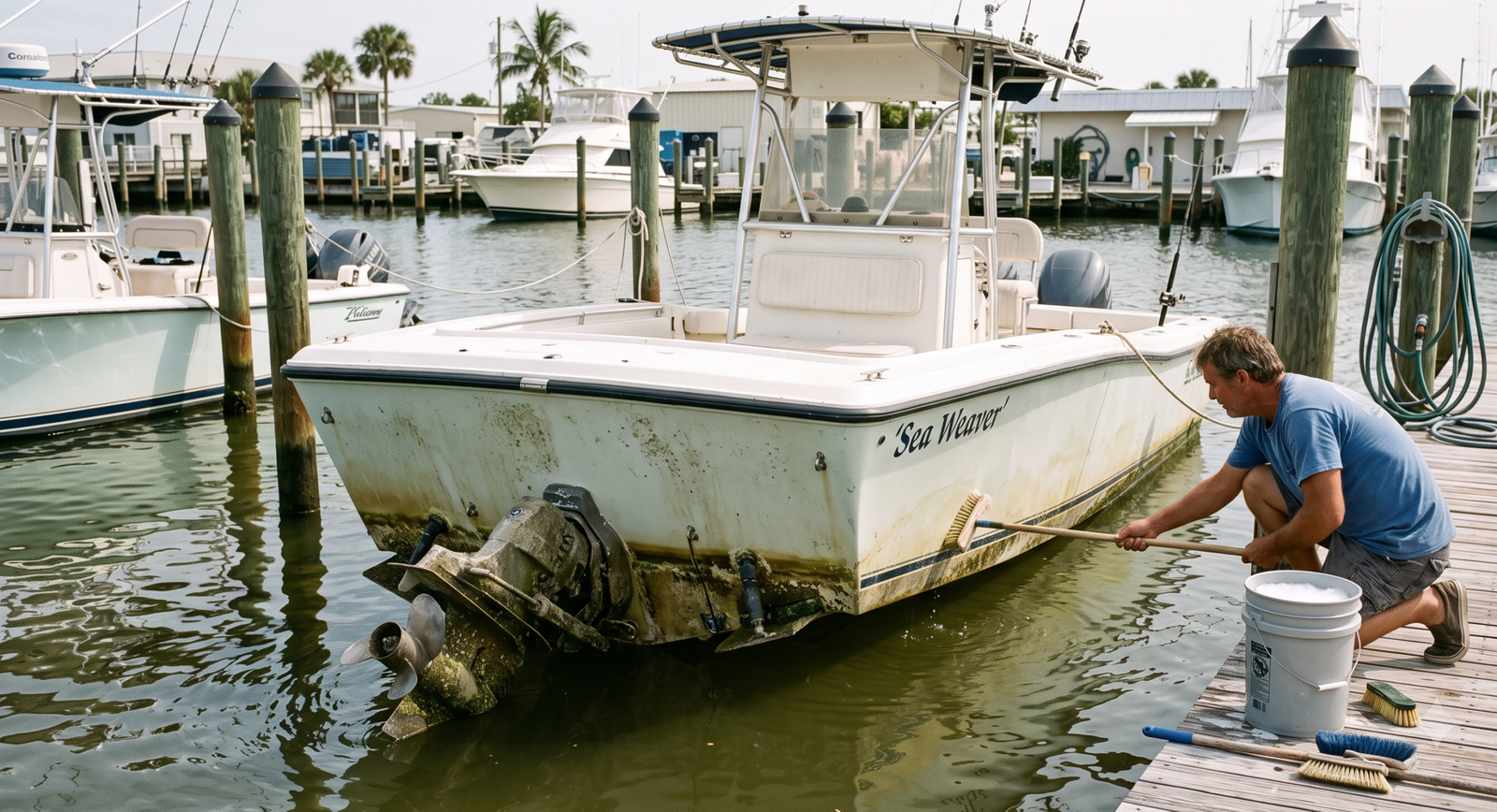
Florida boat owners are used to seeing some growth on an underwater hull. A thin film of slime after sitting in a warm marina is normal. But after an intense algae event, that familiar green or brown coating can become noticeably heavier, especially when a vessel remains stationary for days or weeks. Understanding red tide hull fouling helps owners separate ordinary marine growth from conditions that call for more careful cleaning and inspection.
Along Florida’s coast, harmful algal blooms can change the water around a boat without necessarily looking dramatic from the dock. The effects on a hull are often less obvious than a thick layer of barnacles, but accumulated organic material, algae, and other fouling can still affect the underwater surface and make routine maintenance more difficult.
What Is Red Tide Hull Fouling?
Red tide hull fouling is the accumulation of algae, organic material, slime, and other biological growth on a boat’s underwater surfaces during or following periods of elevated algal activity. The bloom itself is not simply a layer of algae that sticks to the hull, but bloom conditions can contribute to increased organic material and fouling that settles or grows on submerged surfaces.
Florida’s best-known red tide organism is Karenia brevis. Red tide is a type of harmful algal bloom, and the term does not mean that every affected area will literally have red-colored water. Conditions can vary significantly between locations and over time.
For boat owners, that distinction matters. A dirty hull after a bloom does not automatically mean the hull is coated in red tide itself. The visible material may instead consist of ordinary algae, bacterial slime, suspended organic matter, and other marine growth that developed under favorable conditions.
How Florida Algal Blooms Can Affect a Boat Hull
Florida algal blooms can contribute to heavier organic fouling on submerged surfaces, particularly when warm water, sunlight, nutrients, and limited vessel movement create favorable conditions for biological growth. The effect varies by location, bloom conditions, water circulation, vessel type, and how long the boat remains in the water.
A stationary yacht sitting at a dock is more vulnerable to localized accumulation than a vessel that regularly operates at speed. A hull that already has a rough or damaged coating can also provide more places for biological material to remain attached.
Slime Can Develop Before Hard Growth
One of the first things an owner may notice is not a barnacle or shell but a slippery film on the underwater surface. This biological layer can collect dirt and additional organisms, gradually changing the texture of the hull.
That is why hull slime removal should not always wait until the bottom looks severely fouled. Early maintenance can be much easier than trying to restore a heavily contaminated surface later.
Red Tide Is Not the Same as Ordinary Hull Algae
It is easy to use “red tide” as a general term for any unusual algae in Florida water, but that can create confusion.
Florida’s red tide is associated primarily with Karenia brevis, while other harmful algal blooms can involve entirely different organisms. Some blooms occur in freshwater, some in estuaries, and some in marine environments. Their biology, appearance, and environmental effects are not identical.
The Florida Fish and Wildlife Conservation Commission’s Red Tide resources provide current information on Florida red tide, monitoring, research, and identification.
This distinction is also useful when discussing maintenance. Seeing green slime on a hull does not allow you to identify the organism responsible. Hull appearance alone is not a reliable way to determine whether a harmful algal bloom is present.
When Algae Removal From a Boat Hull Becomes Necessary
Algae removal from a boat hull becomes worthwhile when biological growth is affecting the hull’s surface, increasing drag, interfering with inspection, or beginning to build into heavier fouling. Removing growth early generally requires less aggressive cleaning than waiting for the accumulation to become extensive.
Look for:
- Green, brown, or dark slime along the underwater hull.
- Visible organic film around waterline areas.
- Growth concentrated around trim tabs, through-hulls, and fittings.
- Increasing resistance or reduced performance.
- Fouling developing after prolonged periods at the dock.
- Growth hiding the condition of the bottom coating.
A professional Hull Cleaning service can remove appropriate biological fouling while allowing the underwater surface to be checked for other developing problems.
Why Hull Fouling Can Affect Boat Performance
Even relatively soft fouling changes the surface that moves through the water. A smooth hull is designed to move through water with a particular resistance profile. Slime and accumulated biological growth make that surface less efficient.
The practical effects depend on the amount and type of fouling, hull design, operating speed, and propulsion system. A high-performance boat may make the change noticeable sooner than a slower displacement vessel.
Owners may notice:
- Lower cruising speed at the same engine load.
- Higher fuel consumption.
- Reduced acceleration.
- More frequent cleaning requirements.
- Visible buildup around running gear.
Heavy growth around propellers, shafts, rudders, or other underwater components can create additional performance problems beyond the hull itself.
Toxic Algae Boat Maintenance Requires Extra Care
Toxic algae boat maintenance should account for the fact that some harmful algal blooms can affect people and marine life. Owners should follow current local health and environmental guidance rather than assuming that cleaning a visibly affected area is an ordinary wash-down job.
Florida’s Karenia brevis produces brevetoxins. During certain blooms, wave action can release toxins into the air, creating respiratory irritation. That makes awareness of current bloom conditions particularly relevant when working around affected coastal water.
The NOAA Red Tide information page explains the connection between harmful algal blooms, toxins, marine life, and potential human health effects.
If conditions are visibly unusual or local authorities have issued warnings, check current guidance before arranging underwater maintenance. Do not assume that a familiar cleaning procedure is appropriate under every environmental condition.
Cleaning the Hull After a Florida Algal Bloom
Once conditions are suitable for maintenance, the cleaning strategy should match the type and severity of fouling.
Start With a Visual Assessment
Before cleaning, identify where the growth is concentrated. Check the hull, waterline, running gear, through-hulls, trim tabs, transducers, and other underwater hardware.
This is also an opportunity to identify problems hidden beneath the fouling. A professional Underwater Inspection can document the condition of the hull and underwater components before cleaning removes the evidence.
Use the Least Aggressive Effective Method
Not every hull needs aggressive scraping or abrasive cleaning. The correct technique depends on the bottom coating and the type of growth.
Soft slime may require a very different approach from established hard growth. Excessive cleaning can damage antifouling coatings, especially when the operator uses the same aggressive technique on every boat.
Pay Attention to the Bottom Coating
Antifouling paint is designed to manage marine growth, but it is not indestructible. Repeated aggressive cleaning can shorten coating life or expose the underlying surface.
If the coating is already thin, peeling, chalking, or damaged, cleaning should be performed with that condition in mind rather than treating the hull as bare fiberglass.
Red Tide and Gulf Coast Boat Maintenance
Florida’s Gulf Coast is particularly familiar with seasonal red tide activity. Conditions can change from one section of coastline to another, so boat owners should not assume that a bloom affecting one harbor automatically represents conditions throughout the region.
The FWC Red Tide Current Status provides current monitoring information for Florida and is a useful resource before planning work in affected coastal areas.
NOAA also provides Gulf Coast harmful algal bloom forecasts that can help operators understand changing bloom conditions.
This is particularly useful for commercial operators and owners who plan regular maintenance visits rather than reacting only after the hull becomes visibly fouled.
Cleaning Beyond the Hull
Algal and organic growth does not necessarily stop at the hull. Running gear and other underwater components can accumulate their own fouling.
Propellers, shafts, rudders, trim tabs, and thruster components should be assessed separately because their shapes and materials require different cleaning considerations.
Where appropriate, professional Cavitation Cleaning can be used to remove certain types of underwater growth while limiting unnecessary mechanical contact with the surface.
If the boat has an unusual amount of growth around protected metal components, an inspection may also reveal anodes or other corrosion-protection components that need attention. Our Zinc Replacement service addresses sacrificial anodes when inspection shows they need replacement.
Common Mistakes With Algal Bloom Hull Fouling
- Assuming every green or brown film is red tide.
- Cleaning underwater during an active bloom without checking local guidance.
- Using aggressive tools on antifouling paint.
- Waiting until soft slime becomes heavy hard fouling.
- Ignoring growth around propellers and other running gear.
- Cleaning without checking for corrosion or coating damage underneath.
- Assuming one cleaning technique is suitable for every hull coating.
- Moving fouling-contaminated equipment without considering environmental requirements.
DIY vs. Professional Hull Cleaning
Light surface contamination can sometimes be managed as part of routine owner maintenance, but underwater cleaning becomes more complicated when the vessel has sensitive coatings, significant fouling, difficult underwater access, or an active inspection requirement.
Professional cleaning is particularly useful when you need the fouling removed while preserving the condition of the bottom coating and documenting what is underneath it.
A professional Boat Wash & Detailing service can also handle the topside portion of a maintenance visit so the vessel receives a more complete cleaning rather than treating the underwater hull in isolation.
Frequently Asked Questions
Does red tide directly stick to boat hulls?
Red tide is a harmful algal bloom involving microscopic organisms in the water, not simply a coating that attaches to a boat. However, bloom conditions can contribute to increased organic material and biological fouling around submerged surfaces. Visible slime on a hull should not be assumed to be Karenia brevis based on appearance alone.
Can red tide cause more hull fouling?
Red tide can coincide with conditions that increase organic material and biological activity around a vessel, but the amount of hull fouling varies by location, water conditions, vessel movement, coating, and exposure time. A visible buildup after a bloom is not proof that the bloom itself directly caused every layer of fouling.
Should I clean my boat during a red tide event?
Check current local health and environmental guidance before arranging underwater work during an active bloom. Florida red tide can produce brevetoxins, and exposure risks can change with bloom concentration, location, and water movement. Routine maintenance should be scheduled with current conditions in mind.
How do I remove algae from my boat hull?
Use a cleaning method appropriate for the hull material and bottom coating, starting with the least aggressive method that will remove the existing growth. Avoid treating every hull the same way. Heavy fouling or sensitive coatings are better handled by technicians who can clean the surface while monitoring the condition underneath.
Can hull slime reduce boat speed?
Yes. Biological slime changes the surface texture of the hull and can increase resistance through the water. The effect varies with the amount of fouling and the boat’s design, but keeping the underwater surface reasonably clean can help preserve expected performance and fuel efficiency.
Conclusion
Red tide hull fouling is best understood as part of the broader biological fouling problem that Florida boat owners face during warm-water and bloom conditions. Red tide itself should not be confused with ordinary algae growing on a hull, but periods of elevated biological activity can make underwater maintenance more demanding. Monitor local conditions, inspect the hull before cleaning, use a method suited to the bottom coating, and remove growth before a thin layer of slime becomes a larger performance and maintenance problem.
For more practical information about vessel maintenance, underwater cleaning, and Florida marine services, explore our blog and marine resources.
Ready to protect your vessel?
If you need expert help with this, our team of certified divers and marine technicians is ready to step in. Learn more about our specific services here.
Prefer to speak with an expert immediately? Contact us today to schedule a service or get a free quote!
