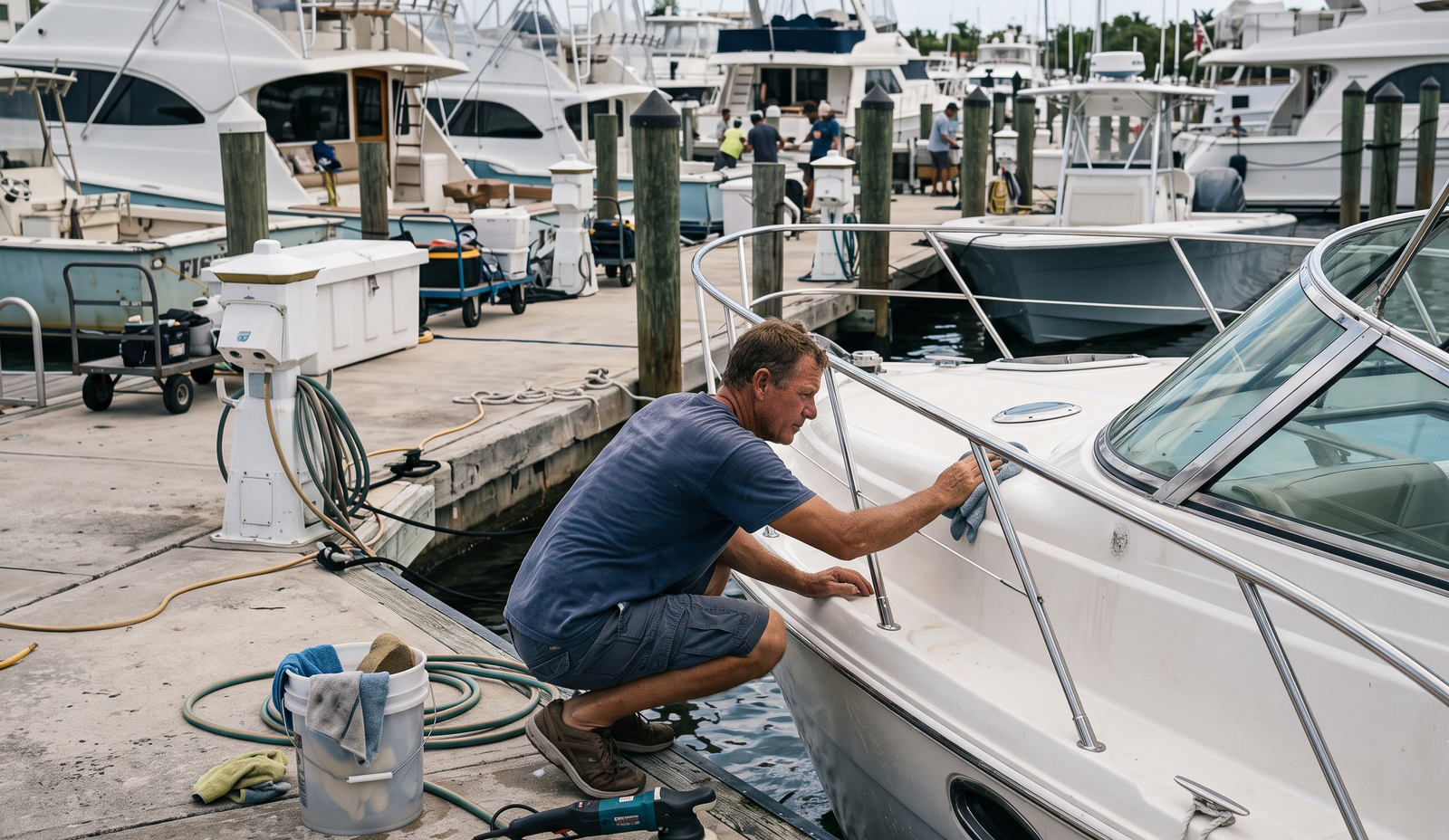
Before the Fort Lauderdale International Boat Show opens its gates, boats throughout South Florida are being moved, washed, polished, staged, and inspected. For owners, brokers, dealers, and yacht-management teams, the final days before the show can be hectic. A vessel that looked clean at the marina can quickly pick up dock dust, fingerprints, salt residue, water spots, and traffic-related grime.
That is why boat show detailing preparation should begin before the final walk-through. A professional mobile detailing team can prepare the vessel where it is located, reducing unnecessary movement and helping the crew focus on the details that visitors and prospective buyers will actually notice.
Whether the vessel is being displayed, sold, chartered, or simply presented to guests, proper preparation should cover the exterior, interior, brightwork, glass, stainless steel, seating, decks, and high-contact areas.
What Is Boat Show Detailing Preparation?
Boat show detailing preparation is the process of cleaning, polishing, protecting, and presenting a vessel so it is ready for inspection and display at a major marine event. The work goes beyond a routine wash because the objective is to create a consistently clean, professional appearance across every area that prospective buyers, guests, brokers, and show visitors may see.
For a major event such as the Fort Lauderdale International Boat Show, preparation also has to account for timing. Multiple boats may be arriving at the same time, docks can become busy, and crews may have limited access to the vessel during setup.
Why FLIBS Yacht Prep Should Start Early
One of the easiest mistakes is leaving detailing until the last possible day.
A yacht may require more work than expected once the first detailed inspection begins. Salt deposits can be heavier than anticipated. Stainless steel may have water spots. Cushions may show stains. Teak may need attention. Glass may have mineral deposits. The hull may have accumulated grime during transit.
Starting early gives the detailing team time to identify problem areas instead of rushing through them immediately before visitors arrive.
A practical preparation schedule can separate major restoration or cleaning work from the final presentation touch-up.
What Should Be Included in Marine Event Detailing?
Exterior Wash and Salt Removal
Salt is one of the first things to address on a boat arriving for an event.
Even a relatively clean yacht can develop visible salt residue around railings, windows, deck hardware, cleats, hatches, and other exposed surfaces.
A thorough wash should remove loose dirt and salt before polishing or applying protective products. This prevents surface contaminants from being dragged across the finish during subsequent detailing.
Our boat wash and detailing services can help prepare vessels for a clean, polished presentation before a major marine event.
Hull Presentation
The hull is often the first large surface a visitor sees.
Waterline staining, scum, algae, and marine growth can make an otherwise well-maintained boat look neglected.
For vessels remaining in the water, underwater maintenance may also be necessary. Our South Florida hull cleaning service can address compatible underwater fouling so the waterline and underwater hull are presented appropriately.
High-Gloss Boat Polish
A high-gloss finish is not created simply by applying more polish.
The surface needs to be properly cleaned and prepared first. Oxidation, staining, light surface imperfections, and accumulated contaminants can affect the final appearance.
The best high gloss boat polish result comes from matching the preparation process to the condition of the existing finish.
On newer finishes, a maintenance polish may be sufficient. Older or oxidized surfaces may require more extensive correction before protection is applied.
Glass and Windows
Clean glass makes a major difference during a boat show.
Visitors naturally look through salon windows, helm glass, doors, and exterior glazing. Water spots and fingerprints become especially noticeable under bright Florida sunlight.
Glass should be cleaned without leaving streaks, residue, or lint. Edges and corners also deserve attention because these areas commonly collect dirt that is visible when the vessel is viewed up close.
Stainless Steel and Metalwork
Railings, cleats, handrails, fixtures, and other stainless-steel components can quickly collect salt and water spots.
They should be cleaned carefully rather than simply covered with a heavy product designed to make the surface temporarily shiny.
Clean stainless steel should look naturally maintained, not greasy or artificially coated.
Broker Boat Cleaning: Why Small Details Matter
A broker preparing a yacht for potential buyers has a different challenge from someone preparing a personal boat for a weekend.
Prospective buyers tend to look closely at areas that owners sometimes overlook. They may open storage compartments, examine hardware, inspect the helm, look behind seating, check the engine-room entrance, and run their hands along surfaces.
That means broker boat cleaning should include more than the obvious exterior surfaces.
High-contact and high-visibility areas include:
- Helm stations.
- Cabin doors.
- Grab rails.
- Cabinet handles.
- Stainless-steel fixtures.
- Glass doors.
- Exterior seating.
- Swim platforms.
- Boarding areas.
- Tables and countertops.
- Engine-room access areas.
A yacht can be mechanically excellent and still make a poor first impression if these areas are dirty or neglected.
Boat Show Display Prep for Different Types of Boats
Not every boat requires the same detailing strategy.
Superyachts and Large Motor Yachts
Larger yachts have more surface area and more guest-facing spaces. Preparation can involve multiple decks, exterior seating areas, stainless-steel rails, glass panels, tender areas, swim platforms, and interior spaces.
Because the scale is larger, detailing should be planned rather than treated as one giant last-minute cleaning job.
Sportfishing Boats
Sportfishing vessels can require special attention around cockpit areas, fighting chairs, fish boxes, tackle stations, rod holders, and deck hardware.
These boats often accumulate salt, fish residue, bait residue, and grime in areas that are not obvious from the dock.
Center Consoles and Smaller Boats
Smaller boats have fewer square feet, but that does not make presentation less important.
On a compact vessel, visitors are close to virtually every surface. Fingerprints, dirty upholstery, water spots, and stained non-skid can therefore be highly visible.
Preparing the Interior for FLIBS
The exterior may attract visitors, but the interior often determines whether they stay interested.
Cabins, heads, galleys, salons, and sleeping areas should feel clean, fresh, and properly maintained.
Attention should be given to:
- Upholstery.
- Carpets and flooring.
- Cabinetry.
- Countertops.
- Stainless-steel fixtures.
- Mirrors.
- Windows.
- Heads and shower areas.
- Door handles.
- Storage compartments.
The objective is not to make a boat look artificially new. It is to present the vessel in the clean, well-maintained condition that a serious buyer or guest expects.
Do Not Forget the Underwater Areas
Boat show display preparation is mostly associated with visible surfaces, but an underwater inspection can be equally useful when a yacht has remained in the water.
Marine growth around the waterline, propellers, rudders, shafts, thrusters, and intake grates can become noticeable to surveyors and knowledgeable buyers.
Our underwater inspection service can help document the vessel’s underwater condition before the event.
For heavy compatible marine growth, cavitation cleaning can be considered where appropriate.
Underwater anodes should also be checked. If sacrificial anodes are significantly depleted, our zinc and anode replacement service can address the issue before the boat is presented to prospective buyers or guests.
How to Build a Boat Show Detailing Checklist
A good boat show detailing checklist divides the vessel into exterior, interior, underwater, and final-touch-up areas so nothing is missed during the rush before opening day.
- Wash exterior surfaces.
- Remove salt and water spots.
- Clean and polish stainless steel.
- Clean exterior glass.
- Inspect hull finish.
- Address oxidation where required.
- Clean decks and non-skid surfaces.
- Clean exterior seating.
- Detail helm and controls.
- Clean salon and cabins.
- Detail heads and galley areas.
- Inspect waterline and underwater surfaces.
- Check propellers, shafts, rudders, and thrusters where accessible.
- Inspect anodes.
- Complete a final fingerprint and dust check before visitors arrive.
Mobile Detailing vs. Taking the Boat to a Shop
For a boat participating in a major event, moving the vessel solely for detailing may create unnecessary scheduling complications.
Mobile marine detailing allows the work to be performed at the vessel’s current location, which can reduce unnecessary movement and make it easier to coordinate preparation around the owner’s or broker’s schedule.
This can be particularly useful when several boats are being prepared at different marinas or when a yacht is already positioned close to its event berth.
The approach is also useful for final touch-ups. After a boat has been moved, walked through, and handled by crew, brokers, and vendors, a mobile team can return for a final presentation clean.
Common Boat Show Detailing Mistakes
- Waiting until the night before opening day.
- Focusing only on the hull and ignoring the interior.
- Polishing surfaces before removing salt and dirt.
- Leaving fingerprints on glass and stainless steel.
- Ignoring waterline staining.
- Forgetting swim platforms and boarding areas.
- Overlooking storage compartments.
- Using excessive dressing products that leave surfaces greasy.
- Ignoring underwater running gear.
- Failing to schedule a final touch-up after the vessel arrives at the show.
When Should You Schedule FLIBS Yacht Prep?
Major restoration work should be scheduled well before the event.
Cleaning, polishing, stain removal, upholstery work, oxidation correction, and other labor-intensive tasks should not compete with final setup during the last few hours before visitors arrive.
The final day should be about presentation, not discovering major cleaning problems.
A useful approach is to schedule the major detailing first, followed by a final inspection and touch-up immediately before the boat is opened to visitors.
How to Make a Yacht Look Naturally Well Maintained
There is a difference between clean and over-detailed.
A boat prepared for a professional marine event should look cared for, not covered in layers of glossy dressing.
Non-skid decks should remain practical. Stainless steel should look clean rather than oily. Upholstery should look fresh rather than artificially saturated with product. Glass should be clear rather than streaked with cleaner.
Good detailing is often most successful when visitors notice the yacht rather than the products used to clean it.
Frequently Asked Questions
What is boat show detailing preparation?
Boat show detailing preparation is the cleaning, polishing, protection, and presentation work performed before a vessel is displayed at a marine event. It typically includes exterior washing, glass cleaning, stainless-steel care, hull presentation, interior detailing, upholstery, decks, high-contact surfaces, and final touch-ups.
How early should I prepare my boat for FLIBS?
Major detailing should be completed before the final setup period, with a final cleaning and touch-up scheduled close to opening day. The earlier work begins, the more time there is to address oxidation, staining, upholstery problems, water spots, or other issues discovered during the initial inspection.
What does broker boat cleaning include?
Broker boat cleaning focuses on the areas prospective buyers are likely to inspect closely. Along with exterior and interior cleaning, this can include glass, stainless steel, helm areas, seating, cabinets, handles, boarding areas, storage spaces, heads, galley surfaces, and other high-contact areas.
Can mobile detailing be done at a marina?
Yes, mobile marine detailing can be performed at many marina locations when site rules, access, water use, and environmental requirements permit it. Working at the vessel’s location can make it easier to coordinate preparation without moving the boat solely for detailing.
Does boat detailing include underwater cleaning?
Standard topside detailing and underwater maintenance are separate services, but they can be coordinated as part of a complete boat-show preparation plan. Hull fouling, waterline staining, propellers, shafts, rudders, thrusters, and anodes may require specialized underwater inspection or cleaning.
How do I get a high-gloss finish before a boat show?
A high-gloss finish starts with proper surface preparation, not simply adding more polish. The existing finish should be cleaned and assessed for oxidation, staining, and surface defects before the appropriate polishing and protection process is selected.
For more practical advice on maintaining a professional-looking vessel, read more marine maintenance and detailing insights.
Conclusion
Boat show detailing preparation is about much more than making a yacht shiny for opening day. It is about presenting the vessel as a complete, well-maintained asset from the hull and waterline to the salon, helm, glass, stainless steel, decks, and guest areas.
For FLIBS yacht prep, starting early gives owners, brokers, and crews enough time to correct problems instead of hiding them with last-minute cleaning. Mobile detailing can make that process easier by bringing professional cleaning and presentation services directly to the vessel.
Whether you are preparing a superyacht, brokerage boat, sportfisher, center console, or another vessel for a major marine event, the best result is a boat that looks naturally clean, maintained, and ready for serious inspection.
Ready to protect your vessel?
If you need expert help with this, our team of certified divers and marine technicians is ready to step in. Learn more about our specific services here.
Prefer to speak with an expert immediately? Contact us today to schedule a service or get a free quote!
