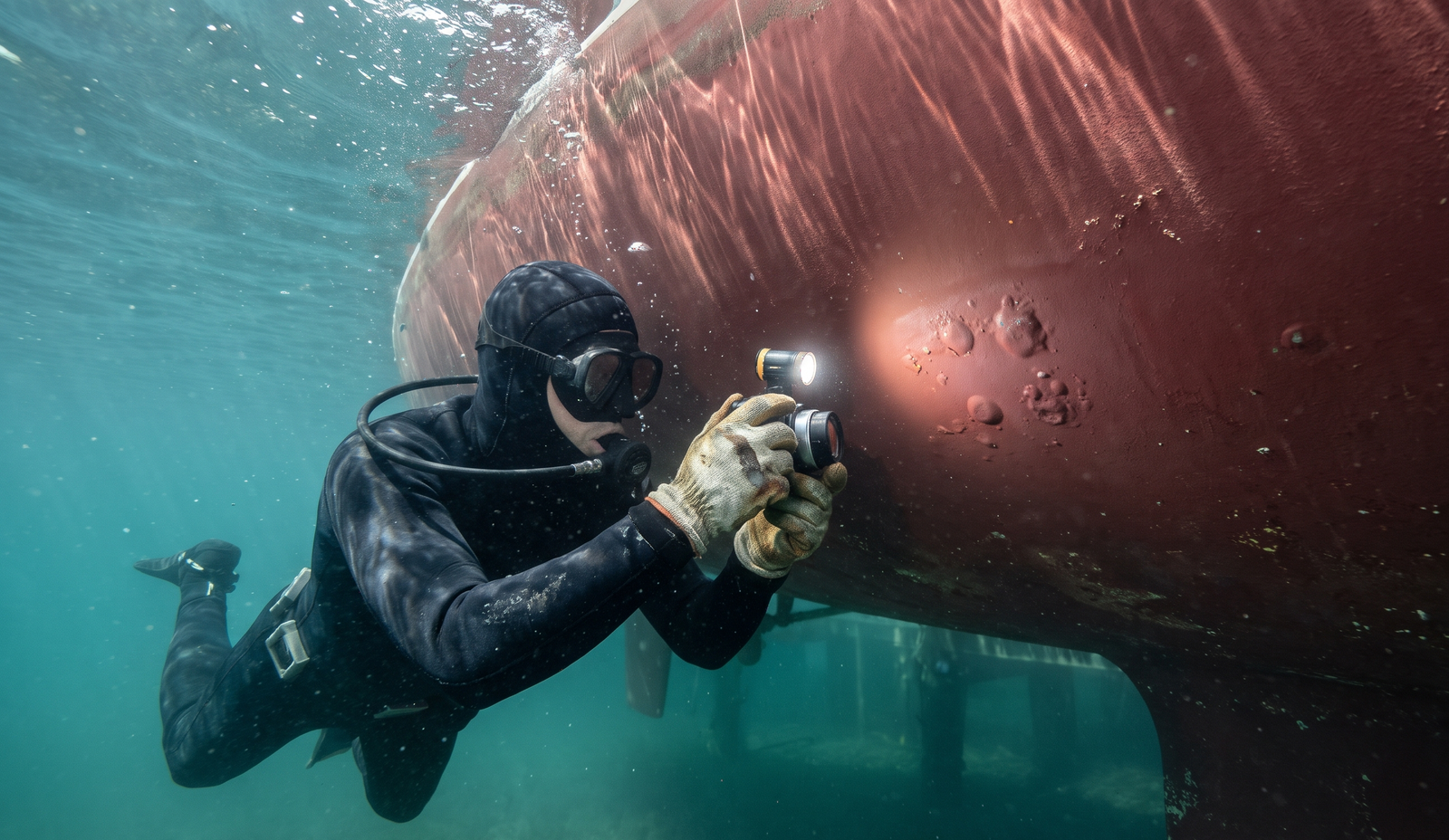
Small bubbles, raised spots, and unusual surface defects below the waterline can worry any fiberglass boat owner. Sometimes the problem is limited to peeling antifouling paint or a damaged gelcoat surface. In other cases, the hull may be developing osmotic blistering, a condition involving moisture movement and chemical reactions within the fiberglass laminate.
Fiberglass boat hull blisters below the waterline should be inspected before you assume they are harmless. Osmotic blisters can develop beneath the gelcoat and may indicate moisture-related deterioration within the laminate. An underwater diver can document visible defects, but confirming the extent of osmosis generally requires a haul-out, dry-hull examination, and appropriate moisture and laminate assessments.
Understanding the difference between bottom paint peeling, ordinary gelcoat damage, and genuine osmotic blistering helps you decide what inspection your boat needs. It also prevents you from paying for cosmetic repairs when the underlying fiberglass requires more attention.
What Are Fiberglass Boat Hull Blisters?
Fiberglass hull blisters are raised areas that develop when material beneath the hull’s outer surface separates or expands. Osmotic blistering is associated with moisture entering the gelcoat and reacting with water-soluble substances within the laminate. The resulting pressure can form fluid-filled pockets and, in more advanced cases, contribute to interlaminar damage.
A typical fiberglass hull has an outer gelcoat layer followed by layers of fiberglass reinforcement and resin. The gelcoat provides the finished exterior surface, while the underlying laminate supplies much of the hull’s strength.
Although gelcoat provides a protective exterior, it is not completely impermeable to water. Over time, moisture can migrate through the coating. If soluble materials or uncured resin components are present within the laminate, chemical reactions can contribute to blister formation.
These blisters may appear as:
- Small, rounded bubbles beneath the waterline
- Raised spots scattered across the underwater hull
- Clusters of blisters concentrated in particular areas
- Larger raised sections that may indicate more extensive damage
- Open cavities or damaged gelcoat where previous blisters have broken
The condition is commonly called osmosis or osmotic blistering. Boat owners sometimes refer to widespread small blisters as fiberglass pox.
For a detailed technical explanation, see the WEST SYSTEM Gelcoat Blister Diagnosis, Repair and Prevention Manual.
What Causes Osmotic Blistering Below the Waterline?
Osmotic blistering develops when moisture moves through the gelcoat and interacts with soluble substances or susceptible areas within the fiberglass laminate. These reactions can create concentrated solutions and pressure beneath the surface, producing blisters. The actual cause and severity depend on the hull’s construction, materials, manufacturing history, and exposure to water.
Several conditions may contribute to blister formation:
1. Moisture penetration through gelcoat
Gelcoat provides a protective finish, but water can gradually migrate through it. Long-term immersion creates ongoing exposure, particularly on hulls that spend most of their lives in the water.
2. Water-soluble materials within the laminate
Soluble substances, residual chemicals, and susceptible resin areas can contribute to the development of concentrated fluid pockets. Moisture movement and chemical reactions may cause these pockets to expand beneath the gelcoat.
3. Manufacturing and laminate conditions
Variations in resin application, trapped air, curing conditions, and laminate construction can contribute to defects. Not every blister has the same origin, and not every surface bubble represents the same underlying problem.
4. Long-term water exposure
A fiberglass boat kept in warm, humid, or biologically active marine environments experiences continuous underwater exposure. However, location alone does not establish that a hull has osmosis. Construction quality, coating condition, maintenance history, and actual laminate condition all matter.
WEST SYSTEM explains that blister formation can involve moisture, soluble substances, and chemical reactions within the laminate. Its technical manual also emphasizes that the condition beneath the visible blister needs to be evaluated before choosing a repair method.
How to Identify Boat Gelcoat Blisters Below the Waterline
Look for raised, rounded defects beneath the underwater hull coating, particularly clusters of small bubbles or isolated blisters that appear to sit beneath the gelcoat rather than within the antifouling paint. Record their locations, sizes, distribution, and appearance. Do not diagnose osmosis from appearance alone because other coating and surface defects can look similar.
During an initial inspection, pay attention to the following characteristics:
- Shape: Osmotic blisters commonly appear rounded or dome-shaped, although their size and appearance can vary.
- Distribution: Some hulls develop isolated blisters, while others show clusters or widespread coverage.
- Location: Record whether the defects appear near the waterline, along the bottom, around repairs, or in specific hull sections.
- Surface condition: Look for cracks, broken gelcoat, exposed laminate, or signs of previous repairs.
- Changes over time: Photographs and inspection records can help establish whether the affected areas are spreading or changing.
One important detail is that blisters can become less obvious after a boat is removed from the water. WEST SYSTEM’s repair guidance explains that some blisters shrink after haul-out and may disappear temporarily before returning when the hull is immersed again.
This is one reason why documenting the hull condition promptly during haul-out can be valuable.
Osmotic Blistering vs. Bottom Paint Peeling: How Are They Different?
Bottom paint peeling usually involves failure or separation of the antifouling coating, while osmotic blistering involves raised defects beneath the gelcoat or within the fiberglass laminate. Peeling paint may expose the coating or substrate underneath, but it does not automatically indicate osmosis. The affected layers must be identified before repair.
| Inspection feature | Bottom paint peeling | Possible osmotic blistering |
|---|---|---|
| Where the defect occurs | Within or at the surface of the antifouling coating | Beneath the gelcoat or within the laminate |
| Typical appearance | Flaking, lifting, patches, or coating separation | Raised bubbles or rounded blister formations |
| Underlying material | May expose primer, barrier coat, or gelcoat | May involve gelcoat and moisture-affected laminate |
| What inspection may require | Coating assessment and surface preparation | Haul-out, moisture assessment, and laminate examination |
| Potential repair | Coating preparation and repainting | May require opening, drying, laminate repair, and barrier coating |
There can also be other explanations for raised areas, including trapped air, previous repair defects, coating incompatibility, or damage to the outer surface. A surveyor or qualified fiberglass repair specialist should determine which layer is affected before any material is removed.
What Can an Underwater Diver Check for Fiberglass Blisters?
An underwater diver can visually inspect accessible hull surfaces, photograph suspicious raised areas, identify visible cracks or coating defects, and record the distribution of apparent blisters. This provides useful preliminary information, but it cannot establish how far moisture or damage extends into the fiberglass laminate. A dry-hull examination is generally needed for a more complete diagnosis.
An underwater inspection is useful because it can identify visible concerns before the boat is hauled out. It may also help an owner decide whether to arrange a more detailed survey or fiberglass assessment.
What a diver can document
- Visible raised spots and blister-like formations
- Areas where bottom paint is peeling or separating
- Cracks, scratches, and visible gelcoat damage
- Exposed or damaged underwater surfaces
- Approximate location and distribution of suspicious areas
- Photographs or video showing the observed condition
What a diver cannot confirm from an ordinary underwater visual inspection
- The moisture content throughout the fiberglass laminate
- The full depth of a suspected blister
- Whether a defect involves only gelcoat or deeper laminate layers
- The extent of hidden interlaminar separation
- Whether the hull requires localized or extensive blister repair
Underwater visual inspection should therefore be treated as an initial condition assessment, not a complete osmosis survey.
For accessible underwater hull condition checks, explore Underwater Inspection Services in South Florida.
What Happens During a Professional Osmotic Blister Inspection?
A thorough osmotic blister assessment generally starts with a visual examination of the hauled-out hull, followed by defect mapping and appropriate moisture measurements. Where necessary and authorized, selected blisters or inspection areas may be opened to examine the material underneath. The goal is to determine whether the problem is superficial, localized, or affecting the underlying laminate.
1. Haul-out and initial hull examination
The boat is lifted out so the underwater hull can be examined above the waterline. The inspection should begin promptly because some blisters may shrink after the hull dries.
The surveyor or repair specialist records the visible defects, including their position, size, approximate quantity, and distribution across the hull.
2. Blister mapping and photography
Suspicious areas can be marked and photographed to create a record of the hull condition. Mapping helps distinguish isolated defects from widespread patterns.
For a larger affected area, documenting the number and size of blisters within measured sections can help establish the scale of the problem.
3. Moisture assessment
A suitable marine moisture meter may be used to assess moisture levels across the hull. Readings should be taken systematically and compared across different areas rather than interpreted as isolated numbers.
Moisture-meter results are influenced by factors such as antifouling paint, coating thickness, temperature, recent haul-out, nearby metal, and the construction of the hull. A reading is an assessment tool, not a standalone diagnosis of osmosis.
4. Sounding and laminate assessment
Where appropriate, a surveyor may use percussion sounding to identify changes in the acoustic response of the hull. Differences can indicate areas that require closer examination for possible voids or delamination.
Sounding results should be interpreted alongside visual findings, construction details, and other inspection results. Not every change in sound confirms structural separation.
5. Selective examination of suspicious areas
If the owner authorizes it and the inspection scope requires it, selected blisters may be opened to examine the material beneath the surface. The condition of the gelcoat, resin, and fiberglass can provide additional information.
Opening a blister is a destructive inspection step. It should not be performed casually by an underwater diver or without understanding the repair implications.
For additional technical information, see the WEST SYSTEM guide to gelcoat blister diagnosis and prevention.
Can a Diver Check for Fiberglass Delamination?
A diver may identify visible cracks, deformation, damaged gelcoat, or other surface signs that justify further investigation. However, an ordinary underwater visual inspection cannot reliably confirm hidden fiberglass delamination. A qualified marine surveyor or fiberglass specialist may need to perform sounding, moisture assessment, and additional examination after haul-out.
Delamination occurs when bonded layers separate or lose their intended connection. In a fiberglass hull, this may involve separation between laminate layers or other structural components.
Possible warning signs include:
- Localized surface deformation or raised areas
- Cracks or fractures around previously damaged sections
- Changes in the surface profile
- Areas that produce a different response during appropriate sounding tests
- Evidence of previous repairs or moisture intrusion
These signs do not prove delamination. They identify areas that may need a more detailed assessment.
Do not assume that every osmotic blister means the hull has lost structural strength. Some blistering is relatively localized, while extensive interlaminar damage requires a more substantial repair evaluation.
How Serious Are Fiberglass Pox and Widespread Blisters?
Widespread fiberglass pox deserves a more detailed assessment than a few isolated surface blisters. Numerous defects can indicate a broader moisture-related problem, but the number of visible blisters alone does not establish structural severity. The condition of the underlying laminate, moisture levels, and extent of damaged material determine the appropriate repair strategy.
Blistering can range from a small number of isolated defects to thousands of closely spaced bubbles across the underwater hull.
When blistering is widespread, the inspection should look beyond the obvious surface defects. WEST SYSTEM recommends examining selected areas of the hull to understand the condition of the laminate beneath the gelcoat before deciding on a repair approach.
Pay particular attention when:
- Blisters cover large sections of the underwater hull.
- Some blisters have broken open or expose underlying material.
- There are signs of soft or damaged laminate.
- Moisture readings are elevated across multiple areas.
- Previous blister repairs have failed or new defects continue appearing.
A qualified specialist should determine whether the hull needs isolated repairs, extensive gelcoat removal, laminate rebuilding, or another treatment.
What Happens After Osmotic Blistering Is Confirmed?
Confirmed osmotic blistering may require opening and cleaning affected cavities, removing damaged material, allowing the laminate to dry thoroughly, and repairing the surface with a compatible system. Extensive damage may require broader gelcoat removal, laminate reconstruction, and an epoxy barrier coat. The repair scope depends on the condition of the hull, not simply the number of visible blisters.
Typical repair stages may include:
- Removing damaged material: The affected gelcoat and any compromised laminate are removed to reach sound material.
- Cleaning blister cavities: Opened areas are cleaned and prepared according to the selected repair system.
- Drying the laminate: The hull must be allowed to dry sufficiently before filling or applying new coatings. This stage can take considerable time.
- Rebuilding damaged areas: Suitable repair materials are used to restore the affected surface and, where required, laminate structure.
- Applying a compatible barrier system: An appropriate epoxy barrier coating may be applied after the hull has been properly prepared and dried.
- Applying antifouling paint: The underwater hull is finished with a compatible bottom coating when the repair system allows it.
One important point: applying a barrier coat over an inadequately dried or deteriorating laminate does not correct the underlying problem. Surface preparation, drying, and proper assessment are essential.
WEST SYSTEM’s Guide to Osmosis Repair discusses the evaluation of blister damage, removal of affected material, drying, and repair preparation.
How to Reduce the Risk of Future Hull Blistering
You cannot guarantee that a fiberglass hull will never develop blisters, but you can reduce avoidable moisture-related problems through proper coating maintenance, timely repairs, and regular hull inspections. Address damaged gelcoat and coating defects promptly, keep the bilge as dry as practical, and follow the manufacturer’s recommendations for hull protection.
Useful maintenance practices include:
- Inspect the underwater hull regularly for cracks, coating damage, and unusual raised areas.
- Repair damaged gelcoat and fiberglass surfaces using compatible materials.
- Maintain antifouling and barrier coatings according to their technical specifications.
- Keep the bilge and accessible internal hull spaces as dry as practical.
- Investigate recurring moisture readings or blister repairs that fail.
- Arrange a more detailed assessment when visible blistering becomes widespread.
For ongoing vessel maintenance, UMS also provides underwater hull cleaning. Cleaning and inspection are separate activities: cleaning removes suitable marine growth, while diagnosing suspected osmotic damage requires appropriate hull assessment.
Frequently Asked Questions
Can you see osmotic blisters while a boat is underwater?
A diver may see raised areas or suspicious surface defects, but underwater visibility and marine growth can make assessment difficult. Some blisters also shrink after haul-out. An underwater inspection can document visible concerns, but a dry-hull examination is generally needed to investigate suspected osmotic damage properly.
Are all fiberglass boat hull blisters caused by osmosis?
No. Raised areas can result from coating failure, trapped air, previous repairs, manufacturing defects, or other surface problems. Osmotic blistering is one possible cause, but appearance alone cannot confirm it. The affected coating and laminate must be examined before selecting a repair method.
Can bottom paint peeling look like osmotic blistering?
Yes. Peeling or separating antifouling paint can create an uneven underwater surface that may be confused with blistering. The key difference is the affected layer: paint failure involves the coating, while osmotic blistering occurs beneath the gelcoat or within the laminate. Proper surface examination helps distinguish them.
Can a diver confirm fiberglass delamination?
An underwater diver can identify visible defects that may justify further investigation, but an ordinary visual inspection cannot reliably confirm hidden laminate separation. A qualified surveyor may need to perform sounding, moisture assessment, and additional examinations after haul-out to evaluate the extent of possible delamination.
Do osmotic blisters make a fiberglass boat unsafe?
Not every blister indicates a structural problem. Some are isolated and mainly affect the gelcoat, while extensive damage can involve the laminate. The seriousness depends on the depth and condition of the affected material. Have widespread, recurring, or visibly damaged areas evaluated by a qualified specialist.
Does a fiberglass hull need a complete barrier coat after blister repair?
Not every hull requires the same treatment. Isolated minor blisters may be suitable for localized repairs, while extensive blistering can require broader preparation and an epoxy barrier system. The repair specialist should determine the appropriate scope after assessing the laminate, moisture condition, and extent of damage.
Read More: Underwater Hull Inspection and Marine Maintenance
If you are concerned about your boat’s underwater condition, explore our underwater inspection services in South Florida and learn more about professional underwater hull cleaning.
You can also explore cavitation cleaning, zinc replacement, and other marine maintenance topics in the Underwater Marine Services blog.
Investigate Hull Blisters Before They Become a Bigger Problem
Fiberglass boat hull blisters below the waterline should never be diagnosed by appearance alone. A few raised spots may be isolated gelcoat defects, while widespread blistering can indicate a more extensive moisture-related problem within the laminate.
An underwater diver can help document visible defects and identify areas that deserve closer attention. However, confirming osmotic blistering and determining the repair scope generally requires haul-out, moisture assessment, and examination of the affected fiberglass.
If you notice unusual raised areas, peeling coatings, or suspected damage below the waterline, arrange an appropriate inspection before assuming the problem is only cosmetic.
Contact Underwater Marine Services to discuss an underwater inspection of your vessel.
