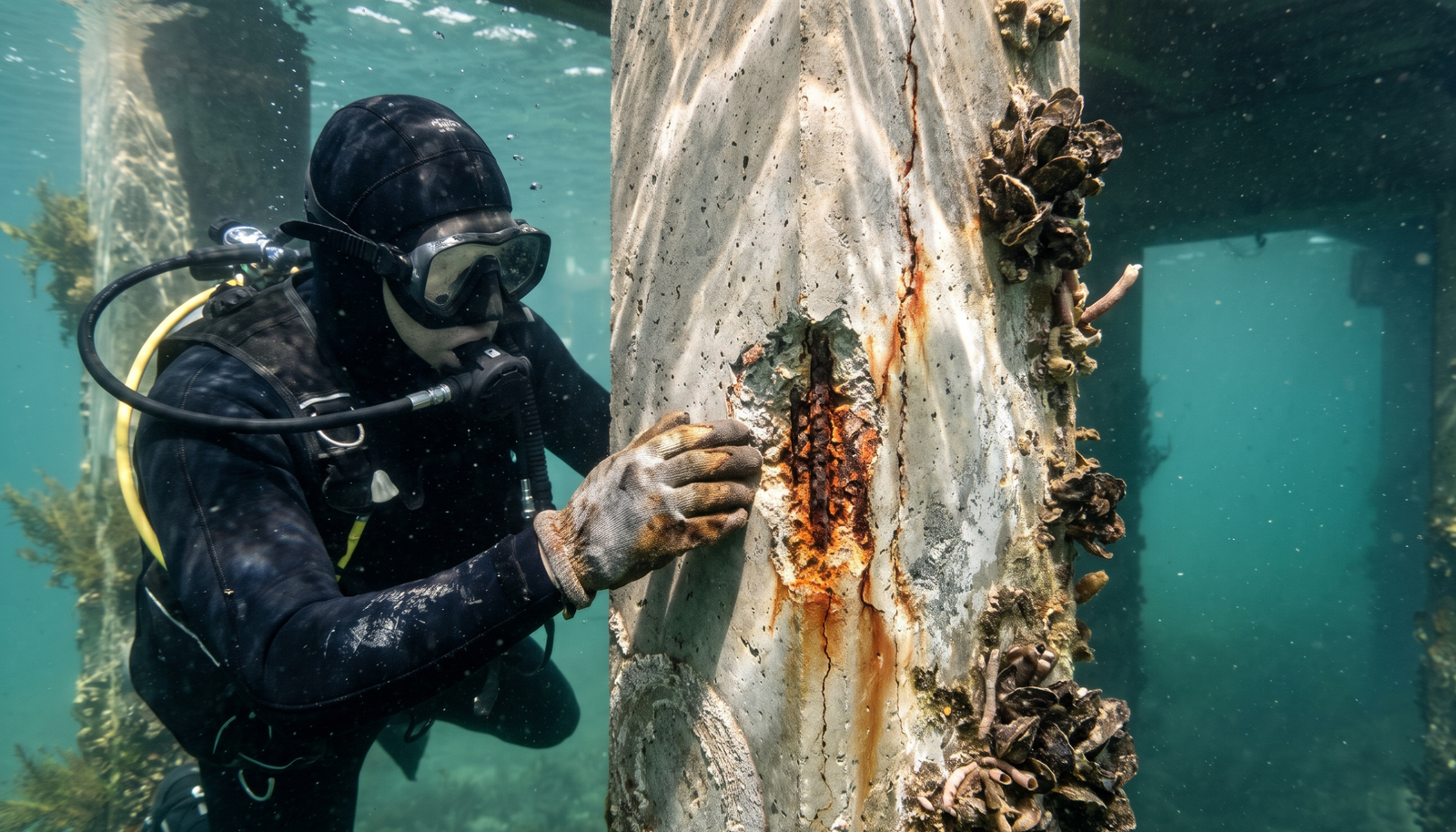
Concrete dock piling repair should begin with understanding the damage, not simply covering it up. Cleaning marine growth from concrete piles can reveal rust stains, cracks, exposed reinforcing steel, and deteriorated concrete that were previously hidden. Identifying these warning signs early helps owners arrange a proper structural assessment before localized damage becomes more extensive.
Concrete dock pilings operate in one of the harshest environments for reinforced concrete. Saltwater, changing tides, wave action, moisture, and marine organisms continually affect the concrete surface. In South Florida, barnacles, oysters, algae, and other marine growth can cover important inspection areas.
That is why cleaning square concrete pier piles is more than a cosmetic maintenance task. When performed carefully, it can improve visibility and help inspectors identify deterioration that needs further investigation. It is an important first step in understanding the condition of a waterfront structure.
Why Concrete Dock Pilings Develop Spalling and Reinforcement Corrosion
Concrete spalling occurs when pieces of the concrete surface break away, often exposing the reinforcing steel inside. In marine environments, chloride exposure can contribute to reinforcement corrosion. As corrosion products accumulate, they create pressure within the concrete, which can cause cracking, delamination, and eventually spalling.
Reinforced concrete depends on the surrounding concrete to protect embedded steel. When saltwater and chlorides penetrate the concrete cover, that protection can deteriorate. Corrosion may then progress beneath the surface before the damage becomes obvious from the outside.
Common causes of concrete piling deterioration
- Chloride penetration: Saltwater can introduce chlorides into concrete, contributing to corrosion of embedded reinforcement.
- Repeated wetting and drying: Splash and tidal zones experience changing moisture and oxygen conditions that can contribute to deterioration.
- Concrete cracking: Cracks can provide pathways for moisture and chlorides to reach reinforcing steel.
- Impact and abrasion: Boats, floating debris, fenders, and water movement can damage exposed concrete surfaces.
- Inadequate concrete cover: Reinforcement positioned too close to the surface may have less protection from the marine environment.
The Federal Highway Administration’s research on corrosion-resistant reinforcement explains how chloride exposure can disrupt the protective condition of reinforcing steel and contribute to cracking and spalling. Although the publication discusses bridge structures, the corrosion mechanism is relevant to reinforced concrete exposed to marine conditions.
How Cleaning Reveals Hidden Concrete Dock Piling Damage
Marine growth can conceal surface defects, especially around the waterline and tidal zone. Carefully removing selected areas of growth gives inspectors a clearer view of the concrete and makes it easier to document visible deterioration. Cleaning does not establish the full structural condition, but it can reveal warning signs that would otherwise remain obscured.
Inspection guidance in the U.S. Department of Defense’s waterfront facilities inspection checklist specifically describes clearing a section of marine growth before checking concrete for cracks with rust staining, spalling, impact damage, and exposed reinforcement.
What inspectors look for after cleaning
- Rust-colored stains emerging through the concrete surface.
- Longitudinal cracks that may follow the direction of reinforcing bars.
- Areas where concrete has broken away or become visibly deteriorated.
- Exposed reinforcing steel, including visible rust and apparent material loss.
- Surface separation or suspected delamination that may indicate deterioration below the visible surface.
- Impact damage, erosion, and other physical defects.
Cleaning should be controlled and appropriate for the structure. Aggressive scraping, impact tools, or high-pressure methods can damage already weakened concrete, remove material that should be documented, or disturb surrounding coatings and surfaces. The inspection objective is to reveal the condition, not make a damaged pile look clean at any cost.
Rust Stains on Concrete Dock Pilings: An Early Warning Sign
Rust stains on concrete dock pilings deserve attention because they can indicate corrosion of embedded reinforcement. Rust-colored streaks may appear where corrosion products and moisture reach the surface through cracks or porous concrete. When these stains occur alongside cracking, delamination, or spalling, the possibility of reinforcement corrosion becomes more concerning.
However, a stain alone does not establish how much steel has corroded or whether the pile has lost structural capacity. The location, pattern, surrounding concrete condition, and results of further testing all matter.
Warning signs that should be documented
- Rust staining that follows a vertical or horizontal line.
- Cracks that run parallel to the likely position of reinforcement.
- Concrete that is separating, bulging, or breaking away.
- Visible reinforcing bars with corrosion products.
- Repeated staining or cracking in the same area over successive inspections.
The ACI publication on offshore and marine concrete structures identifies rust staining, associated cracking, and spalling as important observations during visual surveys. It also notes that exposed reinforcement may require physical measurement of its remaining cross-section.
Marine Growth Hiding Concrete Cracks: Where to Inspect First
Not every part of a dock piling experiences the same exposure. The splash and tidal zones deserve particular attention because they are repeatedly exposed to seawater, air, and changing moisture conditions. Marine organisms can also accumulate heavily in these areas, making the concrete difficult to examine without selective cleaning.
A practical inspection should consider the entire accessible pile, while giving additional attention to areas where environmental exposure and visible deterioration suggest a higher risk.
Priority inspection areas
- Splash zone: Look for rust stains, cracking, concrete loss, and damage caused by repeated wetting and drying.
- Tidal zone: Check for marine growth concealing cracks, exposed steel, and deterioration around the changing waterline.
- Below the waterline: Examine accessible surfaces for spalling, impact damage, and deterioration hidden by marine organisms.
- Pile cap and connection areas: Inspect visible transitions and connections where water entry, cracking, or deterioration may occur.
- Pile base: Where accessible, look for concrete damage and possible undermining or scour around the foundation.
The FHWA Underwater Bridge Inspection Reference Manual highlights the importance of examining concrete substructure units for spalling, hidden fracture planes, and deterioration around the waterline. It also explains that delamination can exist below the visible concrete surface.
Cleaning Square Concrete Pier Piles Without Hiding the Evidence
Square concrete pier piles have multiple faces, corners, and edges that need to be considered during inspection. Marine growth can collect unevenly across these surfaces, and damage may be more apparent on one face than another. A consistent inspection approach helps avoid overlooking defects.
The goal is to remove enough marine growth to make the concrete visible while preserving the surface condition for assessment. Cleaning should not involve unnecessary removal of sound concrete or disturbance of exposed reinforcement.
A practical cleaning and documentation sequence
- Establish the inspection areas. Identify the pile locations, accessible faces, waterline conditions, and areas with visible damage.
- Photograph the original condition. Record marine growth, staining, cracks, and existing concrete loss before cleaning.
- Remove selected marine growth carefully. Use a suitable method to expose the concrete without unnecessarily damaging the surface.
- Inspect the exposed concrete. Look for rust staining, cracks, spalls, exposed reinforcement, and signs of delamination.
- Record the findings. Note the pile identification, face, approximate location, dimensions, and condition of each defect.
- Refer significant damage for assessment. Suspected structural deterioration should be evaluated by a qualified structural engineer.
For UMS-related piling maintenance, see piling cleaning services. The purpose of cleaning is to improve visibility and document the condition of the accessible surfaces, not to certify a pile as structurally sound.
What the Inspection Findings Can Tell You
Visible defects help determine whether a piling needs routine monitoring, a more detailed inspection, or professional repair planning. The combination of symptoms is often more informative than one isolated mark. For example, rust staining accompanied by longitudinal cracking and loose concrete deserves more attention than a superficial stain with no other visible distress.
The following table explains common observations and why they matter. These are inspection indicators, not a structural rating or a diagnosis of the pile’s remaining capacity.
| Visible condition | What it may indicate | Recommended next step |
|---|---|---|
| Rust stains | Possible corrosion of embedded reinforcement | Document the pattern and check for nearby cracks or spalling |
| Longitudinal cracks | Possible cracking associated with reinforcement corrosion | Record location, length, direction, and width |
| Spalled concrete | Loss of concrete cover, potentially exposing reinforcement | Document the affected area and obtain professional assessment |
| Exposed rusty rebar | Direct evidence of reinforcement exposure and corrosion products | Have the steel condition and remaining section assessed |
| Hollow-sounding areas | Possible delamination or separation beneath the surface | Arrange a suitable detailed inspection |
| Cracks without rust stains | Possible shrinkage, movement, impact, or structural cracking | Document and have significant or suspicious cracks evaluated |
Visual inspection and sounding can help identify suspected defects, but more advanced methods may be necessary. Depending on the structure and findings, an engineer may specify reinforcement location surveys, concrete cover measurements, corrosion-potential testing, ultrasonic methods, or selected material sampling. These methods answer different questions and should be chosen as part of an appropriate assessment plan.
When Concrete Dock Piling Repair Requires a Structural Engineer
Cleaning reveals the condition of the visible surface; it does not determine the full extent of corrosion inside the concrete. A structural engineer should evaluate significant cracking, extensive spalling, exposed reinforcement, suspected delamination, or damage that may affect the pile’s load-carrying capacity.
Repair methods depend on the cause, depth, and extent of deterioration. A superficial patch may be inappropriate if corrosion remains active behind the repair. Simply covering rust stains or filling cracks without understanding the underlying condition can leave the deterioration mechanism unresolved.
Possible repair approaches after assessment
- Localized concrete repairs: Used where deterioration is limited and the remaining concrete and reinforcement can be properly assessed and prepared.
- Reinforcement treatment: May be required where steel is exposed or corrosion has affected the reinforcement.
- Concrete jacketing: May be considered where a pile requires additional protection or structural restoration, subject to engineering design.
- Crack treatment: The appropriate method depends on whether a crack is active, structural, or related to reinforcement corrosion.
- More extensive rehabilitation: May be necessary where deterioration affects a significant portion of the pile or its structural performance.
The U.S. Department of Defense’s concrete pile repair guidance describes approaches such as patching and concrete jacketing. These are examples of repair methods, not universal solutions. The appropriate design must account for the actual damage, reinforcement condition, marine exposure, and structural requirements.
For broader guidance on concrete deterioration and repair preparation, the International Concrete Repair Institute is another useful technical resource.
Why Routine Piling Cleaning and Inspection Matter in South Florida
South Florida docks, marinas, and waterfront facilities experience continuous marine exposure. Marine growth can obscure developing surface problems, while saltwater exposure creates conditions in which reinforcement corrosion may progress. A planned maintenance and inspection routine helps owners establish a record of changing conditions instead of relying on occasional visual checks.
Cleaning can make inspections more useful by exposing selected areas for comparison over time. Consistent photographs, measurements, and location notes help identify whether cracks are extending, spalls are growing, or new rust staining is appearing. Inspection frequency should reflect the structure’s age, exposure, use, condition, and applicable requirements.
UMS provides marine maintenance services including piling cleaning, as well as underwater inspection services. Cleaning and underwater observations can support maintenance planning, while structural diagnosis and repair design should be handled by appropriately qualified professionals.
Frequently Asked Questions
1. What causes concrete dock pilings to spall?
Concrete dock pilings can spall when embedded reinforcement corrodes and the expanding corrosion products create pressure inside the concrete. Impact, abrasion, and other deterioration mechanisms can also cause concrete loss. An inspection is needed to identify the likely cause.
2. Do rust stains on concrete dock pilings always mean the rebar is corroding?
Rust-colored staining can indicate corrosion of embedded reinforcement, particularly when it appears with cracking or spalling. However, a stain alone does not establish the extent of corrosion or prove that the pile has lost structural capacity. Further assessment may be needed.
3. Can marine growth hide cracks in concrete pier piles?
Yes. Barnacles, oysters, algae, and other marine organisms can cover cracks, rust stains, and damaged concrete. Carefully removing selected growth can expose these conditions for visual documentation and further inspection.
4. How do you inspect square concrete dock pilings underwater?
An underwater inspection considers the accessible faces of the pile, including the corners, waterline, tidal zone, and submerged sections. Selected marine growth may be removed to expose the concrete, after which visible cracks, rust stains, spalling, and exposed reinforcement can be documented.
5. Can cleaning repair concrete dock piling spalling?
No. Cleaning removes marine growth and improves visibility, but it does not restore lost concrete or repair corroded reinforcement. Spalling requires an assessment to determine the cause, extent, and appropriate repair method.
6. When should a structural engineer inspect a concrete dock piling?
A structural engineer should assess significant cracks, extensive spalling, exposed or visibly deteriorated reinforcement, suspected delamination, and any damage that could affect structural capacity. Cleaning and visual observations can help identify areas that need this additional evaluation.
Read More: Marine Piling and Underwater Maintenance
Maintaining a waterfront structure involves more than keeping visible surfaces clean. Explore additional guidance on marine maintenance and underwater inspection, including how regular cleaning and condition documentation can support better maintenance decisions.
Conclusion: Find Concrete Piling Problems Before They Become More Extensive
Concrete dock piling repair starts with identifying what is happening beneath the visible surface. Marine growth can hide rust stains, cracks, exposed reinforcement, and early spalling. Careful cleaning makes these warning signs easier to document and helps owners determine when a more detailed structural assessment is necessary.
For South Florida waterfront properties, regular piling cleaning and inspection can support a more informed maintenance plan. The important point is to treat cleaning as an inspection aid—not as a substitute for engineering evaluation or concrete repair.
Need help with marine growth on your dock pilings? Contact Underwater Marine Services to discuss piling cleaning and underwater maintenance for your waterfront property.
Contact Underwater Marine Services | Learn About Piling Cleaning
