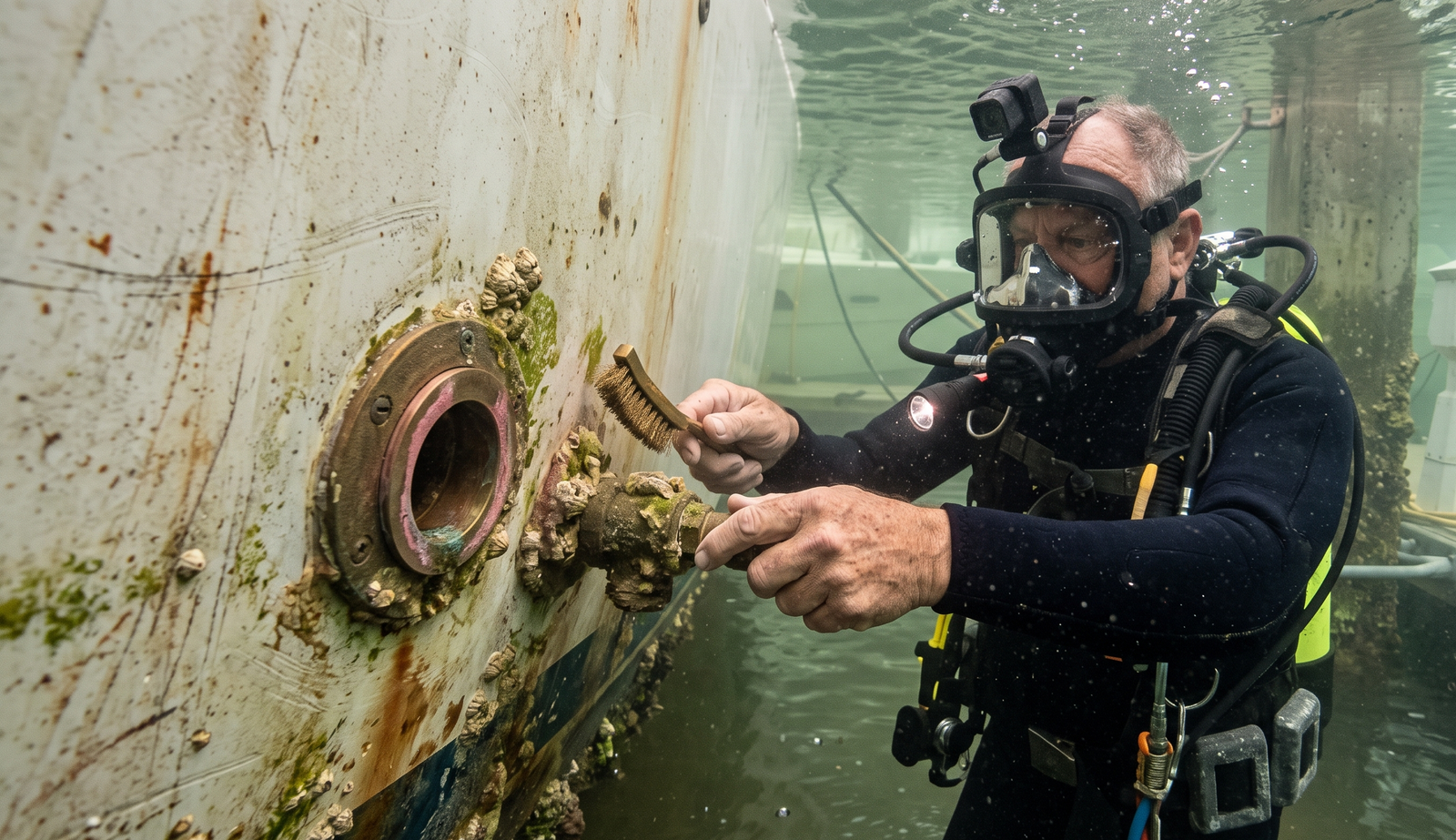
A bronze thru-hull can look perfectly normal from inside the boat while its underwater surface is slowly losing strength. That is what makes bronze thru-hull dezincification so concerning. A fitting may retain its shape and still be structurally compromised beneath the surface.
We have seen boat owners focus on obvious corrosion, only to discover that the more serious warning was a subtle pink or reddish color on an underwater fitting. That change can indicate that zinc has been selectively removed from a copper-zinc alloy. The result is a porous, weakened material that may not tolerate the impact or load the original fitting was designed to handle.
Because a thru-hull penetrates the hull below the waterline, this is one maintenance issue you do not want to discover after a failure.
What Is Bronze Thru-Hull Dezincification?
Bronze thru-hull dezincification is a corrosion process in which zinc is selectively removed from a copper-zinc alloy, leaving behind a porous and weakened copper-rich structure. The fitting may retain its original shape while losing much of its mechanical strength. A pink, reddish, or copper-colored appearance can be a warning sign, particularly when a fitting was originally a yellow-gold brass or zinc-containing alloy.
The terminology can be confusing because boat owners often call many copper-based marine fittings “bronze.” True silicon bronze contains no zinc and therefore does not undergo dezincification in the same way brass does. Some fittings sold or identified as bronze may actually be brass or another zinc-containing alloy. West Marine’s marine fitting guidance explains why identifying the actual alloy matters below the waterline.
Why Dezincification Can Become a Thru-Hull Failure
A thru-hull fitting is part of the barrier separating the inside of your boat from the surrounding water. If the fitting becomes structurally weakened, the consequences can be much more serious than surface corrosion.
Dezincification can create a fitting that looks intact but has lost material and strength internally. The danger is that the weakened component may not provide an obvious warning before it cracks, breaks, or is damaged during maintenance.
ABYC maintains a dedicated standard, H-27 Seacocks, Thru-Hull Fittings, and Drain Plugs, covering fittings that pass water through the hull at or below the maximum heeled waterline. ABYC’s standards are developed specifically for boat design, construction, repair, and maintenance. ABYC Standards and Technical Information Reports
This is why underwater fitting corrosion deserves more attention than simply wiping away visible discoloration.
How to Recognize the Warning Signs
Early signs of dezincification can include pink, reddish, or copper-colored areas on a fitting that originally had a yellow-gold brass appearance, along with porous surfaces, unusual surface texture, or visible corrosion. Because color alone cannot confirm the alloy or structural condition, suspect fittings should be professionally evaluated and replaced when their integrity cannot be established.
Pink or reddish metal
This is one of the classic visual clues. Zinc has been selectively removed from the alloy, leaving a copper-rich surface that can appear pink or red.
Porous or crumbly material
Affected metal can develop a porous appearance. If the surface seems unusually soft, rough, or degraded, do not assume it is ordinary surface oxidation.
Unexpected corrosion around the fitting
Corrosion staining, moisture, seepage, or deterioration around the thru-hull and seacock deserves investigation. A fitting that looks questionable from outside should also be evaluated from inside the boat.
Age and uncertain material history
Older boats can contain fittings whose alloy, installation history, or replacement records are unclear. Never assume that a fitting is suitable simply because someone previously described it as “bronze.”
Pink Brass Marine Fittings: Why the Material Matters
The phrase pink brass marine can sound contradictory, but it points to an important distinction. Brass is a copper-zinc alloy. Bronze is a broader family of copper-based alloys, and some marine bronzes contain little or no zinc.
That distinction matters because zinc-containing alloys can be susceptible to dezincification in seawater.
True silicon bronze is widely used for below-waterline marine fittings because it does not contain zinc as the alloying element responsible for dezincification. ABYC’s H-27 standard specifically addresses seacocks, thru-hulls, and drain plugs, while marine technicians and surveyors also consider the actual alloy, installation, bonding, and condition when evaluating existing hardware. ABYC H-27 reference
If you cannot confidently identify the alloy, treat that uncertainty as a reason for inspection rather than guessing based on appearance.
Underwater Fitting Corrosion Is Not Always Obvious
One reason we recommend regular underwater inspections is that the most important condition may not be visible from the dock.
A diver can inspect the external fitting, surrounding hull area, seacock connection, and nearby hardware for signs of:
- Pink or reddish discoloration
- Localized corrosion
- Pitting
- Cracking
- Loose or damaged fittings
- Marine growth hiding the metal surface
- Evidence of impact
- Damaged or missing anodes
Our underwater inspection service can help document the condition of submerged hardware without waiting until the boat is hauled.
That does not replace a haul-out when a fitting requires removal, replacement, or detailed structural evaluation. It simply gives owners another opportunity to identify problems before they become emergencies.
Preventing Sinking Boat Problems Starts With the Whole System
The goal of preventing a sinking boat situation is not simply to replace one questionable fitting. The entire thru-hull system deserves attention.
Inspect the thru-hull
Check the fitting for corrosion, discoloration, cracking, movement, and physical damage. A thru-hull should be secure and appropriate for its location.
Inspect the seacock
The valve or seacock attached to the thru-hull should operate correctly and be appropriate for below-waterline service. A seized or damaged valve creates another potential failure point.
Check hose connections
Hoses connected to underwater fittings should be marine-rated for their application and securely attached. ABYC H-27 addresses hose connections associated with thru-hulls and seacocks, including requirements concerning hose-end geometry and clamp installation. ABYC guidance on thru-hull hose connections
Inspect corrosion protection
Where the vessel’s corrosion-control system calls for sacrificial anodes, those components should be inspected and maintained. Our zinc replacement service can help address worn anodes as part of a broader underwater maintenance program.
Can Cathodic Protection Prevent Dezincification?
Cathodic protection is an important part of marine corrosion management, but it should not be treated as a cure for an unsuitable or already compromised fitting.
ABYC explains that cathodic bonding connects appropriate underwater metal components to a grounding system and a source of cathodic protection, commonly a sacrificial anode. The purpose is to provide protection to metal components sharing the same electrolyte. ABYC cathodic bonding guidance
The correct arrangement depends on the vessel’s design and electrical system. A technician should evaluate bonding, anodes, isolation, and potential stray-current problems rather than simply adding more zinc.
In other words, an anode cannot turn an inappropriate material into an appropriate thru-hull.
Common Mistakes With Bronze Thru-Hulls
Assuming every “bronze” fitting is actually bronze
Marine terminology is not always precise. If the material cannot be confirmed, have the fitting identified by a qualified marine professional.
Ignoring pink discoloration
Pink or reddish coloration can be a significant warning sign. Do not polish it away and assume the problem is solved.
Only checking from inside the boat
The interior may show the seacock and hose connection, but the external fitting and hull interface also need attention. An underwater inspection can reveal conditions that are not obvious from inside.
Waiting for a leak
A small leak is not a convenient maintenance reminder. A below-waterline fitting should be evaluated before deterioration reaches the point where water intrusion begins.
Replacing only the visibly damaged part
A thru-hull, seacock, hose, clamps, bonding system, and surrounding hull interface work as a connected installation. If one component has failed, the related components should be assessed rather than automatically assuming they are all satisfactory.
DIY vs. Professional Thru-Hull Inspection
Boat owners can perform useful visual checks, particularly when the vessel is hauled. Look for discoloration, corrosion, leaks, movement, damaged hoses, and valves that do not operate normally.
But suspected dezincification is not an area where guessing is worthwhile. A marine surveyor, qualified technician, or experienced corrosion specialist can help identify the alloy and evaluate whether replacement is appropriate.
For underwater components that are difficult to inspect from inside, professional divers can document the exterior condition. When the boat is hauled, the opportunity for a more complete inspection and component replacement is even greater.
If marine growth is obscuring the fitting, professional hull cleaning can help expose underwater surfaces for inspection, provided the cleaning method is appropriate for the hull coating and local environmental requirements.
When Should a Thru-Hull Be Replaced?
A thru-hull should be evaluated for replacement when it shows evidence of dezincification, structural corrosion, cracking, significant deterioration, inappropriate material, or damage that prevents its condition from being confidently verified. Replacement decisions should account for the fitting, seacock, hose connection, hull construction, installation method, and applicable standards rather than relying on age alone.
West Marine’s current guidance recommends replacing through-hull fittings with structural corrosion before relaunch when their condition cannot be confirmed as sound. It also recommends regular inspection for corrosion, discoloration, leaks, and wear. West Marine through-hull inspection guidance
For older vessels, replacement may be particularly worthwhile when the material is uncertain or documentation is unavailable. The correct decision should be based on inspection rather than an arbitrary replacement date.
Frequently Asked Questions About Bronze Thru-Hull Dezincification
What does a dezincified thru-hull look like?
A dezincified fitting can develop a pink, reddish, or copper-colored appearance because zinc has been selectively removed from a zinc-containing copper alloy. The surface may also appear porous or unusually degraded. Color alone does not establish structural condition, so a suspected fitting should be professionally evaluated.
Can true bronze thru-hulls dezincify?
True silicon bronze contains no zinc and therefore does not undergo dezincification in the same manner as brass. The problem is that fittings are sometimes incorrectly described as bronze. If an underwater fitting develops a pink appearance or its alloy is uncertain, have the material identified before assuming it is silicon bronze.
Why does brass turn pink underwater?
Brass contains copper and zinc. In seawater, zinc can be selectively removed through dezincification, leaving behind a copper-rich structure that may appear pink or reddish. This process can substantially weaken the fitting even when its external shape still looks normal.
Can a dezincified thru-hull cause a boat to sink?
Yes, a severely compromised below-waterline fitting can become a flooding risk if it cracks or breaks. A failed thru-hull is particularly serious because it creates a direct path for surrounding water to enter the hull. Suspected structural deterioration should be addressed before the boat returns to the water.
How often should bronze thru-hulls be inspected?
Through-hulls, seacocks, and associated hose connections should be inspected regularly, including during haul-outs. The appropriate frequency depends on the vessel, materials, environment, age, and condition. Any fitting showing pink discoloration, structural corrosion, cracking, movement, or leakage deserves prompt attention rather than waiting for the next routine service.
Do zinc anodes prevent thru-hull dezincification?
Proper cathodic protection is an important part of marine corrosion control, but it does not make an unsuitable or already damaged fitting safe. Anode selection, bonding, electrical isolation, and the condition and material of the thru-hull all need to be considered together.
For more practical information about underwater vessel maintenance and corrosion prevention, read more of our marine maintenance stories and resources.
Conclusion
Bronze thru-hull dezincification deserves serious attention because the damage can be hidden inside a fitting that still appears intact. Pink or reddish discoloration, porous metal, corrosion, uncertain alloy composition, and deterioration around underwater fittings should never be dismissed as ordinary staining.
The best protection is a combination of correct material selection, regular inspection, appropriate corrosion control, and timely replacement of compromised components. If you are unsure whether an existing thru-hull is genuine marine bronze or a zinc-containing alloy, have it evaluated rather than relying on its name or appearance.
For a boat that lives in the water, knowing what is happening below the waterline can make the difference between planned maintenance and an emergency repair.
Ready to protect your vessel?
If you need expert help with this, our team of certified divers and marine technicians is ready to step in. Learn more about our specific services here.
Prefer to speak with an expert immediately? Contact us today to schedule a service or get a free quote!
