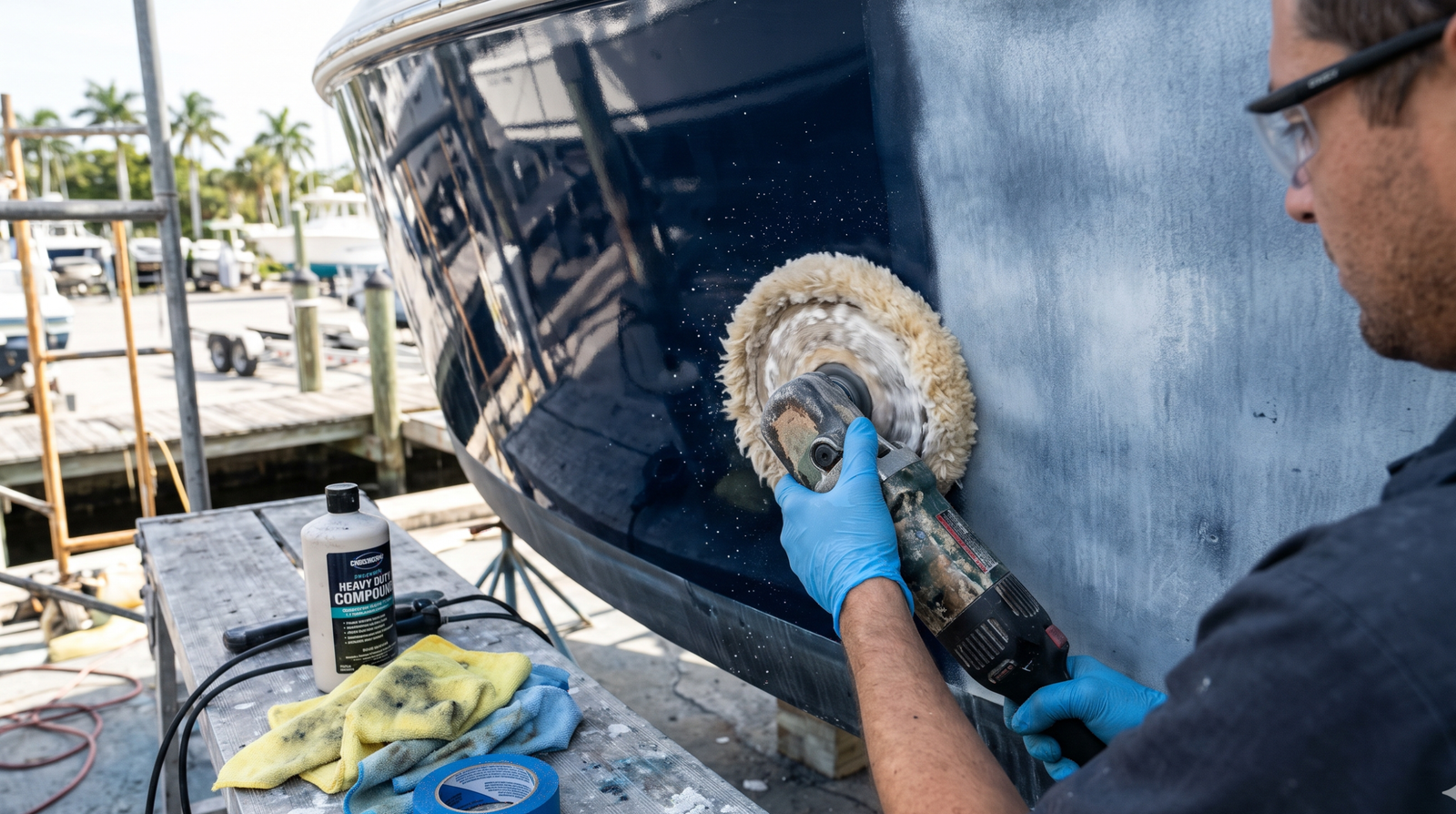
A fiberglass boat that once had a deep, glossy finish can eventually develop a dull, chalky surface. Years of sunlight, saltwater, weather exposure, and inconsistent maintenance gradually break down the appearance of the gelcoat. On colored hulls, oxidation can make the original color look faded, uneven, or almost white.
To remove heavy oxidation from a fiberglass boat, wash and inspect the gelcoat, use an appropriate marine rubbing compound to remove the deteriorated surface layer, refine the finish with a finer polish, and apply a protective wax or compatible sealant. Wet sanding may be necessary for severe oxidation, but it removes material and should only be used when the gelcoat condition and thickness allow it.
The right restoration process depends on how badly the gelcoat has deteriorated. Light oxidation may respond to a one-step polish, while heavily oxidized fiberglass often needs several stages of correction. Understanding the difference helps you restore the finish without unnecessarily thinning or damaging the gelcoat.
What Causes Fiberglass Boat Gelcoat to Oxidize?
Gelcoat oxidation develops as the fiberglass boat’s exterior finish deteriorates through prolonged exposure to ultraviolet radiation, weather, salt, pollutants, and environmental contaminants. The surface gradually loses its gloss and becomes porous or chalky. Without regular cleaning and protection, oxidation can become more noticeable and increasingly difficult to remove.
Gelcoat is the pigmented resin-rich outer finish applied during fiberglass boat construction. It creates the smooth exterior surface and helps protect the underlying laminate.
Over time, several factors contribute to oxidation:
- UV exposure: Continuous sunlight degrades the surface and contributes to fading and loss of gloss.
- Salt and moisture: Salt deposits and repeated wetting can contribute to surface contamination and deterioration.
- Pollution: Airborne contaminants, exhaust residue, and environmental deposits can stain porous gelcoat.
- Insufficient protection: Old or depleted wax leaves the surface more exposed to weather and sunlight.
- Infrequent washing: Dirt and contaminants accumulate and become harder to remove over time.
West Marine explains that oxidized gelcoat becomes more porous and stains more readily. Its Gelcoat Care and Restoration Guide recommends cleaning, stain removal, polishing, and waxing as separate stages of a restoration process.
How to Recognize Heavy Oxidation on a Fiberglass Boat
Heavy gelcoat oxidation usually appears as a chalky, dull surface that transfers a powder-like residue when rubbed with a clean hand or cloth. The finish may look faded, uneven, and rough rather than glossy. Before compounding, distinguish oxidation from permanent color damage, surface scratches, peeling paint, and deeper gelcoat defects.
Use these visual indicators to assess the condition:
- Light oxidation: The gelcoat looks slightly dull but still retains much of its original shine.
- Moderate oxidation: The surface appears faded and may feel less smooth, with noticeable loss of gloss.
- Heavy oxidation: A chalk-like residue transfers onto a hand or cloth, and the original color looks significantly washed out.
- Severe surface deterioration: The finish may have deep pitting, cracking, exposed fiberglass, or areas where the gelcoat is too thin to restore safely through polishing.
Pay special attention to dark blue, black, red, and other colored hulls. Oxidation can make these finishes appear cloudy or faded, while aggressive correction can create uneven patches if the gelcoat has different thicknesses across the surface.
How to Remove Oxidation from a Fiberglass Boat Step by Step
Heavy oxidation removal generally involves five stages: washing, optional wet sanding, machine compounding, polishing, and surface protection. Work in manageable sections, inspect the result after each stage, and use the least aggressive method that produces the required correction. Do not keep cutting the gelcoat simply to chase every remaining imperfection.
Step 1: Wash and prepare the fiberglass surface
Start by removing salt, dirt, loose contaminants, and surface residue with a suitable marine boat wash. Rinse thoroughly and allow the surface to become suitable for the selected restoration products.
Inspect the hull for:
- Deep scratches and gouges
- Stress cracks around fittings
- Damaged or missing gelcoat
- Previous repairs and inconsistent coatings
- Areas where the fiberglass may already be exposed
Compounding will not repair structural damage, cracks, or missing gelcoat. Those defects need appropriate repair before cosmetic restoration.
Step 2: Decide whether wet sanding is necessary
Wet sanding is an optional preparation step for heavily oxidized gelcoat. It can remove a deteriorated surface layer and help level imperfections before machine compounding, but it also removes material.
For example, 3M’s heavy-oxidation procedure describes optional wet sanding for smaller areas using an ultrafine softback sanding sponge. For larger areas, its procedure specifies starting with 800-grit abrasive on a dual-action sander, followed by 1500 grit, with a soft interface pad.
Those are manufacturer-specific process examples, not universal grit recommendations for every boat. The appropriate abrasive depends on the gelcoat condition, thickness, previous repairs, and restoration system.
Do not wet sand automatically. If a suitable compound removes the oxidation without sanding, avoid the additional material removal. If the gelcoat is thin, cracked, or previously sanded, have it assessed before using abrasives.
Step 3: Use a suitable marine rubbing compound
After preparation, apply a gelcoat-compatible cutting compound. Rubbing compounds contain abrasives that level the oxidized surface and remove the microscopic imperfections responsible for the dull appearance.
Use a suitable marine compounding pad and follow the product instructions. Work in small sections with controlled pressure and consistent overlapping passes. Keep the pad moving instead of allowing it to remain in one spot.
For heavy oxidation, a rotary buffer can remove material efficiently, but it also creates heat and can damage gelcoat if operated incorrectly. An experienced operator should select the appropriate pad, product, and machine settings for the surface.
Step 4: Refine the finish with polish
Compounding may restore much of the original color, but it can leave fine swirl marks or a hazy finish. A finer marine polish helps refine the surface and improve gloss.
Use a finishing pad compatible with the polish. Work methodically, wipe away residue with a clean microfiber cloth, and inspect the surface under good lighting before moving to the next section.
Step 5: Apply wax or a compatible protective finish
Once the gelcoat is clean and polished, apply a suitable marine wax or compatible protective coating. This helps protect the restored surface from UV exposure and environmental contamination.
Follow the manufacturer’s application and curing instructions. Wax should not be applied over chalky, uncorrected gelcoat because it can lock in the dull appearance rather than restore the finish.
For a detailed manufacturer procedure, consult 3M’s Gelcoat Finishing – Heavy Oxidation Removal guide.
Rotary Buffer and Marine Compound: What Should You Use?
A rotary buffer paired with a suitable marine cutting compound is an effective professional option for heavy gelcoat oxidation. It can remove chalking and restore color more quickly than hand polishing, but it requires controlled speed, suitable pads, and consistent movement. Less experienced boat owners may find a dual-action polisher easier to control.
There are two common machine-polishing approaches:
Rotary buffer
A rotary buffer spins the pad around a central axis. It provides strong cutting action and is useful for experienced operators correcting heavily oxidized gelcoat.
Its main risks include:
- Heat buildup from excessive pressure or stationary polishing
- Burn-through on thin or previously corrected gelcoat
- Swirl marks and uneven finishing
- Damage around edges, corners, and raised features
Dual-action polisher
A dual-action machine combines rotation with an oscillating movement. It generally offers more forgiving operation for routine polishing and light-to-moderate correction.
It may take longer than a rotary buffer for heavy oxidation, but it can provide better control for less experienced users.
Regardless of the machine, choose pads designed for the product and gelcoat condition. Follow the manufacturer’s speed and application instructions rather than assuming that a higher speed will produce a better result.
Wet Sanding vs. Compounding: Which Is Better for Oxidized Gelcoat?
Compounding is usually the first correction method to consider because it can remove oxidation without the additional sanding stage. Wet sanding is useful when the surface is severely deteriorated or needs leveling before compounding, but it removes more material and requires careful control. The best approach depends on gelcoat thickness and the condition of the finish.
| Consideration | Wet sanding | Compounding |
|---|---|---|
| Main purpose | Remove a deteriorated surface layer and level defects | Cut oxidation and refine the gelcoat surface |
| Typical application | Severe oxidation or surface imperfections when suitable | Light through heavy oxidation, depending on compound grade |
| Material removal | Removes material through abrasive sanding | Also removes material, depending on product and technique |
| Skill required | High when working across large or curved surfaces | Moderate to high, especially with rotary equipment |
| Potential risk | Excessive gelcoat removal or uneven sanding | Heat damage, swirl marks, or burn-through |
For many boats, the appropriate process is to begin with a suitable compound and assess the result. Introduce wet sanding only when the condition justifies it and the remaining gelcoat can safely tolerate the additional correction.
How to Restore a Faded Colored Fiberglass Boat Hull
Restoring a faded colored hull starts with determining whether the color loss is caused by oxidation or deeper surface deterioration. A compatible marine compound can often restore color by removing the chalky surface layer, followed by finer polishing and UV protection. If the pigment or gelcoat has worn through, polishing alone cannot recreate the missing finish.
Colored gelcoat requires particular care because uneven correction can create visible differences between panels or sections.
Use these precautions:
- Test the selected compound on a small, inconspicuous area.
- Check the color transfer and surface response before treating the entire hull.
- Use a consistent pad and process across comparable sections.
- Be especially careful around sharp edges and molded features.
- Stop if the finish becomes uneven or the underlying material appears exposed.
If the colored finish is painted rather than gelcoated, use a compatible paint-correction system. Gelcoat compounds and sanding procedures should not automatically be transferred to a thinner painted surface.
Common Mistakes When Removing Heavy Gelcoat Oxidation
The biggest restoration mistakes are using an abrasive product that is too aggressive, polishing without cleaning, allowing a rotary buffer to stay in one place, and removing too much gelcoat. Use a staged correction process, test a small area, and stop when the surface reaches a suitable finish rather than repeatedly cutting it for marginal improvements.
- Starting with the harshest compound: Use the least aggressive product that achieves the required correction.
- Skipping the wash: Dirt and grit can create additional scratches during polishing.
- Using excessive buffer pressure: Pressure and heat can damage the finish, especially around edges.
- Holding the buffer in one spot: Continuous movement helps reduce localized heat buildup.
- Wet sanding without assessing gelcoat thickness: The surface may already have limited material available for correction.
- Applying wax before correction: Protection does not replace oxidation removal.
- Ignoring non-skid surfaces: Polishing or waxing a walking surface can affect traction. Use a suitable non-skid maintenance product and follow its instructions.
3M warns that abrasive correction should be controlled and recommends appropriate protective equipment based on the work and exposure assessment. Follow product safety information, protect your eyes and skin, and use suitable respiratory and hearing protection where required.
How to Keep Fiberglass Gelcoat from Oxidizing Again
After restoration, protect the gelcoat with a suitable marine wax or compatible sealant and maintain it through regular washing and inspection. Boats exposed to strong sunlight may need more frequent protection than covered or indoor-stored vessels. Reapply according to the product instructions and address early dullness before heavy oxidation develops.
A practical maintenance routine includes:
- Rinse salt and surface contaminants away after boating.
- Wash the boat regularly with a suitable marine soap.
- Inspect gelcoat for early fading, stains, and surface defects.
- Maintain a protective wax or sealant layer.
- Use compatible products on colored gelcoat and painted surfaces.
- Arrange professional correction when oxidation becomes widespread or severe.
West Marine notes that boats stored outdoors in strong-sun environments may benefit from more frequent waxing than vessels kept under cover. The actual interval depends on the protective product, exposure, and surface condition.
Frequently Asked Questions
Can heavy oxidation be removed from a fiberglass boat?
Yes, provided the gelcoat has enough material remaining and has not deteriorated beyond restoration. Heavy oxidation can often be corrected through marine compounding, polishing, and protection. If the gelcoat is worn through, cracked, or deeply damaged, repair or refinishing may be necessary instead.
Should I wet sand or compound an oxidized fiberglass boat first?
Start by assessing the gelcoat and testing a suitable compound on a small area. Compounding may be enough to remove oxidation without sanding. Wet sanding is an optional additional step for severe surface deterioration, but it removes material and should only be used when the gelcoat can tolerate it.
Can a rotary buffer damage boat gelcoat?
Yes. A rotary buffer can create excessive heat, swirl marks, or burn-through if the operator uses too much pressure, an unsuitable pad, or an incorrect technique. Keep the machine moving, follow the compound manufacturer’s instructions, and take extra care around edges and thin areas.
How do I restore a chalky fiberglass boat?
Wash the surface, assess the oxidation, and apply a suitable marine rubbing compound to remove the chalky layer. Refine the surface with a finer polish and finish with marine wax or a compatible protective coating. If the gelcoat is severely deteriorated, seek a professional assessment before sanding.
Can faded colored gelcoat be restored?
Often, yes. If the color loss comes from surface oxidation, suitable compounding and polishing can restore much of the original appearance. If the pigment or gelcoat has worn away, polishing cannot replace the missing material. Test a small section first, especially on dark or strongly colored hulls.
How often should I wax my fiberglass boat?
Waxing at least once per season is a useful starting point, but boats exposed to strong sun and weather may need more frequent protection. Follow the product manufacturer’s instructions and inspect the surface regularly. Loss of water beading and a return of dullness can indicate that protection needs attention.
Read More: Fiberglass Boat Care and Marine Maintenance
Keeping the exterior finish in good condition is one part of complete vessel maintenance. Explore our boat wash and detailing services for general vessel care, and learn more about underwater hull cleaning for submerged hull maintenance.
You can also explore underwater inspections, cavitation cleaning, and zinc replacement. For more practical marine maintenance information, visit the Underwater Marine Services blog.
Restore Your Fiberglass Boat’s Finish the Right Way
Learning how to remove oxidation from a fiberglass boat starts with understanding the condition of the gelcoat. Light oxidation may need only a suitable polish, while heavy chalking can require rubbing compound, controlled machine correction, and sometimes carefully selected wet sanding.
The objective is to restore the finish without removing more gelcoat than necessary. Clean the surface first, test your products, use suitable pads and equipment, and finish with a protective coating. If the gelcoat is thin, damaged, or severely deteriorated, have it assessed before attempting aggressive correction.
For general vessel washing and detailing in South Florida, contact Underwater Marine Services to discuss your boat’s maintenance needs and the services appropriate for its condition.
Contact Underwater Marine Services to discuss your boat care requirements.
