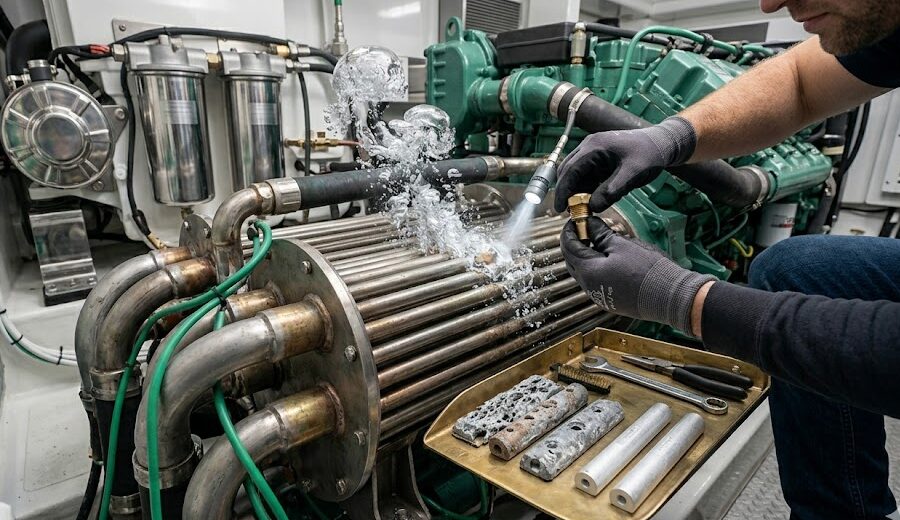
Most yacht owners understand the importance of replacing sacrificial zinc anodes on propellers, shafts, trim tabs, and other underwater metals. However, some of the most critical corrosion protection devices on a vessel are hidden deep inside the engine’s cooling system where they are rarely seen and often forgotten.
These small sacrificial anodes, commonly called marine engine pencil anodes, play a vital role in protecting expensive cooling system components from galvanic corrosion. Despite their relatively low cost, neglected pencil anodes can contribute to costly failures involving heat exchangers, oil coolers, aftercoolers, and raw water cooling systems.
Unfortunately, because they are installed inside cooling passages, many boat owners never inspect them until performance issues or corrosion damage begin to appear.
Understanding how pencil anodes work, how quickly they can deteriorate, and when they should be replaced can help prevent expensive repairs and extend the life of critical marine engine components.
What Are Marine Engine Pencil Anodes?
Marine engine pencil anodes are small sacrificial zinc, aluminum, or magnesium rods installed inside raw water cooling systems to protect metal components from galvanic corrosion.
Unlike external hull anodes that protect underwater hardware, pencil anodes are specifically designed to safeguard internal cooling system components exposed to seawater.
Common installation locations include:
- Heat exchangers
- Oil coolers
- Aftercoolers
- Transmission coolers
- Raw water cooling circuits
- Generator cooling systems
Although small in size, these anodes often protect some of the most expensive components aboard a yacht.
Why Cooling Systems Need Corrosion Protection
Raw water cooling systems continuously circulate seawater through engine cooling components.
Saltwater is highly conductive and creates an environment where galvanic corrosion can occur whenever dissimilar metals are present.
Without adequate protection, corrosion may attack:
- Heat exchanger tubes
- Cooler housings
- Bronze components
- Copper alloys
- Aluminum cooling assemblies
Over time, this corrosion can compromise cooling efficiency and lead to expensive component failures.
How Marine Engine Pencil Anodes Work
Pencil anodes function using the same electrochemical principles as traditional sacrificial zincs.
The anode intentionally corrodes before the surrounding metal components.
As the anode gradually deteriorates, it sacrifices itself to protect more valuable cooling system materials.
This controlled corrosion process helps prevent damage to:
- Heat exchangers
- Cooling tubes
- Cooler end caps
- Raw water passages
- Internal metal surfaces
When the anode is fully consumed, however, the protected components become vulnerable.
The Importance of Heat Exchanger Zinc Replacement
One of the most common maintenance tasks involving internal anodes is heat exchanger zinc replacement.
Heat exchangers transfer heat from engine coolant to seawater and contain numerous metal surfaces that require protection.
As pencil anodes deteriorate, they lose their ability to shield these components from corrosion.
Routine heat exchanger zinc replacement helps:
- Protect internal cooling passages
- Reduce corrosion risks
- Extend heat exchanger lifespan
- Support efficient cooling performance
- Prevent costly repairs
Considering the cost of replacing a damaged heat exchanger, routine anode replacement is one of the most economical maintenance procedures available.
Understanding Pencil Zinc Wear
One of the challenges associated with internal anodes is that deterioration often occurs out of sight.
Pencil zinc wear can vary significantly depending on:
- Water salinity
- Engine usage
- Water temperature
- Electrical conditions
- Cooling system design
Some pencil anodes may last a full season, while others can become heavily depleted in a much shorter period.
Regular inspections are the only reliable way to determine actual anode condition.
Warning Signs of Excessive Pencil Zinc Wear
Several indicators may suggest internal anodes require inspection or replacement.
- Significant zinc depletion
- Broken anode cores
- Heavy scaling
- Corrosion deposits
- Cooling system performance issues
- Visible metal deterioration
Even if no symptoms are present, preventive inspection remains the best approach.
The Role of the Inboard Raw Water Cooling Anode
The inboard raw water cooling anode is specifically designed to protect components exposed directly to seawater circulation.
These systems often include:
- Main propulsion engines
- Generators
- Air conditioning systems
- Auxiliary engines
- Hydraulic coolers
Because seawater flows continuously through these systems, corrosion protection is essential.
Failure of an inboard raw water cooling anode can expose expensive cooling equipment to accelerated deterioration.
What Happens When Pencil Anodes Are Neglected?
Ignoring internal anodes can create a cascade of maintenance problems.
Potential consequences include:
- Heat exchanger damage
- Cooling tube corrosion
- Reduced cooling efficiency
- Engine overheating
- Coolant contamination
- Costly component replacement
In severe cases, internal corrosion can require major repairs that far exceed the cost of routine anode maintenance.
How Often Should Pencil Anodes Be Inspected?
Inspection frequency depends on vessel usage and operating conditions.
Many manufacturers recommend checking pencil anodes during routine service intervals.
Factors influencing inspection schedules include:
- Operating hours
- Saltwater exposure
- Engine type
- Local water conditions
- Previous wear rates
The American Boat and Yacht Council (ABYC) emphasizes the importance of routine corrosion protection maintenance as part of comprehensive vessel care.
Comparing New and Worn Pencil Anodes
| Condition | Protection Level | Recommended Action |
|---|---|---|
| New Anode | Maximum Protection | Monitor routinely |
| Moderately Worn | Reduced Protection | Increase inspection frequency |
| Heavily Depleted | Minimal Protection | Replace immediately |
| Completely Consumed | No Protection | Inspect for corrosion damage |
Waiting until complete depletion often increases the risk of cooling system damage.
Why Pencil Anodes Are Often Overlooked
Several factors contribute to neglect.
- Hidden installation locations
- Lack of awareness
- No obvious visual indicators
- Assumption that external zincs provide sufficient protection
- Infrequent cooling system inspections
Because these components are out of sight, they are frequently omitted from maintenance routines.
Best Practices for Marine Engine Pencil Anode Maintenance
- Inspect anodes regularly
- Follow manufacturer recommendations
- Replace heavily depleted anodes promptly
- Document inspection intervals
- Check all cooling system protection points
- Inspect surrounding components during service
Consistent maintenance helps maximize protection and reduce unexpected repair costs.
Common Mistakes Boat Owners Make
Assuming External Zincs Protect Internal Components
External hull anodes and internal cooling system anodes perform different protective functions.
Replacing Anodes Only After Problems Develop
Preventive maintenance is far less expensive than repairing corrosion damage.
Ignoring Manufacturer Service Intervals
Recommended inspection schedules are designed to prevent excessive anode depletion.
Inspecting Only the Main Engines
Generators and auxiliary systems often contain pencil anodes that require maintenance as well.
Failing to Monitor Pencil Zinc Wear Trends
Tracking wear rates helps establish effective maintenance schedules.
Frequently Asked Questions
What are marine engine pencil anodes?
Marine engine pencil anodes are small sacrificial corrosion protection devices installed inside raw water cooling systems to protect heat exchangers and other cooling components.
Why is heat exchanger zinc replacement important?
Replacing depleted zincs helps prevent corrosion inside heat exchangers and extends the lifespan of expensive cooling system equipment.
How quickly does pencil zinc wear occur?
Pencil zinc wear varies depending on salinity, operating conditions, water temperature, and electrical activity within the system.
What does an inboard raw water cooling anode protect?
These anodes protect internal cooling system components that are exposed to circulating seawater.
Can worn pencil anodes cause engine problems?
Yes. Severe corrosion resulting from depleted anodes can damage cooling system components and potentially contribute to overheating issues.
How often should pencil anodes be inspected?
Inspection intervals vary by manufacturer and operating conditions, but routine checks during scheduled maintenance are strongly recommended.
Conclusion
While they may be small and hidden from view, marine engine pencil anodes play a critical role in protecting expensive cooling system components from corrosion. Neglecting routine heat exchanger zinc replacement can expose heat exchangers, coolers, and internal passages to costly damage that often develops silently over time.
By monitoring pencil zinc wear and maintaining every inboard raw water cooling anode within the vessel’s cooling systems, owners can significantly reduce corrosion risks and extend the service life of critical engine components. In many cases, replacing a low-cost pencil anode is one of the most effective investments in long-term engine reliability.
Schedule a Professional Cooling System Inspection
If your yacht’s pencil anodes have not been inspected recently, now is the ideal time to evaluate their condition. Professional marine technicians can inspect cooling systems, assess anode wear, identify corrosion risks, and help ensure your engines remain protected. Contact a qualified marine service specialist today to schedule a cooling system inspection and protect your investment before hidden corrosion becomes a costly repair.
