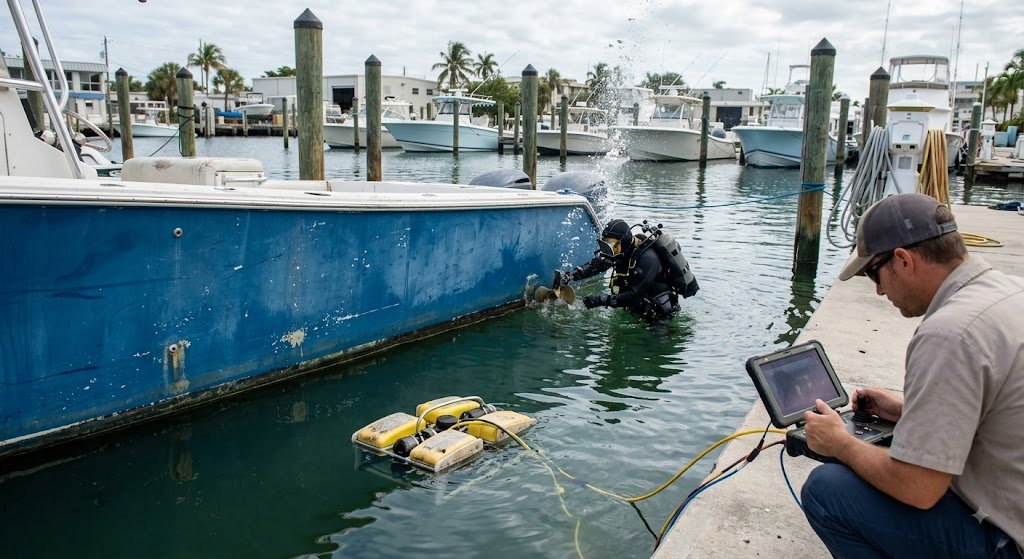
When a vessel needs an underwater inspection, the first question is often simple: should you send a diver into the water or deploy an underwater robot? The answer depends on what you need to see, where the vessel is located, water conditions, and whether the inspection requires hands-on access. Comparing ROV vs commercial diver inspections helps vessel owners choose the right method without paying for technology that cannot answer the actual maintenance question.
Both approaches have a place in modern marine inspection. An ROV can provide live video without putting a person underwater, while a trained commercial diver can physically examine surfaces, reach difficult areas, and identify conditions that may be difficult to interpret through a camera alone.
What Is an ROV Underwater Inspection?
An ROV underwater inspection uses a remotely operated vehicle connected to a surface control station by a tether to inspect submerged structures without placing a diver in the water. The vehicle typically carries cameras, lights, and other sensors, allowing an operator to transmit live video and inspection data to personnel on the surface.
The National Oceanic and Atmospheric Administration (NOAA) explains that ROVs are tethered underwater vehicles controlled from the surface and are commonly used for vessel hull inspections and other underwater surveys.
What Does a Commercial Diver Bring to an Inspection?
A commercial diver provides something an underwater camera cannot: direct physical access and human sensory feedback. A trained diver can feel surface irregularities, identify loose or damaged components, manipulate accessible equipment, and examine an area from different angles without depending entirely on the ROV’s position and camera view.
A professional Underwater Inspection can therefore be especially useful when the condition of the structure is difficult to judge visually or when the inspection requires hands-on assessment.
ROV vs Commercial Diver: Which Is Better?
ROV vs commercial diver is not a question of which technology is universally better. ROVs are often advantageous for repeatable visual surveys, deep or hazardous environments, and situations where keeping personnel out of the water is preferred. Commercial divers are often better when physical contact, close-up assessment, manipulation, or detailed hands-on examination is required.
In many professional operations, the strongest approach is not choosing one permanently. It is selecting the inspection method that matches the specific task and using both when the initial visual survey identifies an area that needs closer examination.
Advantages of Underwater Drone Inspection
An underwater drone inspection can be an efficient way to obtain visual information without putting a diver underwater. Modern ROVs can carry high-definition cameras, powerful lights, sonar, and other sensors depending on the vehicle and inspection scope.
Key advantages include:
- No diver exposure to the underwater environment.
- Live video transmitted directly to the surface.
- Longer continuous operating periods than a typical single dive.
- Useful access in deep or hazardous locations.
- Repeatable visual documentation.
- Potentially lower logistical requirements for certain inspections.
NOAA notes that ROVs are particularly useful where human diving is impractical or dangerous, including deeper environments and areas containing submerged hazards.
When an ROV Makes Sense
ROVs can be particularly useful for initial condition assessments, large structures, deep-water inspections, propeller and hull documentation, and situations where the primary requirement is high-quality visual evidence.
DNV has also used ROVs for in-water bottom surveys, demonstrating that remote inspection can be incorporated into formal marine survey processes when the applicable requirements and conditions are satisfied.
Advantages of Diver Hull Inspection
A diver hull inspection puts an experienced technician directly beside the structure. That can make a major difference when the question is not simply “What does this look like?” but “What does this component feel like, how secure is it, and what is happening beneath the surface?”
Advantages can include:
- Direct tactile examination.
- Ability to work around complex underwater geometry.
- Hands-on examination of accessible components.
- Ability to identify loose, damaged, or moving parts.
- Greater flexibility when an unexpected problem is discovered.
- Potential for certain underwater maintenance tasks during the same mobilization.
For example, if a diver discovers a loose anode, damaged grate, fouled intake, or questionable fitting during an inspection, the technician can often investigate the surrounding area immediately instead of repositioning a vehicle and interpreting the problem remotely.
Marine Robotic Survey: Where ROVs Have an Edge
A marine robotic survey becomes particularly attractive when safety, depth, repeatability, or documentation are major concerns. An ROV keeps the operator on the surface while the vehicle enters the water.
The NOAA Ocean Exploration ROV program describes ROVs as tethered systems capable of transmitting live video and other information back to surface operators.
For commercial vessels, this can make ROVs valuable for preliminary surveys and inspections where the main objective is to identify areas requiring further attention.
However, an ROV does not automatically make an inspection better. Poor visibility, heavy marine growth, strong current, limited maneuverability, or an unsuitable camera angle can make interpretation difficult.
ROV Hull Survey Limitations
An ROV hull survey has limitations that should be understood before it is selected as the only inspection method.
Common challenges include:
- Limited visibility in turbid water.
- Difficulty interpreting surfaces covered with marine growth.
- Camera perspective limitations.
- Difficulty physically testing loose components.
- Current affecting vehicle stability.
- Tether management around complex structures.
- Inability to perform certain hands-on inspection tasks.
The American Bureau of Shipping (ABS) recognizes ROVs as one of several remote inspection techniques but emphasizes that the technology must be appropriate for the specific survey task.
Autonomous Underwater Inspection vs. ROV Inspection
It is also important not to confuse an ROV with an autonomous underwater vehicle (AUV). An ROV remains connected to an operator through a tether, while an AUV generally operates independently without a connecting cable.
Autonomous underwater inspection can be useful for missions involving mapping, data collection, and predefined survey routes. However, an AUV is not automatically the best tool for a close inspection of a particular damaged component.
For vessel maintenance, the choice should follow the inspection objective rather than the novelty of the technology.
When a Diver and ROV Work Together
There are situations where the best answer is both technologies.
An ROV can perform an initial visual survey and document the general condition of the hull. If the operator identifies an area of concern, a diver can then perform a closer examination.
This staged approach can reduce unnecessary diver exposure while preserving the benefits of hands-on inspection where it matters.
DNV’s guidance on remote inspection techniques explains that remote methods can improve safety and efficiency, but the quality of information obtained must be adequate for the intended survey. In some circumstances, additional close-up examination may still be required.
The International Maritime Organization (IMO) has also continued developing guidance for the safe use of remote inspection tools, including drones and robotic devices, during ship structural inspections.
Choosing the Right Inspection Method
Before booking an inspection, define what you actually need to know.
| Inspection Need | ROV | Commercial Diver |
|---|---|---|
| General visual survey | Strong option | Strong option |
| Deep or hazardous location | Often advantageous | May be restricted |
| Hands-on examination | Limited | Strong option |
| Live video documentation | Strong option | Strong option with suitable equipment |
| Manipulating accessible components | Depends on vehicle capability | Strong option |
| Heavy marine growth | Visual limitations possible | Can physically assess the surface |
| Follow-up maintenance | Limited unless specially equipped | Often possible |
The table is a general planning guide, not a substitute for the requirements of a class society, flag administration, insurer, or vessel-specific inspection procedure.
What About Formal Commercial Vessel Surveys?
For commercial vessels, the distinction between a convenient inspection and a credited statutory or class survey is critical. An ROV or diver may be technically capable of collecting useful information, but whether that information satisfies a particular survey requirement depends on the applicable rules and the attending organization.
DNV states that in-water bottom surveys may be carried out by divers or ROVs under defined conditions and surveyor supervision. ABS similarly provides for ROV use in certain underwater inspection contexts when the conditions are suitable and the attending surveyor accepts the examination as equivalent.
The IACS Unified Requirement Z17 also addresses service suppliers performing in-water surveys using divers or ROVs and includes requirements concerning personnel qualification and training.
Common Mistakes When Choosing an Inspection Method
- Choosing an ROV simply because it sounds more advanced.
- Choosing a diver without considering depth, current, visibility, or other hazards.
- Assuming an ROV video automatically satisfies a class or insurance requirement.
- Failing to define the inspection objective before mobilization.
- Ignoring marine growth that can hide the actual hull surface.
- Assuming every ROV has the same camera, lighting, sonar, or maneuverability.
- Failing to document findings consistently for future comparison.
Frequently Asked Questions
Is an ROV better than a commercial diver for hull inspections?
Neither method is universally better. An ROV is often valuable for visual surveys, hazardous environments, and repeatable video documentation, while a commercial diver provides direct physical access and hands-on assessment. The correct choice depends on the vessel, water conditions, inspection objective, and applicable survey requirements.
Can an ROV replace a commercial diver?
An ROV can replace a diver for some visual inspection tasks when the equipment, conditions, and applicable rules allow it. It cannot perform every hands-on task a diver can perform, and some inspections may require physical examination or additional close-up assessment by a qualified diver.
Are ROV inspections accepted for commercial vessel surveys?
ROV inspections can be accepted for certain commercial vessel surveys when the applicable class, flag, or statutory requirements permit remote inspection and the required surveyor accepts the quality of the examination. Acceptance is scope-specific and should be confirmed before the inspection.
What can a diver see that an ROV cannot?
A diver can physically feel surfaces, assess movement or looseness, manipulate accessible components, and investigate unexpected conditions from multiple angles. These hands-on capabilities can be important when a visual image alone cannot establish the condition of a component.
When should I use both an ROV and a diver?
Using both can make sense when an ROV provides an efficient initial visual survey and identifies areas that require closer examination. A diver can then investigate specific findings hands-on, reducing unnecessary diver exposure while preserving detailed inspection capability.
For more practical guidance on underwater inspections, marine maintenance, and vessel protection, visit our blog and marine resources.
Conclusion
Choosing between an ROV and a diver should start with the inspection question, not the equipment. ROV vs commercial diver is ultimately a comparison of capabilities: ROVs offer remote visual access, documentation, and reduced personnel exposure, while commercial divers provide direct physical examination and hands-on flexibility. For many vessels, the most effective strategy is to use the right tool for each stage of the inspection and bring in a diver when visual evidence alone is not enough.
Ready to protect your vessel?
If you need expert help with this, our team of certified divers and marine technicians is ready to step in. Learn more about our specific services here.
Prefer to speak with an expert immediately? Contact us today to schedule a service or get a free quote!
