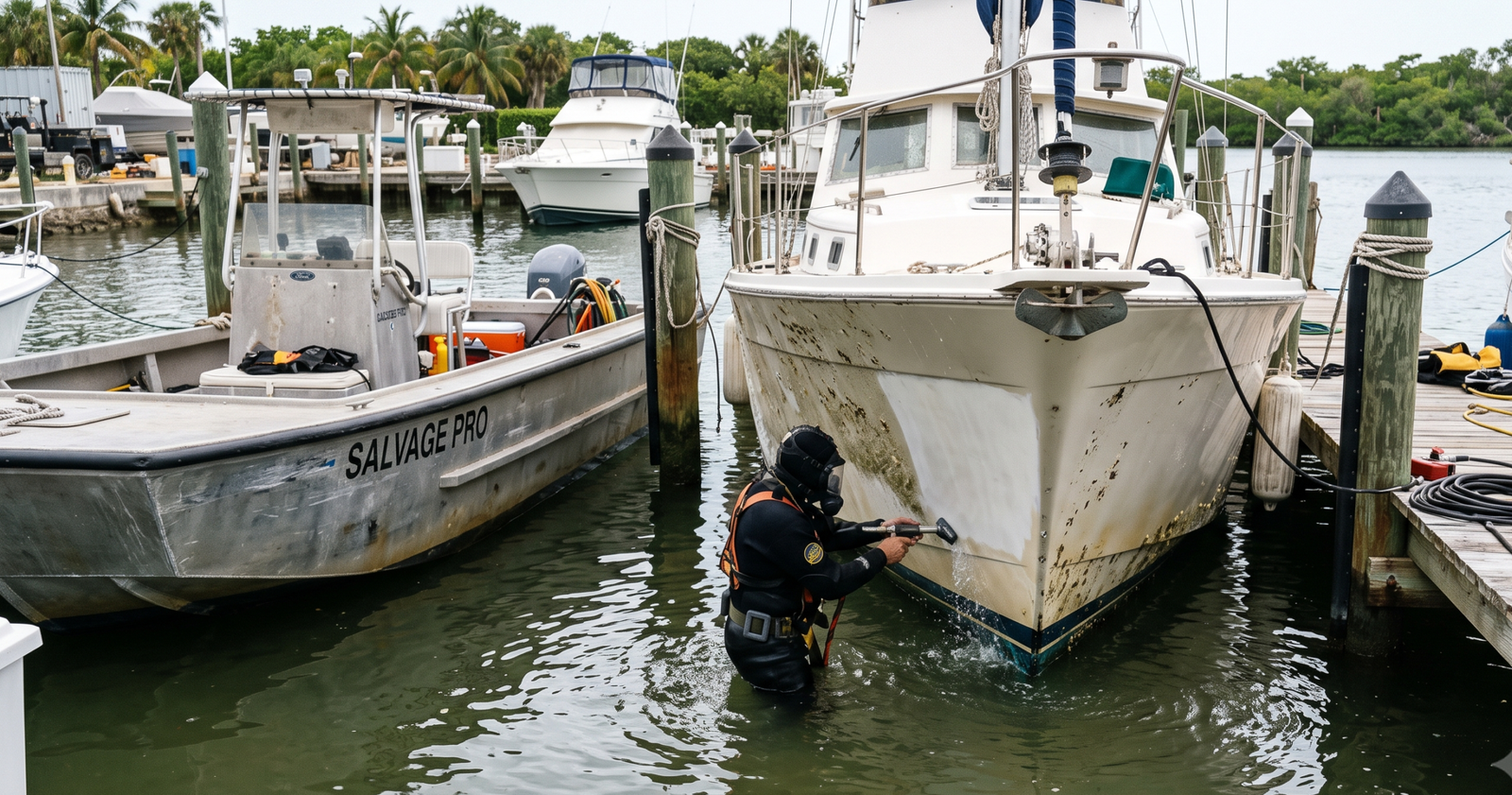
Underwater hull cleaning is not simply a matter of using more water pressure to remove more growth. The cleaning method has to match the type of fouling, the hull coating, the vessel’s construction, and the environmental requirements of the location. That is where the difference between cavitation vs pressure washing becomes important.
Traditional pressure washing relies primarily on the mechanical impact of a high-velocity water stream. Cavitation jet technology uses a specially designed nozzle to create microscopic vapor bubbles within the water stream. As those bubbles collapse near the surface, they generate localized forces that help detach marine growth. Research comparing underwater hull-cleaning technologies identifies both high-pressure and cavitating water jets as established approaches, while also emphasizing that operating parameters and coating compatibility determine the risk of surface damage. :contentReference[oaicite:0]{index=0}
What Is Cavitation Jet Cleaning?
Cavitation jet cleaning is an underwater cleaning method that introduces cavitation into a pressurized water stream through a specialized nozzle. The resulting bubbles collapse near the fouled surface and create localized pressure effects that help loosen marine growth without relying solely on extremely high continuous water pressure.
Traditional water jets primarily use the kinetic energy of the moving water. Cavitating systems modify that water flow so that bubble formation and collapse contribute additional cleaning energy.
The distinction is important because a cavitation system is still a water-jet system. It should not be described as a completely pressure-free cleaning process or as a technology that can never damage a coating. Cavitation itself can be erosive when the equipment is incorrectly positioned or operated at unsuitable parameters. :contentReference[oaicite:1]{index=1}
Cavitation vs. Pressure Washing: How They Work Differently
| Factor | Cavitation Jet | Traditional Pressure Washing |
|---|---|---|
| Primary cleaning mechanism | Cavitation bubble formation and collapse combined with water-jet energy | Direct impact from a high-velocity water stream |
| Pressure strategy | Designed to generate additional localized cleaning energy through cavitation | Relies primarily on increasing water pressure and flow |
| Surface contact | Non-contact cleaning method | Non-contact cleaning method |
| Coating considerations | Requires correct nozzle position, distance, pressure, and dwell time | Requires careful pressure selection and nozzle control |
| Best application | Selected fouling and surfaces where controlled underwater cleaning is appropriate | Broad range of cleaning applications when the surface can safely tolerate the selected pressure |
The underlying principle is supported by published research. A review in the Journal of Marine Science and Application describes cavitating water jets as an improved form of high-pressure water cleaning in which specialized nozzles generate cavitation bubbles that collapse near the hull and produce high local stresses. :contentReference[oaicite:2]{index=2}
Why Traditional Pressure Washing Can Be Aggressive
Traditional marine pressure washing can become aggressive when excessive pressure, an unsuitable nozzle, an incorrect stand-off distance, or prolonged dwell time is used against a vulnerable hull coating.
More pressure does not automatically mean better cleaning. A pressure level that removes hard barnacles quickly may also remove or disturb antifouling coating, particularly if the operator remains focused on one area for too long.
Research on underwater hull cleaning has found that high-pressure water cleaning can be effective but requires professional control, while different hull surfaces and coatings require different operating parameters. :contentReference[oaicite:3]{index=3}
Military underwater-cleaning guidance makes the same basic point from another perspective: the least aggressive brush, disc, or water-jet configuration that effectively cleans the particular surface should be used. :contentReference[oaicite:4]{index=4}
How Cavitation Water Jets Remove Marine Fouling
Inside a cavitation nozzle, changes in water velocity and pressure encourage the formation of microscopic bubbles. When those bubbles collapse near the hull, the collapse produces localized pressure effects that help break the attachment between fouling organisms and the surface.
This gives the cavitation water jet a different cleaning profile from an ordinary continuous-pressure stream.
The technology can be particularly useful for biological fouling because the cleaning energy is concentrated around the attachment area rather than relying exclusively on increasing the continuous pressure of the water stream.
However, the physics also explains why operator control matters. Published experimental research has demonstrated that cavitation jets can cause measurable surface damage when parameters are poorly selected. Jet pressure, incident angle, and stand-off distance all influence the resulting surface effects. :contentReference[oaicite:5]{index=5}
Is Cavitation Really Zero-Damage Boat Washing?
No underwater cleaning technology should be marketed as universally zero-damage.
Cavitation can reduce the need for extremely high continuous water pressure in some applications, but the technology still has enough localized energy to affect coatings and substrates when improperly applied.
A 2023 experimental study specifically examined cavitation-jet damage during marine-fouling removal and found that both jet pressure and incident angle affected surface damage and roughness. :contentReference[oaicite:6]{index=6}
That is why the more accurate goal is controlled, coating-conscious cleaning rather than an absolute promise of zero damage.
The operator needs to know what is being cleaned before selecting the equipment settings. A hard fouling layer on a robust surface may tolerate a different approach from delicate or deteriorated antifouling paint.
When Cavitation Cleaning Has an Advantage
Cavitation technology can be advantageous when an underwater cleaning operation benefits from concentrated cleaning energy while avoiding reliance on extremely high continuous pressure.
Potential advantages include:
- Effective removal of selected marine fouling.
- Non-contact cleaning.
- Reduced dependence on extremely high continuous water pressure in suitable applications.
- Ability to reach underwater surfaces without bringing the vessel into dry dock.
- Compatibility with specialized diver-operated or mechanized cleaning equipment.
A review of underwater hull-cleaning technologies describes cavitating water jets as capable of producing greater cleaning power than conventional high-pressure water jets operating at the same pump pressure because of the additional effects generated by bubble collapse. :contentReference[oaicite:7]{index=7}
When Traditional Pressure Washing Still Makes Sense
Traditional pressure washing remains useful for many marine maintenance applications. It is familiar, widely available, and can be highly effective when the pressure and equipment are correctly matched to the surface.
It may be appropriate for:
- Removing loose surface contamination.
- Cleaning suitable unpainted underwater components.
- Preparing accessible surfaces for additional maintenance.
- Removing fouling where the existing coating can safely tolerate the selected pressure.
- Applications where conventional water-jet equipment is already appropriate.
The key is not whether pressure washing is inherently bad. It is whether the marine pressure washer is being used with the correct pressure, nozzle, distance, angle, and technique for the surface being cleaned.
Protecting Antifouling Coatings During Underwater Cleaning
A boat’s bottom coating should be treated as part of the cleaning decision, not as an afterthought.
Before cleaning, determine:
- What type of antifouling coating is installed.
- How old the coating is.
- Whether the coating is intact or already deteriorating.
- What type of fouling is present.
- Whether previous cleaning has already worn the coating.
- Whether the hull manufacturer or coating manufacturer specifies cleaning restrictions.
Published reviews note that underwater cleaning can damage coatings and that process optimization is essential for minimizing that damage. :contentReference[oaicite:8]{index=8}
For an older hull with thin or deteriorating antifouling paint, the correct answer may be a less aggressive cleaning method rather than simply switching to a more powerful machine.
Soft Fouling vs. Hard Fouling
The type of growth matters just as much as the equipment.
Soft Fouling
Slime, algae, and other soft growth generally require less mechanical energy than firmly attached barnacles and shell organisms. An appropriately controlled cleaning method can remove this material without unnecessarily attacking the underlying coating.
Hard Fouling
Barnacles, tubeworms, mussels, and other hard growth can require considerably more cleaning energy. The temptation is to increase pressure until the growth disappears, but that can also increase the likelihood of coating damage.
The International Maritime Organization’s GreenVoyage2050 program notes that marine fouling increases hull roughness and drag and that heavy hard fouling can contribute to turbulence and other performance problems. :contentReference[oaicite:9]{index=9}
Why Professional Technique Matters More Than Equipment Alone
A sophisticated cleaning system does not automatically produce a safe result. The operator controls how that equipment interacts with the hull.
Important variables include:
- Nozzle selection
- Jet pressure
- Stand-off distance
- Incident angle
- Travel speed
- Time spent over one area
- Type and condition of the coating
- Type and thickness of fouling
Experimental research on cavitation cleaning confirms that these variables can materially affect both cleaning performance and surface damage. :contentReference[oaicite:10]{index=10}
This is one reason professional Cavitation Cleaning should be approached as a controlled maintenance procedure rather than simply choosing the strongest available jet.
Environmental Considerations for Underwater Cleaning
There is another issue that is easy to overlook: removing fouling underwater does not automatically make the operation environmentally acceptable.
Detached organisms, fragments, and biological material can enter the surrounding water. In some ports and waterways, in-water hull cleaning is restricted or prohibited because of the risk of releasing biological material or contaminants.
The International Maritime Organization notes that underwater hull cleaning may not be permitted in many ports because of contamination risks to local aquatic life. :contentReference[oaicite:11]{index=11}
Modern systems can incorporate collection and filtration to reduce the discharge of removed material. Yanmar’s recently developed underwater hull-cleaning ROV, for example, incorporates collection and filtration of material removed during cleaning. :contentReference[oaicite:12]{index=12}
Before scheduling underwater cleaning, always confirm the requirements of the marina, port, waterway, and applicable environmental authority.
Choosing Between Cavitation and Pressure Washing
There is no universal winner in the cavitation vs pressure washing comparison. The better method depends on the actual cleaning job.
| Situation | Preferred Consideration |
|---|---|
| Light slime | Use the least aggressive effective cleaning method. |
| Heavy hard fouling | Consider specialized equipment matched to the fouling and coating. |
| Delicate or deteriorated coating | Prioritize coating protection over maximum cleaning force. |
| Unpainted metal components | Pressure or cavitation may be appropriate depending on the component and manufacturer requirements. |
| Environmentally sensitive waterway | Confirm containment and discharge requirements before cleaning. |
| Complex underwater geometry | Specialized diver-operated equipment may provide better control. |
Common Mistakes With Underwater Cleaning Methods
- Assuming higher pressure always produces a better result.
- Calling cavitation “zero damage” under every operating condition.
- Using the same settings on every hull and coating.
- Ignoring the condition and remaining thickness of antifouling paint.
- Holding a jet in one location for too long.
- Failing to adjust technique for hard versus soft fouling.
- Cleaning underwater without checking local environmental restrictions.
- Focusing on the hull while ignoring propellers, shafts, rudders, and other underwater components.
Frequently Asked Questions
Is cavitation cleaning safer than pressure washing?
Cavitation cleaning can reduce the need for extremely high continuous water pressure in appropriate applications, but it is not inherently damage-proof. Both methods require the correct pressure, nozzle, distance, angle, and operating technique. Cavitation jets can also erode surfaces when incorrectly applied. :contentReference[oaicite:13]{index=13}
Does cavitation cleaning damage bottom paint?
It can if the equipment is improperly configured or used. Cavitation creates highly localized forces, and published research has demonstrated that pressure, incident angle, and stand-off distance affect surface damage. Properly controlled cleaning should therefore be matched to the specific coating and fouling condition. :contentReference[oaicite:14]{index=14}
Is pressure washing safe for a boat hull?
It can be safe when the pressure, nozzle, distance, and cleaning technique are appropriate for the hull and its coating. Excessive pressure or an unsuitable technique can remove or damage coating, so the least aggressive effective method should be selected.
What is the main advantage of a cavitation water jet?
The main advantage is that cavitation adds localized cleaning energy through bubble formation and collapse, allowing the system to remove fouling without relying solely on the direct impact of a conventional high-pressure water stream. :contentReference[oaicite:15]{index=15}
Can cavitation cleaning remove barnacles?
Cavitation water jets can be used to remove marine fouling, including hard fouling, but the appropriate equipment and operating parameters depend on the attachment strength, hull coating, and surface condition. Harder fouling generally requires more controlled cleaning energy than a simple slime layer. :contentReference[oaicite:16]{index=16}
Conclusion
Cavitation vs pressure washing is not simply a contest between two pieces of equipment. Both technologies can be effective underwater cleaning methods when correctly matched to the surface and fouling. Traditional pressure washing relies primarily on water-jet impact, while cavitation jet technology adds the effects of controlled bubble formation and collapse. That can provide substantial cleaning energy without necessarily requiring the same continuous pressure, but cavitation is not a universal zero-damage solution.
The safest approach is to evaluate the hull coating, fouling type, underwater components, environmental requirements, and cleaning objective before selecting the technique. When the process is controlled by experienced technicians, the goal is not merely to make the hull look clean—it is to remove fouling while preserving the surface underneath.
For more information about underwater cleaning and marine maintenance, visit our blog and marine resources.
Ready to protect your vessel?
If you need expert help with this, our team of certified divers and marine technicians is ready to step in. Learn more about our specific services here.
Prefer to speak with an expert immediately? Contact us today to schedule a service or get a free quote!
