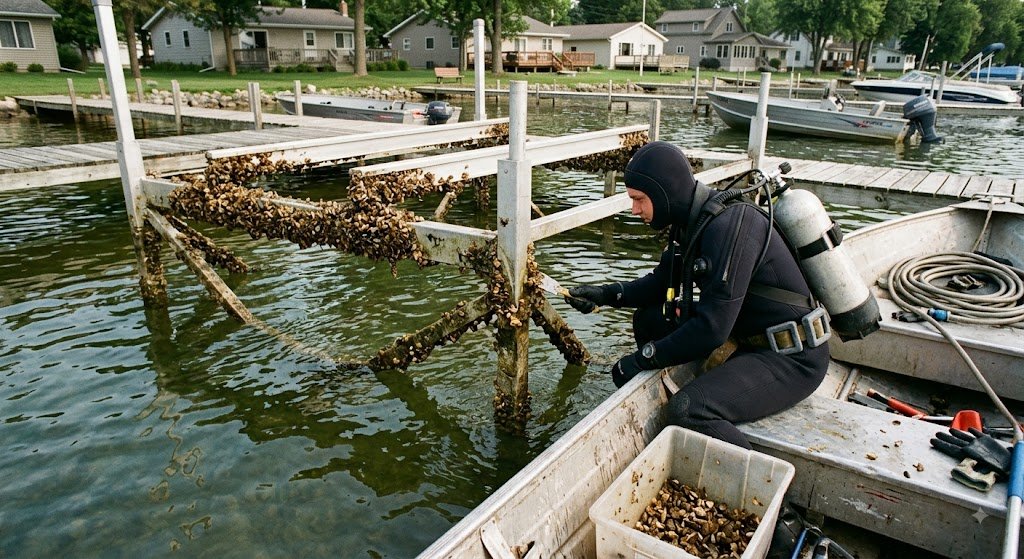
A freshwater marina can look perfectly clean from the dock while zebra mussels cover the underwater parts of a boat lift, piling, or dock frame. What starts as a few small shells can become a dense colony that adds weight, interferes with moving equipment, and creates a serious invasive-species management problem. Professional zebra mussel boat lift cleaning requires more than simply knocking the mussels loose and leaving them in the water.
If your boat lift or dock sits in an infested lake, the maintenance challenge is twofold: remove the existing infestation safely and prevent live mussels or contaminated material from being transported to another waterbody.
What Is Zebra Mussel Boat Lift Removal?
Zebra mussel boat lift removal is the controlled inspection and physical removal of zebra mussels from submerged lift components, dock structures, pilings, and related equipment while following local aquatic invasive species requirements for containment, disposal, and decontamination. The objective is not simply to make the structure look clean. It is to prevent viable mussels and contaminated debris from spreading while restoring the equipment’s condition.
Zebra mussels (Dreissena polymorpha) are invasive freshwater mussels originally native to Eurasia. The National Invasive Species Information Center identifies them as an invasive species that can compete with native organisms and clog pipes and other infrastructure.
Why Zebra Mussels Attach to Boat Lifts and Pilings
Zebra mussels attach firmly to hard underwater surfaces using byssal threads. Boat lifts, metal frames, concrete pilings, dock brackets, cables, and other submerged components provide extensive attachment area.
Unlike a boat hull that regularly moves through the water, a stationary lift or piling remains in the same environment year after year. That gives mussels an opportunity to establish dense colonies.
Common infestation locations include:
- Boat lift frames
- Lift bunks and supports
- Steel pilings
- Concrete pilings
- Dock brackets
- Cables and chains
- Underwater hardware
- Intake and drainage structures
How Invasive Species Dock Removal Should Be Handled
Invasive species dock removal should be planned around containment and disposal, not simply underwater cleaning. Removing attached mussels without controlling the material can allow live organisms, larvae, or contaminated debris to remain in the water and potentially spread to another location.
Requirements differ between jurisdictions and individual waterbodies. The National Invasive Species Information Center advises boaters and equipment operators to check the relevant state or local agency before moving watercraft or equipment between waterbodies.
For marina operators, that means identifying the applicable authority before starting a removal project.
Inspect Before Removing the Mussels
Before cleaning begins, inspect the entire submerged structure. A dense layer of zebra mussels can hide corrosion, damaged welds, deteriorated coatings, loose hardware, and structural defects.
A professional inspection should document:
- Extent of mussel coverage
- Condition of the piling or lift frame
- Corrosion beneath the colony
- Condition of cables and fasteners
- Damage to protective coatings
- Areas where mussels have accumulated inside moving mechanisms
Professional Underwater Inspection services can provide photographic documentation before and after cleaning and help distinguish biological fouling from structural deterioration.
Freshwater Piling Cleaning: What Needs Attention?
Freshwater piling cleaning involves removing biological growth and accumulated debris from submerged structural surfaces while protecting the piling material and surrounding environment.
The appropriate technique depends on whether the piling is concrete, steel, timber, composite, or another material.
Concrete Pilings
Inspect for cracking, spalling, exposed reinforcement, and areas where mussels have attached heavily to deteriorated surfaces.
Steel Pilings
Look beneath mussel colonies for corrosion, pitting, coating failure, and section loss. Removing the mussels can reveal deterioration that was previously impossible to see.
Timber Pilings
Inspect for soft areas, biological deterioration, physical damage, and changes in the condition of the timber around the waterline and submerged portions.
Safe Mussel Removal Techniques
There is no single removal technique suitable for every freshwater structure. Mechanical removal may be appropriate for localized infestations, but the method should be selected based on the structure, infestation level, environmental rules, and required containment.
Possible approaches may include:
- Controlled manual removal
- Specialized scraping equipment
- Collection of detached mussels and debris
- Removal and treatment of accessible equipment on land
- Decontamination of tools and equipment
Wisconsin Department of Natural Resources guidance recognizes physical control methods such as manual removal for localized zebra mussel control while noting that such methods can be expensive and may affect native organisms. Permits may also be required for some control activities.
The Wisconsin DNR zebra mussel guidance is a useful example of why local regulations should be checked before beginning removal work.
Why Mussel Remediation Is Different From Ordinary Cleaning
Mussel remediation is not the same as routine marine or freshwater pressure washing. The goal is to control an invasive organism while protecting the structure and preventing spread.
Simply blasting a colony from a piling can create a cloud of biological material in the water. That may make the structure look cleaner, but it does not necessarily address the invasive-species problem.
For that reason, a professional project should establish how removed material will be collected, contained, transported, and disposed of before cleaning begins.
Inland Boat Lift Cleaning and Decontamination
Inland boat lift cleaning becomes particularly important when a lift or vessel is being moved between lakes. Equipment that appears clean can still carry small organisms or residual water.
The general prevention principle is often summarized as:
- Clean: Remove visible plants, animals, mud, and other material.
- Drain: Remove water from boats and equipment.
- Dry: Allow sufficient drying time where required.
Michigan’s current aquatic invasive species guidance tells boaters to inspect and remove aquatic organisms, drain water, and use appropriate drying or decontamination measures.
Wisconsin similarly requires boaters to inspect equipment and remove aquatic plants and animals before leaving the launch, with additional decontamination requirements depending on circumstances.
What About Chemical Treatment?
Chemical control of zebra mussels should never be treated as a simple DIY cleaning solution. Products intended to kill or control aquatic organisms may be regulated as pesticides, and their use in a natural waterbody can require specific authorization.
The Wisconsin DNR notes that pesticidal zebra mussel control products may require registration and permits and that chemical treatments can create risks for non-target species.
For a marina or private dock, the safest approach is to determine the applicable requirements first and use an approved control method rather than introducing chemicals into the water without authorization.
Lake Dock Maintenance After Zebra Mussel Removal
Removing the visible colony is only the beginning. Regular lake dock maintenance helps identify new settlement before it becomes a large infestation.
Maintenance inspections should check:
- Lift frames and moving parts
- Dock supports
- Pilings
- Cables and chains
- Underwater brackets
- Boat hulls
- Intakes and other niche areas
For structures that remain in the water throughout the year, scheduled Underwater Inspection can establish a useful record of changing conditions.
Common Mistakes During Zebra Mussel Removal
- Knocking mussels into the water without a containment plan.
- Moving contaminated lift equipment to another lake.
- Failing to check local invasive-species regulations.
- Ignoring mussels hidden inside lift mechanisms.
- Cleaning the structure without inspecting for corrosion underneath.
- Using chemical control without confirming that it is legally permitted.
- Assuming a visibly clean lift is automatically free of invasive organisms.
- Failing to clean and dry tools after working in an infested waterbody.
Frequently Asked Questions
How do you remove zebra mussels from a boat lift?
Zebra mussels should be removed using a controlled method appropriate for the lift and local regulations, with detached mussels and debris contained for proper disposal. The structure should be inspected for hidden corrosion or damage, and the lift and tools should be decontaminated before moving them to another waterbody.
Can zebra mussels damage boat lifts and pilings?
Zebra mussels can accumulate in dense colonies on submerged structures and add biological fouling that interferes with equipment and maintenance. More importantly, their colonies can conceal corrosion, coating failure, cracks, and other structural problems that need inspection after removal.
Can I pressure wash zebra mussels off a dock?
Pressure washing may physically remove mussels, but it should not be treated as an automatic solution. Detached mussels and contaminated water can spread invasive organisms, and excessive pressure can damage coatings or the structure. Follow local decontamination and containment requirements before using this method.
What should I do if my boat lift has zebra mussels?
Do not move the lift or associated equipment to another waterbody until you understand the applicable invasive-species requirements. Arrange an inspection, identify the infestation, determine an approved removal and disposal method, and decontaminate equipment before transport.
Can zebra mussels be completely eliminated from a lake dock?
Removing an existing colony from a localized structure may be possible, but preventing reattachment can be difficult in an infested waterbody. Ongoing inspection and maintenance are therefore important, particularly for boat lifts and other submerged structures that remain permanently in the lake.
For more practical guidance on underwater maintenance, marine structures, and professional inspection services, visit our blog and marine resources.
Conclusion
Zebra mussel boat lift removal requires more than making a lift or piling look clean again. Because zebra mussels are invasive organisms, the work should account for containment, disposal, decontamination, and local regulations as well as the physical condition of the structure. A careful inspection can also reveal corrosion and hidden damage beneath the colony. With scheduled freshwater piling cleaning and consistent lake dock maintenance, property owners and marina operators can manage existing fouling while reducing the risk of spreading zebra mussels to other waters.
Ready to protect your vessel?
If you need expert help with this, our team of certified divers and marine technicians is ready to step in. Learn more about our specific services here.
Prefer to speak with an expert immediately? Contact us today to schedule a service or get a free quote!
