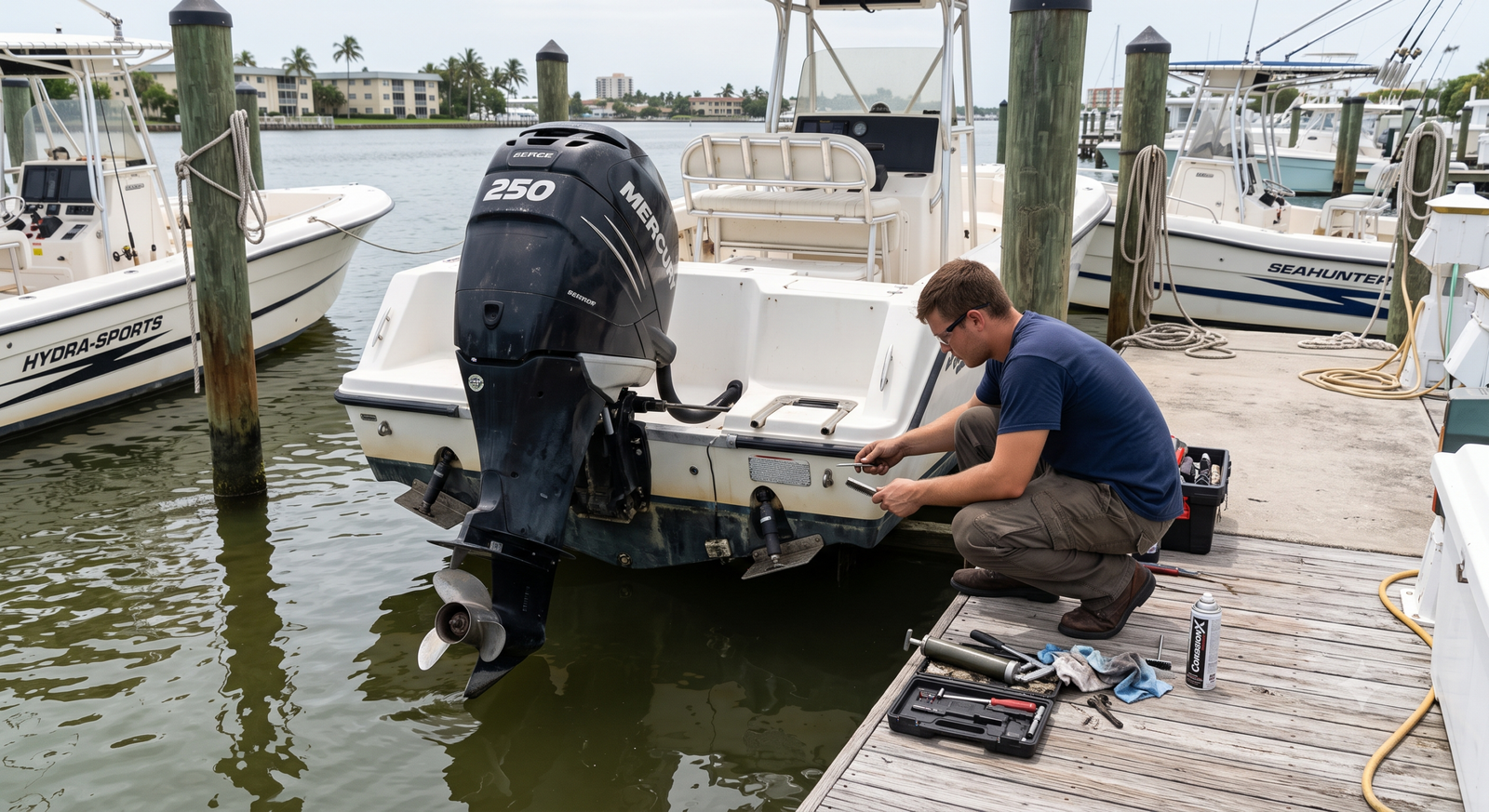
You can have a clean, well-maintained Mercury outboard and still miss one of the smallest parts protecting its most expensive underwater components. Mercury outboard anodes are designed to sacrifice themselves so galvanic corrosion attacks the anode instead of the engine’s submerged metals. For owners running in saltwater, checking these small components should be part of routine lower-unit maintenance, not something you discover after corrosion has already started.
If you operate a Mercury outboard in Florida or another saltwater environment, the inspection interval deserves extra attention. Saltwater accelerates anode erosion, and Mercury recommends checking anodes frequently and replacing them when approximately 50% of the original material has been consumed.
What Do Mercury Outboard Anodes Do?
Mercury outboard anodes are sacrificial corrosion-control components that protect submerged aluminum parts by corroding preferentially. They are commonly installed around the gearcase, transom bracket, trim components, or other designated locations, depending on the specific Mercury outboard model.
When dissimilar metals such as an aluminum lower unit and a stainless-steel propeller are immersed in conductive water, an electrochemical reaction can occur. The sacrificial anode provides a more vulnerable metal that is consumed instead of allowing the protected components to deteriorate as quickly.
Mercury explains that anodes protect aluminum components from galvanic corrosion and should be inspected regularly, particularly when an outboard operates in saltwater. Mercury’s corrosion-prevention guidance also warns that an anode showing little or no deterioration is not necessarily a good sign.
Mercury Outboard Anodes Maintenance Checklist
Use this Mercury outboard anodes checklist whenever the boat comes out of the water, and inspect anodes more frequently on boats that remain in the water. Look for material loss, marine growth, coating, loose hardware, corrosion around the mounting surface, and any visible deterioration of the anode itself.
- Locate every anode specified for your exact Mercury outboard model.
- Check the gearcase and lower-unit anodes.
- Inspect anodes mounted on the transom bracket or trim components.
- Look for excessive material loss or deep pitting.
- Check for white or chalky deposits that may cover the anode.
- Look for marine growth covering the active anode surface.
- Inspect the mounting area for corrosion or buildup.
- Confirm that the anode has good electrical contact with the protected component.
- Never paint or apply protective coating over the active anode surface.
- Replace the anode when approximately half of its original material has been consumed.
- Use the correct replacement alloy and part specified for your engine and operating environment.
- Record the inspection so you can track how quickly the anodes are being consumed.
When Should You Replace Outboard Anodes?
Mercury recommends replacing sacrificial anodes when approximately 50% of the original anode has been consumed. Waiting until the anode is completely gone removes a major part of the corrosion protection that was intended to protect the outboard.
Mercury’s maintenance guidance recommends checking anodes every time a boat comes out of the water. For boats stored on the water, Mercury recommends checking them at least monthly during the boating season. Mercury’s in-season maintenance guidance provides the same 50%-consumed replacement benchmark.
Don’t wait for an exact calendar date if the anode is already heavily depleted. Anodes are sacrificial by design, so their condition tells you something about the corrosion environment surrounding the engine.
Why Saltwater Outboard Care Requires More Frequent Anode Checks
Saltwater is a conductive electrolyte, which makes galvanic corrosion a greater concern for submerged dissimilar metals. That is why saltwater outboard care should include more frequent attention to the corrosion-control system.
Florida boat owners can be particularly familiar with this issue. Warm, conductive coastal water, long periods at the dock, stainless-steel hardware, and aluminum underwater components can create conditions where corrosion protection deserves close attention.
Mercury notes that saltwater accelerates anode erosion and recommends frequent inspection for saltwater-operated outboards. Mercury’s anode inspection guide explains why worn or missing anodes can leave lower-unit and other submerged components vulnerable.
Don’t Judge an Anode by Appearance Alone
A heavily worn anode is easy to recognize, but a clean-looking anode is not automatically healthy. Anodes can become covered with marine growth, scale, or other material that interferes with their effectiveness.
Mercury specifically advises against assuming that an anode showing no corrosion is protecting the engine properly. If anodes are not being consumed as expected, the corrosion-protection system should be evaluated rather than simply celebrated.
Inspecting the Mercury Lower Unit for Corrosion
The lower unit should be inspected whenever you check the anodes. Look for paint blistering, white powdery corrosion, exposed metal, deep pitting, damaged coating, and corrosion concentrated around fasteners or stainless-steel components.
Galvanic corrosion often becomes visible first around edges, fittings, or areas where the protective finish has been compromised. Mercury identifies paint blistering and white powdery deposits as potential signs of galvanic corrosion.
If you find significant pitting or coating failure, don’t simply install a new anode and assume the problem is solved. The underlying corrosion issue needs to be identified.
What Are the Right Mercury Marine Anodes?
One common source of confusion is the word “zinc.” Boaters often call all sacrificial anodes zincs, but the actual anode material can vary by application and operating environment.
Mercury offers sacrificial anodes made from different alloys, including aluminum. The correct material depends on the engine, water type, and Mercury’s specifications for that application.
For that reason, don’t automatically buy a zinc anode simply because someone calls the component a “zinc.” Check the engine’s owner’s manual or the applicable Mercury parts information first.
Mercury’s aluminum anode kit for certain 200–300 hp L6 Verado outboards, for example, is specified for both saltwater and freshwater use. That illustrates why the exact engine and anode application matter.
What About Verado Zincs?
“Verado zincs” is a common search term for the sacrificial anodes used on Mercury Verado outboards, but the correct replacement should be selected according to the specific Verado model and Mercury’s parts specifications rather than by the generic term “zinc.”
Different generations and horsepower ranges can use different anode configurations and replacement kits. Some Mercury Verado applications use aluminum anodes, including specific kits designed for saltwater and freshwater operation.
Before ordering, identify:
- Verado horsepower and engine family.
- Model year or serial number.
- Required anode locations.
- Specified anode alloy.
- Required mounting hardware.
Mercury’s Verado anode information shows how a complete kit can cover the factory-installed anodes on a specific engine application.
How to Inspect an Outboard Lower Unit Anode
Inspection is straightforward, but the engine should be secure and the manufacturer’s service instructions should always take priority over a generic checklist.
1. Locate the Anodes
Use your Mercury owner’s manual to identify every corrosion-control anode on your particular engine. Locations vary between models.
2. Check Material Loss
Compare the remaining anode material with its original shape and size. If roughly half has been consumed, replacement is due.
3. Check for Coating or Marine Growth
An anode covered with paint, heavy marine growth, or other insulating material may not function correctly. Mercury advises against painting anodes and recommends appropriate cleaning methods for certain deposits.
4. Inspect the Contact Area
The anode must make proper electrical contact with the metal it is intended to protect. Corrosion or buildup between the mounting surface and anode can interfere with that connection.
5. Inspect the Surrounding Lower Unit
Look for signs that corrosion may already be affecting the protected aluminum. New anodes cannot reverse metal that has already been lost.
Replacing Outboard Zinc: What Owners Should Know
Replacing an outboard zinc or other sacrificial anode involves removing the depleted anode, preparing the mounting contact area as specified by Mercury, installing the correct replacement with the appropriate hardware, and ensuring proper electrical contact. The replacement should never be painted over.
Mercury’s replacement guidance recommends replacing anodes at approximately 50% consumption and making sure the mounting surface is free of corrosion and buildup so the new anode can make good contact.
Mercury’s anode replacement guide provides model-specific considerations and emphasizes following the owner’s manual for anode locations and applicable replacement parts.
If you are not comfortable working on the lower unit, professional Zinc Replacement service can provide inspection and replacement without guessing at the condition of the corrosion-protection system.
How Often Should You Inspect Mercury Marine Anodes?
There is no single calendar interval that fits every Mercury outboard because anode consumption depends on the operating environment and the engine’s installation. Saltwater, brackish water, marina conditions, shore-power exposure, and nearby underwater metals can all affect corrosion behavior.
As a practical maintenance routine:
- Every time the boat leaves the water: visually inspect the anodes.
- Boat stored in the water: inspect at least monthly during the season.
- Saltwater operation: inspect especially closely for accelerated erosion.
- At approximately 50% consumption: replace the affected anode.
- After unusual corrosion: inspect the entire corrosion-protection system.
Mercury’s owner-maintenance guidance should remain the final authority for the exact inspection and replacement requirements of your engine. Mercury’s maintenance resources explain why the owner’s manual is the basic guide for model-specific maintenance procedures.
Common Mercury Anode Maintenance Mistakes
- Waiting until an anode has completely disappeared before replacing it.
- Assuming every sacrificial anode is made from zinc.
- Installing the wrong alloy for the application.
- Painting an anode to make it look cleaner.
- Ignoring marine growth or deposits covering the active surface.
- Failing to inspect the mounting contact area.
- Checking only the most visible lower-unit anode.
- Replacing anodes without investigating unusually rapid corrosion.
- Assuming a corrosion-free anode automatically means the system is working correctly.
- Ignoring corrosion already visible on the lower unit.
DIY vs. Professional Anode Inspection
Checking anodes is one of the more accessible maintenance tasks on a Mercury outboard, especially when the engine is already out of the water. But replacing an anode is only part of the job when corrosion is abnormal or the condition of the underwater metals is uncertain.
If you see substantial pitting, blistered paint, unexplained metal loss, rapidly disappearing anodes, or corrosion around the lower unit, an underwater assessment can help determine whether the problem extends beyond a worn sacrificial component.
A professional Underwater Inspection can document the condition of the lower unit and other underwater metals. If the engine is heavily fouled, Hull Cleaning can also help expose underwater components that are otherwise difficult to inspect.
Frequently Asked Questions
When should Mercury outboard anodes be replaced?
Mercury recommends replacing sacrificial anodes when approximately 50% of their original material has been consumed. Anodes should be inspected frequently, especially in saltwater. For boats stored on the water, Mercury recommends checking them at least monthly during the season and whenever the boat comes out of the water.
Are Mercury outboard anodes always zinc?
No. Although boaters commonly call sacrificial anodes “zincs,” Mercury uses different anode alloys depending on the application. Some current Mercury outboards use aluminum anodes. Always use the alloy specified for your particular engine, water type, and model rather than choosing a replacement based only on the generic term “zinc.”
How do I know if my Mercury lower unit has corrosion?
Look for paint blistering, white powdery deposits, exposed aluminum, pitting, coating damage, and corrosion around underwater fittings or stainless-steel components. If you see significant metal loss or unusually rapid anode consumption, the lower unit and corrosion-protection system should be evaluated rather than simply replacing the visible anode.
Can I paint a Mercury anode?
No. Mercury specifically warns against painting or applying protective coatings to sacrificial anodes because doing so can reduce their effectiveness. The active surface needs to remain electrically connected to the protected metal so the anode can perform its intended sacrificial function.
How often should I check anodes on a saltwater outboard?
Mercury recommends frequent inspection, particularly in saltwater where anodes can erode faster. A good routine is to inspect them whenever the boat comes out of the water and, for boats stored in the water, at least monthly during the boating season. Replace anodes when about 50% consumed.
Conclusion
Mercury outboard anodes are small components with a major job: sacrificing themselves to help protect the aluminum and other submerged metals in your engine. Regular inspection is especially important for saltwater outboards, and Mercury’s 50%-consumed replacement guideline gives owners a clear point at which replacement should not be delayed. Don’t assume every anode is a zinc, don’t paint the active surface, and don’t ignore unusual corrosion or anode wear.
For more marine maintenance guidance, inspections, and underwater services, explore our blog and marine resources.
Ready to protect your vessel?
If you need expert help with this, our team of certified divers and marine technicians is ready to step in. Learn more about our specific services here.
Prefer to speak with an expert immediately? Contact us today to schedule a service or get a free quote!
