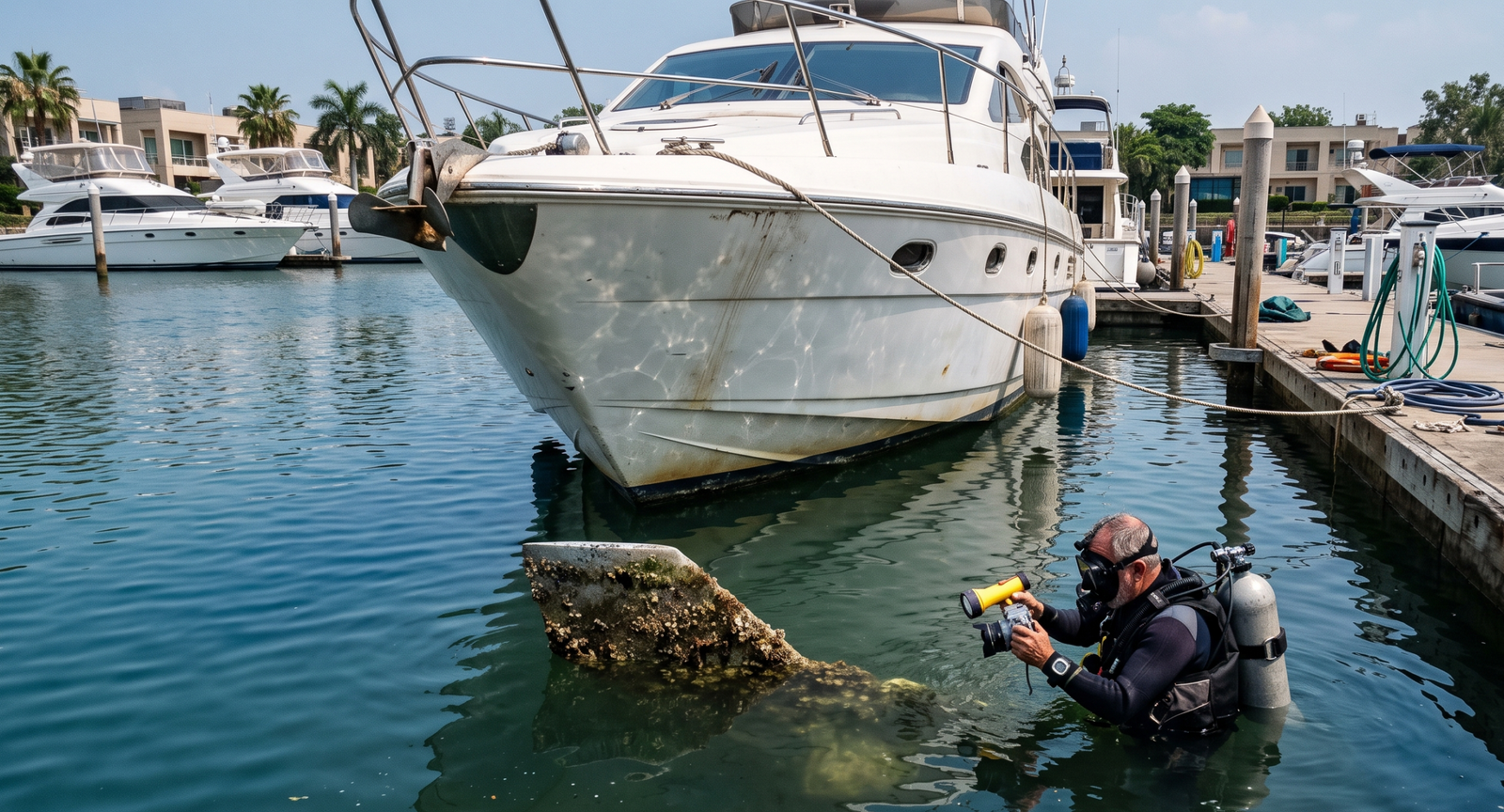
A luxury yacht can feel perfectly comfortable at the dock and still have a stabilizer problem developing below the waterline. A small hydraulic leak, corroded actuator component, damaged fin, loose mounting hardware, or excessive marine growth may not be obvious from the helm. By the time the owner notices unusual roll, delayed stabilizer response, or a hydraulic alarm, the underlying problem may already need more than routine maintenance.
A proper yacht stabilizer inspection looks at the complete system, including the fins, actuator assemblies, hydraulic components, mounting hardware, bonding, anodes, and the underwater condition around each installation. For luxury yachts that spend long periods in saltwater, regular inspection is one of the simplest ways to catch problems before they become expensive repairs.
What Is a Yacht Stabilizer Inspection?
A yacht stabilizer inspection is a systematic examination of the vessel’s stabilizer fins, actuator assemblies, hydraulic components, electrical or control connections, mounting hardware, corrosion protection, and surrounding underwater structure to identify wear, leaks, fouling, damage, or abnormal operation.
Active fin stabilizers use underwater fins that change angle as the vessel moves through the water. The actuator system controls that movement in response to the vessel’s motion. Naiad Dynamics, for example, produces active fin stabilizer systems for luxury yachts using fin actuator assemblies designed around hydraulic or electric drive arrangements. Naiad’s current active fin stabilizer information describes its fin actuator assemblies and composite or steel fin options.
That means an inspection cannot stop at the visible fin. The fin, shaft, actuator, seals, bearings, hydraulic system, and hull attachment all work together.
Fin Stabilizer Maintenance Checklist
Fin stabilizer maintenance should include checking the fin itself, actuator assembly, hydraulic system, mounting hardware, bonding, cooling, anodes, and signs of leakage or corrosion. The exact service interval depends on the stabilizer manufacturer and model, so the vessel’s maintenance documentation should always take priority.
- Inspect both stabilizer fins for impact damage and distortion.
- Check for excessive marine growth around the fins and shafts.
- Inspect exposed actuator components for corrosion.
- Look for hydraulic oil around cylinder rods, hoses, manifolds, and fittings.
- Check actuator mounting hardware.
- Inspect seals around the shaft and actuator housing.
- Check sacrificial anodes where fitted.
- Inspect the vessel’s bonding connection.
- Check hydraulic fluid level and filter indicators where applicable.
- Inspect seawater cooling supply and strainers where the system uses water cooling.
- Check for abnormal noise, movement, or delayed fin response.
- Document the underwater condition with photographs when possible.
Naiad maintenance documentation recommends routine checks of hydraulic leakage, actuator components, bonding, cooling-water supply, mounting-bolt torque, and anodes, with intervals varying by component. Naiad’s stabilizer documentation provides detailed examples of these maintenance requirements.
Inspecting the Stabilizer Fin Underwater
The fin is the part most directly exposed to the underwater environment. It can collect marine growth, suffer impact damage, lose coating, or develop corrosion around associated hardware.
During an underwater inspection, look for:
- Cracks or deformation
- Leading-edge damage
- Trailing-edge damage
- Excessive marine growth
- Blistering or coating failure
- Corrosion around metal components
- Damage around the fin-to-shaft connection
- Evidence of contact with submerged objects
A fin that has struck an underwater object deserves more than a quick visual check. Impact can affect the fin, shaft, actuator, bearings, or mounting structure even when the damage is not immediately obvious.
Professional Underwater Inspection allows the underwater components to be documented without relying solely on what can be seen from inside the engine room.
Inspecting Stabilizer Actuators
Stabilizer actuator inspection focuses on hydraulic leaks, corrosion, mounting security, seals, rods, bearings, hoses, and abnormal movement. Any actuator that moves unpredictably, leaks hydraulic fluid, or shows significant corrosion should be investigated before continued operation.
The actuator is particularly important because it converts the stabilizer control command into physical fin movement. If the actuator cannot respond correctly, the fin cannot produce the expected stabilizing force.
Naiad’s maintenance guidance calls for checking the fin actuator assemblies for evidence of oil leaks around hydraulic cylinder rods, feedback components, and the actuator casting. It also recommends checking mounting-bolt torque according to the applicable installation specifications.
Look for Hydraulic Leaks
Even a small amount of hydraulic oil around a cylinder rod or fitting deserves attention. A leak can indicate seal wear, damaged hose connections, or another problem within the hydraulic system.
Don’t assume that wiping away the oil solves the problem. Clean the area, identify the source, and monitor it according to the manufacturer’s service procedure.
Check for Corrosion
Actuators operate in an aggressive marine environment. Corrosion around exposed components can be a cosmetic issue, but severe corrosion may indicate a bonding problem or prolonged exposure to seawater.
Naiad specifically notes that severe actuator corrosion can indicate a break in the vessel’s electrical bonding connection. That makes corrosion inspection part of the electrical protection assessment, not just a cosmetic check.
Zero Speed Stabilizer Inspection: What Owners Should Know
Zero speed stabilizers are designed to reduce vessel roll while a yacht is stationary or moving slowly, but they should not be confused with every type of stabilizer system. Some fin systems provide stabilization at rest, while other products, such as gyroscopic stabilizers, use a completely different operating principle.
This distinction matters when scheduling service. A yacht equipped with hydraulic active fins requires a different inspection approach from one equipped with a gyroscopic stabilizer.
Naiad’s product range includes systems designed for stabilization at rest, while its active fin stabilizers use underwater fins and actuator assemblies. Naiad’s hydraulic power-pack information describes systems designed for stabilization-at-rest applications.
Always identify the actual stabilization technology installed on the yacht before applying a maintenance checklist.
Seakeeper Inspection vs. Fin Stabilizer Inspection
Seakeeper inspection and fin stabilizer inspection are not the same maintenance task. Seakeeper gyro stabilizers use a flywheel inside a sealed sphere, while Seakeeper Ride uses underwater control blades and actuators. Traditional active fin stabilizers use external fins controlled by actuator systems.
This distinction is especially useful because boat owners sometimes use “stabilizer” as a general term for several different technologies.
For a Seakeeper gyro, the manufacturer’s maintenance schedule includes inspections of hydraulic components, cooling systems, electrical connections, mounting hardware, and other model-specific components. Seakeeper’s maintenance schedule also specifies model-dependent service intervals.
For Seakeeper Ride, the manufacturer provides separate inspection requirements for actuators, blades, sacrificial anodes, connectors, grounds, cables, and other components. Seakeeper Ride’s maintenance documentation lists scheduled inspections and cleaning procedures.
So if a yacht owner asks for a “Seakeeper inspection,” the first step should be identifying which Seakeeper product is installed.
Marine Growth on Stabilizer Fins
Stabilizer fins are exposed to the same biological fouling pressures as the rest of the underwater hull. Slime, barnacles, shell growth, and other organisms can collect around the fin and shaft.
Heavy growth can make the fin more difficult to inspect and may affect its hydrodynamic performance. More importantly, fouling can hide corrosion, coating deterioration, impact damage, and problems around the shaft connection.
Professional Hull Cleaning can help remove appropriate underwater growth, but stabilizer fins should be treated as specialized components rather than simply cleaned with the same technique used everywhere else on the hull.
Where suitable, Cavitation Cleaning can provide a controlled approach for removing certain underwater growth while allowing technicians to work around sensitive marine equipment.
Inspecting Stabilizer Anodes and Bonding
Sacrificial anodes and electrical bonding help protect underwater stabilizer components from galvanic corrosion. An inspection should verify the condition of applicable anodes and look for corrosion that could indicate inadequate bonding or another electrical-protection problem.
Naiad’s maintenance guidance recommends regular inspection of applicable zinc anodes and annual checks that the fin actuator assemblies remain properly connected to the vessel’s bonding system.
Severe corrosion on an actuator should not simply be cleaned and painted. It may be a symptom of an electrical connection problem that needs to be identified first.
If anodes are depleted, professional Zinc Replacement can restore the sacrificial protection system using the appropriate components.
When Should Luxury Yacht Stabilizers Be Inspected?
There is no universal inspection interval for every stabilizer because systems, manufacturers, vessel usage, and operating environments differ. The manufacturer’s maintenance schedule should be the primary reference.
A practical inspection routine can include:
- Before departure: Check for obvious system faults, leaks, and abnormal indications.
- During routine underwater maintenance: Inspect fins, shafts, anodes, and visible actuator components.
- After an underwater impact: Inspect the fin and actuator system before normal operation.
- During scheduled servicing: Complete the manufacturer’s hydraulic, electrical, mechanical, and cooling-system checks.
- After unusual corrosion: Investigate bonding and anode condition.
For example, Seakeeper specifies annual inspection of several external components and more frequent anode replacement for applicable models, while Naiad’s maintenance schedules use different intervals for oil levels, hydraulic inspections, anodes, lubrication, bonding, and actuator hardware. The exact schedule therefore needs to follow the equipment installed on the yacht.
Common Stabilizer Maintenance Mistakes
- Inspecting only the visible fin and ignoring the actuator.
- Assuming a clean fin automatically means the stabilizer is healthy.
- Ignoring small hydraulic leaks.
- Failing to check the bonding system after discovering severe corrosion.
- Allowing marine growth to hide the fin-to-shaft connection.
- Using aggressive cleaning equipment against stabilizer components without checking manufacturer restrictions.
- Assuming Seakeeper, Seakeeper Ride, and traditional fin stabilizers use the same maintenance procedure.
- Operating a system with abnormal fin movement or response.
- Attempting actuator service without securing the fin and following the manufacturer’s safety procedure.
DIY vs. Professional Yacht Stabilizer Inspection
Owners and crew can perform many routine visual checks, but fin actuator assemblies can move unexpectedly when a vessel is in the water. Manufacturer documentation warns that waves and currents can cause unpredictable movement of stabilizer components during service.
For that reason, hands-on actuator work should follow the manufacturer’s lockout, centering, and service procedures. Naiad’s maintenance documentation specifically requires stabilizer fins to be centered and secured before maintenance or service work on the actuator assembly.
A professional underwater assessment is particularly useful when the yacht has suffered an impact, the stabilizer response has changed, corrosion appears excessive, or marine growth is preventing a proper inspection.
Frequently Asked Questions
How often should yacht stabilizer fins be inspected?
Inspection frequency depends on the stabilizer manufacturer, model, vessel usage, and operating environment. At minimum, stabilizers should be checked during scheduled maintenance and underwater inspections, with additional inspection after impacts, unusual noise, hydraulic leaks, abnormal fin movement, or visible corrosion.
What should I look for during a stabilizer fin inspection?
Check the fin for impact damage, distortion, coating failure, corrosion, and marine growth. Inspect the fin-to-shaft area and surrounding hull structure, then examine the actuator for hydraulic leaks, corrosion, loose hardware, damaged seals, and abnormal movement. The complete system—not just the fin—should be evaluated.
How do you inspect a stabilizer actuator?
Inspect the actuator for hydraulic leakage, corrosion, damaged cylinder rods, worn seals, loose mounting hardware, and abnormal movement. The manufacturer’s service procedure should be followed before performing hands-on work because actuator components can move unexpectedly when the vessel is in the water.
Are Seakeeper systems the same as fin stabilizers?
No. A traditional active fin stabilizer uses external underwater fins and an actuator system. A Seakeeper gyro uses a spinning flywheel inside a sealed sphere. Seakeeper Ride uses underwater blades and actuators. Each technology has its own inspection and maintenance requirements.
Can marine growth affect yacht stabilizer fins?
Yes. Slime, barnacles, and other marine growth can accumulate on stabilizer fins and surrounding components. Fouling can obscure corrosion or impact damage and may affect the underwater surface. Cleaning should be performed with a technique appropriate for the fin material, coating, and manufacturer’s requirements.
Conclusion
Yacht stabilizer inspection should go beyond looking at whether the fins appear intact. The fin, shaft, actuator, hydraulic system, mounting hardware, anodes, bonding, and surrounding hull structure all deserve attention. Catching a hydraulic leak, loose mounting component, damaged fin, or corrosion problem early can prevent a relatively manageable maintenance issue from becoming a major stabilizer repair.
For more guidance on underwater yacht maintenance, inspections, and marine equipment care, explore our blog and marine resources.
Ready to protect your vessel?
If you need expert help with this, our team of certified divers and marine technicians is ready to step in. Learn more about our specific services here.
Prefer to speak with an expert immediately? Contact us today to schedule a service or get a free quote!
