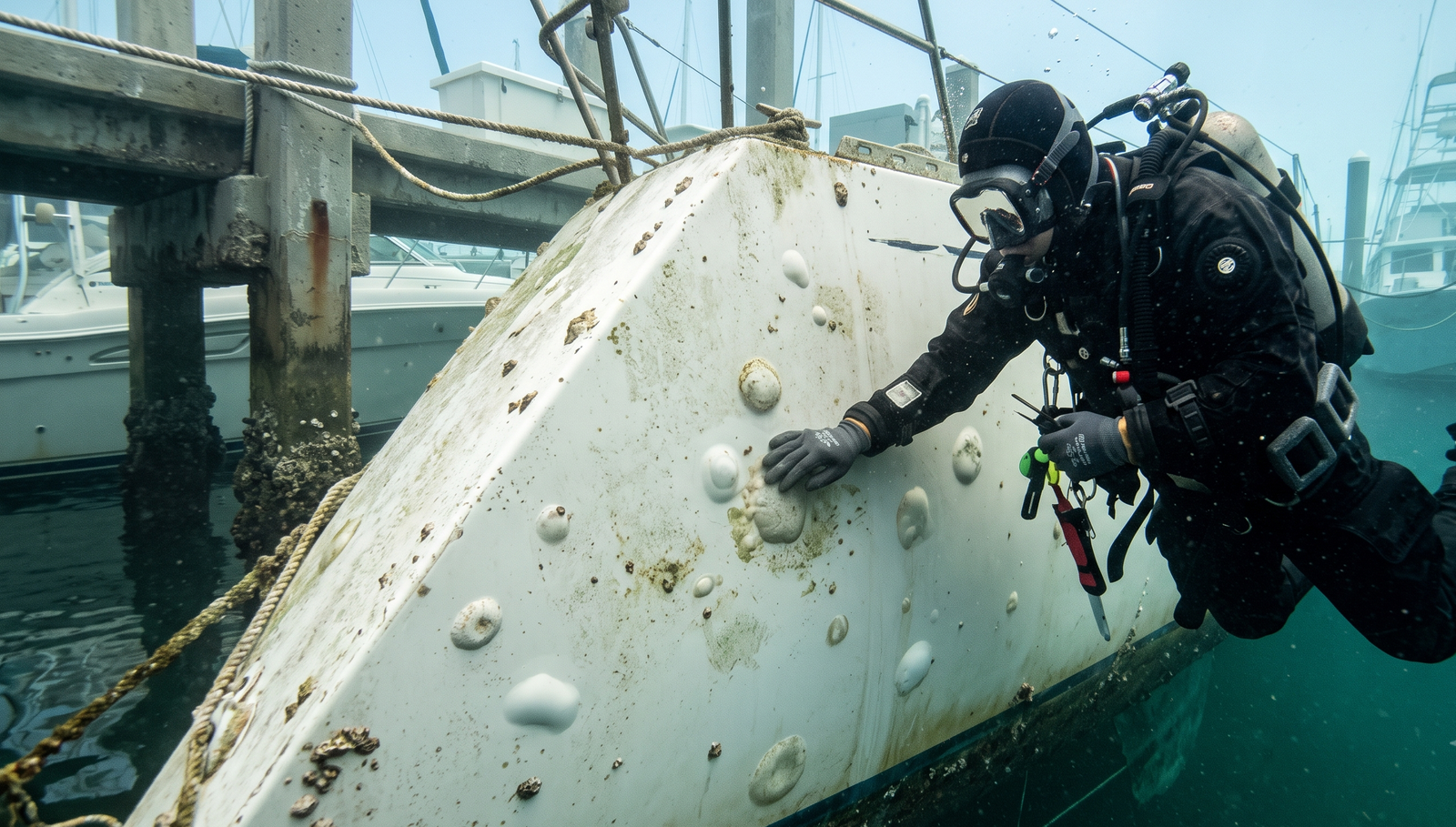
A boat owner can dive beneath a fiberglass hull and find what looks like a small bubble, blister, or raised spot in the gelcoat. One or two may seem harmless. A hull covered with dozens or hundreds of them is a different story. Osmotic blistering boat problems are among the underwater conditions that deserve careful inspection because what appears to be a simple surface bubble can sometimes indicate moisture and chemical activity within the laminate or coating system.
Fiberglass boats are durable, but they are not immune to water intrusion. Boats that spend long periods in the water can develop fiberglass hull blisters, commonly called “boat pox.” Identifying the pattern, location, size, and condition of the blisters is the first step toward deciding whether monitoring, further testing, or a more extensive hull osmosis repair is appropriate.
What Is Osmotic Blistering on a Boat?
Osmotic blistering is the formation of fluid-filled blisters within or beneath a fiberglass boat’s resin, laminate, gelcoat, or coating system, often associated with moisture entering the laminate and reacting with water-soluble materials. The resulting pressure can push against surrounding material and create raised areas below the waterline.
Not every bubble on a fiberglass hull is necessarily osmosis. Similar-looking defects can result from trapped air, coating failure, impact damage, laminate voids, previous repairs, or other manufacturing and maintenance issues.
That is why visual identification is useful, but it should not automatically be treated as a final diagnosis.
Why Fiberglass Hull Blisters Usually Appear Below the Waterline
The underwater portion of a fiberglass boat spends long periods exposed to moisture. Water can migrate into microscopic spaces and interact with substances within the laminate or coating system.
Over time, chemical reactions can create soluble compounds. Moisture movement and the accumulation of liquid can contribute to pressure beneath the outer surface.
The result may appear as a raised, rounded blister that feels different from the surrounding hull surface.
The location and pattern matter. Blisters concentrated below the normal waterline are more consistent with an underwater moisture-related problem than isolated damage on a dry topside surface.
What Do Boat Pox and Fiberglass Hull Blisters Look Like?
Fiberglass hull blisters commonly appear as small raised circular or oval areas beneath the waterline, ranging from tiny bumps to larger fluid-filled pockets. Some are barely noticeable during a quick inspection, while advanced blistering can produce extensive areas of unevenness across the hull.
During an underwater inspection, look for:
- Rounded raised areas in the gelcoat or coating.
- Clusters of small bubbles.
- Larger isolated blisters.
- Areas of softened or damaged gelcoat.
- Discoloration surrounding raised areas.
- Previous blister repairs.
- Cracked or detached coating.
- Irregular hull-surface texture.
Some blisters are easiest to detect by touch rather than sight. Running a gloved hand across the underwater surface can reveal small raised areas that are difficult to see in poor visibility.
Are All Fiberglass Boat Bubbles Osmotic Blisters?
No. A bubble or raised area does not automatically mean the hull has osmosis. Fiberglass boat bubbles can come from several causes, including trapped air, coating defects, laminate voids, impact damage, poor previous repairs, or moisture-related blistering.
This distinction matters because the correct repair depends on the cause.
For example, removing and rebuilding an entire hull coating system because of a few isolated coating defects may be unnecessary. Conversely, dismissing widespread blistering as cosmetic could allow a larger moisture-related problem to go uninvestigated.
How to Identify an Osmotic Blistering Boat Problem
1. Inspect the Hull Underwater
An underwater inspection gives you a much better understanding of the actual condition of the hull than looking at the boat from the dock.
A diver can examine the underwater surface for blister patterns, coating breakdown, marine growth, impact damage, and previous repairs.
Our underwater inspection services can help document the condition of a vessel while it remains in the water.
2. Record the Location and Distribution
Blister distribution can provide useful information.
Are there only a few isolated areas? Are the blisters concentrated in one section? Do they cover large portions of the underwater hull? Are they clustered around previous repairs?
Recording the pattern is more useful than simply counting the number of visible blisters.
3. Measure the Blisters
Size matters when documenting a blistering problem.
Small surface defects and large fluid-filled pockets may represent very different levels of concern. A maintenance record should include approximate dimensions and photographs whenever visibility allows.
4. Check for Fluid
During a professional diagnostic process, selected blisters may be opened or sampled to examine their contents. The appearance and chemistry of the fluid can help distinguish osmotic blistering from other defects.
This should not be done casually underwater. Opening the laminate or coating can create additional damage and should form part of an appropriate diagnostic or repair process.
5. Consider Moisture Testing
Moisture meters can provide additional information when the boat is hauled out and the hull surface is accessible.
A high reading does not automatically prove that osmosis is present. Moisture readings are affected by hull construction, coatings, temperature, salts, and other factors.
Moisture readings should be interpreted alongside the hull’s construction, visual condition, blister pattern, and inspection history.
What Causes Boat Pox?
The term “boat pox” is often used by boat owners to describe widespread fiberglass hull blistering. The underlying mechanisms can involve moisture migration and chemical reactions within the laminate or coating system.
Several factors can influence the risk and severity of blistering, including:
- Fiberglass laminate construction.
- Resin chemistry.
- Manufacturing quality.
- Water exposure.
- Previous repairs.
- Coating systems.
- Hull age.
- Time spent continuously in the water.
It is also worth remembering that a blistering hull is not necessarily the result of poor maintenance by the current owner. Some problems originate in construction or develop gradually over many years.
Does Osmotic Blistering Affect Hull Strength?
Surface blistering does not automatically mean a fiberglass hull has lost its structural integrity. Many blistering problems begin within the gelcoat or near-surface laminate, while more extensive moisture damage can involve deeper portions of the laminate.
The important question is how deep the damage extends and whether the laminate itself has been compromised.
If blisters are widespread, deep, repeatedly returning after repair, or associated with delamination or unusually high moisture levels, a qualified fiberglass technician should evaluate the hull.
Classification and marine-industry organizations recognize that fiberglass-reinforced plastic construction requires proper assessment of laminate condition rather than judging structural integrity from surface appearance alone. ABYC’s marine standards program provides industry standards covering numerous aspects of boat construction and systems.
Osmotic Blistering vs. Other Underwater Hull Damage
| Condition | Typical Appearance | Possible Cause |
|---|---|---|
| Osmotic blistering | Rounded raised areas or fluid-filled pockets | Moisture and chemical activity within laminate/coating system |
| Impact damage | Cracks, dents, fractures, localized distortion | Collision or physical impact |
| Coating blistering | Raised or detached coating | Coating adhesion or moisture problem |
| Delamination | Soft or separated laminate areas | Loss of bond between laminate layers |
| Marine growth | Irregular external deposits | Barnacles, algae, tube worms and other organisms |
These conditions can sometimes occur together. Heavy marine growth can also hide hull-surface defects, which is another reason thorough underwater inspection is useful.
Why Marine Growth Can Hide Fiberglass Hull Blisters
A hull covered in barnacles and slime is difficult to evaluate properly.
Marine growth can conceal small blisters, cracks, coating failures, and previous repair areas. Once the surface is cleaned, defects that were invisible from the dock can become obvious.
Our South Florida hull cleaning service can remove compatible marine growth so the underwater hull surface is easier to inspect.
For heavier hard fouling, underwater cavitation cleaning may be appropriate for compatible hull surfaces and coatings.
Cleaning and diagnosis are different jobs, however. The cleaning method must be suitable for the existing hull coating so that the maintenance process does not create additional surface damage.
Can Osmotic Blisters Be Repaired Underwater?
Most meaningful osmotic blister repairs require the boat to be hauled out so the hull can dry and the affected laminate or coating can be properly prepared. Underwater divers can identify and document blistering, but complete remediation generally involves above-water access.
A typical repair strategy may involve:
- Hauling the boat out.
- Removing marine growth and contaminated coatings.
- Mapping the blistered areas.
- Allowing the hull to dry where required.
- Opening and cleaning affected blisters.
- Assessing laminate condition.
- Repairing damaged laminate or resin systems where necessary.
- Fairing the repaired areas.
- Applying an appropriate barrier or coating system.
- Re-launching after the required cure and preparation period.
The exact repair specification depends on the construction and severity of the problem.
When Should You Worry About Fiberglass Hull Blisters?
A few small blisters do not necessarily mean an emergency.
However, several patterns deserve closer attention:
- Rapidly increasing numbers of blisters.
- Large or deep-looking blisters.
- Fluid-filled pockets.
- Soft laminate surrounding blistered areas.
- Evidence of delamination.
- Extensive blistering across the underwater hull.
- Repeated blistering after previous repairs.
- High or unusual moisture readings after haul-out.
- Visible cracking or laminate deterioration.
The most useful response is to document the condition and obtain a professional diagnosis rather than guessing at the repair.
South Florida Conditions and Hull Blistering
Boats kept in South Florida can spend extended periods immersed in warm water. That creates a strong marine-growth environment and means underwater surfaces are rarely given a break from moisture exposure.
A boat that remains continuously afloat may therefore develop a different maintenance profile from one that is routinely hauled out and stored dry.
Regular underwater inspections do not prevent osmotic blistering by themselves, but they can help owners detect changes before a small surface problem becomes a major surprise during a haul-out.
For vessels undergoing broader underwater maintenance, an inspection can also identify anodes, running gear, through-hulls, and other components that require attention.
Common Osmotic Blistering Mistakes
- Assuming every fiberglass bubble is osmosis.
- Ignoring small blisters because they appear cosmetic.
- Waiting years before documenting widespread blistering.
- Trying to diagnose laminate damage solely from the dock.
- Removing blisters without understanding why they formed.
- Applying a new coating before the hull is properly prepared.
- Ignoring moisture readings after haul-out.
- Failing to distinguish coating defects from laminate defects.
- Using aggressive underwater cleaning methods on damaged or fragile coatings.
- Assuming hull cleaning and blister repair are the same service.
DIY vs. Professional Fiberglass Hull Inspection
It is easy to notice a blister. Determining what caused it is much harder.
An owner can document visible bubbles and monitor whether they appear to be increasing. But diagnosing the condition of the laminate may require moisture testing, controlled blister sampling, laminate inspection, and knowledge of the boat’s construction.
If the hull has widespread blistering, large fluid-filled pockets, delamination, or suspected structural damage, professional assessment is a better choice than experimenting with repairs.
An underwater inspection can be a useful first step because it establishes what is actually present before the vessel is hauled out. If the hull needs cleaning before inspection, underwater hull cleaning can make the surface easier to examine.
Owners can also review our marine maintenance articles and underwater service insights for additional information about protecting and maintaining vessels.
Frequently Asked Questions
What does an osmotic blister look like on a boat?
An osmotic blister usually appears as a rounded or oval raised area beneath the hull’s waterline, sometimes containing fluid. Blisters can range from very small bumps to larger pockets. Because coating defects, trapped air, impact damage, and other problems can look similar, appearance alone does not prove that a hull has osmosis.
Are fiberglass hull blisters serious?
Fiberglass hull blisters are not automatically a structural emergency, but widespread, deep, or recurring blistering deserves professional evaluation. Some blisters remain near the surface, while others can be associated with deeper laminate problems. The number, size, distribution, depth, moisture condition, and laminate quality all matter.
Can you detect boat pox underwater?
Yes, an underwater inspection can identify visible blistering, raised areas, coating damage, and suspicious patterns below the waterline. A diver can photograph and document the condition, but determining the chemical or structural cause may require additional inspection after haul-out, including moisture testing or controlled examination of selected areas.
Can osmotic blistering be repaired without hauling the boat out?
Complete osmotic blister repair generally requires the hull to be hauled out. Underwater inspection can identify and document the problem, but proper repair often requires removal of affected material, drying, laminate preparation, fairing, and application of an appropriate coating or barrier system. These steps cannot normally be completed correctly while the hull remains submerged.
How do I know if a fiberglass boat has osmosis?
Look for clusters of rounded blisters below the waterline, especially where fluid-filled pockets or recurring blistering are present. A professional assessment may also include moisture readings, inspection of the laminate, and examination of blister contents. A visual inspection alone cannot reliably diagnose every type of hull blister.
Does hull cleaning remove osmotic blisters?
No. Hull cleaning removes compatible marine growth and surface fouling; it does not cure osmotic blistering within a fiberglass laminate. Cleaning can make the underwater surface easier to inspect, but actual blister remediation normally requires a separate haul-out and fiberglass repair process when the condition warrants it.
For more information about underwater vessel maintenance, read more from our marine maintenance and inspection library.
Conclusion
An osmotic blistering boat problem should be diagnosed rather than guessed at. Fiberglass hull blisters can range from isolated cosmetic-looking defects to widespread moisture-related damage that requires extensive repair. The first step is understanding what is actually happening beneath the waterline.
Look for patterns, document the size and location of blisters, distinguish marine growth from hull defects, and use professional inspection when the condition is widespread or unusual. Underwater inspection can provide valuable information before a haul-out, while proper hull osmosis repair generally requires dry access to the affected laminate.
For boats operating year-round in South Florida, routine underwater inspections and appropriate hull maintenance can help owners spot changes earlier and make better decisions when the vessel eventually comes out of the water.
Ready to protect your vessel?
If you need expert help with this, our team of certified divers and marine technicians is ready to step in. Learn more about our specific services here.
Prefer to speak with an expert immediately? Contact us today to schedule a service or get a free quote!
