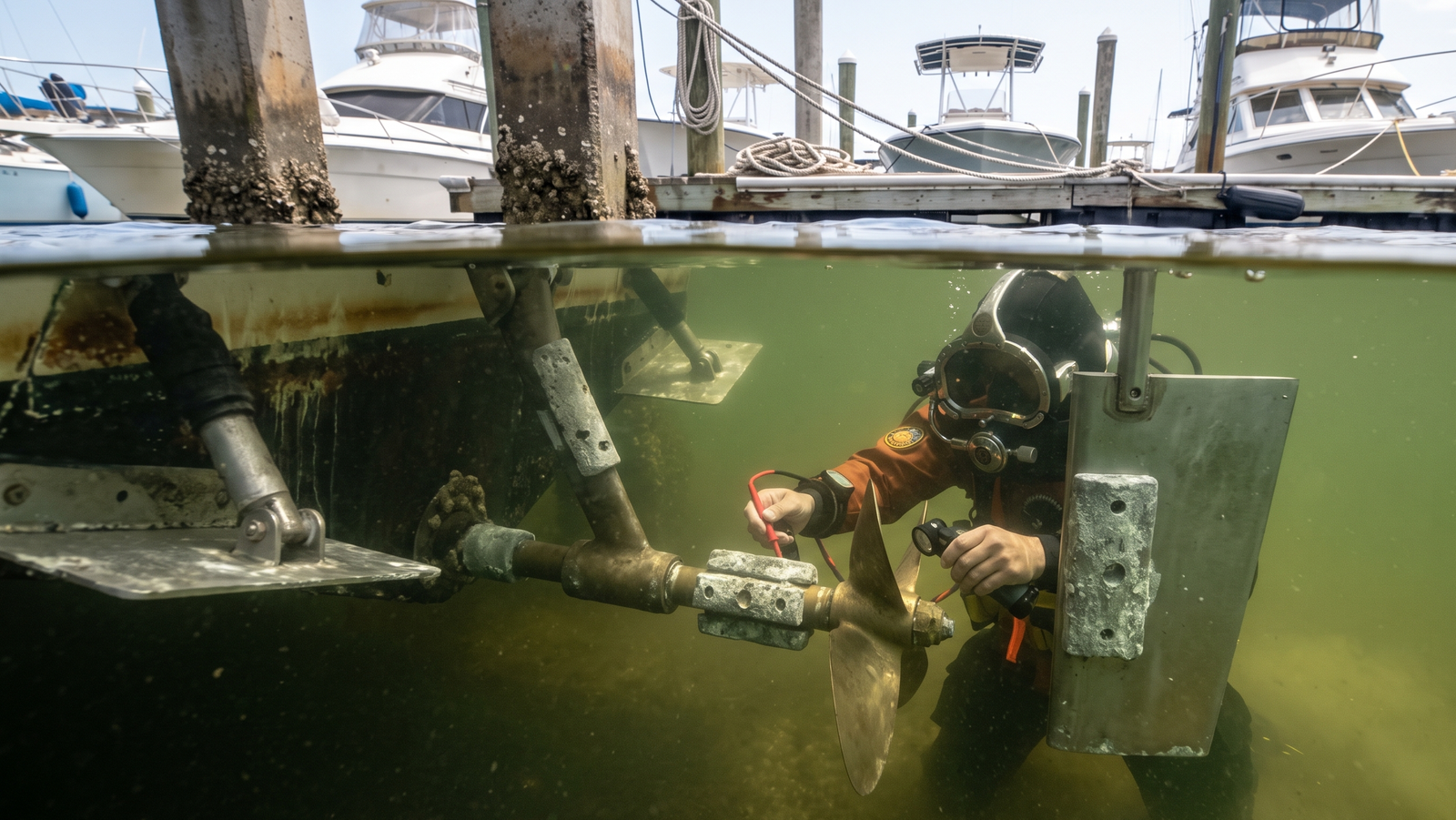
Brackish water can be one of the most confusing environments for boat corrosion protection. A boat may spend the morning in salty coastal water, cruise through the Intracoastal Waterway in the afternoon, and finish the day farther upriver where salinity is much lower. That changing environment makes brackish water boat anodes a maintenance decision rather than a simple “use zinc because you have always used zinc” rule.
The right sacrificial anode depends on the water chemistry, the boat’s underwater metals, its electrical bonding system, and how often it moves between salt, brackish, and freshwater. Aluminum anodes are commonly used for brackish conditions, while zinc remains a traditional choice for saltwater. Freshwater introduces another consideration: magnesium.
If your boat regularly moves between South Florida’s coastal waters, the Intracoastal Waterway, canals, and freshwater-connected rivers, understanding the difference between aluminum vs zinc anodes can help prevent expensive corrosion problems.
What Are Brackish Water Boat Anodes?
Brackish water boat anodes are sacrificial metal components selected to provide cathodic protection in water with a salinity between freshwater and seawater. Aluminum alloy anodes are commonly recommended for brackish environments because they can provide effective protection across variable salinity conditions, while zinc is traditionally associated with saltwater.
A sacrificial anode is intentionally made from a more active metal than the underwater components it protects. Instead of allowing a propeller, shaft, trim tab, or other protected component to become the preferred site of corrosion, the anode is designed to corrode first.
West Marine’s current corrosion guidance identifies zinc as a traditional saltwater anode, aluminum for salt or brackish water, and magnesium primarily for freshwater. :contentReference[oaicite:0]{index=0}
Why Brackish Water Changes Anode Selection
Pure seawater, freshwater, and brackish water do not behave the same way electrically. Salinity affects the conductivity of the electrolyte surrounding the boat’s underwater metals, while temperature, water movement, pollution, electrical activity, and the metals connected to the bonding system can also influence corrosion.
That is why a boat that spends its entire life in offshore saltwater may have a different anode strategy from a vessel that spends most of its time on an estuary or river.
The water where the boat actually operates matters more than what the anode is traditionally called.
For example, a boat owner who keeps replacing zinc anodes because “boats use zincs” may overlook the fact that the vessel now spends most of its time in brackish water.
Aluminum vs Zinc Anodes: Which Is Better?
Aluminum anodes are generally the more versatile choice for boats operating in brackish water, while zinc remains a traditional choice for saltwater. However, the correct selection also depends on the boat’s underwater metals, propulsion system, manufacturer recommendations, and electrical environment.
| Anode Material | Typical Environment | Key Consideration |
|---|---|---|
| Zinc | Saltwater | Traditional marine anode for seawater applications |
| Aluminum | Saltwater and brackish water | Broad operating range and commonly preferred for variable salinity |
| Magnesium | Freshwater | Highly active; generally intended for low-conductivity freshwater |
Martyr Anodes likewise identifies premium aluminum as an option for salt and brackish water and traditional zinc for saltwater. :contentReference[oaicite:1]{index=1}
That does not mean you should automatically replace every zinc anode on a boat with aluminum. The complete protection system needs to be considered.
Why Intracoastal Anode Choice Can Be Complicated
The Intracoastal Waterway is not one uniform chemical environment. Conditions can change significantly between locations, tides, freshwater inflows, marinas, canals, and nearby coastal areas.
A boat based in South Florida may experience several different water conditions during normal operation. A vessel leaving a marina near the coast can enter more brackish water farther inland, then return to saltwater.
For boats that regularly transition between salt and brackish water, aluminum anodes can provide a practical option, but the final choice should still be checked against the propulsion manufacturer’s specifications.
This is especially important on outboards, sterndrives, thrusters, and other systems where the manufacturer specifies a particular anode alloy and geometry.
What Happens If You Use the Wrong Anode?
Choosing an anode is not simply about attaching a piece of metal underwater and waiting for it to disappear.
An anode has to remain electrochemically active and make good electrical contact with the system it is protecting. If the material is poorly matched to the environment, protection may be inadequate or the anode may be consumed at an inappropriate rate.
West Marine notes that using the wrong anode material for the water type can result in little or no effective galvanic protection. :contentReference[oaicite:2]{index=2}
Potential warning signs include:
- Rapid anode depletion.
- Anodes that appear almost untouched after long periods.
- Pitting on underwater metals.
- White or powdery corrosion products.
- Corrosion around propellers and shafts.
- Damage to aluminum drive housings.
- Uneven anode wear.
- Unexpected corrosion after changing the boat’s normal operating location.
An unusual anode condition deserves investigation rather than simply installing another replacement.
Florida Brackish Boating and Corrosion Risk
Florida’s extensive network of bays, rivers, canals, estuaries, and coastal waterways creates plenty of opportunities for changing water conditions.
For boat owners, that means the maintenance environment can change without the boat ever leaving the state.
A vessel may spend weeks at a coastal marina, then move into a river system for a cruising trip. Another boat may remain in an estuarine marina year-round. A third may be transported between freshwater and coastal destinations.
Your anode strategy should reflect the boat’s actual operating pattern, not simply its home-port address.
If the boat is routinely moving between environments, record where it operates and inspect the anodes after significant changes in use. This provides a much better picture of how quickly the anodes are actually being consumed.
Can You Mix Aluminum and Zinc Anodes?
Different anode materials should not be mixed casually on the same protection system. Whether aluminum and zinc can coexist on a particular vessel depends on the components being protected, their electrical connections, manufacturer specifications, and the overall cathodic-protection design.
There are situations where a vessel may have different anode assemblies serving different systems, but that is not the same as randomly installing aluminum and zinc anodes together.
Before changing alloy, identify what the existing anodes protect and how those components are electrically bonded.
This is particularly important on boats with:
- Multiple propulsion systems.
- Aluminum outboards.
- Bronze propellers.
- Stainless-steel shafts.
- Bow or stern thrusters.
- Trim tabs.
- Bonding systems.
- Shore-power connections.
- Galvanic isolators or isolation transformers.
West Marine’s galvanic-corrosion guide explains how dissimilar metals and electrical connections can create galvanic cells and why sacrificial anodes are used to protect underwater hardware. :contentReference[oaicite:3]{index=3}
Why Shore Power Can Affect Anode Life
A boat connected to shore power can have a different corrosion environment from a boat operating independently.
Electrical connections between boats and marina infrastructure can create additional galvanic pathways. The result may be faster or unusual anode consumption, particularly when several vessels are electrically connected through marina systems.
If anodes suddenly disappear much faster than expected after a boat begins spending more time plugged into shore power, investigate the electrical environment instead of assuming the anode alloy is the only problem.
A galvanic isolator or isolation transformer may be part of an appropriate electrical-protection strategy, depending on the vessel and electrical system. These components should be evaluated by a qualified marine electrician.
How Often Should Brackish Water Anodes Be Inspected?
There is no universal replacement interval because anode consumption depends on the water, vessel, electrical environment, underwater metals, and operating pattern.
As a practical maintenance principle, anodes should be inspected regularly and replaced before they are substantially depleted. West Marine recommends replacement around 50% consumption as a general guideline. :contentReference[oaicite:4]{index=4}
For boats that move between salt and brackish environments, inspections can be particularly valuable after a change in operating location.
During an underwater inspection, a technician can document:
- Anode percentage remaining.
- Uneven or unusual consumption.
- Condition of mounting surfaces.
- Electrical continuity where appropriate.
- Propeller condition.
- Shaft condition.
- Struts and rudders.
- Trim tabs and thrusters.
- Visible corrosion or pitting.
Our underwater inspection services can help identify these conditions while the boat remains in the water.
Brackish Water Anodes for Propellers and Shafts
Propellers and shafts deserve particular attention because they are valuable underwater components and can involve dissimilar metals.
A bronze propeller, stainless-steel shaft, shaft coupling, strut, and other connected components can create a complex galvanic environment when submerged.
Sacrificial anodes are commonly installed on shafts, propellers, rudders, trim tabs, drives, and other underwater components. Marine shaft and propeller anode systems are available in different materials and configurations based on the application. :contentReference[oaicite:5]{index=5}
If an anode is depleted but the propeller or shaft is beginning to show pitting, do not treat the problem as a routine replacement alone.
It may indicate that the protection system needs a closer technical assessment.
Brackish Water and Aluminum Outboards
Outboard-powered boats have an additional reason to take anode selection seriously. Their lower units are commonly aluminum alloy, while propeller shafts, fasteners, propellers, and other components can involve different metals.
Without effective sacrificial protection, the aluminum housing can become part of the galvanic reaction.
Outboard anode guidance explains that sacrificial anodes are intended to protect aluminum lower units and other underwater components from galvanic corrosion. :contentReference[oaicite:6]{index=6}
For a boat that spends time in brackish water, selecting the correct manufacturer-approved aluminum anode can be particularly relevant.
Do Not Paint Your Sacrificial Anodes
Sacrificial anodes need direct electrical and water exposure to perform their intended function, so they should not be painted or isolated from the water.
Paint applied over an anode can interfere with its ability to participate in the electrochemical process.
The mounting surface also matters. An anode that is physically present but has poor electrical contact with the protected system may not provide the protection the boat owner expects.
When replacing anodes, use the correct mounting hardware and follow the propulsion-system or anode manufacturer’s installation instructions.
What About Freshwater Marine Anodes?
Freshwater changes the equation again.
Magnesium is generally associated with freshwater because it is more active than zinc and aluminum. However, a boat that moves between freshwater and saltwater should not simply switch to magnesium without considering its entire operating profile.
Some aluminum anode products are designed for broader water conditions, while other applications have specific manufacturer requirements.
If a boat regularly transitions between freshwater, brackish water, and saltwater, anode selection should be based on the vessel’s complete operating environment rather than choosing an alloy for only one portion of the trip.
BoatZincs, for example, provides an anode-selection chart that considers both water type and vessel configuration, demonstrating why there is no universal alloy answer for every boat. :contentReference[oaicite:7]{index=7}
Common Brackish Water Anode Mistakes
- Assuming every marine anode should be zinc.
- Choosing an anode based only on where the boat is registered.
- Ignoring time spent in rivers or estuaries.
- Mixing anode materials without understanding the protection system.
- Using freshwater magnesium anodes in saltwater.
- Leaving heavily depleted anodes installed.
- Painting over sacrificial anodes.
- Ignoring electrical bonding and shore-power conditions.
- Replacing anodes without investigating unusually rapid consumption.
- Inspecting anodes without checking the propeller, shaft, rudder, and other protected metals.
DIY vs. Professional Anode Inspection
Checking an easily visible anode during routine maintenance is straightforward. Diagnosing unusual corrosion is different.
If an anode is disappearing quickly, remaining almost untouched, or wearing unevenly, simply installing another one may not solve the problem.
A professional underwater inspection can evaluate the anodes alongside the components they are supposed to protect. That provides context that a visual check of the anode alone cannot provide.
Our anode and zinc replacement service can address worn sacrificial protection, while inspection can help identify whether the surrounding underwater metals show signs of corrosion or damage.
For vessels that also need marine growth removal, underwater hull cleaning can be coordinated with an underwater inspection so the vessel’s underwater condition is assessed as part of the same maintenance visit.
Frequently Asked Questions
What anodes are best for brackish water?
Aluminum anodes are commonly recommended for brackish water because they can provide effective protection across variable salinity conditions. Zinc is traditionally used in saltwater, while magnesium is generally intended for freshwater. The correct choice still depends on the boat’s underwater metals, propulsion system, manufacturer specifications, and electrical environment.
Are aluminum anodes better than zinc in brackish water?
Aluminum is generally a more versatile choice for brackish water than traditional zinc. Aluminum anodes are commonly designed for salt and brackish conditions, while zinc is primarily associated with saltwater. However, the manufacturer’s specified alloy should take priority for engines, drives, thrusters, and other specialized systems.
Can I use zinc anodes in the Intracoastal Waterway?
Zinc may be appropriate in some mixed salt and brackish operating environments, but it should not be selected automatically. The actual salinity, time spent in each environment, vessel configuration, bonding system, and manufacturer recommendations all matter. Aluminum is commonly used where brackish conditions are a significant part of the operating profile.
Can I mix aluminum and zinc anodes on the same boat?
You should not mix aluminum and zinc anodes casually without understanding the protection system. Different anodes may serve different components, but their compatibility depends on electrical bonding, protected metals, propulsion equipment, water conditions, and manufacturer specifications. An unusual corrosion pattern should be professionally investigated before changing alloys.
How do I know when a boat anode needs replacement?
Anodes should generally be replaced before they become heavily depleted, with about 50% consumption commonly used as a practical replacement guideline. Uneven wear, rapid depletion, loose mounting, or anodes that remain unusually intact can also indicate a problem that deserves further investigation.
What happens if I use the wrong marine anode?
The wrong anode material may provide inadequate protection or behave poorly in the operating environment. That can leave propellers, shafts, drives, trim tabs, and other underwater metals vulnerable to galvanic corrosion. The correct alloy must be matched to the water conditions and the components being protected.
For more practical guidance on protecting underwater marine equipment, read more marine maintenance insights and underwater service stories.
Conclusion
Brackish water boat anodes require more thought than simply replacing an old “zinc” with another one. Boats operating around Florida’s Intracoastal waterways, rivers, estuaries, and coastal marinas can experience changing salinity and electrical conditions that affect how sacrificial anodes perform.
Aluminum is commonly favored for brackish water, while zinc remains a traditional saltwater option and magnesium is generally associated with freshwater. But the best anode choice ultimately depends on the boat’s specific underwater metals, propulsion equipment, bonding system, operating pattern, and manufacturer requirements.
Regular inspection is just as important as selecting the correct alloy. If anodes are wearing unusually fast, barely wearing at all, or protecting components that are already showing corrosion, investigate the underlying cause rather than simply installing replacements.
Ready to protect your vessel?
If you need expert help with this, our team of certified divers and marine technicians is ready to step in. Learn more about our specific services here.
Prefer to speak with an expert immediately? Contact us today to schedule a service or get a free quote!
