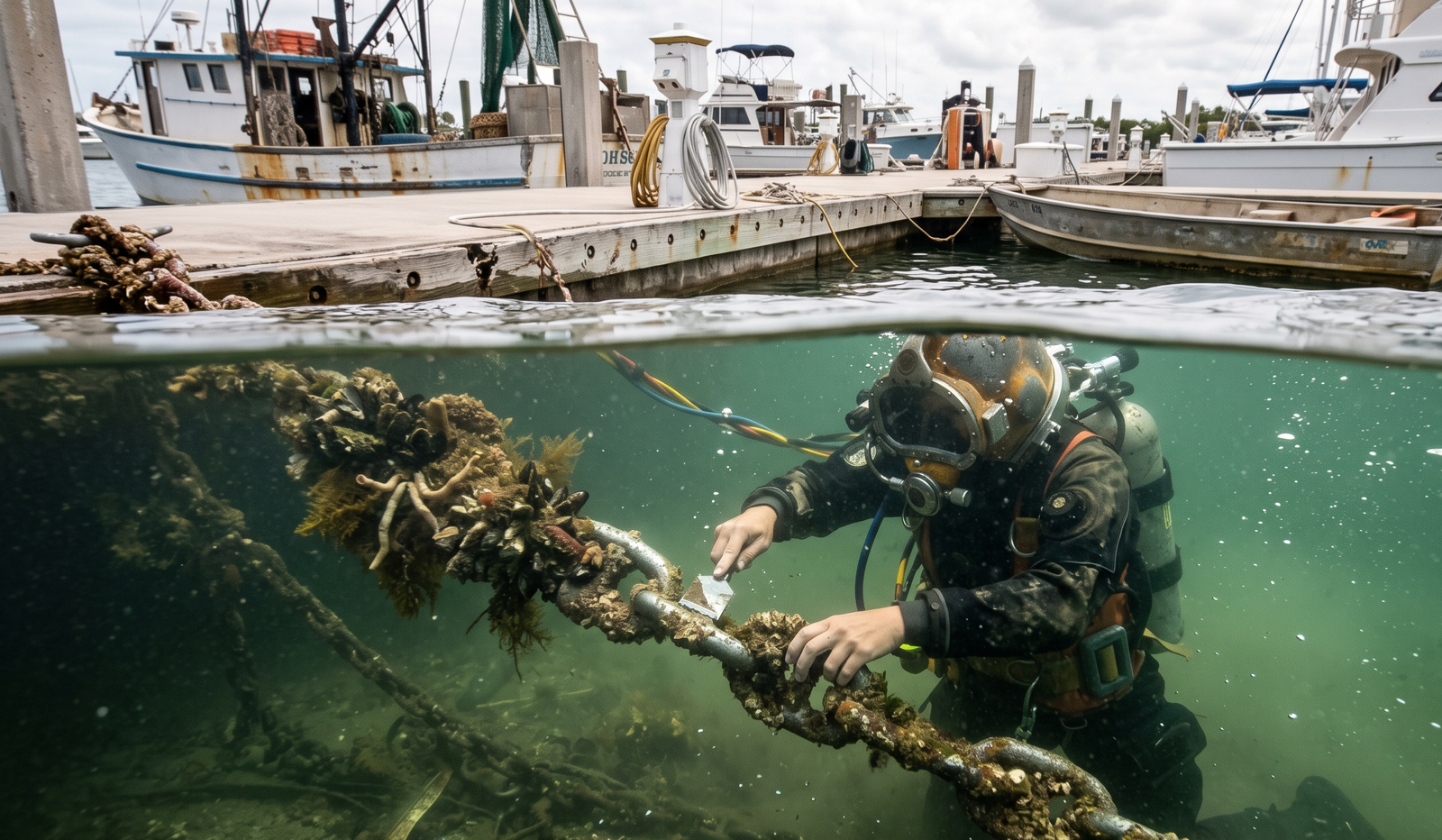
A floating dock can look perfectly secure from above while its underwater anchoring system is slowly disappearing beneath barnacles, mussels, algae, and sediment. We have seen this happen in busy marinas, waterfront facilities, and working docks where mooring chain marine growth becomes so heavy that the chain, cable, shackles, and anchor points are difficult to inspect properly.
For dock owners and marina operators, the problem is not simply cosmetic. Marine growth can hide corrosion, add weight, restrict movement, and make it harder to identify damaged hardware before a floating dock shifts during strong wind, current, or storm conditions.
Regular underwater maintenance gives you a much better chance of finding those problems while they are still manageable.
What Is Mooring Chain Marine Growth?
Mooring chain marine growth is the accumulation of barnacles, algae, mussels, tubeworms, and other aquatic organisms on submerged chains, cables, anchors, shackles, piles, and related dock hardware. The buildup can conceal corrosion and damaged components while adding bulk and weight to the anchoring system. Its severity depends on water temperature, salinity, location, immersion time, and local marine conditions.
The IMO Biofouling Guidelines recognize biofouling as the accumulation of aquatic organisms on submerged surfaces and identify biofouling management as an important environmental and operational concern. While those guidelines primarily address ships, the same basic fouling process affects underwater dock infrastructure.
Why Floating Dock Cables and Chains Need Regular Cleaning
Floating docks depend on underwater hardware to remain where the designer intended them to be. Depending on the installation, that system may include chains, wire rope, synthetic lines, anchors, piles, shackles, swivels, connectors, brackets, and other components.
When marine growth becomes established, it can make routine inspection surprisingly difficult.
- Corrosion becomes harder to see: Barnacles and shell growth can cover pitting, rust, damaged coatings, or wasted metal.
- Hardware becomes heavier: Thick fouling adds unnecessary mass to submerged components.
- Movement can be restricted: Fouling and sediment can interfere with chain movement around connection points.
- Damage can stay hidden: Cracked shackles, worn links, damaged cables, and loose connections may not be obvious from the surface.
- Storm readiness can suffer: An anchoring system that has not been inspected may have unknown weaknesses before severe weather arrives.
NOAA’s mooring design guidance shows how environmental factors such as currents, wind, waves, biofouling, corrosion, and expected ocean conditions all matter when evaluating mooring systems. For floating dock operators, that reinforces a simple point: underwater conditions are part of the structural maintenance picture, not an afterthought.
How Anchor Chain Barnacles Hide Problems
Anchor chain barnacles are more than an eyesore. A chain covered with hard shell growth can become difficult to examine link by link, especially around connections where wear and corrosion matter most.
During an underwater inspection, we look beyond the visible layer of growth. The goal is to understand what is happening underneath it.
Look for corrosion beneath the growth
Marine growth can cover areas where metal has started to deteriorate. Removing enough growth to expose the chain surface allows technicians to assess the condition of the actual hardware rather than guessing from its appearance.
Inspect shackles and connection points
Shackles, swivels, anchor connections, and cable terminations deserve special attention. These points can experience concentrated loads and are often more difficult to inspect when thick fouling has developed.
Check for sediment and entanglement
Heavy marine growth often exists alongside accumulated sediment, discarded line, vegetation, and other underwater debris. These materials can interfere with chain movement or create additional hazards for divers and dock users.
Floating Dock Cable Cleaning: What the Process Involves
Floating dock cable cleaning involves underwater removal of marine growth, debris, and other accumulated material from submerged cables and associated anchoring hardware so technicians can inspect the system and identify maintenance needs. The appropriate method depends on cable type, coating, fouling thickness, environmental conditions, and the condition of the hardware underneath.
A professional cleaning and inspection typically starts with identifying the complete anchoring arrangement. We want to know what the chain or cable is connected to, where it runs, and which areas experience the most movement or load.
The diver then works systematically rather than simply scraping everything aggressively. The objective is to remove enough growth to expose the hardware without unnecessarily damaging coatings, protective systems, lines, or nearby marine surfaces.
This distinction matters. The IMO’s current guidance on in-water cleaning recognizes that underwater cleaning can have environmental consequences if fouling organisms or coating materials are released into local waters. Local rules and marina requirements should therefore be checked before cleaning begins.
Heavy Mooring Cleaning Should Include an Inspection
Cleaning without looking at the hardware afterward misses much of the value of the work.
Once growth is removed, technicians can evaluate the condition of exposed components and document areas that need repair or replacement. Depending on the installation, this may include:
- Chain links and connection points
- Wire rope and cable sections
- Shackles and pins
- Swivels and connectors
- Anchor points
- Pile connections
- Dock brackets and underwater fittings
- Areas affected by corrosion or marine debris
If the dock itself has accumulated significant fouling, cleaning the surrounding underwater structures can also make future inspections easier. Our piling cleaning service can be useful when marine growth is established on submerged support piles and related dock infrastructure.
When Should You Clean a Marina Anchoring System?
There is no universal cleaning interval that works for every marina. Warm tropical water can produce much faster fouling than cooler locations, while sheltered areas may develop different growth patterns than exposed waterfronts.
A practical maintenance program should consider:
- Water temperature and salinity
- Local fouling rates
- Amount of time the dock remains submerged
- Storm and current exposure
- Age and material of the mooring components
- Previous inspection findings
- Manufacturer or engineering requirements
IMO notes that fouling is influenced by factors including location, water conditions, operating patterns, and maintenance history. Those same environmental differences explain why one marina may need substantially more frequent underwater maintenance than another.
For floating docks exposed to heavy growth, an annual underwater inspection can be a sensible starting point, with more frequent checks when previous inspections reveal accelerated corrosion, heavy fouling, storm damage, or unusual movement. Your engineer, marina authority, or system manufacturer should determine any required inspection interval for critical installations.
Common Mistakes With Floating Dock Maintenance
Only inspecting what is visible from the dock
The most obvious mistake is assuming that a floating dock is healthy because its deck, cleats, floats, and surface hardware look good. The anchoring system is underwater, so a surface-only inspection cannot tell you what condition the submerged components are in.
Waiting until the dock moves
If a dock starts shifting farther than expected, the problem may already be significant. Movement should be treated as a reason to investigate the anchoring arrangement rather than simply tightening or adjusting visible hardware.
Scraping aggressively without considering the environment
Hard fouling can be stubborn, but the strongest cleaning method is not automatically the safest. The technique should account for the material being cleaned, nearby coatings, marine life, water quality, and local discharge rules.
Cleaning without documenting the condition
Photos and inspection notes create a useful baseline. When the system is checked again, you can compare what has changed rather than starting from zero.
DIY vs. Professional Underwater Maintenance
Light surface maintenance is one thing. Inspecting a submerged anchoring system while working around chains, cables, current, limited visibility, and marine growth is another.
Professional underwater maintenance is particularly valuable when the system is large, heavily fouled, difficult to access, or responsible for stabilizing a high-value dock or marina structure. Divers can identify conditions that cannot be confirmed from the surface and provide a clearer picture of what needs attention.
For a complete assessment, consider pairing cleaning with an underwater inspection. If the surrounding vessel or dock area also has substantial fouling, professional hull cleaning and related underwater maintenance can be coordinated as part of a broader service visit.
Protecting the Dock Means Protecting Everything Under It
A floating dock is only as dependable as the system holding it in position. Chains and cables may not attract attention until something goes wrong, but they carry a significant share of the load every day.
That is why we recommend treating mooring chain marine growth as a maintenance signal. Heavy fouling tells you it is time to look closer. It may conceal corrosion, damaged connections, debris, or other conditions that deserve attention before the next major weather event.
Good underwater maintenance is not about making every chain look brand new. It is about exposing the hardware, understanding its condition, removing problematic buildup responsibly, and creating a record that helps you manage the system over time.
Frequently Asked Questions About Mooring Chain Marine Growth
How often should mooring chains be cleaned?
Mooring chains should be cleaned and inspected according to local fouling conditions, material condition, system design, and exposure to wind, waves, and currents. In warm, productive waters, marine growth can accumulate quickly, so an annual underwater inspection is a practical starting point for many floating dock systems, with shorter intervals when conditions warrant.
Can barnacles damage anchor chains?
Barnacles themselves do not normally cause structural failure simply by attaching to a chain, but heavy growth can conceal corrosion, wear, damaged links, and connection problems. The bigger maintenance concern is that a heavily fouled chain becomes harder to inspect accurately. Cleaning should therefore be paired with a careful condition assessment.
Is floating dock cable cleaning the same as chain cleaning?
No. Cable and chain require different inspection considerations. Wire rope can have broken wires, corrosion, crushed sections, or damaged terminations that need close examination. Chain is assessed for worn links, deformation, corrosion, and connection condition. Cleaning techniques should be selected according to the material and system design.
Can marine growth make a floating dock less stable?
Marine growth can contribute to maintenance problems by adding weight, increasing drag, hiding damaged hardware, and interfering with moving components. It is rarely useful to blame instability on fouling alone without inspecting the complete anchoring system. Changes in dock movement should trigger an underwater inspection of chains, cables, anchors, piles, and connections.
Should I clean mooring chains before hurricane season?
Yes, cleaning and inspection before periods of severe weather can help expose problems while there is still time to address them. However, cleaning is only one part of storm preparation. The complete anchoring arrangement should be evaluated against the dock’s design requirements, local conditions, and the recommendations of the responsible engineer or manufacturer.
For more practical marine maintenance guidance, explore our marine maintenance stories and resources.
Conclusion
Mooring chain marine growth is easy to ignore because most of it is hidden underwater. But when barnacles, algae, mussels, sediment, and debris cover chains and cables, they can hide the very problems dock owners need to find.
Regular cleaning combined with underwater inspection gives you a clearer view of your marina anchoring system and helps identify corrosion, wear, damaged connections, and other maintenance issues before they become emergencies. For floating docks in demanding marine environments, that visibility is worth far more than simply having clean-looking hardware.
Ready to protect your vessel?
If you need expert help with this, our team of certified divers and marine technicians is ready to step in. Learn more about our specific services here.
Prefer to speak with an expert immediately? Contact us today to schedule a service or get a free quote!
