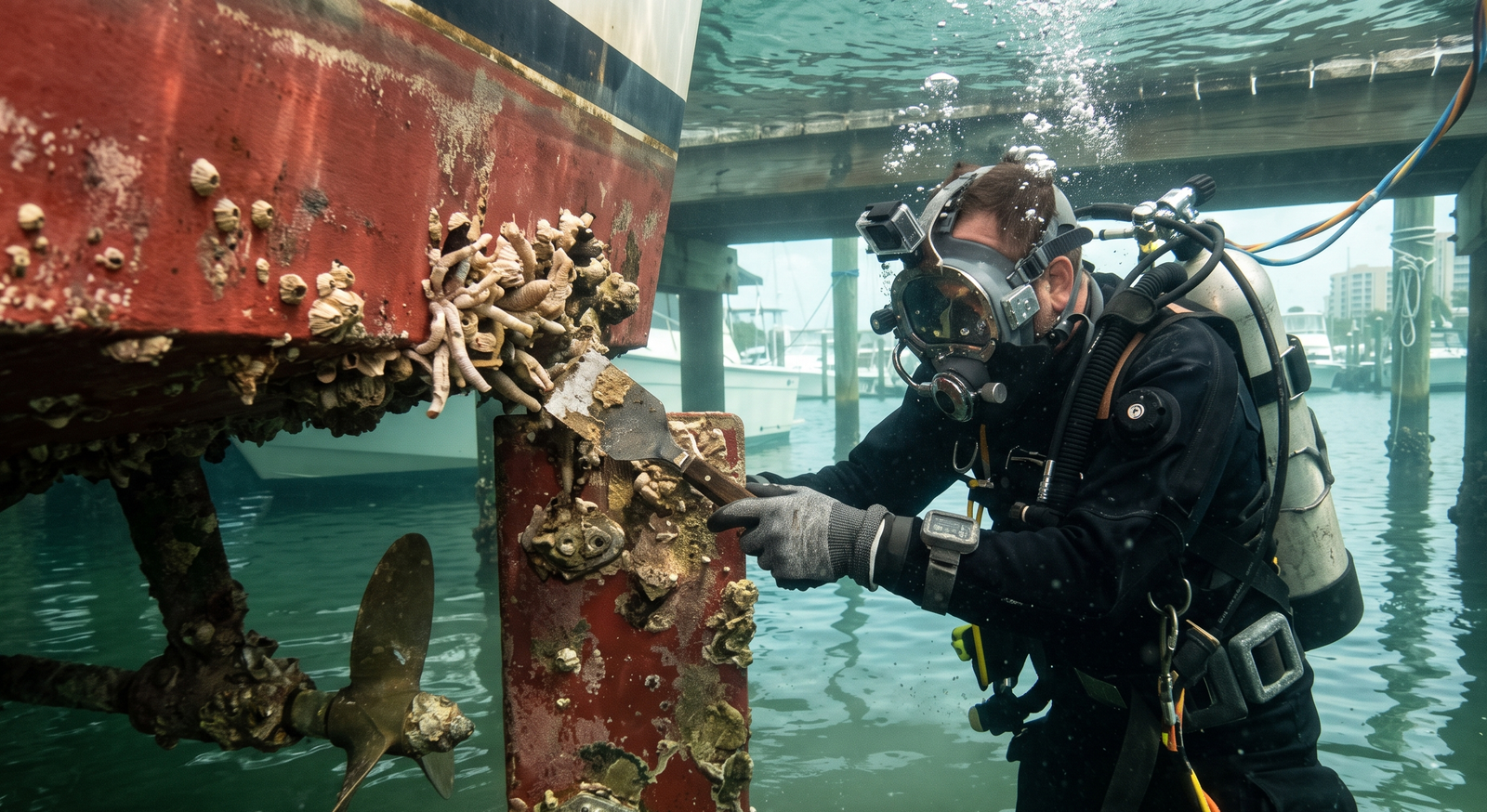
If your boat spends enough time in the Intracoastal Waterway, you eventually learn that not all fouling is soft and easy to wash away. A thin green film can turn into a rough layer of barnacles, tube worms, shell growth, and other organisms that seem almost bonded to the hull. This is where calcareous fouling removal becomes a serious part of ICW boat maintenance.
We regularly see the frustration that comes with hard marine growth. A boat may look acceptable from the dock, yet underwater the hull can feel like sandpaper. Propellers become rough, running gear gets coated, and areas around trim tabs, intakes, transducers, and through-hulls can become especially difficult to inspect.
Managing this buildup is not just about making the bottom look cleaner. Done correctly, it helps protect underwater surfaces, maintain performance, and identify problems before they become expensive repairs.
What Is Calcareous Fouling?
Calcareous fouling is hard, mineral-like marine growth formed by organisms such as barnacles and tube worms that attach firmly to submerged surfaces. Unlike soft slime or algae, calcareous fouling can develop a rigid shell structure that is difficult to remove and may create a rough underwater surface. On boats, it commonly develops on hulls, running gear, trim tabs, through-hulls, and other submerged components.
The International Maritime Organization (IMO) describes biofouling as the accumulation of aquatic organisms on submerged surfaces. Its guidance specifically recognizes hard or shell fouling such as barnacles and tubeworms as a form of fouling that can affect vessel performance. IMO Biofouling Guidelines
Why Hard Marine Growth Is Common in the ICW
The Intracoastal Waterway is not one uniform marine environment. Conditions vary significantly along its length, and boats may encounter different combinations of salinity, temperature, current, tidal exchange, water quality, and time spent stationary.
Those conditions influence what grows on an underwater surface and how quickly it establishes itself.
A vessel that spends most of its time at a marina may experience a very different fouling pattern from one that regularly travels offshore. A boat kept in a protected canal can also develop stubborn growth in areas that receive less water movement.
IMO notes that biofouling is influenced by factors including water temperature, salinity, operating profile, location, time spent moored, and maintenance history. Its guidance also recognizes that recreational craft can accumulate fouling and may contribute to the movement of aquatic species between locations. IMO guidance for recreational boating
How Calcareous Fouling Removal Protects Boat Performance
Hard fouling changes the texture of the underwater surface. Instead of water flowing smoothly across the hull, the roughened surface creates additional resistance.
For boat owners, the symptoms can be familiar:
- Lower speed at the same engine RPM
- Higher fuel consumption
- Slower acceleration
- More vibration from fouled running gear
- Reduced propeller efficiency
- Difficulty maintaining normal cruising performance
The IMO’s GreenVoyage2050 program explains that marine fouling increases drag and can negatively affect hydrodynamic performance, speed, power, and fuel consumption. It also notes that heavy hard fouling such as barnacles and tubeworms can contribute to turbulence, cavitation, and underwater noise. IMO GreenVoyage2050 hull-cleaning guidance
That does not mean every small patch of growth will produce a measurable performance problem. The effect depends on the amount, location, vessel design, propulsion system, and overall condition of the underwater surfaces.
Hard Marine Growth Does More Than Cover the Hull
When owners hear “fouling,” they often think only about the bottom of the boat. In practice, some of the most troublesome areas are the smaller underwater components.
Propellers and shafts
Even a relatively small amount of hard growth on a propeller can interfere with its smooth underwater shape. Heavy fouling can contribute to vibration and reduced propulsion efficiency.
If the propeller is already rough or covered with stubborn deposits, cavitation cleaning may be appropriate depending on the condition of the running gear.
Through-hulls and intakes
Hard growth around through-hull fittings and water intakes deserves close attention. Fouling can reduce openings, hide corrosion, and make it harder to confirm the condition of the fitting.
Trim tabs and underwater hardware
Trim tabs, transducers, brackets, rudders, struts, and other appendages create edges and surfaces where organisms can establish themselves. These areas are easy to overlook during a quick visual check from the dock.
Tube worms and niche areas
Tube worms can create particularly stubborn deposits because their calcareous tubes adhere firmly to the surface. They may also develop around corners, fittings, and other protected areas where routine cleaning is less effective.
How to Approach Barnacle Removal in the Intracoastal Waterway
Barnacle removal in the Intracoastal Waterway should begin with identifying the fouling type and checking the condition of the underlying surface before selecting a cleaning method. Hard growth should not simply be attacked with maximum force. The appropriate tool and technique depend on the hull material, antifouling coating, thickness of the growth, and location of the work.
For example, a fiberglass hull with a sound antifouling system requires a different approach from exposed metal, painted running gear, or sensitive underwater equipment.
We also pay close attention to what comes off the hull during cleaning. In-water cleaning can release organisms, coating particles, and other material into the surrounding water. The IMO’s 2025 guidance on in-water cleaning addresses the need for safe operations that consider both environmental impacts and the condition of underwater coatings. Current IMO biofouling and in-water cleaning guidance
Local marina, state, and environmental requirements can also determine whether certain types of in-water cleaning are permitted and how waste must be managed.
Calcareous Fouling Removal Should Include an Inspection
One of the biggest advantages of professional underwater cleaning is that you can see what was hidden underneath the fouling.
Once hard growth is removed, a diver can examine areas for:
- Exposed corrosion
- Damaged antifouling coatings
- Cracked or damaged underwater fittings
- Worn propellers and running gear
- Damaged anodes
- Loose or missing hardware
- Blocked or restricted openings
- Damage around through-hulls and transducers
If corrosion protection components are heavily consumed, zinc replacement and anode service should be considered rather than simply cleaning around the existing anodes.
For owners who want a documented condition report, an underwater inspection can provide a more complete picture of what is happening below the waterline.
ICW Boat Maintenance: How Often Should You Remove Hard Fouling?
There is no single cleaning schedule that fits every ICW boat. The right interval depends on where the boat is kept, how often it moves, water conditions, the antifouling system, and the species establishing on the hull.
Instead of waiting until the boat feels noticeably slower, watch for early signs:
- Visible barnacles around the waterline or running gear
- Roughness felt during an underwater inspection
- Increasing fuel consumption
- Loss of normal cruising speed
- Propeller vibration
- Growth around intakes or through-hulls
- Rapid recurrence of hard fouling after cleaning
A boat that remains in warm water year-round may need substantially more attention than a vessel that is hauled regularly. Your antifouling paint manufacturer and marine technician can help establish a maintenance interval appropriate for your vessel and location.
Common Mistakes When Removing Hard Fouling
Waiting until the hull is heavily encrusted
Light fouling is generally easier to manage than thick, established shell growth. Waiting too long can turn routine maintenance into a much more aggressive cleaning job.
Using excessive pressure or aggressive tools
Hard growth can be tempting to attack with force. But aggressive cleaning can damage antifouling coatings or other underwater surfaces. The goal is controlled removal, not simply maximum abrasion.
Ignoring niche areas
Cleaning the center of the hull while leaving propellers, rudders, intakes, trim tabs, and other appendages covered creates an incomplete maintenance job. IMO specifically identifies niche areas as important parts of biofouling management.
Assuming clean means healthy
A clean hull can still have corrosion, worn anodes, damaged fittings, or mechanical problems. Cleaning should create an opportunity to inspect, not replace the inspection itself.
DIY vs. Professional Calcareous Fouling Removal
There is a big difference between removing a small amount of soft growth from an accessible surface and dealing with established calcareous fouling underwater.
Professional divers can work around running gear, through-hulls, coatings, intakes, and other components while documenting conditions as they go. They can also recognize when a patch of fouling is hiding a more serious issue.
For larger or heavily fouled vessels, professional hull cleaning can address the underwater surface systematically rather than leaving isolated patches of hard growth behind.
It is also worth remembering that cleaning requirements differ by location. The fact that an underwater cleaning method is possible does not automatically mean it is permitted at every marina or waterway. Always confirm applicable local environmental and marina rules before arranging in-water work.
Managing Hard Fouling Before It Becomes a Bigger Problem
The most effective ICW boat maintenance programs do not wait for severe fouling. They combine regular observation, appropriate antifouling maintenance, underwater inspection, and cleaning when conditions call for it.
If your boat stays in the water for long periods, keep a simple record of when it was cleaned, what type of fouling was found, and how quickly it returned. Over time, that history can help you identify a practical maintenance cycle.
It is also worth documenting changes in vessel performance. If your boat suddenly requires more RPM to maintain its normal cruising speed, do not automatically assume the engines are responsible. Fouling is one possible contributor, particularly when the underwater surfaces have not been inspected recently.
Frequently Asked Questions About Calcareous Fouling
What is the best way to remove hard marine growth from a boat hull?
The appropriate method depends on the hull material, antifouling coating, fouling thickness, and location. Professional underwater cleaning uses controlled tools and techniques to remove hard growth while reducing the risk of unnecessary coating damage. The work should also consider local environmental rules governing in-water cleaning and disposal of removed material.
Why do tube worms grow on boat hulls?
Tube worms are marine organisms that attach to submerged surfaces and build hard calcareous tubes. Boat hulls provide stable surfaces where these organisms can establish themselves. Warm water, time spent stationary, local species, salinity, and fouling history can all influence how quickly tube worm growth develops.
Can barnacles reduce boat speed?
Yes. Barnacles and other hard fouling create surface roughness and additional resistance. The amount of performance loss varies with the extent and location of the fouling, vessel design, and propulsion system. Heavy fouling can increase drag and may contribute to turbulence around underwater surfaces.
How often should an ICW boat be hull cleaned?
There is no universal schedule for every Intracoastal Waterway boat. The appropriate interval depends on water conditions, time afloat, vessel use, antifouling protection, and how quickly fouling returns. Regular inspections can help establish a practical schedule based on what is actually happening on your hull rather than relying on a fixed calendar alone.
Can removing barnacles damage antifouling paint?
Yes. Aggressive tools or unsuitable cleaning techniques can damage antifouling coatings, particularly when the coating is already worn or compromised. Professional cleaning should account for the coating type and condition and use a method appropriate for the surface being cleaned.
Does hull cleaning help prevent invasive species?
Proper biofouling management can help reduce the risk of transferring aquatic organisms between waterways. The IMO identifies recreational vessels as potential vectors for invasive aquatic species and recommends biofouling management practices that address hulls and other submerged niche areas.
For more practical guidance on underwater vessel care and marine maintenance, read more of our marine maintenance stories and resources.
Conclusion
Calcareous fouling removal is an important part of maintaining boats that spend significant time in the Intracoastal Waterway. Barnacles, tube worms, and other hard marine growth can increase surface roughness, hide corrosion and damaged fittings, and interfere with the performance of underwater components.
The best approach is not simply to scrape away everything you can see. Clean the hull and underwater hardware using a surface-appropriate method, inspect what is underneath, document the condition, and follow the environmental and marina requirements that apply to the location.
For ICW boat owners, that combination of cleaning and inspection can turn an underwater maintenance job into an early warning system for problems that are much harder to see from the dock.
Ready to protect your vessel?
If you need expert help with this, our team of certified divers and marine technicians is ready to step in. Learn more about our specific services here.
Prefer to speak with an expert immediately? Contact us today to schedule a service or get a free quote!
