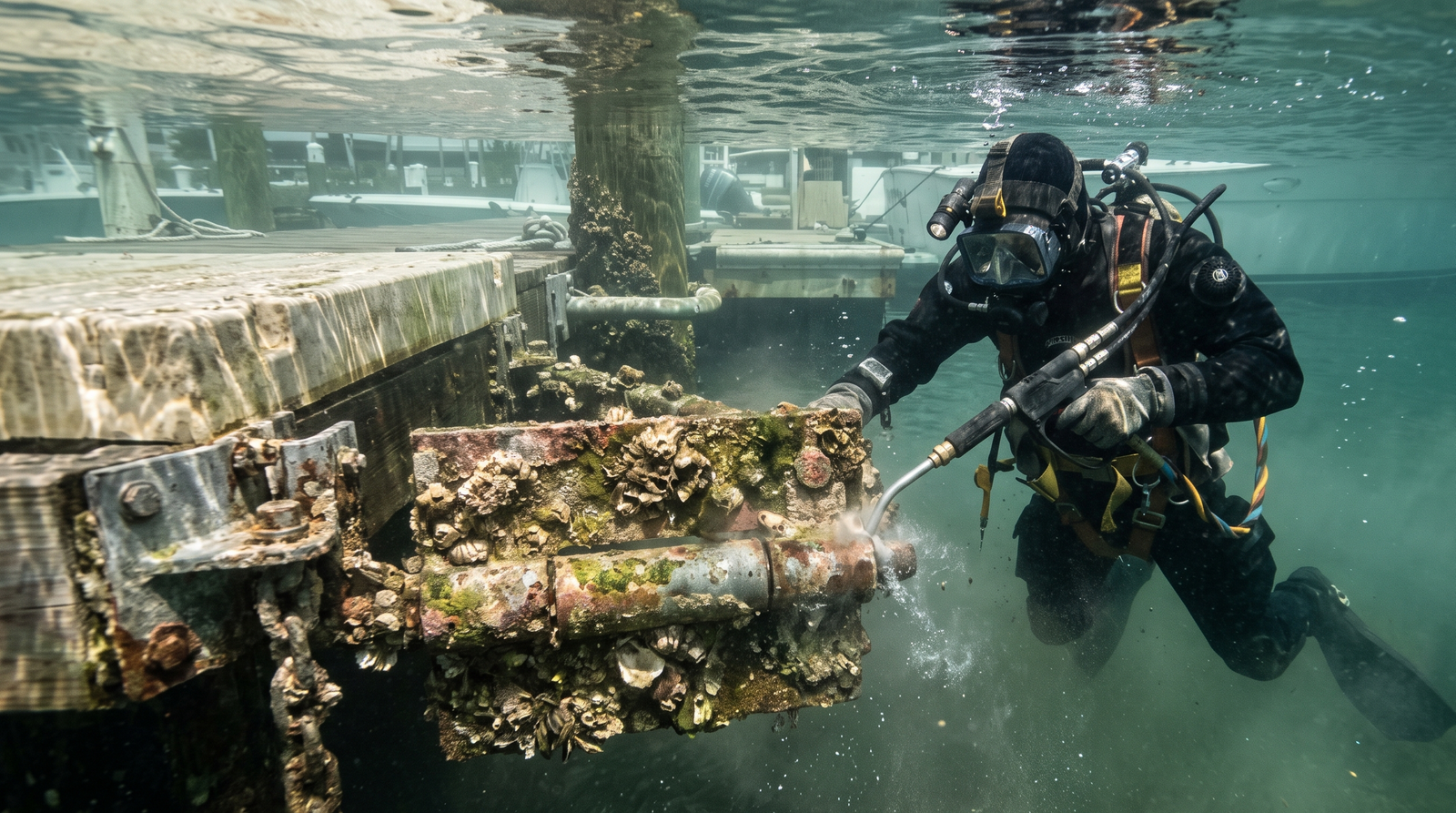
Floating docks take a surprising amount of punishment. Wind, wake action, tidal movement, salt water, brackish water, and constant articulation all work against hinges, brackets, pins, rollers, and underwater connections. Then marine growth arrives and makes the problem harder to see. This is where floating dock hardware cleaning becomes more than a cosmetic job.
We have seen marina hardware that looked reasonably clean from the dock while the underwater hinge assemblies were packed with barnacles, shell deposits, algae, and corrosion products. Once growth builds around an articulation point, a hinge may no longer move as freely as designed. A connection can become difficult to inspect. A worn pin or corroded fitting can remain hidden beneath layers of buildup.
For floating docks, cleaning should be tied to inspection and maintenance. The goal is not simply to make underwater hardware look better. It is to keep the moving and load-bearing parts accessible, functional, and easier to evaluate.
What Is Floating Dock Hardware Cleaning?
Floating dock hardware cleaning is the controlled removal of marine growth, corrosion deposits, sediment, and accumulated debris from submerged hinges, pins, brackets, fittings, and other dock components. The cleaning method should match the material and condition of the hardware. For heavily fouled metal components, cavitation cleaning can provide a controlled way to remove stubborn buildup while allowing technicians to inspect the underlying surface.
The exact equipment and pressure settings should be selected by trained technicians based on the hardware, coating, fouling, and surrounding environment. Underwater cleaning is not simply a matter of applying more force.
Why Marina Hinge Maintenance Matters
Floating dock hinges are designed to accommodate movement. As waves, wakes, tides, and changing water levels affect the dock, hinge assemblies allow connected sections to articulate rather than behaving like one rigid structure.
When hard marine growth accumulates around those moving parts, several problems can develop:
- Restricted movement: Barnacles and shell deposits can interfere with the intended range of motion.
- Hidden corrosion: Fouling can cover rust, pitting, coating failure, and deteriorating metal.
- Obstructed inspection: Technicians cannot properly evaluate a hinge that is buried beneath marine growth.
- Debris accumulation: Lines, vegetation, sediment, and other material can become trapped around hardware.
- Accelerated wear: A component that cannot articulate or move as designed may experience abnormal loads or contact.
The condition of each dock system is different, so restricted movement should be investigated rather than automatically attributed to marine growth. A hinge can be fouled, worn, corroded, improperly aligned, or damaged for other reasons.
How Cavitation Cleaning Works on Dock Hardware
Cavitation cleaning uses controlled water flow to create microscopic vapor bubbles that collapse against a submerged surface, helping loosen marine growth and deposits from underwater hardware. When properly controlled, the process can remove stubborn fouling from complex components without relying solely on abrasive mechanical scraping.
The technique is particularly useful where underwater hardware has irregular shapes, tight corners, pins, hinge interfaces, and other areas that are difficult to clean manually.
However, cavitation cleaning is not automatically appropriate for every surface. The technician must consider the hardware material, coating, condition, surrounding components, and the type of growth being removed.
Our cavitation cleaning service is designed for underwater surfaces where controlled cleaning can help remove stubborn fouling and expose the condition of the equipment underneath.
Where Floating Dock Hardware Collects the Most Growth
Hinge barrels and pins
Hinge assemblies create sheltered surfaces where marine organisms can establish themselves. Barnacles and shell growth can build around the barrel, pin, and adjacent plates, making inspection difficult and potentially restricting movement.
Brackets and connection plates
Metal brackets below the waterline often develop a combination of marine growth and corrosion products. Cleaning exposes the actual condition of the connection rather than leaving the technician to judge it through the fouling.
Underwater rollers and guides
Some floating dock systems use rollers, guides, or similar components that experience movement. Growth and debris around these areas can interfere with normal operation.
Chains, cables, and anchoring connections
Anchoring components can accumulate heavy marine growth, particularly in warm and biologically active water. These areas should be inspected for corrosion, wear, deformation, and damaged connections after cleaning.
For extensive buildup on submerged support structures, professional piling cleaning can also be incorporated into a broader marina maintenance program.
Dock Rust Removal: Cleaning Is Not the Same as Repair
One common mistake is treating visible rust as the entire problem. Rust removal can expose a surface, but it does not tell you by itself how much structural material has been lost.
Once marine growth and loose corrosion products have been removed, technicians can look for:
- Pitting and localized corrosion
- Thinned metal
- Cracked welds or connections
- Damaged pins
- Missing or loose fasteners
- Degraded coatings
- Deformation around load-bearing points
- Evidence of abnormal wear
Where anodes are part of the corrosion-control system, they should also be checked rather than assuming that cleaning has solved the corrosion problem. If sacrificial anodes are significantly consumed, our zinc replacement service can address that part of the maintenance program.
Cleaning also creates a much better opportunity for a documented underwater inspection of the dock hardware.
Why Environmental Controls Matter During Underwater Cleaning
Marine growth may look like harmless dirt, but removing it underwater can release organisms, coating particles, and other material into the surrounding water. That is why the cleaning method and location matter.
The IMO’s current biofouling guidance recognizes in-water cleaning as an important management tool but also identifies potential risks, including damage to antifouling coatings and release of fouling organisms and coating substances. In April 2025, the IMO approved dedicated guidance on in-water cleaning of ship biofouling. IMO Biofouling and In-Water Cleaning Guidance :contentReference[oaicite:0]{index=0}
Those international guidelines are primarily directed at ships, so they do not automatically establish the rules for every floating dock or marina. Local environmental agencies, marina operators, and waterway authorities may have their own requirements. Cleaning plans should account for the rules that apply at the actual work site.
Floating Dock Articulation: What Technicians Should Check
Cleaning an articulation point should give you more information than simply removing the visible fouling.
We recommend checking the complete movement and connection area for:
- Excessive play in hinge pins
- Restricted or uneven articulation
- Visible deformation
- Corrosion around welds and fasteners
- Marine growth between moving surfaces
- Debris trapped inside the assembly
- Worn bushings or sleeves where applicable
- Unexpected contact between components
If a dock section is moving differently from neighboring sections, do not assume that cleaning alone will correct it. Uneven movement can have several causes, including worn hardware, structural damage, alignment problems, anchoring issues, or excessive environmental loading.
When Should Marina Hardware Be Cleaned?
There is no universal calendar interval for every floating dock. Fouling rates vary with water temperature, salinity, local biology, dock usage, exposure, and the amount of time the hardware remains submerged.
Instead of relying only on a fixed schedule, look for maintenance triggers:
- Visible barnacle or shell accumulation
- Hinges becoming difficult to inspect
- Changes in dock movement
- Unusual noise during articulation
- Corrosion visible around connection points
- Heavy debris accumulation
- Recent storms or unusually strong wake activity
- Previous inspection findings that require follow-up
The IMO notes that biofouling is affected by factors including water temperature, salinity, operating profile, location, time spent moored, and maintenance history. Those variables help explain why two nearby marinas can experience very different fouling rates. IMO recreational craft biofouling guidance :contentReference[oaicite:1]{index=1}
Common Mistakes in Marina Infrastructure Maintenance
Only cleaning what can be seen from the dock
Floating dock hardware is often hidden below the waterline. A surface inspection cannot tell you whether a hinge pin is corroded, a bracket is deteriorating, or marine growth has filled a connection.
Using the most aggressive cleaning method available
More force does not automatically mean better maintenance. Aggressive cleaning can damage coatings or sensitive surfaces. The method should be selected for the component being cleaned.
Removing rust without checking metal loss
A freshly exposed surface can look much better while still being structurally compromised. Cleaning should be followed by an assessment of the remaining material and connection condition where appropriate.
Ignoring safety around moving hardware
Underwater dock work involves more than cleaning. Divers may be working around hinges, moving structures, tools, lines, current, and restricted visibility. OSHA identifies low visibility, physical injury, material handling, cleaning, and power-tool use among hazards associated with commercial diving operations. OSHA Commercial Diving Safety Resources :contentReference[oaicite:2]{index=2}
DIY vs. Professional Cavitation Dock Cleaning
Small amounts of accessible surface growth are one thing. Working on heavily fouled underwater hinges and marina infrastructure is another.
Professional divers can assess the hardware before cleaning, select an appropriate technique, and document what is revealed as the growth is removed. They can also recognize when a cleaning job has uncovered a condition that needs engineering review or physical repair.
For marina operators, that combination is valuable because the cleaning visit can become part of a broader preventive maintenance program instead of an isolated cosmetic service.
If the surrounding vessel fleet also requires underwater maintenance, hull cleaning can be coordinated with dock and marina work where practical.
Building a Better Marina Hardware Maintenance Program
A useful maintenance program starts with a baseline. Document the condition of hinges, pins, brackets, anchoring connections, and other submerged components when they are first inspected.
Then record what changes over time. If one hinge develops heavy growth much faster than another, that is useful information. If corrosion repeatedly appears at the same connection, that pattern deserves investigation. If a dock begins articulating differently after a major storm, document the change before assuming the cause.
Regular records also make it easier to distinguish normal marine growth from genuine deterioration.
For larger marina infrastructure, the maintenance program may combine underwater inspection, cleaning, corrosion-control work, piling maintenance, and scheduled follow-up inspections. The goal is simple: identify changes before they become failures.
Frequently Asked Questions About Floating Dock Hardware Cleaning
What is floating dock hardware cleaning?
Floating dock hardware cleaning is the controlled removal of marine growth, corrosion deposits, sediment, and debris from submerged hinges, pins, brackets, anchors, and related components. The purpose is to expose the hardware for inspection, help preserve intended movement, and identify conditions that may require repair or replacement.
Can cavitation cleaning remove barnacles from dock hinges?
Cavitation cleaning can help remove stubborn marine growth from suitable underwater surfaces, including complex hardware where conventional scraping is difficult. The technique must be selected according to the material, coating, condition, and type of fouling. It should not be treated as a universal cleaning method for every component.
Does dock rust removal fix corrosion?
No. Removing rust exposes the surface and can make the condition easier to evaluate, but it does not restore metal that has already been lost. After cleaning, technicians may need to assess pitting, thickness loss, damaged coatings, welds, pins, and other connection points to determine whether repair or replacement is necessary.
How often should floating dock hinges be cleaned?
The appropriate interval depends on local fouling rates, water conditions, dock design, exposure, and inspection findings. Instead of relying on one universal schedule, monitor marine growth, hinge movement, corrosion, and debris accumulation. Heavily fouled or high-use marina systems may require more frequent inspection and cleaning.
Can marine growth stop a floating dock hinge from moving?
Heavy growth and trapped debris can restrict movement, but they are not the only possible causes. Worn pins, damaged brackets, corrosion, misalignment, structural movement, or excessive loading can also affect articulation. Cleaning and inspection together help determine what is actually happening.
Is underwater cleaning environmentally safe?
It depends on the cleaning method, fouling condition, coating, location, and how removed material is managed. The IMO recognizes that in-water cleaning can release fouling organisms and coating substances, which is why responsible planning and environmental controls matter. Local marina and environmental requirements should always be checked before work begins.
For more practical guidance on underwater maintenance and marine infrastructure, read more of our marine maintenance stories and resources.
Conclusion
Floating dock hardware cleaning is about more than removing barnacles from a hinge. It creates an opportunity to inspect the components that allow dock sections to move, connect, and remain stable in a constantly changing marine environment.
Cavitation cleaning can be a useful tool for stubborn underwater fouling when the method is appropriate for the hardware and surrounding environment. The most effective approach combines controlled cleaning with inspection, documentation, corrosion assessment, and timely repairs.
For marina operators and floating dock owners, keeping underwater hinges and hardware accessible makes it easier to spot deterioration before a small maintenance issue becomes an infrastructure problem.
Ready to protect your vessel?
If you need expert help with this, our team of certified divers and marine technicians is ready to step in. Learn more about our specific services here.
Prefer to speak with an expert immediately? Contact us today to schedule a service or get a free quote!
