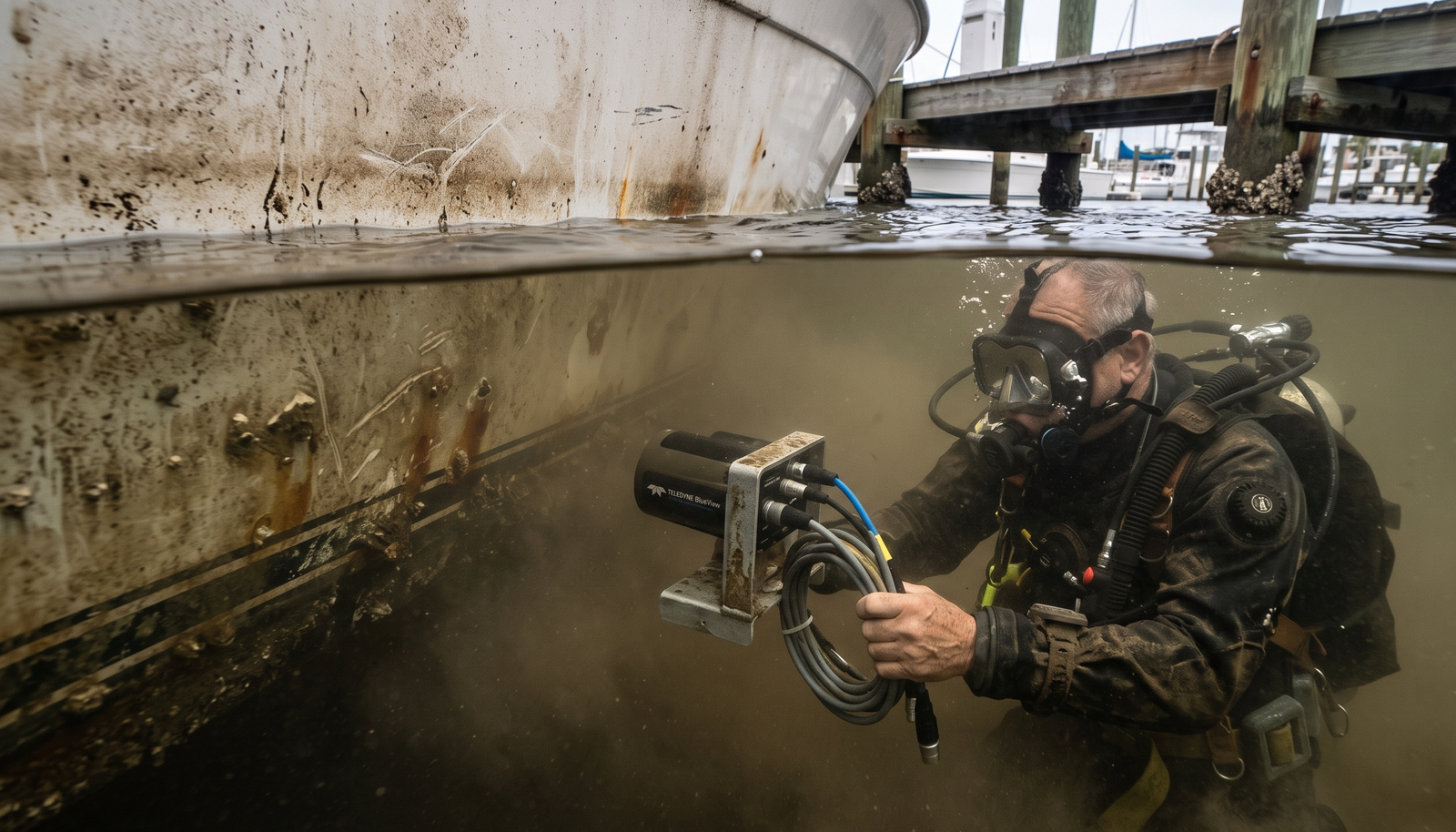
When a diver drops below a marina dock and visibility disappears after a few inches, a normal underwater camera can become almost useless. Mud, suspended sediment, algae, and heavy marine traffic can turn clear-looking water at the surface into a dark, featureless environment below it. This is where underwater acoustic imaging can provide another way to investigate what is happening beneath the surface.
For boat owners and marina operators, poor visibility does not necessarily mean an inspection has to stop. Acoustic systems use sound rather than visible light to detect and map underwater objects. Depending on the equipment and inspection objective, sonar can help locate submerged obstructions, characterize the bottom, identify underwater structures, and support follow-up work by divers or remotely operated vehicles.
It is not a magic replacement for every visual inspection. But in muddy or highly turbid water, acoustic information can give technicians another valuable layer of evidence before putting a diver in the water.
What Is Underwater Acoustic Imaging?
Underwater acoustic imaging uses sound waves to detect underwater objects and create an image or map from returning acoustic signals. Active sonar sends a sound pulse into the water and measures the returning echo. The travel time helps determine range, while the strength and characteristics of the return can provide information about the target and surrounding environment.
NOAA explains that sonar is particularly useful underwater because sound travels much farther through water than visible light. Active sonar can determine the range and orientation of objects by measuring the time between transmission and the returning echo. NOAA’s sonar overview
Depending on the system, acoustic imaging may involve side-scan sonar, multibeam sonar, imaging sonar, or other specialized equipment. The right technology depends on what you are trying to find.
Why Turbid Water Boat Inspection Is So Difficult
Visibility is one of the first limitations a diver encounters in a muddy marina.
A diver may be able to feel a hull, piling, anchor, or underwater fitting without actually seeing it clearly. That creates several challenges:
- Visual confirmation becomes difficult: The diver may only see a few inches in front of the mask or camera.
- Reference points disappear: It becomes harder to determine exactly where the diver is relative to the hull or dock.
- Marine growth can blend into the background: Fouling and sediment can make visual identification more difficult.
- Objects can be hidden on the bottom: Debris, anchors, chains, and submerged equipment may be difficult to locate visually.
- Photography becomes less useful: Even a good underwater camera cannot photograph what light cannot penetrate.
This is where acoustic information can complement conventional inspection methods.
How Sonar Hull Survey Technology Works
A sonar hull survey sends acoustic signals toward the underwater area being examined and records the returning echoes to identify surfaces, objects, distances, and changes in underwater structure. Depending on the sonar type and installation, the system can scan an area from a vessel, remotely operated vehicle, or other underwater platform.
NOAA describes multibeam sonar as an active system that uses multiple beams to map the seafloor and detect objects in the water column or along the bottom. The resulting data can provide both depth and backscatter information. NOAA multibeam sonar technology
For marina work, however, the objective is often much smaller and more localized than a full hydrographic survey. The equipment may be used to investigate a specific berth, dock, hull area, obstruction, or underwater structure rather than mapping miles of seafloor.
Side-scan sonar
Side-scan sonar creates imagery of the seafloor and objects lying on or above it. It can be useful when the question involves finding an object, obstruction, debris field, anchor, or other feature near the bottom.
NOAA notes that side-scan systems are well suited to shallow areas and can be particularly useful for mapping in turbid water where optical methods have limitations. NOAA Acoustic Backscatter Imagery
Multibeam sonar
Multibeam sonar sends multiple beams in a swath, allowing a broader area to be mapped. It is especially valuable when depth, bottom shape, and broader underwater geometry are part of the inspection question.
Imaging sonar
Imaging sonar can provide a more localized acoustic view of underwater structures. In very poor visibility, this can help a diver or remotely operated system identify the shape and location of nearby objects before making physical contact.
What Can Acoustic Imaging Find Around a Marina?
Acoustic imaging is useful because marina environments contain far more underwater infrastructure than most people see from the dock.
Depending on the equipment and survey objective, an acoustic survey may help locate or characterize:
- Submerged dock structures
- Anchors and mooring hardware
- Chains and cables
- Sunken or displaced equipment
- Underwater debris
- Scour areas around piles
- Changes in bottom elevation
- Potential underwater obstructions
- Hull or structural surfaces within the acoustic field
NOAA uses acoustic surveying for underwater obstruction detection, marine debris identification, hydrographic mapping, and other applications where optical inspection may be limited. NOAA surveying and mapping information
Acoustic Hull Camera vs. Conventional Underwater Camera
The term “acoustic hull camera” can be useful for explaining the concept, but acoustic imaging is not literally a camera that produces a normal photograph.
An optical camera records visible light. An acoustic imaging system records sound energy returning from underwater surfaces. The resulting display can look image-like, but the information is generated from acoustic measurements rather than ordinary photography.
That difference matters when interpreting results.
| Inspection Method | Strength | Limitation |
|---|---|---|
| Optical underwater camera | Provides direct visual detail, color, coating condition, and surface appearance when visibility is adequate. | Performance can drop sharply in muddy or highly turbid water. |
| Imaging sonar | Can provide useful target information when optical visibility is poor. | Does not provide normal photographic color or surface detail. |
| Side-scan sonar | Useful for locating and characterizing objects across a broader bottom area. | Interpretation depends on survey geometry, equipment settings, and target characteristics. |
| Multibeam sonar | Useful for mapping depth and underwater geometry over larger areas. | May be more equipment than needed for a small, localized inspection. |
NOAA notes that sonar backscatter represents the strength of reflected sound and that different bottom materials can return sound differently. Harder surfaces generally produce stronger returns than softer materials such as mud, but acoustic interpretation still requires appropriate survey methods and expertise. NOAA explanation of acoustic backscatter
When Poor Visibility Diving Calls for Acoustic Support
Not every low-visibility inspection requires sonar. Sometimes an experienced diver can safely perform a tactile inspection using known reference points and controlled procedures.
Acoustic support becomes more useful when the inspection requires better spatial awareness or when the target is difficult to locate visually.
Locating a submerged object
If a marina reports a lost anchor, chain, tool, fender, or other object, acoustic surveying can help narrow down where it is before divers begin a search.
Investigating underwater structures
For larger dock or marina projects, acoustic information can help identify the underwater layout before detailed visual or physical inspection begins.
Working around hazardous visibility conditions
Remote inspection technologies can reduce the need for divers to enter certain difficult environments. ABS recognizes remotely operated underwater vehicles and other remote inspection technologies as tools that can support safer and more efficient inspection work when appropriately deployed. ABS guidance on remote inspection technologies
Muddy Water Boat Inspection Still Needs Human Interpretation
One of the biggest misconceptions about sonar is that the system automatically tells you exactly what every object is.
It does not.
Acoustic returns must be interpreted in context. The appearance of an object can be affected by its shape, material, orientation, range, acoustic frequency, beam angle, bottom composition, water conditions, and equipment settings.
For example, a strong acoustic return may indicate a hard target, but that does not automatically identify it as a damaged hull fitting, an anchor, or a piece of debris.
That is why experienced technicians combine acoustic information with vessel drawings, known dock locations, positioning data, diver observations, and optical imagery whenever conditions allow.
Combining Acoustic Imaging With Underwater Inspection
The strongest inspection programs do not necessarily choose between sonar and divers. They use each tool for what it does best.
An acoustic survey can help answer questions such as:
- Where is the target?
- How large is the area of interest?
- Is there an obstruction on the bottom?
- Has the underwater geometry changed?
- Where should a diver or ROV investigate?
A diver or optical camera can then help answer different questions:
- What material is the component?
- Is the surface corroded?
- Is there marine growth?
- Is a fitting cracked or damaged?
- What does the coating actually look like?
Our underwater inspection service can be part of that broader condition-assessment process when physical access and visual confirmation are required.
Common Mistakes With Acoustic Hull Surveys
Assuming sonar replaces every dive
Acoustic imaging can extend what technicians can detect in poor visibility, but it does not automatically provide the same information as touching, measuring, or visually examining a fitting at close range.
Using the wrong sonar for the question
A broad-area bottom search and a close inspection of a small underwater component are different jobs. Equipment selection should follow the inspection objective.
Ignoring positioning
Knowing that an acoustic target exists is only useful if you can relate its location to the vessel, dock, chart, or physical reference system. Survey positioning and repeatability matter.
Interpreting every return as a defect
Acoustic imagery contains information, not automatic diagnoses. Reflections can be caused by normal structures, bottom features, debris, marine growth, or changes in geometry.
Skipping visual confirmation when it is needed
If the decision involves corrosion, cracks, coating condition, material identification, or physical damage, acoustic data may need to be followed by a closer inspection.
DIY vs. Professional Acoustic Inspection
Consumer sonar is excellent for navigation and depth awareness, but a professional acoustic survey is a different task. Inspection-grade work depends on equipment selection, deployment geometry, positioning, data quality, interpretation, and an understanding of the structure being examined.
This becomes especially important in marinas where multiple boats, dock sections, pilings, chains, cables, bottom features, and debris may all produce acoustic returns close together.
A professional team can also coordinate acoustic information with other underwater services. If fouling is obscuring a hull or underwater component, professional hull cleaning may be appropriate before a detailed physical inspection. If underwater structures are involved, piling cleaning can help expose submerged support surfaces for closer evaluation.
What to Ask Before Scheduling an Acoustic Survey
Before arranging an underwater acoustic inspection, define the question you actually need answered.
Are you trying to locate a missing object? Check a dock’s underwater footprint? Investigate a suspected obstruction? Assess bottom conditions? Support a difficult hull inspection? The answer determines the most appropriate equipment and survey approach.
Also ask how the results will be documented. A useful survey should give you more than an interesting sonar image. You should understand what was surveyed, what was detected, where the targets are located, and what additional inspection is recommended.
For larger or technically significant projects, establish the required accuracy and reporting standard before work begins.
Frequently Asked Questions About Underwater Acoustic Imaging
Can sonar see through muddy water?
Yes. Sonar uses sound rather than visible light, so it can operate in conditions where underwater cameras have very limited visibility. Acoustic performance still depends on equipment, frequency, range, water conditions, target characteristics, and survey geometry. Sonar can reveal targets and underwater structure, but the resulting data requires proper interpretation.
Can acoustic imaging inspect a boat hull?
Acoustic systems can provide information about underwater surfaces and objects, but they do not automatically replace a close visual or physical hull inspection. Depending on the system, acoustic imaging can help locate structural features, obstructions, or areas requiring follow-up. Detailed assessment of coatings, cracks, corrosion, fittings, and material condition may still require direct inspection.
What is the difference between sonar and an underwater camera?
An underwater camera records visible light and produces conventional photographs or video. Sonar sends sound into the water and interprets returning echoes to determine range and other characteristics. Because sound travels farther than light in water, sonar can remain useful in conditions where a camera produces little or no usable image.
Can sonar find objects on a muddy marina bottom?
Yes. Side-scan, multibeam, and other acoustic systems can detect and map underwater objects and bottom features. The ability to identify a particular object depends on its size, shape, material, orientation, acoustic properties, bottom conditions, equipment, and survey quality. A diver or other inspection method may be needed for positive identification.
Is underwater acoustic imaging a replacement for diving?
Not in every situation. Acoustic imaging and diving answer different inspection questions. Sonar can provide valuable information when visibility is poor or an area needs to be searched before a diver enters. Direct inspection remains useful when technicians need close visual, tactile, dimensional, or material information.
Is acoustic imaging useful for marina infrastructure?
Yes. Acoustic surveying can support investigations involving submerged dock structures, piles, anchors, chains, debris, bottom changes, and other underwater features. The appropriate sonar system depends on the size of the area and the question being investigated, and acoustic results are strongest when combined with accurate positioning and follow-up inspection.
For more practical information about underwater inspections and marine maintenance, read more of our marine maintenance stories and resources.
Conclusion
Underwater acoustic imaging gives marina operators and boat owners another way to investigate underwater conditions when poor visibility makes conventional cameras ineffective. By using sound instead of visible light, sonar can help locate objects, characterize underwater structures, and guide follow-up inspections in turbid environments.
The key is understanding what the technology can and cannot tell you. Acoustic imagery is most useful when the survey objective is clearly defined, the right equipment is selected, positioning is reliable, and the results are interpreted by people who understand the underwater environment.
For difficult marina inspections, combining acoustic data with professional diving or other remote inspection methods can provide a more complete picture of what is happening below the surface.
Ready to protect your vessel?
If you need expert help with this, our team of certified divers and marine technicians is ready to step in. Learn more about our specific services here.
Prefer to speak with an expert immediately? Contact us today to schedule a service or get a free quote!
