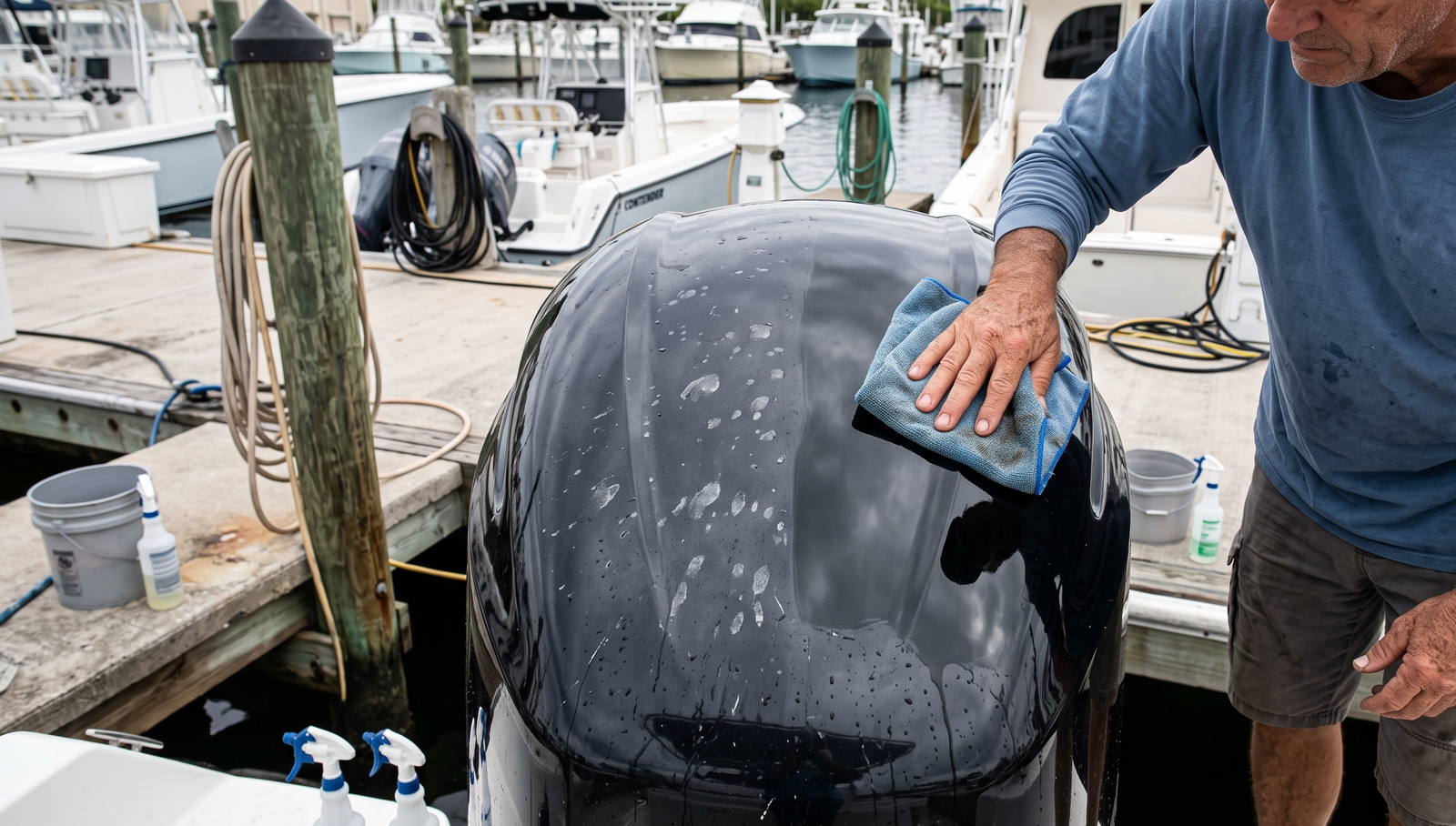
A clean outboard can make an entire boat look cared for, but hard-water spots have a way of ruining that appearance quickly. On a black or dark-colored cowling, dried salt and mineral deposits can leave pale rings, cloudy patches, and stubborn white marks that seem impossible to remove. This is why outboard cowling water spots deserve a little more attention than a quick rinse.
We see this often on boats that live in marinas or spend long days in saltwater. The owner washes the boat, lets it dry, and then notices the same spots have returned. Over time, repeated deposits can make a glossy cowling look dull and neglected.
The good news is that most water spotting can be managed with the right cleaning process. The key is avoiding aggressive scrubbing that creates a bigger cosmetic problem than the original stain.
What Causes Outboard Cowling Water Spots?
Outboard cowling water spots form when water evaporates and leaves behind dissolved minerals, salts, and other deposits on the finished surface. Saltwater can leave salt residue, while freshwater can leave mineral deposits, especially when the water contains significant calcium or other dissolved solids. Repeated drying makes those deposits increasingly noticeable.
Mercury Marine specifically identifies mineral deposits, saltwater spots, and freshwater spots as causes of visible water spotting on outboard and boat surfaces. Its maintenance guidance recommends rinsing salt residue from the exterior of an outboard and cleaning the cowl with appropriate products. Mercury Marine boat-cleaning guidance
The problem is usually worse when water is allowed to dry naturally on the cowling rather than being rinsed and wiped away.
Why Black Outboard Water Spots Look So Bad
Dark paint and plastic surfaces reveal mineral deposits particularly well. A small amount of residue can create a strong contrast against black, navy, charcoal, or other dark finishes.
That does not necessarily mean the cowling itself is damaged. Often, the visible white or cloudy material is sitting on top of the finished surface.
The trouble starts when owners attack the spots with a dry towel, rough sponge, abrasive pad, or unsuitable household cleaner. Mercury’s owner documentation warns that dry wiping a plastic cowl can create minor surface scratches and recommends wetting the surface before cleaning. Mercury FourStroke cowl cleaning instructions
How to Remove Hard Water From a Boat
To remove hard water from a boat, first rinse away loose dirt and salt, then use a marine-safe cleaner designed for water spots and mineral deposits, work gently with a soft microfiber cloth, and rinse or wipe the surface clean according to the product instructions. Avoid dry scrubbing and aggressive abrasives that can scratch paint, plastic, decals, or clear finishes.
For light spotting, the process can be surprisingly simple.
- Rinse first. Remove loose sand, salt, dust, and grit before touching the finish.
- Keep the surface wet. This reduces the chance of dragging dry particles across the cowl.
- Use a marine-safe spot remover. Choose a product appropriate for painted, plastic, or finished surfaces.
- Work with a clean microfiber cloth. Use light pressure rather than trying to force the mineral deposit away.
- Rinse and inspect. Look at the surface from several angles before deciding whether more treatment is needed.
- Protect the finish. Once clean, use a compatible protective product if recommended for that particular finish.
Mercury’s current cleaning guidance recommends wiping a boat after it comes out of the water to prevent water spots from forming. For larger deposits, Mercury recommends a non-acidic, marine-safe cleaner and explains that its All-In-One Spotless Shine product is designed to remove mineral and water spots from several marine surfaces. Mercury Marine hard-water spot guidance
Yamaha Cowling Cleaning: Start With the Manufacturer’s Instructions
Owners searching for Yamaha cowling cleaning often want one universal recipe, but the safest approach is to start with the maintenance information for the exact outboard model.
Different cowl materials, decals, graphics, finishes, and replacement parts can respond differently to cleaners and polishing compounds. The product that works beautifully on one painted surface may not be appropriate for another.
Yamaha provides model-specific owner and service information through its marine customer-support resources. Yamaha Marine customer service
If the water spots are persistent, check the engine’s owner manual before reaching for a stronger chemical. That extra step can prevent damage to the finish, decals, or plastic components.
Mercury Paint Care and Cowl Finish
Mercury provides specific cowl-care information because the finish is more delicate than many owners realize.
Its maintenance instructions state that the surface should be wet before cleaning because dry wiping can cause minor scratches. The instructions also warn against detergents containing hydrochloric acid and provide a specific cleaning and waxing procedure. Mercury cowl cleaning and waxing instructions
Mercury also offers an All-In-One Spotless Shine product specifically marketed for mineral deposits and water spots on gelcoat, fiberglass, plastic, chrome, glass, and painted surfaces. The manufacturer states that the product can be used on wet or dry surfaces and is formulated not to strip wax or damage paint, finishes, decals, or wraps when used as directed. Mercury All-In-One Spotless Shine
That makes manufacturer-specific product guidance more useful than simply choosing the strongest water-spot remover available.
Why You Should Not Scrub Hard Water Spots Aggressively
Hard deposits can feel like they are bonded to the surface. That creates the temptation to use a rough pad or heavy pressure.
On a glossy outboard cowling, that can create fine scratches that are more difficult to correct than the original water spots.
Avoid treating a painted or plastic cowl like a stainless-steel surface. The objective is to dissolve or loosen the deposit and lift it away, not grind it off.
We also recommend avoiding improvised combinations of household chemicals. A product can be effective at removing mineral scale and still be inappropriate for an automotive-style painted or plastic marine finish.
What About Severe Marine Hard Water Remover?
When ordinary washing does not remove the spots, the next step should be a purpose-made marine water-spot product or a professional detailing assessment.
The more established the mineral deposit, the more important it becomes to identify what you are actually looking at. A white haze may be mineral residue. It could also be oxidation, damaged clear coat, salt accumulation, or an existing finish problem.
Before escalating to an aggressive chemical, test the selected product in a small inconspicuous area and follow the manufacturer’s instructions.
If the boat has widespread exterior buildup rather than isolated cowl spots, our boat wash and detailing service can address the broader exterior finish as part of a professional maintenance visit.
How to Prevent Water Spots on an Outboard Cowling
Prevention is much easier than repeatedly correcting baked-on mineral deposits.
Rinse after saltwater use
Mercury recommends rinsing salt residue from the exterior of the outboard after saltwater use. Its guidance specifically recommends rinsing the cowl, mounting bracket, and trim-ram area with fresh water. Mercury outboard rinsing guidance
Dry the cowl instead of letting water evaporate
A quick wipe with a clean microfiber towel after washing can prevent dissolved minerals from drying onto the finish.
Keep the cloth clean
A microfiber cloth that already contains sand, salt, or dried dirt can scratch a glossy surface. Use clean towels and replace them when they become contaminated.
Do not ignore small spots
Fresh water spots are usually much easier to remove than deposits that have accumulated through repeated wash-and-dry cycles.
Protect the finish
A compatible wax, sealant, or manufacturer-approved protective product can make future cleaning easier. Always confirm compatibility with the cowl finish and decals.
Common Mistakes When Cleaning Black Outboard Water Spots
Dry wiping the cowl
Dry dust and mineral particles can act like fine abrasives. Wet the surface first.
Using household bathroom descaler
A powerful limescale product may contain acids that are unsuitable for marine paint, plastics, decals, or trim. A marine-safe product is a better starting point.
Using a magic eraser or abrasive pad
These products can remove stains, but they can also alter the sheen of a glossy finish. If the cowl has a painted or polished appearance, avoid unapproved abrasive methods.
Pressure-washing the engine
High-pressure water is not a substitute for careful cleaning. Mercury specifically cautions against high-pressure spray around engine components because it can force water into electrical connections and other areas where it does not belong. Mercury marine engine cleaning guidance
Forgetting the engine’s owner manual
The exact cleaning and maintenance requirements can vary by model. If there is any uncertainty, the manufacturer’s manual should take priority over a generic cleaning recipe.
DIY vs. Professional Outboard Detailing
Light water spotting is usually manageable when you have the correct product, clean microfiber towels, and patience. The problem becomes different when spots are severe, the finish is already oxidized, or the cowl has accumulated years of staining.
Professional detailing can help determine whether the issue is mineral buildup or actual finish deterioration before more aggressive correction begins.
It is also useful when the cowl is only one part of a larger cosmetic maintenance project. A clean engine sitting on a stained hull can still make the boat look unfinished, which is why we often recommend treating the boat’s exterior as one coordinated detailing job.
When Water Spots Are Actually a Finish Problem
Not every white mark is removable mineral residue.
If a spot remains after appropriate cleaning, changes only slightly with polishing, or appears cloudy beneath the surface, the problem may involve oxidation, clear-coat deterioration, paint damage, or another finish issue.
At that point, repeated chemical treatment can make matters worse. Stop and evaluate the finish before escalating.
A useful test is to clean a small section properly and compare it with an untreated area. If the surface remains hazy after the deposit is removed, you may be dealing with the finish itself rather than another layer of water spots.
Frequently Asked Questions About Outboard Cowling Water Spots
How do you remove hard water spots from an outboard cowling?
Start by rinsing the cowl with clean water to remove loose dirt and salt. Then use a marine-safe water-spot cleaner appropriate for the surface and wipe gently with a clean microfiber cloth. Avoid dry scrubbing, abrasive pads, and unsuitable acids. If the spots remain, determine whether the finish itself is damaged before using stronger methods.
Can vinegar remove water spots from a boat?
Vinegar can dissolve some mineral deposits, but that does not mean it is appropriate for every outboard cowl, painted finish, decal, or plastic component. Manufacturer instructions should take priority. For valuable or sensitive finishes, a purpose-made marine water-spot product is a safer starting point than experimenting with household acids.
How do you clean a black outboard without scratching it?
Rinse first, keep the surface wet, and use clean microfiber towels with a compatible marine-safe cleaner. Do not dry-wipe dust or salt from the cowl. Avoid abrasive pads and aggressive polishing unless the finish specifically requires correction. Mercury’s cowl instructions also warn that dry wiping plastic surfaces can create minor scratches.
Can hard water spots damage an outboard cowling?
Water spots are primarily a cosmetic issue at first, but repeated deposits and aggressive attempts to remove them can affect the appearance and finish. The greater risk often comes from improper cleaning, such as dry abrasion, unsuitable chemicals, or excessive pressure. Regular rinsing and gentle cleaning help prevent buildup.
How do I prevent water spots after washing my boat?
Rinse away salt and mineral residue, then dry the cowl and other glossy surfaces rather than allowing water to evaporate on them. A compatible protective product can also make future cleaning easier. Mercury specifically recommends wiping down the boat after it comes out of the water to help prevent water spots from forming.
Can I pressure wash my outboard cowling?
Avoid using high-pressure water as a general engine-cleaning method. Mercury cautions that high-pressure spray can force water into electrical connections and other sensitive areas. Follow the specific instructions in your outboard’s owner’s manual and use gentle freshwater rinsing where appropriate.
For more practical boat-care advice and maintenance stories, read more of our marine maintenance resources.
Conclusion
Outboard cowling water spots are usually easier to prevent than remove after they have been allowed to build up. Regular freshwater rinsing, gentle cleaning, clean microfiber towels, and compatible marine detailing products can keep mineral and salt deposits from becoming a persistent cosmetic problem.
If hard spots have already formed, resist the temptation to attack them with abrasive pads or strong household chemicals. Start with the manufacturer’s care instructions and a surface-appropriate marine cleaner. If the discoloration remains after the deposits are removed, the issue may be oxidation or finish damage rather than water spotting.
A little attention after each trip can save a lot of polishing later—and help keep your Yamaha, Mercury, or other outboard looking as good as the rest of the boat.
Ready to protect your vessel?
If you need expert help with this, our team of certified divers and marine technicians is ready to step in. Learn more about our specific services here.
Prefer to speak with an expert immediately? Contact us today to schedule a service or get a free quote!
