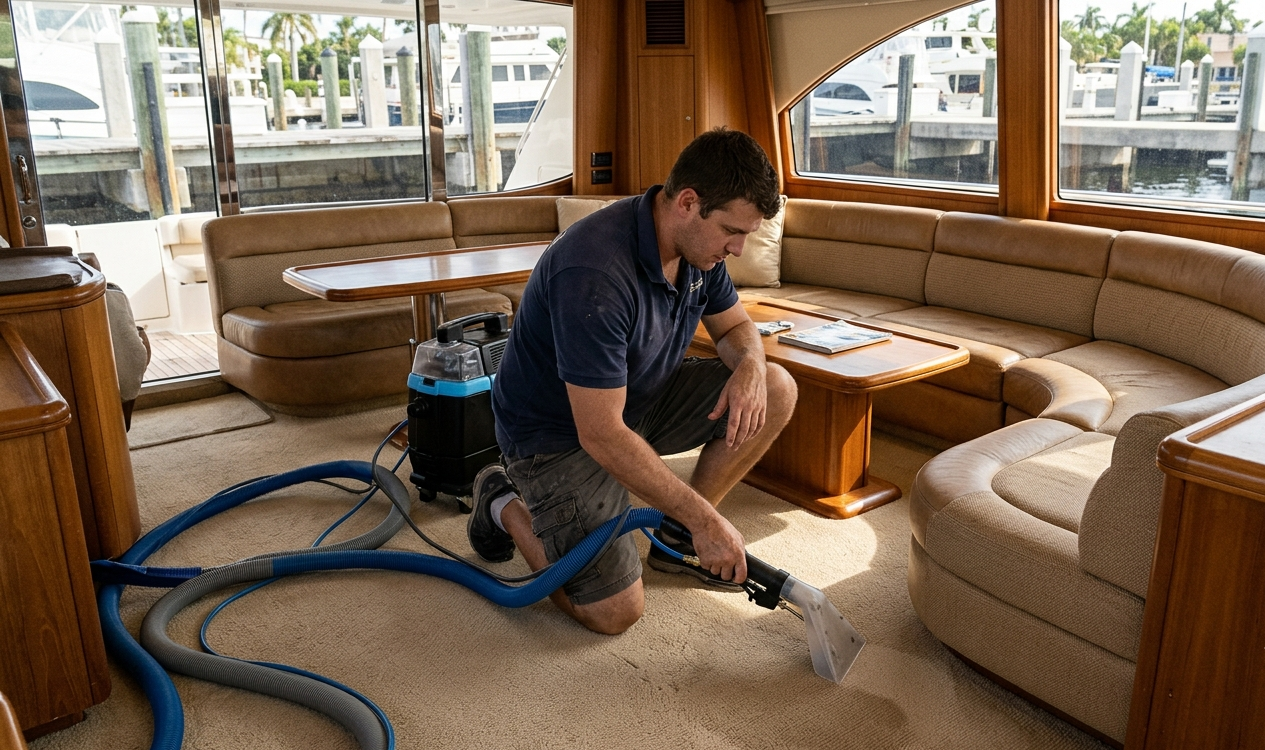
Luxury yacht interiors take a beating in ways that are easy to miss. Salt air, wet swimwear, sunscreen, food, humidity, tracked-in dock grime, and everyday foot traffic can push dirt deep into carpet fibers and upholstery. A quick vacuum may improve the surface, but it does not remove everything trapped below it.
Yacht interior carpet cleaning uses controlled extraction methods to remove embedded soil, moisture-related odors, stains, and contaminants from marine carpets without treating a luxury cabin like an ordinary room. The process should account for carpet construction, upholstery fabrics, backing materials, ventilation, and the limited drying environment found aboard a vessel.
We see this often before a yacht charter season, a major owner trip, a vessel sale, or a professional detailing appointment. The owner knows the interior looks tired, but the real problem is often deeper than appearance. That is where professional extraction cleaning makes a measurable difference.
What Is Yacht Interior Carpet Cleaning?
Yacht interior carpet cleaning is the professional inspection, treatment, extraction, and drying of carpet installed aboard a marine vessel. Unlike household carpet cleaning, the process must account for marine humidity, restricted airflow, sensitive furnishings, tight cabin spaces, delicate fibers, and the risk of excess moisture reaching flooring or substrates.
The ANSI/IICRC S100 Standard for Professional Cleaning of Textile Floor Coverings addresses carpet inspection, cleaning chemistry, soil removal, equipment, cleaning methods, safety, and post-cleaning inspection. Those principles are useful on yachts, where selecting the correct method matters as much as removing the soil.
Why Luxury Yacht Carpeting Needs a Different Approach
A yacht cabin can look clean while its carpet is carrying months of fine particulate soil. Marine environments add another layer of complexity because moisture is constantly nearby.
- Salt and mineral residue: Damp shoes, towels, and clothing can transfer dissolved salts and minerals into carpet fibers.
- Sand and fine grit: Beach and dock particles can work downward through carpet with repeated foot traffic.
- Food and beverage spills: Sugars, oils, and proteins can leave residues that attract additional soil.
- Humidity: Poor drying conditions can leave carpets smelling musty and increase the risk of microbial growth.
- Heavy upholstery use: Salons, dining areas, helm seating, and guest cabins often accumulate body oils and sunscreen residue.
This is why simply adding more fragrance or running a household carpet machine is rarely the right answer for a high-value vessel.
How Deep Extraction Cleaning Works on a Yacht
Deep extraction should begin with inspection rather than immediately applying water or chemicals. We first look at the carpet fiber, construction, visible staining, previous treatments, surrounding materials, and likely source of contamination.
1. Inspect the Carpet and Surrounding Area
Inspection helps determine whether the problem is ordinary soil, staining, odor, moisture damage, or something that requires specialized restoration. Carpet construction and fiber type can affect which cleaning method is appropriate.
The ANSI/IICRC S800 Standard for Professional Inspection of Textile Floor Coverings recognizes inspection as a distinct professional process covering issues such as soiling, staining, discoloration, carpet construction, and cushion conditions.
2. Remove Dry Soil First
Dry soil should be removed before wet cleaning whenever practical. This reduces the amount of material that has to be suspended in the cleaning solution and extracted later.
On yachts, this step is particularly useful around companionways, salon entrances, crew passageways, and other high-traffic areas where sand and grit accumulate.
3. Pre-Treat Problem Areas
Different soils require different treatment. Grease, food residue, beverage stains, and body oils do not respond identically to the same chemical.
Professional technicians should select cleaning agents according to the carpet or upholstery material and always consider manufacturer care instructions. Overly aggressive chemistry can create discoloration, fiber damage, residue, or unwanted texture changes.
4. Perform Controlled Extraction
Extraction cleaning introduces a controlled amount of cleaning solution and then removes suspended soil and moisture using extraction equipment. The goal is not to saturate the yacht’s interior. It is to achieve effective soil removal while keeping moisture exposure and drying time under control.
That distinction matters aboard a vessel because excessive moisture can migrate into carpet backing, padding, flooring systems, furniture bases, or concealed areas.
5. Accelerate Drying
Drying is part of the cleaning job, not an afterthought. Fans, air movement, dehumidification, and controlled ventilation can help remove remaining moisture.
EPA guidance emphasizes moisture control and rapid drying when dealing with mold-prone materials. It also notes that porous materials such as carpet can be difficult to clean completely once mold has become established. For serious moisture or mold problems, cleaning should be evaluated separately from routine detailing.
See the EPA guidance on basic mold cleanup for additional information on moisture control and porous materials.
Marine Upholstery Extraction Goes Beyond Carpet
Carpet is only one part of the interior. Luxury yacht cabins frequently contain fabric headliners, dining seats, salon sofas, berth cushions, decorative pillows, and other upholstered surfaces.
Marine upholstery extraction should use the same basic philosophy: inspect first, identify the material, control moisture, extract effectively, and dry thoroughly.
The IICRC professional cleaning standards include a dedicated S300 standard for professional upholstery cleaning, reflecting the fact that upholstery requires its own cleaning considerations rather than simply treating it like carpet.
For a complete interior reset, professional boat wash and detailing services can also address surrounding hard surfaces, exterior areas, and the overall presentation of the vessel.
Yacht Mold Removal Interior: When Cleaning Is Not Enough
Musty odors or visible spotting should never be treated as a simple cosmetic issue. Mold problems are fundamentally moisture problems.
The EPA states that the key to mold control is moisture control and warns that porous materials such as carpet may need to be discarded when they become moldy because growth can penetrate spaces within the material.
That means yacht mold removal interior work should start by finding the moisture source. A leaking hatch, plumbing connection, air-conditioning condensate problem, wet bilge-adjacent area, or recurring condensation can undermine even a thorough cleaning job.
For significant mold contamination or water damage, professional remediation may be more appropriate than routine detailing. Cleaning visible mold without correcting the moisture source can allow the problem to return.
Common Mistakes With Luxury Yacht Interior Cleaning
- Using too much water: More moisture does not automatically mean better cleaning.
- Skipping inspection: Different fibers and backing systems can require different treatment.
- Covering odors with fragrance: Deodorizer does not solve the source of a persistent marine odor.
- Ignoring drying: Damp carpet left inside a humid vessel can create a bigger problem.
- Scrubbing aggressively: Excessive agitation can damage delicate fibers or alter their appearance.
- Treating mold like ordinary staining: Established mold and water damage may require remediation rather than routine extraction.
DIY vs. Professional Yacht Interior Carpet Cleaning
DIY spot cleaning is reasonable for a fresh, isolated spill when the carpet or upholstery manufacturer allows it. Deep cleaning throughout a luxury vessel is different.
Professional cleaning becomes particularly useful when the carpet covers large areas, the interior contains expensive furnishings, odors persist after normal cleaning, staining is widespread, or the vessel has experienced water intrusion.
A professional also has the advantage of matching the cleaning method to the material and controlling moisture during extraction and drying. For high-value interiors, that risk management is often as important as the visible cleaning result.
How Often Should Yacht Carpets and Interiors Be Deep Cleaned?
There is no single schedule that fits every vessel. Usage, charter frequency, climate, guest traffic, pets, food service, and interior materials all affect the ideal interval.
A privately used yacht may need deep extraction less frequently than a heavily chartered vessel. High-traffic areas should be monitored between full cleaning cycles, while cabins and upholstery should be inspected whenever odors, staining, or changes in texture become noticeable.
A regular underwater inspection program can also complement interior maintenance by identifying exterior or underwater issues that may contribute to broader vessel maintenance concerns.
Frequently Asked Questions About Yacht Interior Carpet Cleaning
Can yacht carpet be steam cleaned?
Yes, some yacht carpets can be cleaned using hot-water extraction or other professional methods, but the correct approach depends on the fiber, construction, backing, installation, and manufacturer’s care requirements. The cleaning method should be selected after inspection rather than assuming every yacht carpet can tolerate the same process.
How long does yacht carpet take to dry after extraction?
Drying time varies with carpet construction, moisture level, cabin temperature, humidity, ventilation, and equipment. Professional air movement and dehumidification can significantly improve drying conditions. The goal is to return the carpet to a properly dry condition before normal use.
Can extraction cleaning remove yacht carpet odors?
It can remove many odor sources when they are caused by embedded soil, food residue, body oils, or other removable contaminants. Persistent musty odors may indicate trapped moisture, microbial growth, or contamination beneath the visible carpet and require further investigation.
Can professional cleaning remove mold from yacht carpet?
It depends on the extent of contamination and the condition of the material. EPA guidance notes that mold can penetrate porous materials such as carpet, making complete removal difficult. Mold-affected carpet should be evaluated based on contamination, moisture history, material condition, and whether it can be thoroughly cleaned and dried.
Should upholstery be cleaned at the same time as yacht carpet?
Often, yes. Salon seating, berth cushions, dining upholstery, and carpets are exposed to many of the same contaminants. Coordinating boat cabin detailing with carpet extraction creates a more consistent interior cleaning program and helps prevent freshly cleaned carpet from being surrounded by heavily soiled upholstery.
Build Deep Extraction Into Your Yacht Maintenance Program
Luxury interiors stay cleaner when deep extraction is part of a planned maintenance program instead of an emergency response to stains and odors. Regular vacuuming and spot treatment handle daily soil, while periodic professional extraction removes contamination that routine cleaning cannot reach.
For owners and captains managing a high-value vessel, the goal is simple: protect the appearance, comfort, and condition of the interior without introducing unnecessary moisture or aggressive cleaning methods.
For related maintenance, explore our hull cleaning services, cavitation cleaning, and zinc replacement services for the underwater side of your vessel.
Read more marine maintenance insights and practical vessel-care advice on our marine maintenance blog.
Conclusion
Yacht interior carpet cleaning is more than making carpet look fresh. Done correctly, deep extraction removes embedded soil, controls odors, improves the condition of high-traffic areas, and helps protect expensive interior materials. The key is controlled cleaning, appropriate chemistry, effective extraction, and thorough drying.
For luxury yachts, the interior deserves the same level of technical care as the machinery, exterior finish, and underwater running gear. A professional approach can help preserve the vessel’s comfort and presentation while reducing the risk of moisture-related problems.
Ready to protect your vessel?
If you need expert help with this, our team of certified divers and marine technicians is ready to step in. Learn more about our specific services here.
Prefer to speak with an expert immediately? Contact us today to schedule a service or get a free quote!
