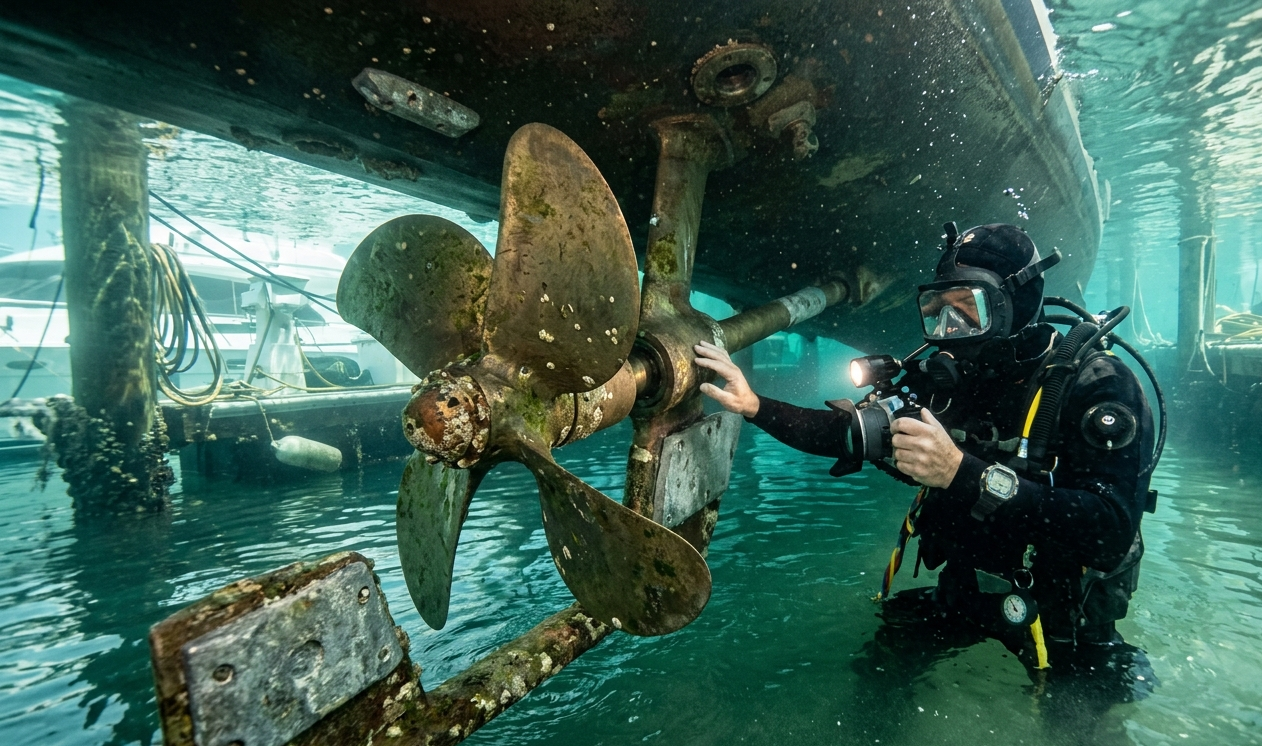
A megayacht can have an immaculate exterior and still develop problems where you cannot see them: underneath the hull. Propeller shafts, struts, bearings, seals, rudders, and propellers operate under significant loads, and small changes in alignment, bearing condition, or vibration can become expensive problems if they are ignored.
Megayacht running gear inspection is therefore more than checking whether a propeller looks clean. It is about understanding the condition of the entire underwater propulsion system and identifying signs that may warrant mechanical or engineering investigation.
For large yachts, a vibration noticed at the helm, a new shaft seal leak, unusual bearing wear, or a slight change in engine behavior can be connected to an underwater component. DNV notes that inadequate shaft alignment can contribute to stern-tube bearing damage and costly propulsion-system failures. :contentReference[oaicite:0]{index=0}
We approach these inspections by looking for the physical clues first: condition, movement, wear, alignment-related symptoms, marine growth, impact damage, and anything that has changed since the previous inspection.
What Is a Megayacht Running Gear Inspection?
A megayacht running gear inspection is a detailed examination of the underwater propulsion components of a large yacht. Depending on the vessel, it can include the propellers, shafts, struts, bearings, rudders, shaft seals, anodes, and surrounding hull structure.
The purpose is to document visible and measurable conditions, identify abnormal wear or damage, and determine whether further mechanical, engineering, or haul-out inspection is appropriate.
For a large yacht, the inspection should be treated as part of the propulsion system rather than as an isolated underwater cleaning task.
Why Large Vessel Running Gear Requires Careful Inspection
Large vessel running gear operates under substantial mechanical and hydrodynamic loads. Propeller forces can influence shaft and bearing behavior, while hull deflection and operating conditions can affect the alignment of the shaft line.
ABS guidance on propulsion shaft alignment emphasizes that shafting alignment should be considered across relevant operating conditions, including propeller loads and hull deflections. :contentReference[oaicite:1]{index=1}
DNV likewise emphasizes the relationship between shaft alignment, propeller loads, bearing loads, and operating conditions. Its guidance notes that shaft alignment is important for reliable propulsion and bearing performance. :contentReference[oaicite:2]{index=2}
That does not mean every underwater defect is an alignment problem. It means the inspection should document the evidence carefully before anyone assumes a cause.
What We Look for During a Megayacht Running Gear Inspection
Propeller Condition
The propeller is one of the first components we examine because damage or deformation can create vibration and affect propulsion performance.
Look for:
- Nicks or impact damage on blade edges
- Visible bending or deformation
- Uneven marine growth
- Corrosion or dezincification on applicable alloys
- Signs of cavitation erosion
- Loose or damaged propeller hardware
- Unusual wear around the hub
A propeller that has contacted a submerged object may continue to turn normally while producing vibration or abnormal loading. A visual inspection can identify clues, but determining whether a propeller remains within design tolerances may require specialist measurement or removal.
Propeller Shaft
The shaft should be checked for visible scoring, corrosion, pitting, damage, unusual wear, and signs of contact or movement.
Where appropriate, the inspection should also consider the shaft’s relationship with the surrounding bearing and stern-tube arrangement.
A shaft that appears visually sound does not automatically prove that the alignment is correct. Alignment assessment can require measurements and engineering analysis beyond what can be established by an underwater visual inspection.
Yacht Shaft Alignment: What an Underwater Inspection Can Tell You
Yacht shaft alignment is a technical subject that involves the shaft line, bearings, propeller loads, hull behavior, and operating conditions.
An underwater inspection cannot replace a complete shaft-alignment calculation or measurement program. What it can do is identify physical evidence that may justify further investigation.
Examples include:
- Uneven bearing wear
- Abnormal shaft contact marks
- Evidence of repeated vibration
- Damage near shaft supports
- Unusual propeller condition
- Signs of grounding or impact
- Changes compared with previous inspection reports
DNV provides dedicated propulsion shaft alignment services for investigating operational shaft-alignment problems, including root-cause analysis, measurement verification, and troubleshooting. :contentReference[oaicite:3]{index=3}
Strut Bearing Check: What Matters Underwater
A proper strut bearing check should look beyond whether the bearing is still physically present.
The underwater inspection should document visible wear, damage, clearance-related symptoms, marine growth, and the condition of the surrounding strut and shaft.
For a water-lubricated bearing, examine the bearing surface and shaft interface for abnormal wear patterns, scoring, cracking, missing material, or other signs of distress.
For oil-lubricated systems, the underwater inspection is only one part of the condition assessment. Lubricant condition, shaft seals, bearing temperatures, operational data, and engineering measurements may also be relevant.
DNV highlights that bearing performance is closely connected to shaft alignment, bearing loading, contact area, lubrication, and operating conditions. :contentReference[oaicite:4]{index=4}
Cutlass Bearing Underwater: What Can Be Seen?
A cutlass bearing underwater inspection can reveal visible deterioration without removing the vessel from the water.
We look for:
- Uneven bearing wear
- Missing or damaged bearing material
- Excessive visible clearance
- Cracks or deformation
- Scoring on the shaft
- Foreign material lodged around the bearing
- Marine growth affecting the inspection area
However, an underwater visual inspection has limits. Exact bearing clearance, internal condition, shaft alignment, and other mechanical measurements may require additional procedures according to the vessel’s design and the manufacturer’s or classification requirements.
The value of the underwater inspection is that it can identify evidence and help determine whether further work should be planned before a problem becomes a propulsion failure.
Propeller Vibration Check: What Can an Inspection Reveal?
Propeller vibration check begins with understanding what the crew is experiencing.
Ask when the vibration occurs. Does it happen only at a particular RPM? Does it increase with speed? Does it appear during acceleration, cruising, or maneuvering? Is it felt through the deck, steering system, or machinery space?
These observations provide useful context.
Potential physical contributors can include:
- Propeller damage
- Marine growth or fouling
- Shaft damage
- Bearing wear
- Loose components
- Alignment-related issues
- Hydrodynamic loading
- Other propulsion-system conditions
Advanced vibration diagnosis may require sensors, sea-trial measurements, shaft-speed analysis, or specialist engineering. DNV’s machinery analysis tools specifically address whirling and axial vibration, natural frequencies, critical speeds, bearing stiffness, and propeller effects. :contentReference[oaicite:5]{index=5}
Inspecting the Shaft Seal and Stern Tube Area
The shaft seal is another critical area of the propulsion system.
During an underwater inspection, look for visible leakage, damaged components, unusual marine growth patterns, physical damage, and anything that appears inconsistent with the vessel’s normal condition.
For systems using lubricating oil, seal condition is particularly important because water contamination can affect lubricant condition and bearing performance. DNV identifies degraded or contaminated lubricant, including issues associated with leaking aft seals, as one potential contributor to propeller shaft bearing damage. :contentReference[oaicite:6]{index=6}
Again, an underwater inspection provides visual evidence. Oil analysis, temperature monitoring, seal testing, and engineering assessment may be needed to establish the actual condition of the system.
Why Marine Growth Should Be Documented Before Cleaning
Marine growth can conceal the condition of running gear. Barnacles, shell growth, algae, and other fouling can make it difficult to distinguish normal component surfaces from damage.
For that reason, it can be useful to document the existing condition before cleaning.
If fouling is heavy, appropriate underwater hull and running-gear cleaning can provide a clearer surface for inspection.
Where sensitive components or complex underwater equipment require controlled cleaning, cavitation cleaning may also be considered when appropriate for the surface and fouling condition.
Common Signs That Running Gear Needs Attention
| Observed condition | Possible area of concern | Recommended next step |
|---|---|---|
| New vibration at a specific RPM | Propeller, shaft, bearing, alignment, or other propulsion condition | Document operating conditions and arrange appropriate diagnostic assessment |
| Uneven bearing wear | Shaft/bearing interaction or alignment-related issue | Inspect further and consider engineering measurement |
| Propeller blade damage | Impact, cavitation, erosion, or deformation | Measure and assess before assuming normal operation |
| Visible shaft scoring | Possible bearing or foreign-object contact | Investigate shaft and bearing condition |
| Seal leakage | Possible seal or stern-tube issue | Check system condition and follow manufacturer/class procedures |
| Rapid anode consumption | Possible galvanic or electrical issue | Inspect anodes and investigate the broader corrosion system |
Common Mistakes During Large Yacht Running Gear Inspection
Only Inspecting the Propeller
A clean-looking propeller does not prove that the shaft, bearings, struts, seals, and other propulsion components are healthy.
The entire running gear system should be considered.
Assuming Vibration Always Means a Bent Shaft
Vibration can have many causes. Propeller condition, fouling, bearings, alignment, mounting, machinery, and operating conditions can all be relevant.
Jumping to one diagnosis without collecting evidence can result in unnecessary work.
Ignoring Changes in Vibration
Even if the vibration is not severe, a new or changing vibration pattern deserves attention—particularly on a vessel with expensive propulsion machinery.
Relying Only on a Visual Inspection for Alignment
A visual underwater inspection is valuable, but it cannot establish every aspect of shaft alignment.
Where alignment is suspected, appropriate engineering measurements and analysis should be performed by qualified specialists.
Failing to Compare With Previous Reports
One inspection tells you the condition today. A series of inspections can reveal trends.
Photographs, measurements, defect locations, bearing observations, anode condition, and propeller condition should be documented consistently so changes are easier to identify.
DIY vs. Professional Megayacht Running Gear Inspection
For a small recreational boat, an owner may be able to observe some underwater components during haul-out. A megayacht is different.
The size, complexity, propulsion configuration, equipment value, and potential consequences of a running-gear problem make professional inspection especially useful.
A commercial dive team can document the underwater condition while the vessel remains afloat, potentially reducing the need for an immediate haul-out simply to determine whether an obvious underwater issue exists.
Our underwater inspection services can be used to assess submerged running gear, propellers, shafts, struts, rudders, anodes, and other accessible underwater components.
If the inspection identifies a condition requiring specialist mechanical or engineering analysis, the findings can provide useful documentation for the next stage of investigation.
When a Running Gear Problem Requires Engineering Analysis
Some findings can be documented underwater. Others require measurements that cannot be obtained reliably by a diver alone.
Engineering analysis may be appropriate when there is:
- Persistent or increasing vibration
- Suspected shaft misalignment
- Repeated bearing damage
- Unusual shaft or bearing wear
- Propeller deformation
- Repeated seal failures
- Grounding or impact damage
- Unexplained propulsion-system temperature changes
DNV states that shaft-alignment investigations can include root-cause analysis, measurement verification, shaft-line improvements, and assistance during repair or replacement. :contentReference[oaicite:7]{index=7}
ABS guidance similarly treats alignment as a system-level issue involving shafting, bearings, propeller loads, and hull behavior. :contentReference[oaicite:8]{index=8}
Building a Preventive Running Gear Inspection Program
Large yachts benefit from treating underwater running gear as a scheduled maintenance item rather than waiting for a vibration, leak, or bearing failure.
A practical inspection program can include:
- Routine underwater visual inspections
- Propeller condition documentation
- Shaft and bearing observations
- Strut and rudder inspections
- Anode condition checks
- Shaft seal observations
- Vibration and machinery trend monitoring
- Comparison with previous inspection reports
- Engineering assessment when abnormal conditions appear
This approach does not eliminate mechanical failures. It gives the owner and crew more information about developing conditions before they become major repair events.
FAQs About Megayacht Running Gear Inspection
What is included in a megayacht running gear inspection?
A typical underwater inspection can include the propellers, shafts, struts, bearings, rudders, shaft seals, anodes, and accessible surrounding hull areas. The exact scope depends on the vessel’s propulsion configuration and the purpose of the inspection.
Can yacht shaft alignment be checked underwater?
An underwater inspection can identify visible signs that may suggest an alignment-related problem, but it does not replace a complete shaft-alignment measurement or engineering analysis. Alignment should be evaluated using procedures appropriate to the vessel’s propulsion system.
What does a strut bearing check look for?
A strut bearing check can look for visible wear, damage, unusual clearance, missing bearing material, shaft scoring, foreign material, and other signs of abnormal shaft-to-bearing interaction. Exact clearance and internal condition may require additional measurement.
Can a cutlass bearing be inspected underwater?
Yes. A diver can inspect an accessible cutlass bearing for visible wear, damage, missing material, shaft scoring, marine growth, and other physical conditions. Determining exact internal clearance or complete bearing condition may require additional procedures.
What can cause propeller vibration on a megayacht?
Possible contributors include propeller damage or fouling, shaft condition, bearing wear, alignment-related problems, loose components, hydrodynamic loading, and other machinery or propulsion-system conditions. Vibration diagnosis may require specialized measurements.
How often should large yacht running gear be inspected?
The appropriate interval depends on the vessel, propulsion system, operating profile, class requirements, maintenance program, and previous condition history. Routine underwater inspections can be coordinated with scheduled maintenance, with additional inspections when vibration, impact, leakage, or other changes occur.
Read More: Explore more practical underwater maintenance guidance and real-world marine service insights on the UMS marine maintenance blog.
Conclusion
Megayacht running gear inspection is about more than looking at a propeller. Shafts, bearings, struts, seals, rudders, anodes, and surrounding structures all contribute to reliable propulsion, and changes in one component can sometimes provide clues about another.
An underwater inspection can document physical evidence while the yacht remains afloat, helping owners and crews identify damage, unusual wear, fouling, and other conditions that may require further attention.
When the findings point toward alignment, vibration, bearing, or structural issues, the next step should be appropriate specialist measurement and engineering analysis rather than guessing at the cause.
Ready to protect your vessel?
If you need expert help with this, our team of certified divers and marine technicians is ready to step in. Learn more about our specific services here.
Prefer to speak with an expert immediately? Contact us today to schedule a service or get a free quote!
