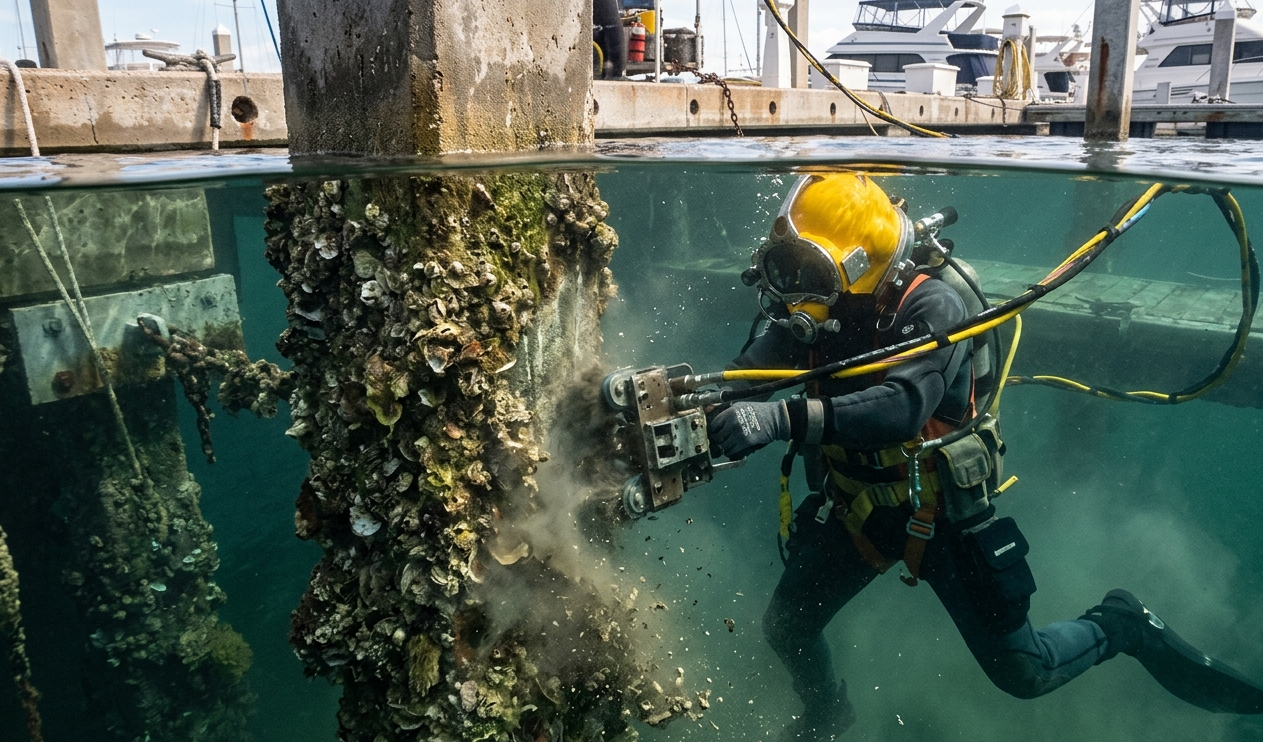
Keeping a large marina clean is very different from maintaining a private dock. Hundreds of pilings, floating dock components, seawalls, ladders, chains, and underwater structures can collect marine growth at the same time. When that happens, hand tools and small portable equipment can turn a maintenance project into a slow, labor-intensive operation.
A hydraulic piling scrubber gives commercial marine maintenance teams a way to remove heavy biological buildup more efficiently while divers work underwater. When properly selected and operated, these systems can increase cleaning consistency, reduce repetitive manual effort, and make large-scale underwater maintenance more practical.
We have seen the difference equipment selection makes on commercial waterfront projects. A piling with years of barnacles and shell growth does not respond the same way as a lightly fouled dock support. The right hydraulic system needs enough cleaning power to remove buildup without unnecessarily damaging the underlying structure.
What Is a Hydraulic Piling Scrubber?
A hydraulic piling scrubber is an underwater cleaning tool powered by hydraulic flow and designed to remove marine growth from submerged structures such as pilings, dock supports, seawalls, and related infrastructure. The rotating or powered cleaning head allows a diver or operator to maintain steady contact with the surface while removing accumulated fouling.
Compared with relying entirely on hand scrapers, a hydraulic system can provide more consistent mechanical action over large areas. The exact brush, cutter, pressure, and attachment configuration should be matched to the structure and the type of fouling present.
Why Large Marinas Need Specialized Cleaning Equipment
Commercial marinas deal with a combination of scale, access, scheduling, and environmental considerations that make underwater cleaning more complicated than it appears from the dock.
- Large numbers of pilings: A single marina may contain dozens or hundreds of submerged supports.
- Heavy marine growth: Barnacles, mussels, algae, tunicates, and other organisms can form thick layers.
- Restricted underwater visibility: Turbid water can make visual cleaning difficult.
- Continuous vessel traffic: Maintenance may need to happen while portions of the facility remain operational.
- Different structural materials: Timber, concrete, steel, composite, and coated surfaces may require different cleaning approaches.
- Contract deadlines: Commercial operators often need predictable production rates to keep maintenance programs on schedule.
This is where commercial dock cleaning equipment can become valuable. The objective is not simply to use the most powerful machine available. It is to use equipment that provides the appropriate cleaning action for the structure while allowing the crew to work safely and efficiently.
How Hydraulic Scrubber Systems Improve Marina Maintenance
Hydraulic equipment can reduce the physical effort required for repetitive underwater cleaning. Instead of a diver manually scraping every square foot of a piling, the powered scrubber provides continuous mechanical action while the diver controls its position and movement.
Consistent Cleaning Action
Hand scraping naturally varies from one section to another. A powered brush can provide a more repeatable cleaning pattern, especially when the same type of piling is being treated across a large facility.
Faster Coverage of Large Surfaces
Production speed depends on fouling thickness, surface condition, equipment configuration, water visibility, diver experience, and site conditions. However, powered tools can make repetitive cleaning substantially less demanding than manual scraping alone.
Better Crew Productivity
Large-scale marine maintenance often involves more than the diver in the water. Surface personnel manage hydraulic power, hoses, communications, safety, access, and debris-control procedures. A well-organized system allows each crew member to focus on a defined part of the operation.
Choosing the Right Hydraulic Piling Scrubber
Not every piling should be cleaned with the same brush or hydraulic configuration. Before choosing equipment, inspect the structure and identify the type and thickness of marine growth.
Consider the Structure
Concrete pilings can tolerate different cleaning methods than painted steel or older timber. A coating that looks intact from the surface may be compromised underneath marine growth. Aggressive mechanical cleaning can remove more than the fouling if the equipment is poorly matched to the surface.
For structures requiring a closer assessment before cleaning, an underwater inspection can document the condition of the piling and identify defects that should be addressed before aggressive cleaning begins.
Consider the Fouling
Soft algae and slime require less mechanical force than thick calcareous growth. Barnacles and shell-forming organisms can create a hard crust that requires more aggressive action, but the cleaning approach should still account for the substrate underneath.
Consider Hydraulic Flow and Pressure
Hydraulic tools depend on an appropriate power source and operating range. Matching the scrubber to the hydraulic power unit helps prevent poor performance, overheating, excessive wear, and inefficient operation.
Equipment specifications should always be checked against the manufacturer’s operating requirements. Professional commercial diver tools are only effective when the complete system—including hoses, power unit, attachments, and controls—is configured correctly.
Automated Piling Cleaning vs. Manual Scraping
Automation does not necessarily mean removing the diver from the process. In many commercial applications, the most practical arrangement is a diver-guided powered cleaning system.
The diver remains responsible for positioning the cleaning head, controlling contact, identifying unexpected structural conditions, and recognizing areas that need additional attention. The hydraulic system supplies the repetitive mechanical action.
This combination can be particularly useful when a marina has a large number of similar pilings that require scheduled cleaning.
Marine Growth Should Not Be Removed Blindly
Marine growth can hide important structural information. A thick layer of barnacles may conceal cracks, corrosion, coating failure, fastener deterioration, timber damage, or other defects.
For that reason, a large-scale cleaning project should not automatically begin with maximum mechanical force. Inspection and cleaning should work together.
Once growth is removed, technicians may discover conditions that were impossible to see beforehand. The findings should be documented and escalated when they involve structural damage or safety concerns.
Environmental Considerations for Marina Cleaning
Underwater cleaning can dislodge marine organisms, paint fragments, sediment, and other material into the surrounding water. The environmental requirements for a project depend on the location, structure, cleaning method, type of material being removed, and applicable local regulations.
Commercial operators should establish debris-control and disposal procedures before work begins rather than treating them as an afterthought.
Regulatory requirements can differ substantially between jurisdictions. Marina owners and contractors should consult the applicable environmental authority before undertaking large-scale underwater cleaning, particularly where invasive species, contaminated sediments, antifouling coatings, or protected marine organisms may be involved.
Where appropriate, NOAA resources can provide useful marine and coastal information for U.S. projects, while local and state authorities may impose additional requirements.
Common Mistakes With Commercial Dock Cleaning Equipment
- Choosing equipment based only on power: Maximum force is not automatically the safest or most productive option.
- Skipping a pre-cleaning inspection: Hidden defects can be exposed only after marine growth is removed.
- Using the same brush everywhere: Surface material and coating condition should influence tool selection.
- Ignoring hydraulic specifications: The power unit and cleaning head need to be compatible.
- Failing to plan debris management: Removed fouling and sediment can create environmental and operational problems.
- Treating every piling as identical: Age, material, coating, location, and structural condition can vary across one marina.
When Professional Large-Scale Marine Maintenance Makes Sense
Small amounts of surface growth may be manageable with basic maintenance tools, but a large commercial marina is a different proposition.
A professional large scale marine maintenance program can combine inspection, cleaning, documentation, equipment selection, diver safety, and project scheduling. This is especially valuable when hundreds of submerged surfaces need to be addressed without disrupting marina operations unnecessarily.
Professional teams can also coordinate piling cleaning with related underwater work such as piling cleaning, underwater inspections, hull cleaning, and zinc replacement.
Building a Marina Cleaning Contract Around Production
A marina cleaning contract should define more than a price per piling. The scope should establish what is being cleaned, the expected level of marine-growth removal, access requirements, environmental controls, documentation, and how unexpected structural findings will be handled.
Before mobilization, the contractor and marina operator should agree on practical details such as work zones, vessel movements, dock access, working hours, diver communications, emergency procedures, and reporting requirements.
For recurring maintenance, dividing a large facility into scheduled zones can make the workload easier to manage. Instead of allowing heavy fouling to build up for years, routine cleaning can keep surfaces within a more manageable condition.
Frequently Asked Questions About Hydraulic Piling Scrubbers
What is a hydraulic piling scrubber used for?
A hydraulic piling scrubber is used to mechanically remove marine growth from submerged pilings and other underwater structures. It is particularly useful for repetitive commercial cleaning where manual scraping would require substantial time and physical effort.
Can hydraulic scrubbers damage marine pilings?
They can if the equipment or cleaning attachment is poorly matched to the surface, coating, or structural condition. Proper tool selection, controlled contact, and inspection before and during cleaning help reduce the risk of unnecessary surface damage.
Are hydraulic scrubbers suitable for concrete pilings?
They can be suitable for concrete structures, but the cleaning configuration should reflect the concrete condition and the type of marine growth present. Cracks, exposed reinforcement, spalling, or other defects should be documented rather than aggressively cleaned without assessment.
Do commercial divers operate hydraulic piling scrubbers?
Yes. Many underwater cleaning systems are designed to be controlled by commercial divers working with a surface support crew. The diver positions and operates the cleaning equipment while the surface team manages hydraulic power, hoses, communications, and safety support.
How often should marina pilings be cleaned?
There is no universal interval. Fouling rates vary by water temperature, salinity, location, season, structure, and local marine biology. A recurring inspection and cleaning program can help a marina determine an interval based on actual growth rates rather than relying on a fixed calendar alone.
A Smarter Approach to Large-Scale Marina Maintenance
Hydraulic scrubber systems can turn a repetitive underwater cleaning task into a more controlled commercial operation. The equipment does not replace experienced divers or inspection procedures. Instead, it gives skilled crews a more efficient way to perform mechanical cleaning over large areas.
The best results come from matching the hydraulic system to the structure, marine growth, operating environment, and project requirements. When inspection, equipment selection, environmental planning, and documentation are built into the process, marina maintenance becomes easier to schedule and manage.
For additional marine maintenance information, explore our cavitation cleaning services and marine maintenance articles.
Read more about practical underwater maintenance, inspections, and commercial marine services on our marine maintenance blog.
Conclusion
A hydraulic piling scrubber can be a valuable part of a professional marina maintenance program when large numbers of submerged structures require recurring cleaning. Its biggest advantage is controlled mechanical productivity, but successful operation still depends on experienced divers, appropriate equipment selection, structural awareness, and responsible debris management.
For marina operators, the objective should not simply be to remove as much growth as possible. It should be to maintain underwater infrastructure efficiently while preserving the condition of the structures and identifying problems that marine growth may be hiding.
Ready to protect your vessel?
If you need expert help with this, our team of certified divers and marine technicians is ready to step in. Learn more about our specific services here.
Prefer to speak with an expert immediately? Contact us today to schedule a service or get a free quote!
