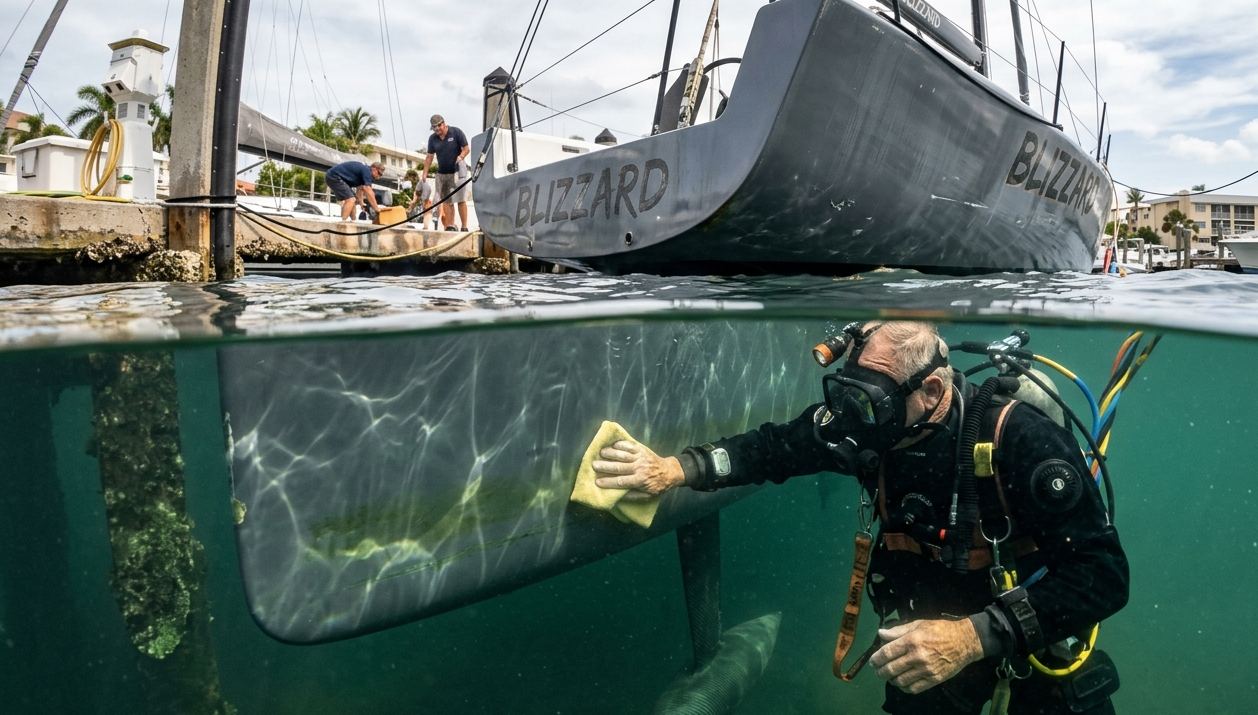
On a racing sailboat, small amounts of underwater fouling can matter. A thin layer of slime may not look dramatic from the dock, but it changes the surface of the hull and can add resistance when every fraction of speed matters. Before a regatta, racing sailboat hull cleaning should therefore be treated as performance maintenance, not simply cosmetic work.
We often see the same situation before a race weekend: the deck is polished, sails are prepared, rigging is checked, and the crew is ready—but nobody has looked closely at the bottom. The boat may feel slightly slower or less responsive, and the first suspect is often the rig or sails. Sometimes the problem is much simpler: a thin biological film has developed below the waterline.
NOAA-supported research has found that even early-stage biofilm can affect vessel performance. One NOAA resource reports that biofilm can reduce speed by about 3% and increase required shaft power by approximately 10%, while heavier fouling can have substantially larger effects. :chatgpt-content-reference{index=”0″}
What Is Racing Sailboat Hull Cleaning?
Racing sailboat hull cleaning is the controlled removal of slime, algae, light fouling, and other surface contamination from the underwater hull, keel, rudder, and related appendages. The objective is to restore a clean, consistent underwater surface without unnecessarily removing or damaging the vessel’s antifouling or performance coating.
For a racing boat, that second part is essential. More aggressive cleaning is not automatically better. The correct approach depends on the coating system, fouling level, hull material, local regulations, and the boat’s racing program.
Why Slime Matters Before a Regatta
Slime is usually the earliest and easiest stage of biological fouling to overlook. It can form a thin film over the underwater surface without producing the obvious barnacle or weed growth that immediately signals a problem.
That does not mean it is harmless to performance.
- Surface texture changes: A biological film can make the underwater surface less clean and consistent.
- Increased resistance: Fouling contributes to additional resistance as water flows over the hull.
- Reduced speed potential: Racing boats are particularly sensitive to changes in underwater condition.
- Less predictable handling: Fouling on the keel and rudder can affect the underwater flow around performance-critical appendages.
- Greater cleaning difficulty: If early fouling is allowed to develop, later removal may require more aggressive tools.
NOAA research on boat fouling has also found that longer intervals between cleaning were associated with heavier growth, while more aggressive cleaning tools were needed as fouling increased. :chatgpt-content-reference{index=”1″}
How to Approach Regatta Bottom Cleaning
Regatta preparation should start with inspection rather than immediately putting a brush on the hull.
1. Identify the Coating
First determine what is actually on the bottom. A racing sailboat may have a hard antifouling, ablative coating, epoxy system, foul-release coating, or another specialized finish.
These coatings do not respond identically to underwater cleaning. International Yacht Paint specifically warns that even hard antifouling can become softer while immersed and that aggressive scrubbing can remove sound paint. Its guidance recommends gentler cleaning for slime and emphasizes extra care with ablative or self-polishing coatings. :chatgpt-content-reference{index=”2″}
2. Inspect the Entire Underwater Profile
Do not focus only on the broad hull panels. A proper pre-regatta inspection should include the keel, rudder, transom, leading edges, through-hull areas, and other underwater appendages.
The keel and rudder deserve particular attention because they are central to the boat’s ability to generate lift and maintain efficient flow while sailing upwind.
3. Determine How Much Cleaning Is Actually Needed
A light slime layer may require a very different cleaning approach from established weed, barnacles, or calcareous growth. The goal should be to remove the unwanted biological film while preserving the intended surface and coating condition.
That is why experienced technicians avoid treating every racing bottom as though it needs the same brush, pressure, or number of passes.
Racing Bottom Paint Cleaning Requires a Light Touch
Racing bottom paint cleaning can be especially sensitive because many performance-oriented coating systems are selected partly for their ability to provide a smooth underwater finish.
International’s technical guidance explains that hard antifouling systems are commonly used on racing sailboats because they can withstand repeated handling and can be prepared for a smooth racing finish. However, burnishing or aggressive cleaning removes some coating and can shorten its useful life. :chatgpt-content-reference{index=”3″}
This creates an important maintenance balance: a boat needs to stay clean, but the cleaning process should not gradually destroy the coating that is helping keep it clean.
Keel Fouling Deserves Special Attention
Keel fouling is easy to overlook because the keel is often harder to access than the main hull. Yet it is one of the most important underwater surfaces on a racing sailboat.
Even a relatively thin accumulation can create an inconsistent surface across the keel. A technician should inspect the leading edge, sides, trailing edge, bulb if fitted, and transitions into the hull.
The same principle applies to the rudder. Cleaning the hull while leaving fouling on the rudder or keel creates an incomplete performance-maintenance job.
Sailboat Speed Preparation Starts Below the Waterline
Sailboat speed preparation is often associated with sail trim, rig tension, weight distribution, and tactical preparation. Those areas matter, but the underwater surface provides the foundation through which the boat moves.
A clean underwater surface cannot compensate for poor sail trim or incorrect rig setup. It can, however, eliminate one avoidable source of resistance.
For race teams, this is useful because underwater cleaning is relatively straightforward to verify. The crew can inspect the surface, identify fouling, clean it using an appropriate method, and document the condition before launching or racing.
How Often Should a Racing Sailboat Be Cleaned?
There is no universal cleaning interval for every racing sailboat. Water temperature, salinity, marina conditions, coating type, boat usage, and time between races all affect how quickly slime and other fouling develop.
NOAA research has documented seasonal differences in fouling growth and found that warmer water and longer intervals between cleanings were associated with heavier fouling. :chatgpt-content-reference{index=”4″}
For a boat actively competing during a regatta season, monitoring the underwater condition between races is more useful than relying on an arbitrary calendar interval.
In some locations, frequent professional cleaning is used to prevent early fouling from developing into more firmly attached growth. However, the appropriate interval should be based on the boat’s coating and local conditions rather than copied from another marina or racing program. :chatgpt-content-reference{index=”5″}
DIY Cleaning vs. Professional Racing Sailboat Hull Cleaning
A crew may be tempted to jump overboard with a brush before race day. The problem is that an inexperienced cleaning job can create more coating wear than necessary.
Professional racing sailboat hull cleaning offers an advantage when the bottom has a specialized coating or the team needs a predictable, repeatable finish. An experienced underwater technician can distinguish between light slime and harder fouling, adjust the cleaning method, and recognize when the surface should not be scrubbed aggressively.
This is especially useful for performance boats with expensive coatings or carefully prepared racing bottoms.
Common Regatta Bottom-Cleaning Mistakes
- Using an overly aggressive brush: Removing paint is not the same as removing fouling.
- Cleaning without identifying the coating: Ablative, hard, and specialized performance coatings have different maintenance requirements.
- Ignoring the keel and rudder: A clean hull does not mean the entire underwater profile is clean.
- Waiting until heavy fouling develops: More established growth can require more aggressive cleaning.
- Cleaning immediately before a race without inspection: Give the team enough time to identify coating or surface problems.
- Assuming every marina has the same fouling rate: Local water conditions can change how quickly slime develops.
Environmental Considerations for Regatta Hull Cleaning
Underwater hull cleaning can release fouling organisms, sediment, coating particles, or other material into the surrounding water. The environmental rules governing in-water cleaning differ between locations, and some jurisdictions restrict particular cleaning methods or require controls.
This matters beyond environmental compliance. NOAA identifies vessel hulls as an important pathway for transporting marine fouling organisms, including potentially invasive species. :chatgpt-content-reference{index=”6″}
Race teams and boat owners should therefore check local requirements before arranging underwater cleaning, particularly when racing in a new harbor or traveling between regions.
Can Cleaning Improve Hydrodynamic Drag?
Sailboat hydrodynamic drag is influenced by many factors, including hull shape, surface condition, speed, appendage geometry, and the flow of water around the vessel.
Fouling adds another variable. NOAA’s boat-fouling guidance reports measurable performance penalties even at early biofilm stages, while heavier fouling produces substantially larger effects. :chatgpt-content-reference{index=”7″}
Cleaning does not magically make a boat faster than its design allows. Instead, the practical goal is to remove avoidable surface contamination so the boat can operate closer to its intended underwater condition.
Frequently Asked Questions About Regatta Bottom Cleaning
How close to a regatta should a racing sailboat hull be cleaned?
The timing depends on local fouling growth, coating type, marina conditions, and the cleaning method. The objective is to have a clean, stable underwater surface at the start of racing without performing unnecessary aggressive cleaning that could damage the coating.
Can slime slow down a racing sailboat?
Yes. NOAA-supported information reports that early-stage biofilm can reduce vessel speed and increase required power. The exact performance effect on an individual racing sailboat will vary with hull design, fouling thickness, speed, and other conditions.
Should racing bottom paint be scrubbed regularly?
Cleaning frequency should be based on the coating and fouling conditions. International Yacht Paint warns that aggressive scrubbing can remove sound antifouling, particularly when the coating is immersed. A gentler method is generally preferred for light slime, subject to the coating manufacturer’s instructions. :chatgpt-content-reference{index=”8″}
What is the best way to clean a racing sailboat keel?
The appropriate method depends on the keel surface, coating, and fouling. The keel should be inspected first, followed by controlled removal of slime or fouling using a tool that will not unnecessarily damage the coating or surface.
Does hull cleaning remove antifouling paint?
It can. Even hard antifouling can be susceptible to paint loss when scrubbed aggressively underwater. The amount removed depends on the coating, cleaning tool, pressure, frequency, and condition of the paint. :chatgpt-content-reference{index=”9″}
Build Regatta Prep Around the Whole Underwater Surface
A clean racing bottom is only one part of a complete race-preparation program, but it is one of the easiest areas to overlook. The hull, keel, rudder, propeller if fitted, and other underwater surfaces should be checked as a complete system.
For boats that spend significant time in the water between races, scheduled professional hull cleaning can help prevent slime from becoming established fouling. Other underwater services, such as cavitation cleaning and zinc replacement, can be incorporated into a broader vessel maintenance program when appropriate.
For a race team preparing a new boat or evaluating an unfamiliar bottom, an underwater inspection can also provide a useful baseline before the season begins.
Read more practical vessel-care guidance and underwater maintenance insights on our marine maintenance blog.
Conclusion
Racing sailboat hull cleaning is not about scrubbing a bottom as hard as possible. It is about maintaining a clean underwater surface while protecting the coating and geometry that the boat depends on for performance.
For regatta preparation, controlling slime early can be far more sensible than waiting for heavy fouling to develop. Inspect the coating, identify the fouling level, use an appropriate cleaning method, and pay close attention to the keel and rudder. When every part of the race program is being optimized, the underwater surface should not be the forgotten variable.
Ready to protect your vessel?
If you need expert help with this, our team of certified divers and marine technicians is ready to step in. Learn more about our specific services here.
Prefer to speak with an expert immediately? Contact us today to schedule a service or get a free quote!
