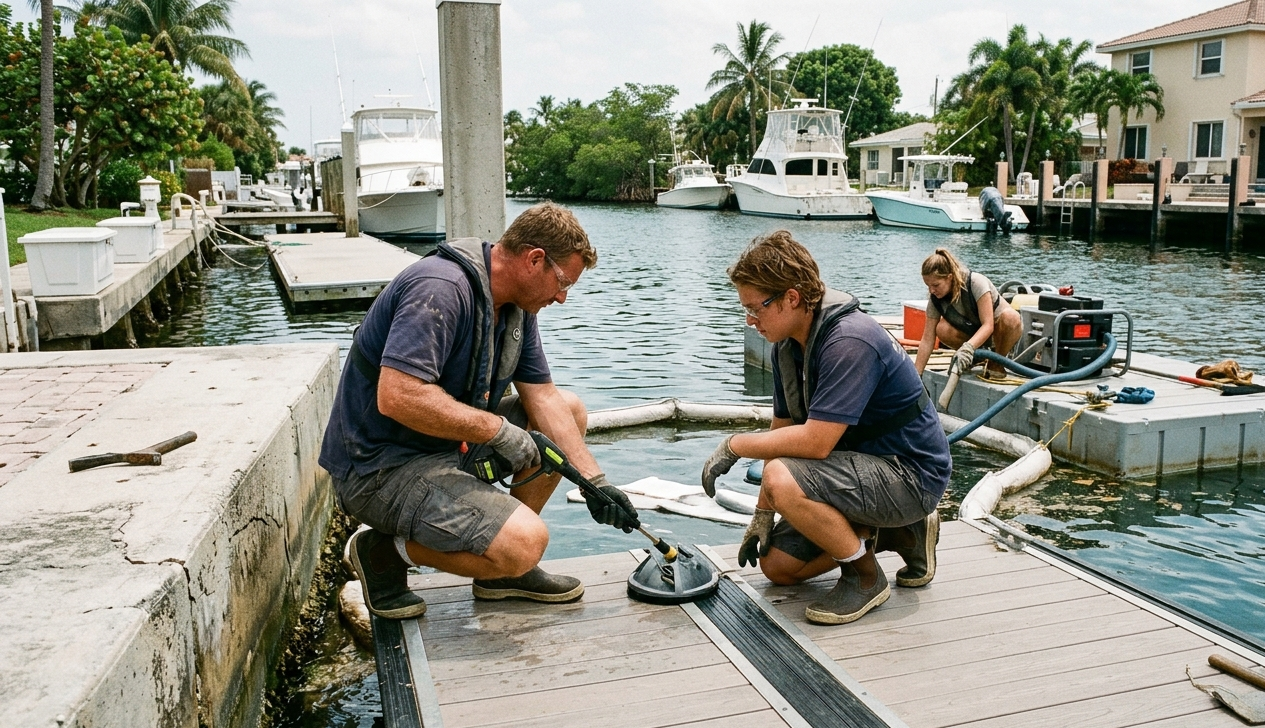
Owning waterfront property in Florida comes with a maintenance responsibility that goes beyond keeping the dock looking good. A pressure washer, paint scraper, cleaning chemical, or seawall repair can potentially affect the water immediately beside your property. That is why understanding EPA waterfront maintenance requirements—and knowing when Florida DEP or local rules also apply—matters to homeowners, waterfront HOAs, marinas, and property managers.
The good news is that environmentally responsible maintenance does not have to mean leaving your dock, seawall, or waterfront structures dirty. It means planning the work so debris, chemicals, sediment, paint particles, and contaminated wash water are prevented from entering nearby surface waters.
Federal and Florida requirements vary depending on the activity, property, waterbody, and project scope. Florida DEP’s Environmental Resource Permitting program regulates many alterations affecting surface waters, while exemptions and general permits exist for certain activities. :chatgpt-content-reference{index=”0″}
What Is EPA Waterfront Maintenance?
EPA waterfront maintenance refers broadly to maintaining docks, seawalls, boats, shorelines, and related property while preventing pollutants from entering protected waters. Depending on the activity, requirements may involve the federal Clean Water Act, EPA programs, Florida DEP regulations, local ordinances, stormwater requirements, or specific permits and exemptions.
The key principle is simple: maintenance work should be planned to prevent contaminated runoff, waste materials, chemicals, paint debris, sewage, oil, and other pollutants from reaching the water.
EPA identifies marinas and boating activities as potential sources of water pollution because cleaning, fueling, maintenance, repair, and stormwater runoff can introduce pollutants into marina basins and surrounding waterways. :chatgpt-content-reference{index=”1″}
How Does the Clean Water Act Affect Waterfront Maintenance?
The Clean Water Act establishes the federal framework for regulating pollutant discharges into waters of the United States. The National Pollutant Discharge Elimination System (NPDES) regulates certain point-source discharges, while other federal and state programs address specific activities and pollution sources. :chatgpt-content-reference{index=”2″}
For a waterfront homeowner, that does not mean every dock cleaning requires an EPA permit. The applicable requirements depend on what you are doing, where you are doing it, and whether the activity creates a regulated discharge or falls under a specific exemption.
That distinction is especially important when maintenance involves:
- Pressure washing or cleaning
- Boat bottom maintenance
- Painting or sanding
- Seawall repair or replacement
- Dock construction or modification
- Dredging or excavation
- Stormwater alterations
- Fuel or chemical handling
- Sewage or wastewater
Florida DEP Dock Regulations: What Waterfront Owners Should Know
Florida’s Environmental Resource Permitting program regulates many activities that alter surface-water flows, involve dredging or filling, or otherwise affect wetlands and surface waters. Florida DEP also provides self-certification and other permitting pathways for certain single-family dock projects. :chatgpt-content-reference{index=”3″}
That means you should not assume that a dock repair is either always exempt or always subject to an individual permit.
Florida DEP currently provides a self-certification process for certain single-family dock activities, including some new docks, repairs or replacements of existing docks, and additions of boat lifts. The eligibility requirements still need to be checked for the specific property and project. :chatgpt-content-reference{index=”4″}
Florida also distinguishes between activities that qualify for exemptions, general permits, and individual permits. If a project does not clearly fit an exemption or general permit, the appropriate DEP district office or delegated permitting agency should be consulted before work begins. :chatgpt-content-reference{index=”5″}
Eco-Friendly Seawall Cleaning and Maintenance
Seawalls are exposed to algae, barnacles, sediment, mineral deposits, salt deposits, and other marine growth. Cleaning them can improve appearance and help property owners identify damage, but the cleaning method matters.
A common mistake is to treat the water beside the seawall as a convenient drain. Blasting accumulated material directly into the water can disperse sediment and debris rather than actually removing it from the property.
For eco-friendly seawall cleaning, consider these practices:
- Use the least aggressive effective cleaning method.
- Collect loose debris whenever practical.
- Avoid unnecessary chemical cleaners near the water.
- Do not wash paint chips, sanding dust, or contaminated debris into the water.
- Inspect the seawall for cracks, settlement, exposed reinforcement, or other damage while cleaning.
- Check whether planned repairs require Florida DEP or local authorization.
Florida DEP guidance recognizes that certain seawall repairs and restoration activities may qualify for exemptions or other authorization pathways, but the exact requirements depend on the project. :chatgpt-content-reference{index=”6″}
Why Toxic Runoff Prevention Matters
Waterfront runoff can carry pollutants directly into the same waterbody where people swim, fish, boat, and live. EPA marina guidance identifies materials such as oil, fuel, antifreeze, paint particles, sanding debris, and other maintenance-related contaminants as potential pollutants. :chatgpt-content-reference{index=”7″}
Consider a homeowner sanding a painted dock structure on Friday afternoon. The work area may look clean after the sanding is finished, but fine dust and paint particles left on the surface can be mobilized by the next rainfall.
EPA guidance recommends controlling maintenance debris at the source, cleaning work areas promptly, and using measures such as tarps, screens, filtration, sweeping, and vacuuming where appropriate. :chatgpt-content-reference{index=”8″}
Pressure Washing Near the Water: What Should You Do?
Pressure washing can produce large amounts of wastewater. When that water has contacted marine growth, paint residue, oil, dirt, cleaning chemicals, or other contaminants, simply allowing it to flow into a nearby waterbody can create a pollution problem.
EPA’s marina management guidance recommends minimizing the environmental impact of boat cleaning and managing pressure-washing wastewater appropriately. The guidance notes that wash water from hull cleaning should not simply be discharged directly to U.S. waters and that local requirements should be checked. :chatgpt-content-reference{index=”9″}
For waterfront properties, practical controls may include:
- Preventing wash water from reaching storm drains or the waterbody.
- Using containment where feasible.
- Capturing solids and debris.
- Using environmentally appropriate cleaning products when cleaning chemicals are necessary.
- Following local requirements for collection, treatment, or disposal of wastewater.
For vessel-specific cleaning, professional boat wash and detailing services can help keep maintenance organized while reducing the temptation to discharge dirty wash water directly into the surrounding water.
Clean Water Act and Marina Maintenance
A marina or waterfront facility can have more complicated compliance responsibilities than an individual homeowner. EPA identifies boat cleaning, fueling, marine head discharge, and runoff from maintenance and repair areas as potential pollution sources around marinas. :chatgpt-content-reference{index=”10″}
Commercial facilities may also have stormwater or other discharge obligations depending on their activities. EPA’s marina guidance recommends designated maintenance areas, spill-control equipment, vegetated buffers, good housekeeping, and regular inspections to reduce pollutant loading. :chatgpt-content-reference{index=”11″}
For certain larger non-recreational vessels, the Vessel Incidental Discharge Act also establishes a federal framework for discharges incidental to normal vessel operations. EPA’s current program applies to specified categories of commercial and other non-recreational vessels. :chatgpt-content-reference{index=”12″}
This is separate from ordinary waterfront-property maintenance, so property owners should avoid assuming that one federal vessel rule covers every marina or shoreline activity.
Waterfront HOA Rules Can Add Another Layer
Federal and state environmental requirements are not necessarily the only rules governing a waterfront property.
A condominium association, homeowners association, private marina, municipality, or neighborhood association may have additional rules concerning:
- Dock appearance and materials
- Pressure washing
- Cleaning chemicals
- Boat maintenance
- Construction hours
- Contractor requirements
- Waste disposal
- Seawall modifications
- Use of common waterfront areas
EPA notes that state and local governments may establish requirements that are broader or more stringent than federal recreational-vessel management practices. :chatgpt-content-reference{index=”13″}
For that reason, a property owner should check the HOA documents, municipal code, marina rules, and applicable environmental requirements before beginning significant waterfront work.
Protecting Mangroves and Other Waterfront Habitat
Florida waterfront properties may also contain mangroves or other protected environmental resources. Maintenance around these areas requires particular care.
Florida DEP explains that certain mangrove trimming or alteration activities may qualify for exemptions in specific circumstances, but those exemptions do not provide a general right to remove mangroves. DEP recommends contacting the appropriate district office when there is uncertainty about whether an activity qualifies. :chatgpt-content-reference{index=”14″}
Never assume that cutting vegetation simply because it grows on your side of the property line is automatically permitted. The location, activity, habitat, and applicable authorization all matter.
Eco-Friendly Cleaning vs. Aggressive Waterfront Cleaning
| Maintenance Approach | Environmental Consideration |
|---|---|
| Dry sweeping or vacuuming | Helps capture debris before rainfall can transport it |
| Contained pressure washing | Reduces uncontrolled wastewater and debris release |
| Harsh chemical cleaning | Can create additional wastewater and aquatic-toxicity concerns |
| In-water scraping | Can release marine growth, paint, and debris into surface waters |
| Professional underwater cleaning | Allows the method and scope to be selected according to the surface and environmental conditions |
For underwater vessel and structure maintenance, professional hull cleaning can remove marine growth while allowing the service team to assess the condition of the underwater surface.
How to Build a Waterfront Maintenance Plan
A written maintenance plan can make compliance much easier, particularly for HOAs, marinas, commercial waterfront properties, and large estates.
1. Identify the Waterbody
Determine whether the property borders a canal, river, lake, estuary, bay, coastal water, aquatic preserve, or another specially regulated area.
2. List the Planned Activities
Separate routine cleaning from construction, repair, dredging, vegetation work, painting, and other activities. Different work can trigger different requirements.
3. Check Federal, State, and Local Requirements
Review applicable EPA requirements, Florida DEP rules and guidance, water-management-district requirements, municipal ordinances, and HOA or marina rules.
4. Plan Runoff Controls Before Starting
Do not wait until dirty water is already flowing toward the canal. Decide where debris, wash water, sanding dust, paint chips, and other waste will be captured and disposed of.
5. Document the Work
Keep permits, exemption determinations, contractor information, inspection photographs, maintenance records, and waste-disposal documentation where appropriate.
Common Waterfront Maintenance Mistakes
- Assuming a homeowner’s project needs no authorization: Some activities are exempt, but exemptions have specific conditions.
- Pressure washing directly toward the water: Wash water can carry contaminants into the waterbody.
- Leaving sanding dust or paint chips on the dock: Rain can transport the material into surface water.
- Using unnecessary chemicals: A stronger cleaner is not automatically a better environmental choice.
- Ignoring storm drains: A nearby drain can provide a direct pathway to a waterbody.
- Assuming HOA approval equals environmental approval: Private property rules do not replace government permits or exemptions.
- Starting seawall work before checking requirements: Repair, replacement, restoration, and expansion can have different regulatory treatment.
When Should You Contact Florida DEP?
If you are unsure whether a proposed activity is exempt, requires a general permit, or needs an individual authorization, it is better to resolve the question before work begins.
Florida DEP’s ERP program provides pathways for exemption verification, general permits, and individual or conceptual permits. The department also works with Florida’s water management districts and delegated local programs in certain jurisdictions. :chatgpt-content-reference{index=”15″}
Questions are especially appropriate before projects involving:
- New or significantly modified docks
- Seawall replacement or substantial repair
- Dredging or filling
- Shoreline alteration
- Mangrove removal or alteration
- Stormwater changes
- Work in wetlands or other surface waters
FAQs About EPA Waterfront Maintenance
Does every waterfront maintenance project require an EPA permit?
No. Federal, state, and local requirements depend on the type and location of the activity. Some projects are exempt or covered by general authorizations, while others require permits. Florida DEP’s ERP program provides different pathways depending on the project. :chatgpt-content-reference{index=”16″}
Can I pressure wash my dock directly into the water?
Direct discharge of contaminated wash water should not be assumed to be acceptable. EPA marina guidance recommends minimizing the release of harmful cleaners, solvents, paint, debris, and pressure-washing wastewater to surface waters and checking applicable local requirements. :chatgpt-content-reference{index=”17″}
Do Florida DEP dock regulations apply to repairs?
They can. Florida provides exemptions and self-certification options for certain dock repair and replacement projects, but eligibility depends on the specific activity and applicable conditions. Check the current DEP requirements before beginning work. :chatgpt-content-reference{index=”18″}
What is toxic runoff prevention?
Toxic runoff prevention means controlling pollutants before rain or maintenance wastewater can transport them into surface waters. Common controls include collecting paint chips, sanding dust, oil, debris, and contaminated wastewater instead of allowing them to enter drains or waterways. :chatgpt-content-reference{index=”19″}
Can my waterfront HOA create additional maintenance rules?
Yes. HOA, condominium, marina, and local rules can add requirements governing property maintenance, contractors, cleaning methods, appearance, and construction. These private or local requirements exist alongside applicable federal and state environmental rules.
Does seawall cleaning require a permit in Florida?
Routine cleaning is different from structural repair, replacement, alteration, or shoreline expansion. Whether authorization is required depends on the work being performed and the property’s circumstances. Florida DEP should be consulted when the work goes beyond ordinary maintenance. :chatgpt-content-reference{index=”20″}
Read More: Explore more practical marine maintenance guidance and underwater service insights in our marine industry articles and stories.
Conclusion
EPA waterfront maintenance is ultimately about understanding what can enter the water and preventing pollution before it happens. For Florida property owners, that means looking beyond the federal Clean Water Act and checking Florida DEP requirements, local rules, HOA restrictions, and project-specific exemptions or permits.
The most effective approach is usually straightforward: identify the work, check the applicable requirements, contain debris and wastewater, use the least harmful effective cleaning method, and document what was done. Whether you are maintaining a private dock, cleaning a seawall, managing a waterfront HOA, or overseeing a marina, responsible maintenance protects both the property and the water surrounding it.
Ready to protect your vessel?
If you need expert help with this, our team of certified divers and marine technicians is ready to step in. Learn more about our specific services here.
Prefer to speak with an expert immediately? Contact us today to schedule a service or get a free quote!
