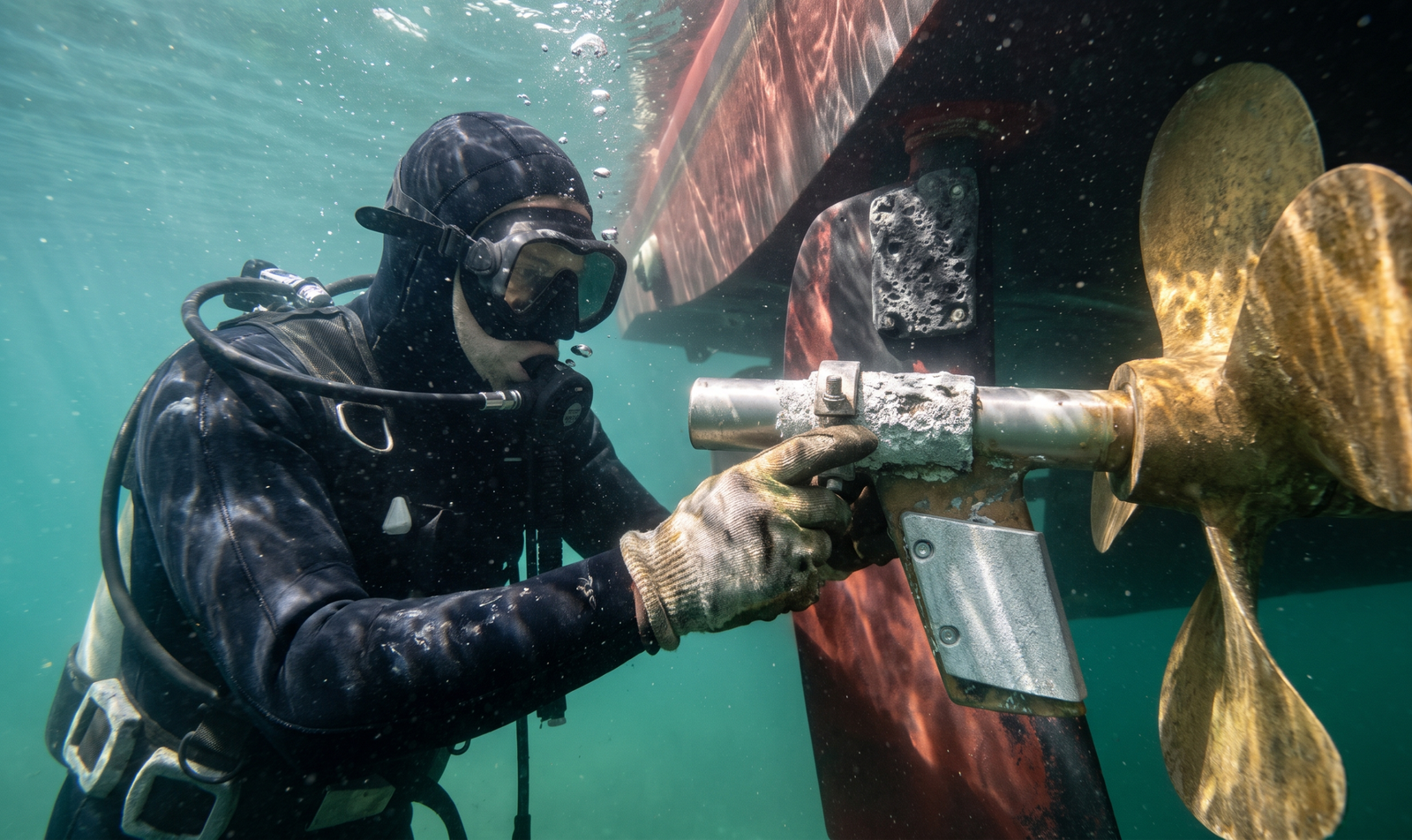
If you keep your boat in a South Florida marina, you probably pay attention to its hull, propellers, and engine. But there is another small component underneath your boat that quietly protects those expensive parts from corrosion: the sacrificial anode.
Whether your vessel spends its time in saltwater around Fort Lauderdale, moves between brackish and coastal waters, or operates in freshwater lakes, choosing the wrong anode material can leave underwater metals vulnerable to corrosion.
Boat sacrificial anodes protect underwater metal components by corroding preferentially instead of more valuable metals such as bronze, stainless steel, and aluminum. Zinc and aluminum-alloy anodes are commonly used in saltwater, aluminum is generally preferred for brackish water, and magnesium is primarily used in freshwater. Correct selection also depends on hull material, underwater equipment, and the vessel’s cathodic protection system.
What Are Boat Sacrificial Anodes and How Do They Work?
Sacrificial anodes are replaceable metal components attached to a boat’s underwater equipment. They provide cathodic protection by corroding in preference to the metals they are designed to protect.
This process helps prevent galvanic corrosion, an electrochemical reaction that can occur when different metals are electrically connected and exposed to an electrolyte such as seawater.
Understanding galvanic corrosion
Imagine your boat has a stainless-steel shaft connected to a bronze propeller. When these dissimilar metals are electrically connected underwater, a galvanic cell can develop. One metal becomes more susceptible to corrosion depending on the metals, electrical connection, and surrounding water conditions.
A correctly selected sacrificial anode provides a more active metal that corrodes preferentially, helping protect the connected underwater components.
This is particularly important for boats with:
- Bronze propellers and shaft assemblies.
- Stainless-steel shafts and underwater fittings.
- Aluminum outdrives and lower units.
- Rudders, trim tabs, and underwater hardware.
- Metal through-hull fittings and connected components.
A sacrificial anode is designed to corrode instead of the protected underwater metal. Its effectiveness depends on the correct alloy, electrical continuity, adequate surface area, and suitable placement.
Zinc vs. Aluminum vs. Magnesium Anodes: What’s the Difference?
Zinc, aluminum, and magnesium are the three main sacrificial anode materials used in recreational and commercial marine applications. Each has different electrochemical properties, making it more suitable for certain water environments.
The biggest difference is how actively each material behaves in a particular electrolyte. An anode that works well in seawater may become ineffective or corrode too quickly in freshwater.
| Anode Material | Saltwater | Brackish Water | Freshwater | Typical Application |
|---|---|---|---|---|
| Zinc | Suitable | Generally avoid | Not recommended | Traditional saltwater protection |
| Aluminum Alloy | Suitable | Recommended | Some approved alloys suitable | Saltwater and brackish-water versatility |
| Magnesium | Not suitable | Generally avoid | Recommended | Freshwater protection |
These are general selection guidelines, not a substitute for the engine manufacturer’s anode specifications or a cathodic protection assessment. Specialized aluminum alloys may be suitable for additional environments.
1. Zinc sacrificial anodes
Zinc has traditionally been the preferred sacrificial anode material for boats operating in saltwater. It provides effective galvanic protection for compatible underwater metals when correctly installed.
However, zinc has limitations in freshwater and some brackish-water environments. It can develop a passive surface layer that reduces its ability to deliver protective current. This condition is commonly called anode passivation.
For a boat permanently kept in saltwater around Fort Lauderdale or Miami, a correctly specified zinc anode can still be an appropriate option.
Best application: Traditional saltwater installations where zinc is specified by the vessel or equipment manufacturer.
2. Aluminum sacrificial anodes
Modern aluminum anodes are manufactured using specialized alloys, commonly containing zinc and indium. These are not the same as ordinary aluminum metal.
The alloy composition allows marine aluminum anodes to provide effective cathodic protection while offering greater electrochemical capacity per unit of weight than traditional zinc anodes.
Aluminum-alloy anodes are widely used in saltwater and brackish water. Some manufacturer-approved alloys are also suitable for freshwater applications.
They are particularly useful for boats that move between different water environments or remain in marinas where salinity changes with tides, rainfall, and freshwater discharge.
Best application: Saltwater and brackish-water vessels, subject to the manufacturer’s specifications and the vessel’s protection requirements.
3. Magnesium sacrificial anodes
Magnesium is more electrochemically active than zinc or aluminum. This makes it particularly effective in freshwater, where zinc and certain aluminum anodes may struggle to provide adequate protection.
However, magnesium is generally unsuitable for saltwater applications because it can corrode excessively fast. Its high driving potential can also cause overprotection, which may damage certain coatings or create other corrosion-related problems.
For this reason, magnesium anodes should not be installed simply because they appear to offer stronger protection. The correct material must match the water environment and protected metals.
Best application: Freshwater vessels using anodes specifically approved for their hull and underwater equipment.
Sacrificial Anode Chart for Boats: Which Material Should You Choose?
The correct anode depends on where your boat operates and which underwater metals need protection. The following quick-reference chart provides a practical starting point for recreational vessels.
| Operating Environment | Preferred Material | Alternative | Material to Avoid |
|---|---|---|---|
| Open saltwater | Aluminum alloy | Zinc | Magnesium |
| Coastal brackish water | Aluminum alloy | Manufacturer-approved zinc in specific installations | Magnesium |
| Freshwater lakes | Magnesium | Approved aluminum alloy | Conventional zinc |
| Mixed saltwater and brackish operation | Aluminum alloy | Manufacturer-approved alternative | Magnesium |
One technical point matters here: do not select anodes based on water type alone. An aluminum-hulled boat, a fiberglass boat with bronze running gear, and an outboard-powered aluminum center console can have different cathodic protection requirements.
Consult the American Boat & Yacht Council (ABYC) standards, particularly ABYC E-2 for cathodic protection, alongside your engine and equipment manufacturer’s specifications.
Understanding Anode Voltage and Electrochemical Potential
Each sacrificial anode alloy produces an electrical potential when immersed in water. This potential helps determine how effectively it can protect another metal.
The following representative open-circuit potentials are published for common marine anode alloys, measured relative to a silver/silver-chloride reference electrode in seawater.
| Anode Material | Representative Potential | Relative Activity |
|---|---|---|
| Zinc alloy | Approximately -1,040 mV | Active |
| Aluminum alloy | Approximately -1,100 mV | More active |
| Magnesium | Approximately -1,600 mV | Highly active |
These are representative open-circuit figures, not universal protection targets. Actual readings depend on the alloy specification, water chemistry, temperature, and measurement conditions. Different reference electrodes also produce different numerical readings.
The important takeaway is that magnesium is substantially more active than zinc or aluminum. This is why it is useful in freshwater but can be consumed excessively in seawater.
How to Know When Your Boat Anodes Need Replacement
Sacrificial anodes are designed to deteriorate over time. Their condition should be inspected regularly because an anode that has been consumed or electrically isolated may no longer provide adequate protection.
A widely used maintenance guideline is to replace anodes when approximately 50% of their original material has been consumed, unless the equipment manufacturer specifies a different limit.
Signs your anodes need attention
- Significant material loss: The anode has lost approximately half its original volume or weight.
- Uneven corrosion: One section has deteriorated much faster than the rest.
- White or chalky deposits: A passive layer or other surface buildup may be interfering with performance.
- Loose mounting: The anode no longer has reliable electrical contact with the protected metal.
- Visible corrosion elsewhere: Pitting on propellers, shafts, or other underwater components requires further investigation.
Do not simply install a new anode and assume the problem is solved if it is being consumed unusually quickly. Excessive consumption can indicate stray-current corrosion, an electrical fault, unsuitable anode material, or problems with the cathodic protection system.
Our zinc replacement and sacrificial anode services help boat owners address deteriorated anodes and maintain underwater protection.
Why Proper Anode Installation and Electrical Bonding Matter
Even the correct anode material cannot protect your boat if it is installed incorrectly. Sacrificial anodes need proper electrical continuity with the metals they are intended to protect.
Paint, corrosion, dirt, and loose mounting hardware can interrupt this connection. An anode may look perfectly healthy while providing little or no useful protection.
Important installation considerations
- Use an anode designed for the specific engine, outdrive, shaft, or hull application.
- Ensure clean, reliable electrical contact at the mounting surface.
- Never paint over an anode or cover its working surface with insulating material.
- Follow manufacturer torque specifications and mounting instructions.
- Do not assume that two different anode alloys can be mixed on the same protected assembly.
- Verify that shaft anodes do not restrict water flow to shaft bearings.
ABYC E-2 addresses cathodic protection design and installation, while ABYC E-11 addresses AC and DC electrical systems. Both are relevant when investigating corrosion that may involve electrical faults or improper bonding.
For additional technical background, review the ABYC explanation of cathodic bonding.
Common Vessel Owner Mistakes with Sacrificial Anodes
Many corrosion problems begin with an incorrect assumption about how anodes work. Replacing anodes without understanding the surrounding electrical and marine conditions can allow the underlying problem to continue.
Using zinc in every type of water
Zinc is a traditional saltwater anode, not a universal solution. Boats that regularly operate in brackish or freshwater may require another approved alloy.
Installing magnesium in saltwater
Magnesium is highly active and can be consumed rapidly in seawater. Its use should be restricted to suitable freshwater applications unless a specific manufacturer-approved design states otherwise.
Painting or covering anodes
Paint prevents the anode surface from interacting properly with the surrounding water. This can stop the anode from delivering the protective current required by the system.
Ignoring excessive anode consumption
If a new anode disappears unusually quickly, replacing it repeatedly without investigating the cause is poor maintenance. A professional should assess possible stray-current corrosion, shore-power issues, and electrical continuity.
Professional Underwater Anode Inspection in South Florida
Boats operating in South Florida face year-round exposure to warm saltwater, marina electrical systems, and changing coastal conditions. These factors make regular underwater maintenance particularly valuable.
A professional inspection can identify deteriorated anodes, loose mounting hardware, corrosion on underwater fittings, and potential problems involving the hull or running gear.
Depending on your vessel, an inspection may include:
- Visual examination of shaft, propeller, and hull anodes.
- Assessment of anode material and compatibility with the operating environment.
- Inspection of accessible bonding connections.
- Observation of corrosion and pitting on underwater metals.
- Assessment of propellers, rudders, and other running gear.
- Recommendations for anode replacement or further electrical testing.
We also recommend periodic underwater vessel inspections to identify developing issues before they become expensive repairs. If marine growth is affecting the underwater surfaces, our professional hull cleaning services can help maintain the vessel alongside its corrosion protection program.
Frequently Asked Questions
What are sacrificial anodes on a boat?
Sacrificial anodes are replaceable metal components that protect underwater boat equipment from galvanic corrosion. They are made from more electrochemically active materials such as zinc, aluminum alloy, or magnesium. By corroding preferentially, they help protect propellers, shafts, outdrives, and other connected underwater metals.
Are aluminum or zinc anodes better for saltwater?
Both can work in saltwater when manufactured to the appropriate marine specifications. Aluminum-alloy anodes generally offer higher electrochemical capacity and can be a versatile choice, while zinc remains a traditional option. The correct material depends on the equipment manufacturer’s requirements and the vessel’s cathodic protection system.
Can I use aluminum anodes in brackish water?
Yes. Properly manufactured marine aluminum-alloy anodes are generally recommended for brackish water because they remain active in conditions where conventional zinc anodes may become passive. Always verify the specific alloy and its suitability for your boat’s underwater metals and protection system.
Can magnesium anodes be used in saltwater?
Magnesium anodes are generally unsuitable for saltwater because they are highly active and can corrode excessively quickly. This can cause rapid anode consumption and potential overprotection. Magnesium is primarily intended for freshwater applications where less active anode materials may not provide sufficient protection.
When should sacrificial anodes be replaced?
A common maintenance guideline is to replace sacrificial anodes when approximately 50% of their original material has been consumed. However, the correct replacement limit depends on the equipment manufacturer’s recommendations. Inspect anodes regularly and investigate unusually rapid corrosion rather than simply replacing them.
Why are my boat’s zinc anodes disappearing so quickly?
Rapid anode consumption can result from excessive electrical activity, stray-current corrosion, unsuitable anode material, poor electrical system isolation, or incorrect installation. A qualified marine technician should inspect the cathodic protection system and relevant electrical connections to identify the underlying cause.
Read More: Underwater Marine Maintenance and Corrosion Protection
Proper corrosion protection is only one part of keeping your vessel in good condition. Explore our marine maintenance articles and underwater service resources for more practical information about hull maintenance, running gear, and professional diving services.
Protect Your Boat with the Right Sacrificial Anodes
Choosing the correct boat sacrificial anodes can make a significant difference in protecting your propellers, shafts, outdrives, and other underwater metal components. Zinc remains a traditional saltwater choice, aluminum alloy provides excellent versatility in saltwater and brackish environments, and magnesium is generally reserved for freshwater applications.
However, the right material is only one part of effective cathodic protection. Correct installation, electrical continuity, regular inspections, and timely replacement all matter. If you notice unusually rapid anode deterioration or corrosion on underwater equipment, arrange a professional assessment rather than simply installing another anode.
Underwater Marine Services provides professional underwater maintenance and anode-related services throughout South Florida. Contact our team to discuss your vessel’s corrosion protection requirements.
Is Your Boat Properly Protected Against Corrosion?
Don’t wait until corrosion damages your propeller, shaft, or underwater hardware. Arrange a professional underwater assessment and discuss the right anode maintenance for your vessel.
