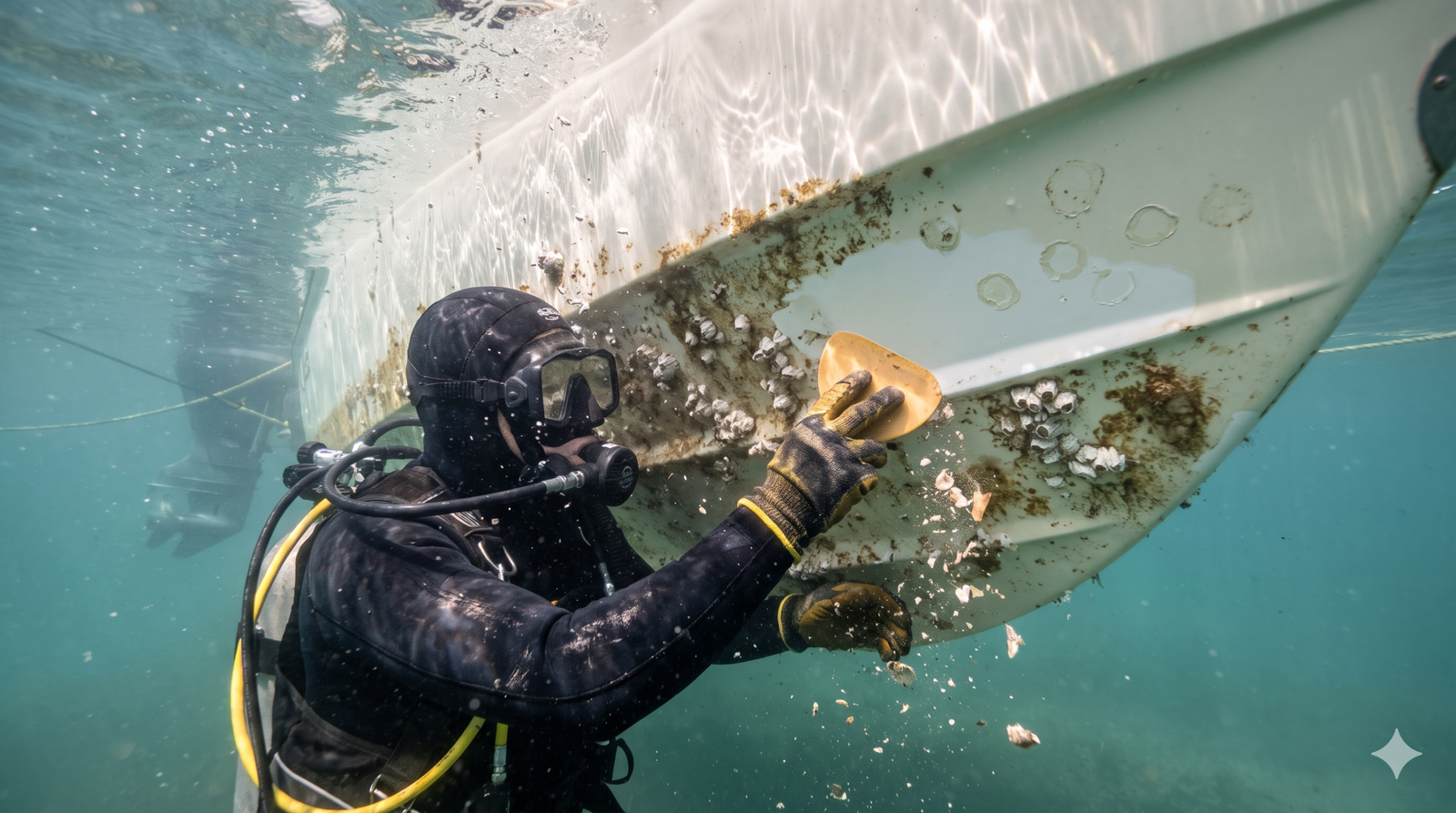
If your center console has been sitting in a South Florida marina for several weeks, you may already know what happens beneath the waterline. Small barnacles begin attaching themselves to the fiberglass, eventually developing hard, white calcium shells that resist ordinary cleaning. The frustrating part is that removing them too aggressively can leave permanent scratches in your gelcoat.
To remove barnacles from a fiberglass hull without scratching it, use the least abrasive method that can safely release the growth. Start with a soft cleaning pad for slime and a rounded plastic scraper for individual barnacles. Keep the tool at a shallow angle, work underwater only where permitted, and never grind or force the remaining calcium base into the gelcoat.
At Underwater Marine Services, we understand that an unpainted fiberglass bottom requires a different maintenance approach from a conventional antifouling-painted hull. Here is how to protect the original finish while removing established marine growth.
Why Barnacles Are Difficult to Remove from Unpainted Fiberglass
Barnacles attach themselves to submerged surfaces using a strong natural adhesive. Once established, their calcium carbonate shells form hard deposits that can remain firmly bonded to your boat even after the visible organism has been removed.
On an unpainted fiberglass hull, the exposed surface is the gelcoat itself. Gelcoat is the smooth protective outer finish applied to the fiberglass laminate. Scraping too aggressively can cut through this finish, creating visible scratches and potentially exposing the underlying laminate.
What happens when barnacles are scraped incorrectly?
- Surface scratches: Metal tools and abrasive pads can leave permanent marks in the gelcoat.
- Gelcoat gouging: Digging underneath a tightly attached barnacle can remove material from the hull surface.
- White calcium rings: Barnacle bases can remain attached after the shell breaks away.
- Surface discoloration: Marine deposits and biological staining can leave visible marks even after physical removal.
- Expensive restoration: Deep scratches and damaged gelcoat may require professional compounding, polishing, or repair.
According to fiberglass hull maintenance guidance from Boats.net, plastic and wooden scraping tools are preferable to metal implements because they reduce the likelihood of damaging the fiberglass surface.
How to Remove Barnacles from Fiberglass Hulls Safely
The safest approach is to work progressively, beginning with soft cleaning tools and increasing the cleaning force only when necessary. Small, recently established barnacles are easier to remove than mature shells with heavily bonded calcium bases.
For an unpainted fiberglass hull, the objective is to release the barnacle without cutting into the gelcoat underneath. The following steps explain the basic process.
Step 1: Identify the type and amount of marine growth
Before cleaning, inspect the submerged hull and identify whether you are dealing with slime, algae, small barnacles, or mature calcareous deposits.
A light layer of slime may require only a soft cloth or non-abrasive pad. Individual barnacles need more careful mechanical removal. Extensive shell growth may require professional assessment and a controlled cleaning process.
Pay particular attention to the waterline, chines, transducer areas, and the underside of the hull. These areas can develop different levels of marine growth depending on exposure and water movement.
Step 2: Use a rounded plastic scraper
For individual barnacles, a stiff plastic scraper with rounded corners is a sensible starting tool. Keep the scraper nearly parallel to the hull and work beneath the edge of the shell using controlled sideways pressure.
A practical starting angle is approximately 30–45 degrees, adjusted to the curvature and condition of the surface. This is a technique guideline rather than a guaranteed scratch-free angle. Never use the tool like a chisel or drive its edge directly into the gelcoat.
Let the barnacle release rather than forcing it off. If the shell resists, stop and reassess instead of applying additional pressure.
Step 3: Remove the remaining barnacle rings carefully
After the shell comes away, a white or beige circular deposit may remain. This is the calcified barnacle base, sometimes called a barnacle ring or husk.
Do not immediately attack this deposit with a harder scraper. The remaining material can be more firmly attached than the shell itself. Use a compatible marine cleaning product only when its manufacturer confirms suitability for bare fiberglass gelcoat, and follow the product’s instructions.
Some cleaners contain acids or other active ingredients that can damage nearby metals, finishes, or the gelcoat if incorrectly applied. Products intended for painted hulls should not automatically be assumed safe for unpainted fiberglass.
Step 4: Finish with a non-abrasive cleaning pad
Once the larger growth has been removed, use a suitable soft pad or microfiber cleaning material to address remaining slime and loose deposits. Rinse the cleaned surface thoroughly when working out of the water and inspect the finish under good lighting.
Do not use abrasive scouring pads, wire brushes, sanding discs, or aggressive grinding equipment to chase the last visible mark. If a deposit will not release safely, arrange a professional assessment.
Cleaning an Unpainted Boat Bottom While It Is in the Water
Many South Florida boat owners leave their center consoles and recreational vessels in the water throughout the year. Underwater cleaning can be practical, but removing hard barnacles from bare gelcoat requires careful control of the cleaning equipment and technique.
Professional divers can inspect the hull, identify the growth, and select appropriate tools without automatically requiring the vessel to be hauled out. However, cleaning must comply with applicable environmental requirements and marina restrictions.
What does underwater hull cleaning involve?
A typical professional assessment begins with an inspection of the hull, followed by selection of a suitable cleaning method. The diver evaluates the condition of the gelcoat, the strength of the marine growth, and the accessibility of the affected surfaces.
For light growth, controlled hand cleaning may be sufficient. For harder deposits, the diver must determine whether the barnacles can be removed safely underwater or whether a controlled haul-out cleaning is the better option.
Our professional underwater hull cleaning services help boat owners address marine growth while keeping the condition of the hull in focus.
Can Cavitation Cleaning Remove Barnacles from Bare Fiberglass?
Cavitation cleaning uses specialized equipment to create controlled cavitation effects in water, helping dislodge marine deposits from suitable submerged surfaces. However, the suitability of a particular system depends on its operating characteristics, the hull surface, and the type of growth being removed.
Unpainted fiberglass should not be treated like a conventional commercial vessel hull with a hard coating. Equipment settings and cleaning methods must be assessed before use to avoid damaging the gelcoat.
When should cavitation cleaning be considered?
It may be worth evaluating for appropriate underwater cleaning applications where conventional methods are unsuitable or inefficient. However, no cavitation system should be assumed safe for bare gelcoat without confirming compatibility with the equipment manufacturer and testing the proposed method under controlled conditions.
Our cavitation cleaning services in South Florida provide additional information about specialized underwater cleaning options.
For a better understanding of the environmental considerations involved, the International Maritime Organization’s 2023 Biofouling Guidelines (MEPC.378(80)) explain the importance of managing marine growth and minimizing the transfer of invasive aquatic species.
Tools You Should Avoid When Removing Barnacles from Gelcoat
Choosing the wrong cleaning tool can cause more damage than the barnacles themselves. Bare fiberglass has no antifouling paint layer to sacrifice, so protecting the original gelcoat should guide every cleaning decision.
| Cleaning Tool | Suitability for Bare Gelcoat | Recommendation |
|---|---|---|
| Soft microfiber cloth | Suitable for light deposits | Recommended |
| Soft non-abrasive pad | Suitable for slime and light growth | Recommended |
| Rounded plastic scraper | Suitable for carefully releasing barnacles | Use controlled pressure |
| Rounded hardwood scraper | Potentially suitable for stubborn growth | Use with caution |
| Metal putty knife | High risk of scratching | Avoid |
| Wire brush | Highly abrasive | Avoid |
| Grinding or sanding disc | Can remove gelcoat material | Avoid for routine cleaning |
| Uncontrolled pressure washing | Risk of surface damage | Do not use as a default method |
The general principle is to use the least abrasive cleaning method capable of removing the growth. This is consistent with the approach outlined in the U.S. Environmental Protection Agency’s vessel discharge guidance.
Common Mistakes Boat Owners Make When Removing Barnacles
Most gelcoat damage occurs when owners try to remove stubborn growth quickly instead of allowing it to release gradually. A few common mistakes can turn a relatively straightforward cleaning job into a costly fiberglass restoration project.
Using metal tools because plastic feels too soft
Metal scrapers may remove barnacles quickly, but their sharp edges can cut into gelcoat. A rounded plastic tool provides a more appropriate starting point for delicate fiberglass surfaces.
Trying to remove every white ring immediately
Not every remaining calcium deposit should be removed through additional scraping. Forcing a tightly bonded ring away can take part of the gelcoat with it. A professional should determine whether additional cleaning or restoration is appropriate.
Using household acids and aggressive chemicals
Household cleaning products are not necessarily compatible with marine gelcoat. Strong chemicals can affect the surface, nearby metal fittings, and the surrounding marine environment. Use only products approved for the intended application.
Waiting until the hull is completely covered
Allowing barnacles to establish and mature makes removal more difficult. Regular inspections and early intervention generally require less aggressive cleaning than waiting until the entire bottom has developed hard shell growth.
How to Prevent Barnacles from Returning to an Unpainted Hull
Removing existing barnacles is only part of the job. An unpainted fiberglass hull can develop new marine growth quickly in warm coastal waters, particularly when a boat remains stationary in a marina for extended periods.
Preventive maintenance should focus on monitoring growth, choosing an appropriate surface protection system, and scheduling cleaning before deposits become firmly established.
1. Inspect the underwater hull regularly
Arrange periodic underwater inspections to monitor early slime formation, barnacle attachment, and the condition of the gelcoat. Regular observations help establish a maintenance schedule based on actual fouling conditions.
2. Consider a compatible foul-release coating
Some unpainted fiberglass boat owners choose compatible foul-release products rather than conventional biocidal antifouling paint. These systems are designed to make organism attachment or subsequent removal easier. Confirm compatibility with the existing gelcoat and follow the manufacturer’s preparation and application instructions.
3. Keep the bottom clean before hard growth develops
Early maintenance is generally easier than removing mature barnacles. A cleaning interval should be based on water temperature, marina conditions, boat usage, and observed growth rather than a fixed schedule for every vessel.
For broader maintenance needs, explore our underwater inspection services and zinc anode inspection and replacement.
Frequently Asked Questions
Can you remove barnacles from an unpainted fiberglass hull without scratching it?
Yes. Use a rounded plastic scraper, soft cleaning pads, and controlled pressure to release barnacles without cutting into the gelcoat. The method must match the size and strength of the growth. Deeply attached deposits may require professional removal rather than increasingly aggressive scraping.
What is the safest tool for removing barnacles from fiberglass?
A stiff plastic scraper with rounded corners is a suitable starting tool for individual barnacles on bare fiberglass. Use it at a shallow angle with controlled sideways pressure. Avoid metal blades, wire brushes, and abrasive pads because they can scratch or remove gelcoat material.
Can I clean a center console with barnacles while it is still in the water?
Yes, suitable underwater cleaning can be performed by qualified divers while a center console remains in its marina slip. The cleaning method depends on the hull condition, marine growth, and local environmental restrictions. Heavy shell growth may be better addressed during a controlled haul-out.
Is cavitation cleaning safe for unpainted fiberglass?
Not automatically. Cavitation cleaning equipment must be evaluated for compatibility with bare fiberglass gelcoat before use. Operating characteristics, cleaning intensity, and the condition of the surface all matter. A professional should confirm equipment suitability rather than assume that every underwater cleaning system is safe.
Why do white circles remain after removing barnacles?
White circles are commonly calcium-rich barnacle bases that remain attached after the visible shell is removed. They can be difficult to release because of their strong attachment to the surface. Avoid aggressive scraping, as removing the remaining deposits can also remove or scratch the gelcoat.
How often should I clean an unpainted fiberglass hull in South Florida?
There is no universal cleaning interval for every unpainted hull. Warm marina water and long periods without vessel movement can encourage marine growth. Regular underwater inspections help determine when cleaning is necessary, allowing owners to remove early growth before it develops into hard barnacle deposits.
Read More: Professional Underwater Marine Maintenance
Protecting your boat’s underwater surfaces involves more than removing visible barnacles. Explore our marine maintenance articles and professional underwater service insights for additional information about keeping your vessel in good condition.
Protect Your Fiberglass Hull with the Right Cleaning Method
Learning how to remove barnacles from fiberglass hull surfaces without scratching them starts with understanding the difference between bare gelcoat and painted bottoms. Plastic tools, controlled cleaning pressure, suitable products, and early maintenance can help preserve the original fiberglass finish.
If your center console or yacht has been sitting in the water and developed stubborn barnacle growth, avoid aggressive scraping that could turn a cleaning job into a gelcoat repair. At Underwater Marine Services, we help South Florida boat owners assess underwater growth and identify appropriate professional maintenance options.
Need Professional Barnacle Removal for Your Boat?
Protect your unpainted fiberglass hull with a cleaning approach suited to its surface condition. Contact Underwater Marine Services to discuss your vessel and arrange an underwater assessment.
