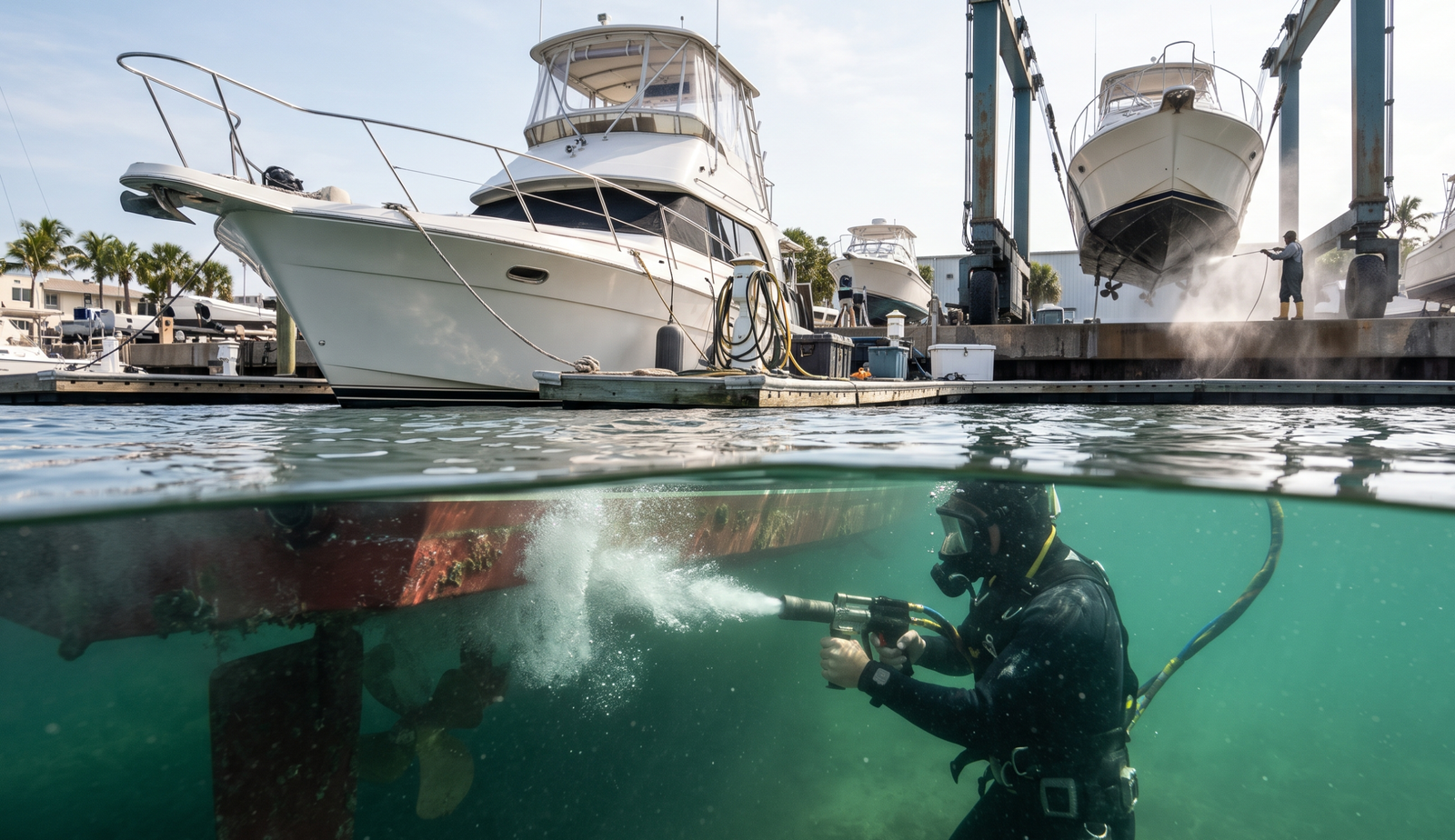
When barnacles and marine growth build up on your boat’s bottom, you have two main maintenance options: clean the hull underwater with professional equipment or haul the vessel out for pressure washing at a boatyard. The right choice depends on more than the cleaning price. Haul-out fees, blocking, yard time, fouling severity, coating condition, and additional repairs can all change the final bill.
In-water cleaning can cost less for suitable hulls because it avoids lifting, blocking, and relaunching the boat. Cavitation cleaning may also help remove stubborn underwater growth without conventional abrasive scraping. However, heavy fouling, damaged antifouling paint, necessary hull repairs, or local restrictions can make a boatyard haul-out the better option. Compare the complete job cost, not just the cleaning charge.
If you are deciding between boat haul out vs in water cleaning in South Florida, understanding the differences between cavitation equipment and conventional pressure washing can help you choose a practical maintenance method.
What Is the Difference Between In-Water Cavitation Cleaning and Boatyard Pressure Washing?
In-water cavitation cleaning uses specialized underwater equipment to generate and collapse vapor bubbles near a fouled surface, helping loosen marine growth while the boat remains afloat. Boatyard pressure washing uses a high-pressure water stream after the vessel is lifted out. Both methods remove fouling, but they operate differently and have different cost components.
In-water cavitation cleaning
Cavitation cleaning uses a specialized water-jet system to create localized cavitation. As bubbles collapse near the fouled surface, they generate cleaning energy that helps release marine growth.
A trained operator controls the equipment underwater and works across suitable hull surfaces. The process can be useful for selected hard-growth removal where ordinary brushing may be ineffective or unnecessarily abrasive.
It is important to understand that cavitation is not simply a pressure washer pointed at the bottom of a boat. The nozzle, operating parameters, distance, surface condition, and operator technique all influence the result. Incorrect settings or operation can still damage a coating or surface.
Learn more about professional cavitation cleaning in South Florida.
Boatyard haul-out pressure washing
A haul-out takes the boat out of the water using a travel lift, crane, or other lifting system. The yard places the vessel on suitable supports so workers can access the underwater hull.
Once the boat is out, the yard can pressure wash accumulated marine growth, inspect the exposed hull, and prepare the surface for additional work such as sanding, coating repairs, or antifouling paint application.
This approach provides access to the entire underwater surface, but the cleaning charge is only one part of the total cost. You may also pay for lifting, blocking, relaunching, storage, labor, and additional maintenance.
Boat Haul-Out vs. In-Water Cleaning: Cost Comparison
For a boat that only needs suitable underwater cleaning, an in-water service can avoid several boatyard charges. A haul-out quote may include separate fees for lifting, blocking, pressure washing, and relaunching. Compare itemized estimates for the same vessel size and work scope before deciding which option is cheaper.
Published Florida service rates provide useful examples of how these costs can add up. The following figures are from different Florida businesses and boatyards, not a standardized Fort Lauderdale price list.
Published Florida price examples
| Service or fee | Published example | Source and pricing context |
|---|---|---|
| In-water hull cleaning | From $4 per foot | Hull Cleaning FL; $130 minimum for smaller boats |
| In-water hull cleaning | From $6 per foot | Below Hull in Miami; $200 minimum |
| Haul, block, and relaunch | $25 per foot | Blenker Boatworks in Bradenton |
| Pressure washing | $150 flat rate | Blenker Boatworks published yard rate |
| Haul-out and relaunch with blocking | $18 per foot | Angler Marine published rate |
| Pressure washing | $4.50 per foot | Angler Marine published rate |
| Haul, splash, or lift | $10 per foot | Shell Point Marina published service-yard rate |
| Pressure washing | $5–$10 per foot | Shell Point Marina, depending on growth level |
Sources: Hull Cleaning FL, Below Hull, Blenker Boatworks, Angler Marine, and Shell Point Marina’s published rate sheet. Rates and terms can change.
These examples come from different locations and may not include identical services. They are useful as cost benchmarks, not guaranteed quotes for Fort Lauderdale or any particular vessel.
What Would Each Method Cost for a 35-Foot Boat?
A 35-foot boat illustrates why the total invoice matters. Using published examples, routine in-water cleaning could calculate to approximately $140–$210 at the listed per-foot rates. Published haul-out and pressure-wash combinations from other Florida yards calculate to approximately $525–$1,025. These are illustrative calculations, not quotes for cavitation cleaning or a Fort Lauderdale boatyard.
| Option | Calculation for 35 ft | Illustrative total |
|---|---|---|
| In-water cleaning at $4/ft | 35 × $4 | $140 |
| In-water cleaning at $6/ft | 35 × $6 | $210 |
| Haul/block/relaunch plus pressure wash at Blenker | 35 × $25 + $150 | $1,025 |
| Haul-out/relaunch plus pressure wash at Angler Marine | 35 × $18 + 35 × $4.50 | $787.50 |
| Haul/lift plus pressure wash at Shell Point | 35 × $10 + 35 × $5–$10 | $525–$700 |
The comparison has an important limitation: the in-water figures are published routine hull-cleaning rates, not verified prices for severe barnacle removal or specialized cavitation work. Heavy growth may involve hourly labor, additional charges, or a separate quote. Similarly, boatyard totals may exclude storage, extra labor, coating work, repairs, taxes, or other yard fees.
There is no published UMS cavitation-cleaning price in the service information referenced here. Request a vessel-specific estimate rather than treating ordinary hull-cleaning rates as a cavitation price.
What Makes Severe Barnacle Removal More Expensive?
Severe barnacle removal costs more because hard, established growth takes additional time and may require specialized equipment and a closer coating assessment. The final price depends on vessel size, the amount and location of growth, bottom-paint condition, underwater access, and whether the job can be completed safely and legally while the boat remains in the water.
Not all marine growth requires the same cleaning approach. A light layer of slime is very different from mature barnacles, oysters, or hard calcareous deposits attached to the hull.
Factors that can increase the cost include:
- Time since the last cleaning: Long periods without maintenance can allow hard growth to become more established.
- Growth density: Large barnacle clusters require more attention than a thin film of algae.
- Hull size and shape: Longer vessels, wide hulls, complex running gear, and difficult-to-reach areas increase the work involved.
- Coating condition: Damaged, peeling, or unsuitable antifouling paint may restrict the available cleaning methods.
- Underwater access: Visibility, current, berth restrictions, and access to the vessel can affect labor and scheduling.
- Environmental requirements: Capture equipment, disposal arrangements, or local restrictions may affect the method and price.
If the hull has not been cleaned for a long time, ask the service provider to inspect the fouling before agreeing to a fixed routine-cleaning price. An initial heavy-growth service should not be priced as though it were an ordinary monthly maintenance visit.
Is Cavitation Cleaning Better Than an Underwater Pressure Washer?
Cavitation cleaning and conventional pressure washing use different cleaning mechanisms. Cavitation uses controlled bubble formation and collapse to help loosen growth, while conventional pressure washing relies mainly on the force of a water jet. The best choice depends on the fouling, coating, surface, equipment, and operator—not simply the advertised pressure or cleaning speed.
Conventional pressure washing is widely used in boatyards because the hull is accessible above water and removed material can be managed on land. It is particularly useful when the vessel is already out for maintenance or when the hull needs preparation for coating work.
Cavitation cleaning can be considered for selected underwater applications where hard growth needs more specialized treatment than ordinary brushing. It may reduce the need for direct scraping, but it is not a universal solution for every hull or coating.
Do not assume cavitation is completely risk-free or that it can never affect antifouling paint. Equipment settings, nozzle position, distance, operating technique, and surface condition matter. The provider should explain why the method is suitable for your vessel before starting.
UMS explains the differences in its guide to cavitation jet technology vs. traditional pressure washing.
When Should You Avoid a Boatyard Haul-Out?
You may avoid a haul-out when the boat needs only appropriate underwater cleaning, the hull and coating are in suitable condition, and the marina permits the work. In-water cleaning can eliminate lifting, blocking, and relaunching charges. However, avoiding a haul-out should never take priority over necessary repairs, coating work, or environmental compliance.
In-water maintenance may be worth considering when:
- The vessel is structurally sound and does not need out-of-water repairs.
- The fouling can be addressed using a suitable approved underwater method.
- The antifouling coating is in a condition compatible with the cleaning process.
- The marina or waterway allows the proposed in-water cleaning method.
- The boat does not need painting, sanding, blister repairs, or other work that requires dry access.
Routine underwater hull cleaning can help prevent fouling from becoming severe enough to require more intensive maintenance. The key is to inspect and maintain the bottom before heavy growth becomes established.
When Is a Haul-Out the Better Investment?
A haul-out is often the better choice when the hull needs repairs, antifouling paint removal or application, blister assessment, or cleaning that cannot be performed safely and appropriately underwater. It also provides access to the full hull surface and allows removed material to be collected and managed at a suitable facility.
Consider a boatyard visit when:
- Antifouling paint is peeling, failing, or due for renewal.
- The hull needs sanding, barrier coating, or surface preparation.
- There is suspected hull damage or a condition that requires dry inspection.
- Heavy growth cannot be removed appropriately using an available in-water method.
- Local environmental requirements prohibit the proposed underwater cleaning operation.
- The vessel needs other out-of-water repairs that make combining the work more economical.
A haul-out can seem expensive when viewed as a cleaning expense alone. But if the boat already needs paint or repairs, combining those jobs into one yard visit may be more practical than paying for separate maintenance later.
Environmental Rules Can Affect the Cleaning Decision
In-water cleaning can release antifouling paint particles, biocides, and marine organisms into surrounding water. The method must comply with applicable federal, state, local, and marina requirements. Where capture is required or appropriate, the cleaning system must collect and manage removed material rather than simply releasing it into the water.
The U.S. Environmental Protection Agency distinguishes between in-water cleaning with capture and cleaning without capture. Its vessel-discharge standards address hull and niche-area cleaning and the need to minimize the release of antifouling coatings and biofouling organisms.
For guidance, review the EPA’s vessel discharge and standards information and the International Maritime Organization’s biofouling guidance.
Removing growth underwater does not automatically make the process environmentally harmless. Even a chemical-free cleaning method can release organisms or coating debris. Check the rules that apply to your specific berth and vessel before scheduling the work.
How to Compare Cavitation Cleaning and Haul-Out Quotes
Ask both providers to quote the same work scope. Include vessel length, fouling severity, coating condition, underwater fittings, cleaning method, environmental controls, and any additional services. A clear itemized quote helps you identify whether the lower initial price actually represents the lower total maintenance cost.
Before approving either option, ask:
- Is the quote for routine cleaning or severe barnacle removal?
- Does the price include the propeller, rudder, shafts, trim tabs, and other running gear?
- What cleaning equipment and technique will be used?
- Is the method suitable for the existing antifouling coating?
- Are debris capture and disposal included or required?
- For a haul-out, are lifting, blocking, relaunching, pressure washing, and yard storage itemized?
- Will the provider document the hull condition before and after cleaning?
- What additional charges could apply if the fouling is heavier than expected?
For a complete view of the vessel’s underwater condition, consider arranging an underwater inspection before committing to extensive cleaning or repairs. If corrosion protection also needs attention, ask about zinc replacement services.
Frequently Asked Questions
Is in-water cavitation cleaning cheaper than hauling a boat out?
It can be cheaper when the vessel needs only suitable underwater cleaning because it avoids lifting, blocking, relaunching, and some yard charges. However, severe fouling, special equipment, or environmental controls can change the estimate. Compare complete quotes for the same vessel and cleaning scope.
How much does a yacht short haul cost in Fort Lauderdale?
There is no single Fort Lauderdale short-haul price that applies to every yacht. Charges depend on vessel length, beam, weight, yard equipment, lifting requirements, and how long the boat remains ashore. Ask local yards for an itemized quote covering haul-out, blocking, washing, storage, and relaunch.
Can an underwater pressure washer remove severe barnacles?
Specialized underwater water-jet systems can remove selected hard marine growth, but suitability depends on the hull coating, equipment, and fouling condition. Conventional pressure washing is more commonly performed after haul-out. A professional assessment should determine whether cavitation, another underwater method, or dry cleaning is appropriate.
How much does cavitation cleaning cost per foot?
Cavitation cleaning does not have one universal per-foot rate. Pricing depends on boat size, growth severity, access, coating condition, equipment, and the work required. Request a specific estimate for the vessel rather than using ordinary monthly hull-cleaning rates as a substitute for cavitation pricing.
Does cavitation cleaning damage bottom paint?
Correctly selected and controlled cavitation cleaning can help remove suitable growth while reducing reliance on abrasive scraping. However, no underwater cleaning method should be assumed harmless for every coating. Equipment settings, distance, operator technique, and existing paint condition all affect the risk of surface damage.
When should I haul my boat out instead of cleaning it underwater?
Choose a haul-out when the hull needs painting, sanding, coating repairs, blister assessment, or other work requiring dry access. It may also be necessary when heavy growth cannot be addressed appropriately underwater or local rules prohibit the proposed cleaning method.
Read More: Underwater Hull Maintenance in South Florida
Explore more about professional underwater hull cleaning, cavitation cleaning, and underwater inspections.
You can also browse the Underwater Marine Services blog for additional information about vessel maintenance and marine services.
Choose the Right Cleaning Method for Your Boat
Comparing in-water cavitation cleaning vs. boatyard haul-out pressure washing costs requires looking beyond the advertised cleaning rate. In-water maintenance can avoid several yard charges when the hull is suitable for underwater work. A haul-out, however, provides dry access for pressure washing, coating maintenance, repairs, and other work that cannot be completed properly while the vessel is afloat.
For severe barnacle removal in water, ask about the actual equipment, coating compatibility, environmental controls, and total labor involved. Do not assume that routine hull-cleaning rates apply to specialized cavitation work.
Underwater Marine Services can help assess your vessel’s cleaning needs and discuss whether professional hull cleaning or cavitation cleaning is appropriate. Contact the team with your boat’s length, location, and current hull condition to request an estimate.
Contact Underwater Marine Services for a vessel-specific cleaning estimate.
