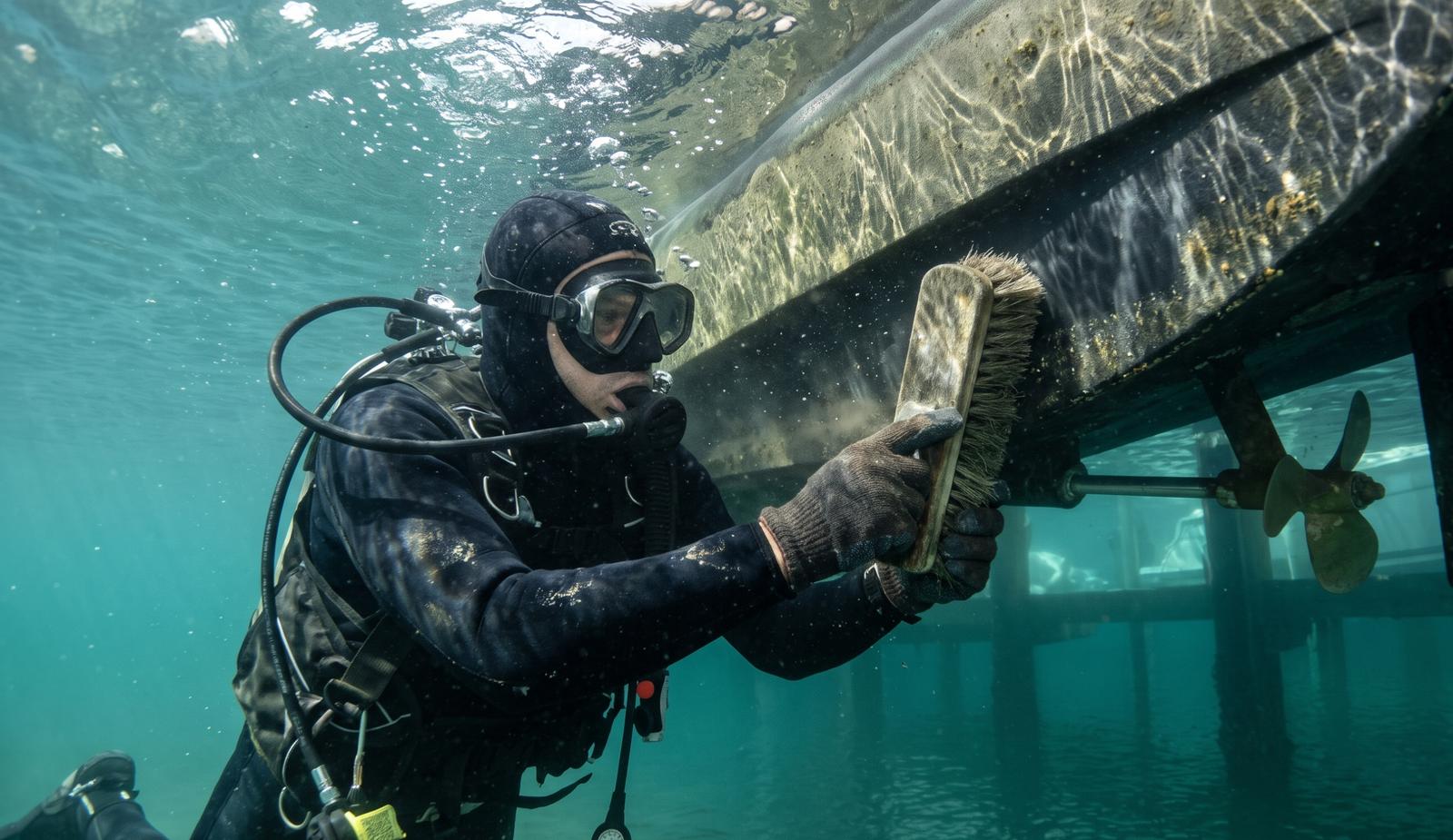
If your boat stays in the water, algae, slime, barnacles, and other marine growth gradually collect on the hull. That buildup can make the bottom rough, increase drag, and affect how efficiently your boat moves through the water. You may be tempted to grab a brush and clean it yourself, but underwater hull cleaning requires more care than ordinary boat washing.
To clean a boat hull in the water, first identify the type of marine growth and the hull’s antifouling coating. Light slime may be removable with a soft cloth or suitable brush where local rules permit. Heavy algae, barnacles, and hard growth require a more careful assessment because aggressive scrubbing can damage coatings and release paint debris or marine organisms into the water.
Professional divers use underwater inspection, coating-appropriate cleaning tools, and controlled techniques to remove fouling while reducing unnecessary abrasion. DIY cleaning may be suitable for limited maintenance, but it is not a substitute for professional attention when the hull has heavy growth, damaged paint, or difficult underwater areas.
Why Clean a Boat Hull While It Is Still in the Water?
In-water hull cleaning removes accumulated marine growth without requiring the boat to be hauled out. It can help maintain a smoother underwater surface and reduce drag caused by fouling. However, the cleaning method must match the hull coating and local environmental requirements, especially when the hull has more than a light layer of slime.
Marine growth develops at different rates depending on water temperature, salinity, sunlight, vessel use, berth conditions, and the type of antifouling system. A boat that stays in warm South Florida waters may develop fouling differently from a vessel kept in cooler or less biologically active water.
Common types of hull fouling include:
- Slime and biofilm: A thin, slippery layer of microscopic organisms and organic material that forms on submerged surfaces.
- Soft algae: Green or brown growth that may collect on the hull, around the waterline, and in sheltered areas.
- Grass and weed: Larger growth that can collect around underwater fittings and hull surfaces.
- Barnacles and shell growth: Hard marine organisms that attach firmly and may require more controlled removal.
- Growth around appendages: Fouling can collect around propellers, shafts, rudders, trim tabs, intakes, and other underwater fittings.
The International Maritime Organization’s hull-cleaning guidance explains that marine fouling increases drag and can affect vessel hydrodynamic performance, fuel consumption, and underwater equipment. The amount and type of growth matter when deciding how to clean.
How Professional Divers Clean Boat Bottoms
Professional underwater hull cleaning starts with an assessment, not immediate scrubbing. A diver identifies the hull material, coating type, fouling level, and vulnerable fittings before selecting suitable tools. The diver then cleans using controlled movements and appropriate brush or cleaning equipment, checking the surface for coating damage and remaining growth throughout the job.
1. Underwater inspection before cleaning
A diver first examines the hull to understand what needs attention. This includes identifying the type of fouling, checking the condition of the antifouling coating, and locating areas that need extra care.
Important inspection areas include:
- Flat hull surfaces and the waterline
- Keel, chines, and hull-to-keel transitions
- Propeller, shaft, and rudder
- Trim tabs and stabilizers
- Through-hull fittings and water intakes
- Recesses and other areas where growth can accumulate
These less accessible areas are important because fouling does not always develop evenly across the hull. The EPA identifies hull niche areas as important parts of vessel maintenance because significant biofouling can accumulate on relatively small underwater surfaces.
2. Selecting the right cleaning equipment
Professional divers select cleaning tools according to the growth and coating rather than using one brush on every boat. A soft brush or less abrasive cleaning method is generally preferred for light fouling. Harder brushes should be reserved for appropriate hard-growth removal where the coating and applicable requirements allow it.
Depending on the vessel and cleaning system, equipment may include:
- Soft underwater brushes for light slime and biofilm
- Purpose-made hand pads or non-abrasive cleaning tools
- Specialized rotary or powered cleaning equipment for suitable applications
- Controlled tools designed for propellers and underwater fittings
- Debris-capture or vacuum systems where available and appropriate
Powered equipment is not automatically better. Brush pressure, rotation, tool material, and the condition of the coating all affect the risk of removing paint or damaging the hull surface.
3. Controlled underwater scrubbing
After selecting the equipment, the diver works across the hull in a controlled pattern. The objective is to remove the targeted fouling without unnecessarily abrading the antifouling system. Areas with delicate coatings, exposed metal, sensors, fittings, or other vulnerable components may require different treatment.
A professional cleaning operation should not leave a visible cloud or plume of paint coming away from a copper-based antifouling coating. If the cleaning method visibly removes coating, the tool or technique needs to be reassessed.
4. Checking the finished hull
Once cleaning is complete, the diver checks the treated areas for remaining growth and signs of damage. Depending on the job, an underwater report or video can help the owner understand the hull’s condition and identify maintenance concerns that need separate attention.
For a closer look at underwater vessel condition, see Underwater Inspection Services in South Florida.
DIY In-Water Hull Cleaning: What Can You Safely Do?
DIY in-water cleaning is best limited to light maintenance, such as removing a thin slime layer with a suitable soft cloth or brush, when local rules and the coating manufacturer’s instructions permit it. Avoid aggressive scraping, hard brushes, and powered tools unless you understand the coating and have confirmed that the method is appropriate.
If you are considering cleaning your own hull, start with these checks:
- Confirm the hull coating. Find out whether the boat has ablative, hard antifouling, non-biocidal, or another specialized coating.
- Check the manufacturer’s instructions. Some coatings have specific restrictions on underwater cleaning, brush type, and cleaning frequency.
- Check local rules. Marina policies and environmental regulations may restrict in-water cleaning, particularly when it releases paint residue or marine organisms.
- Assess the fouling. A thin film of slime is different from barnacles, tubeworms, or established shell growth.
- Use the least abrasive suitable method. Do not use a tool simply because it removes growth quickly.
- Stop if paint or coating comes away. A visible paint plume or unusual coating loss is a warning that the technique may be too aggressive.
Never enter the water to clean a hull around an operating engine or propeller. Secure the vessel, prevent accidental engine starting, and use appropriate water-safety precautions. If visibility, current, boat traffic, depth, or access creates a hazard, leave the work to a qualified professional.
In-Water Hull Cleaning Tools: Which Ones Should You Use?
The best in-water hull cleaning tool depends on the hull coating and the type of fouling. Soft cloths and suitable soft brushes are generally more appropriate for light slime. Hard brushes and powered tools can remove more stubborn growth but may also remove antifouling paint or damage the surface if used incorrectly.
| Tool | Typical application | Important consideration |
|---|---|---|
| Soft cloth or fleece mitt | Light slime and surface film | Use only when compatible with the coating and local rules |
| Soft-bristle underwater brush | Light fouling on suitable surfaces | Choose brush stiffness carefully |
| Hard brush | Appropriate hard-growth removal | Can damage or remove antifouling coating |
| Powered rotary cleaner | Specialized professional cleaning applications | Requires correct settings, tools, and coating assessment |
| Vacuum or capture system | Collecting removed growth and coating debris | Availability and suitability depend on the cleaning operation |
California State Parks recommends non-abrasive hull-cleaning methods such as soft cloths, fleece mitts, and soft brushes, and warns that aggressive scraping and powered rotary brushes can cause paint to slough off. Its guidance also recommends using divers trained in environmentally sound hull-cleaning practices.
See the California State Parks boat cleaning and maintenance guidance for further information on reducing unnecessary coating removal.
Why Aggressive Hull Scrubbing Can Damage Antifouling Paint
Antifouling paint is designed to control marine growth, and some coating systems release active ingredients gradually during normal use. Aggressive underwater scrubbing can remove coating material faster than intended, shorten its service life, and release paint particles or biocides into the water. Always match cleaning intensity to the specific coating.
Not all bottom paints behave in the same way. For example, ablative coatings are designed to wear gradually, while hard antifouling coatings have different surface and cleaning characteristics. Specialized slick or foul-release coatings may have their own maintenance requirements.
Before cleaning, identify the coating and consult its technical data and maintenance instructions. A method that is acceptable for one hull finish may be damaging to another.
Watch for these warning signs:
- Paint visibly clouding or coming away during cleaning
- Unusual color transfer onto a brush or cleaning pad
- Exposed substrate or primer
- Uneven patches where the coating appears thinner
- Scratches or damage around fittings and hull transitions
If the coating is already deteriorating or substantial hard growth is attached, hauling the boat out may be more suitable than attempting aggressive in-water removal.
Environmental Considerations: What Happens to Removed Hull Growth?
In-water hull cleaning can release marine organisms, antifouling paint particles, and other debris directly into the surrounding water. These materials may affect local water quality or contribute to the spread of non-native marine species. Check local requirements before cleaning and use suitable capture technology where available and appropriate.
This is one of the most important differences between cleaning a boat in the water and cleaning it ashore. At a suitable haul-out facility, removed growth and wash water can be collected and managed. In-water cleaning without capture may release material into the water column or onto the seabed.
The U.S. Environmental Protection Agency distinguishes between in-water cleaning with capture and cleaning without capture in its vessel-discharge guidance. It also identifies methods for minimizing the release of fouling organisms and antifouling coatings.
Relevant guidance includes:
- EPA: Discharges and Standards of Performance
- IMO: Biofouling Management
- New Zealand Ministry for Primary Industries: Hull Fouling
Regulations differ by location, vessel size, coating type, and cleaning method. Do not assume that a method permitted at one marina is permitted everywhere. In South Florida, check the applicable local, state, federal, and marina requirements before arranging underwater cleaning.
Professional Diver Cleaning vs. DIY: Which Is Better?
DIY cleaning may be suitable for light slime maintenance when the coating and local rules allow it. Professional diver cleaning is a better option when the hull has substantial growth, underwater fittings need attention, the coating requires careful handling, or you cannot safely inspect and reach the entire underwater surface yourself.
| Consideration | DIY cleaning | Professional diver cleaning |
|---|---|---|
| Light slime | May be suitable with approved soft tools | Can assess and clean where appropriate |
| Heavy algae or hard growth | Higher risk of incorrect tool use | Can assess growth and select a suitable method |
| Antifouling coating | Owner must know coating requirements | Cleaning can be selected according to coating condition |
| Underwater fittings | Access and visibility may be limited | Can inspect accessible underwater components |
| Environmental controls | Owner must verify local requirements | Can discuss appropriate methods and available capture systems |
| Condition reporting | Limited to what the owner can observe | May include underwater photos or video, depending on the service |
Professional cleaning does not automatically mean aggressive cleaning or a better result in every situation. The correct approach is the one that addresses the actual fouling while protecting the coating and complying with applicable requirements.
How Often Should You Clean a Boat Hull in the Water?
There is no single cleaning schedule that suits every boat. The interval depends on local fouling conditions, vessel use, antifouling coating, water temperature, and how quickly growth develops. Inspect the hull regularly and address light fouling before it becomes heavy hard growth, while following the coating manufacturer’s maintenance guidance.
Instead of relying only on a fixed calendar, consider these factors:
- Where the boat is kept: Warm, biologically active waters can encourage faster fouling.
- How often the boat moves: Regular use may influence fouling, but it does not eliminate the need for inspection.
- Coating type and age: Different antifouling systems have different maintenance limits and service lives.
- Recent inspection results: Actual hull condition is more useful than guessing from the time since the last cleaning.
- Operating requirements: Boats used frequently or expected to maintain particular performance levels may need closer monitoring.
New Zealand’s Ministry for Primary Industries recommends regular cleaning for boats kept in the water and emphasizes preventing the spread of marine pests. Its guidance also notes that a thin slime layer is easier to remove than established heavy fouling. Always apply the rules and coating requirements relevant to your own location.
Frequently Asked Questions
Can I clean my boat hull underwater myself?
You may be able to remove light slime with a suitable soft cloth or brush if the coating manufacturer and local rules permit it. Avoid aggressive scraping or powered tools unless the method is specifically appropriate. Heavy growth, poor visibility, strong currents, or difficult access are reasons to use a professional.
What is the best brush for cleaning a boat hull in the water?
For light slime, a soft cloth, fleece mitt, or suitable soft-bristle brush is generally less abrasive than a hard brush. The correct choice depends on the hull coating and fouling. A hard brush can remove paint, so do not use one without confirming that it is suitable.
How do divers clean boat bottoms?
Divers inspect the hull, identify the coating and type of growth, and select appropriate cleaning equipment. They use controlled brush or cleaning techniques to remove the targeted fouling while taking care around fittings and vulnerable surfaces. Some operations can also use debris-capture systems where available and appropriate.
Can scrubbing remove antifouling paint?
Yes. Abrasive brushes, scraping, and unsuitable powered tools can remove antifouling paint or release coating particles into the water. Some coatings are designed to wear gradually, so excessive cleaning can shorten their useful life. Follow the manufacturer’s instructions and stop if paint visibly comes away.
Is underwater hull cleaning environmentally safe?
Not automatically. In-water cleaning can release paint particles, biocides, and marine organisms into the surrounding environment. The impact depends on the coating, fouling, cleaning method, and available capture technology. Check local regulations and marina policies before arranging or performing underwater cleaning.
When should I haul my boat out instead of cleaning it underwater?
Haul-out cleaning may be more appropriate when the hull has heavy hard growth, deteriorating antifouling paint, or fouling that requires aggressive removal. An ashore facility can collect and manage removed growth and wash water. A professional can help determine whether in-water cleaning is suitable for your hull.
Read More: Underwater Boat Maintenance in South Florida
Hull cleaning is one part of a wider underwater maintenance routine. You can also explore our services for cavitation cleaning, zinc replacement, and underwater inspections.
For topside care and general vessel appearance, see our boat wash and detailing services. You can find more marine maintenance information in our Underwater Marine Services blog.
Keep Your Boat Hull Clean Without Unnecessary Damage
Knowing how to clean a boat hull in the water means understanding the difference between light slime removal and aggressive marine-growth removal. The right cleaning method depends on the hull coating, the type of fouling, the condition of underwater fittings, and the environmental rules that apply to your berth.
DIY cleaning can be useful for limited maintenance when the method is permitted and appropriate. For heavier fouling or more complex underwater conditions, professional diver assessment and controlled cleaning can help protect the hull and its coating. The goal is not simply to make the bottom look clean. It is to maintain the underwater surfaces responsibly and avoid unnecessary damage.
If your boat needs underwater hull maintenance in South Florida, contact Underwater Marine Services to discuss the vessel’s condition and the appropriate service.
Contact Underwater Marine Services to discuss your underwater maintenance needs.
