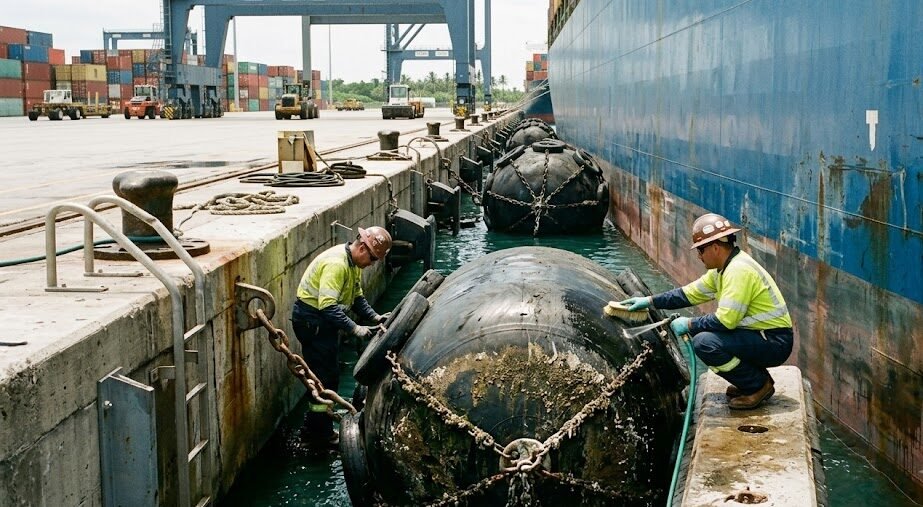
Commercial marine fenders work in one of the harshest environments in the marine industry. Every berthing operation exposes rubber fenders, chains, tires, brackets, panels, and other components to saltwater, vessel contact, marine growth, dirt, oil, ultraviolet radiation, and repeated mechanical loading.
Commercial port fender cleaning is therefore more than an appearance issue. Removing salt, marine growth, oil, and accumulated debris makes it easier to identify cuts, abrasion, deformation, damaged hardware, corrosion, and other conditions that can affect fender performance.
This is especially important for busy shipping terminals where fenders may be exposed to frequent vessel contact and where a damaged component can affect both berth protection and operational safety. Industry guidance emphasizes inspection of rubber bodies, valves, attachments, fixings, supports, and other components rather than treating cleaning as an isolated cosmetic task. :contentReference[oaicite:0]{index=0}
Why Commercial Port Fender Cleaning Matters
Regular fender cleaning removes contaminants that can obscure damage and allows maintenance teams to inspect the actual condition of the protective system.
Marine fenders can accumulate:
- Salt deposits
- Algae
- Barnacles and other marine growth
- Mud and sediment
- Oil and grease
- Rust staining
- Sand and grit
- Organic debris
These deposits can hide cracks, abrasion, cuts, deformation, loose hardware, and corrosion. A documented inspection and cleaning program therefore provides more useful information than simply washing a fender when it becomes visibly dirty.
The Port and Airport Research Institute’s fender maintenance guideline, for example, includes inspection of rubber bodies, air inlet valves, attachments, panels, fixings, supports, and resin pads, with photographic documentation of observed conditions. :contentReference[oaicite:1]{index=1}
Types of Commercial Marine Fenders
Port facilities use different fender configurations depending on berth design, vessel size, energy requirements, tidal conditions, and operating environment.
Pneumatic Yokohama-Type Fenders
Pneumatic fenders use compressed air inside a rubber body to absorb berthing energy and are widely used for ship-to-ship and ship-to-quay applications.
Yokohama’s own pneumatic-fender documentation identifies the fenders as low-maintenance equipment but still specifies maintenance considerations including pressure and chain-net condition. :contentReference[oaicite:2]{index=2}
Cleaning these fenders requires attention to both the rubber body and the components surrounding it. Valve areas, attachment points, chain nets, and tire elements can collect marine debris and should not be ignored.
Sliding and Fixed Rubber Fenders
Ports also use fixed rubber fender systems attached directly to quay structures. Depending on the design, these may incorporate cylindrical, sliding, D-shaped, cone, arch, or other rubber profiles.
Cleaning should expose the contact surface and attachment areas so maintenance personnel can identify abnormal wear, cuts, deformation, loose fasteners, and corrosion.
Panel Fender Systems
Panel systems combine rubber fender elements with a larger contact panel that distributes berthing loads across the vessel’s hull.
For these installations, cleaning needs to address both the exposed rubber and the structural components around the panel. The inspection guideline from CDIT specifically includes fender panels, fixings, supports, and resin pads in its inspection framework. :contentReference[oaicite:3]{index=3}
Commercial Port Fender Cleaning Process
A practical commercial fender-cleaning process begins with inspection, followed by freshwater rinsing, appropriate cleaning, gentle removal of attached growth, thorough rinsing, drying where practical, and a post-cleaning inspection.
1. Inspect Before Cleaning
Do not start with the pressure washer.
First document the fender’s condition. Look for:
- Surface cuts
- Abrasion
- Cracking
- Deformation
- Soft or damaged areas
- Loose or damaged attachments
- Corroded hardware
- Damaged chain nets
- Valve problems on pneumatic fenders
- Missing or damaged components
Photographs taken before cleaning can be valuable because they establish the condition before marine growth and dirt are removed.
2. Remove Loose Marine Debris
Remove loose seaweed, sediment, trash, and other debris before applying cleaning chemicals or mechanical force.
This prevents loose material from being pushed across the rubber surface during subsequent cleaning.
3. Freshwater Rinse
Freshwater is the foundation of routine marine fender cleaning because it removes loose salt and surface contamination without introducing additional seawater contaminants.
For pneumatic fenders, manufacturer and industry-oriented maintenance guidance commonly recommends freshwater cleaning and appropriate control of cleaning pressure. One current cleaning protocol recommends keeping high-pressure equipment away from the rubber rather than concentrating the nozzle at close range. :contentReference[oaicite:4]{index=4}
4. Treat Heavy Contamination
Stubborn oil, grease, algae, or embedded dirt may require a suitable marine cleaning product. The cleaning chemical should be compatible with the particular rubber compound and fender manufacturer’s recommendations.
Avoid assuming that stronger chemicals produce better results. Aggressive solvents, strong acids, or unsuitable alkaline products can damage rubber or associated components.
5. Remove Marine Growth Carefully
Barnacles and algae can become firmly attached to submerged rubber. Mechanical removal may be necessary, but metal scrapers and aggressive tools can gouge the rubber.
Use appropriate non-damaging tools and controlled force when removing attached marine growth from rubber fenders.
A current Yokohama-type fender cleaning protocol recommends soft brushes and plastic scrapers rather than steel wool, wire brushes, or metal scrapers. :contentReference[oaicite:5]{index=5}
6. Rinse Away Cleaning Residue
After cleaning, rinse the entire system thoroughly. Pay particular attention to attachment points, valve areas, chain nets, brackets, and other locations where cleaner and loosened contamination can accumulate.
Leaving chemical residue against rubber or metal components defeats the purpose of cleaning and can contribute to material degradation.
7. Allow the Fender to Dry Where Practical
Where the maintenance procedure permits it, allow cleaned components to dry naturally in a ventilated area. Stored pneumatic fenders should be dry before long-term storage.
Do not use uncontrolled heat or open flames to accelerate drying. Rubber components can be damaged by excessive heat.
8. Inspect Again After Cleaning
The most important part of commercial fender cleaning may happen after the dirt is gone: inspect the newly exposed surface for damage that was previously hidden.
Look again for cuts, cracks, abrasion, deformation, corrosion, damaged attachments, and other abnormalities.
Cleaning Yokohama Fenders Without Damaging the Rubber
Yokohama pneumatic fenders should be cleaned using methods appropriate for their rubber construction, while maintaining attention to pressure, valves, chain nets, and the manufacturer’s requirements.
The original Yokohama pneumatic-fender documentation describes these systems as relatively low-maintenance and identifies pressure and chain-net maintenance as important considerations. :contentReference[oaicite:6]{index=6}
Professional maintenance providers also inspect and service pneumatic fender bodies, chain and tire cages, safety valves, and other components. James Fisher, for example, describes cleaning, inspection, testing, recalibration, chain and tire-cage replacement, and body restoration as components of its fender maintenance services. :contentReference[oaicite:7]{index=7}
This illustrates an important distinction: fender cleaning should be part of an inspection and maintenance program, not a substitute for one.
Commercial Dock Fender Maintenance Checklist
A useful maintenance checklist should cover the complete fender assembly rather than just its visible rubber surface.
| Component | What to Inspect |
|---|---|
| Rubber body | Cuts, cracks, abrasion, aging, deformation, surface damage |
| Contact surface | Uneven wear, deep abrasion, excessive deformation, embedded debris |
| Chains and tire nets | Corrosion, broken links, missing components, excessive wear |
| Valves | Damage, leakage, corrosion, service condition |
| Fasteners | Looseness, bending, missing components, corrosion |
| Supports | Bending, cuts, corrosion, structural deterioration |
| Panels | Deformation, corrosion, damage |
| Resin pads | Wear, abrasion, cuts, missing sections |
These inspection categories align closely with the component-level approach shown in the CDIT fender maintenance guideline. :contentReference[oaicite:8]{index=8}
How Often Should Port Fenders Be Cleaned?
There is no single cleaning interval that applies to every commercial port fender installation.
Cleaning frequency should reflect water quality, marine-growth rate, vessel traffic, exposure, contamination, fender type, and the facility’s inspection program.
Some maintenance guidance recommends frequent visual inspections and more comprehensive periodic inspections, with pneumatic-fender pressure and safety-valve requirements determined by the applicable equipment and manufacturer specifications. James Fisher states that Yokohama safety valves should be serviced every two years and notes the same interval as a recommended period for checking or repairing tire nets. :contentReference[oaicite:9]{index=9}
Other maintenance guidance suggests more frequent inspections in harsh or heavily trafficked port environments. :contentReference[oaicite:10]{index=10}
Rather than choosing a universal calendar interval, port operators should establish a documented schedule based on the actual operating environment and equipment requirements.
Why Marine Growth Should Not Be Ignored
Marine growth isn’t simply an aesthetic problem on a commercial fender.
Barnacles and other growth can:
- Hide cuts and abrasion.
- Make surface deterioration harder to identify.
- Create additional contact points.
- Increase cleaning difficulty.
- Trap sediment and organic material.
- Obscure hardware and attachment areas.
For floating pneumatic fenders, growth can also accumulate around chain nets, attachment components, and protected areas.
Removing growth during scheduled maintenance makes the subsequent inspection substantially more informative.
Port Fender Cleaning and Corrosion Control
Commercial fender systems frequently combine rubber components with chains, shackles, bolts, brackets, panels, and other metal hardware. Cleaning therefore provides an opportunity to identify corrosion before it affects the mechanical connection.
Inspect areas where water and sediment remain trapped. Pay particular attention to:
- Chain connections
- Shackles
- Bolted brackets
- Fender anchors
- Panel connections
- Metal support structures
- Areas beneath accumulated marine growth
Cleaning alone does not repair corroded hardware. Any component showing significant deterioration should be evaluated according to the port’s engineering and maintenance procedures.
Why Documentation Matters for Port Authority Maintenance
A commercial fender-cleaning program becomes much more useful when every inspection is documented with photographs, dates, locations, component identifiers, and observed defects.
Documentation allows maintenance teams to compare the condition of the same fender over time.
Useful records can include:
- Fender identification number.
- Berth or terminal location.
- Cleaning date.
- Inspection date.
- Photographs before cleaning.
- Photographs after cleaning.
- Observed damage.
- Pressure readings for pneumatic units.
- Valve condition.
- Chain-net condition.
- Hardware condition.
- Repairs performed.
- Replacement components.
- Next scheduled inspection.
The CDIT guideline includes a standardized inspection form with fields for location, installation information, inspection dates, deterioration conditions, measured pressure, fixings, supports, resin pads, and photographic documentation. :contentReference[oaicite:11]{index=11}
When Professional Fender Maintenance Makes Sense
Routine rinsing and basic cleaning may be handled by trained port maintenance personnel. More complicated work should be assigned to technicians with appropriate fender experience.
Professional assistance is particularly useful when the job involves:
- Large pneumatic fenders.
- Heavy marine-growth accumulation.
- Suspected air leaks.
- Damaged valves.
- Damaged chain or tire nets.
- Significant rubber cuts or splits.
- Corroded attachment hardware.
- Fender-body repairs.
- Pressure testing.
- Safety-valve testing.
- Large commercial fleets.
- Hard-to-access submerged fender systems.
Specialist providers such as James Fisher describe inspection, cleaning, testing, safety-valve servicing, chain and tire-cage work, and fender-body repair as parts of professional maintenance programs. :contentReference[oaicite:12]{index=12}
Common Commercial Fender Cleaning Mistakes
- Treating cleaning as a purely cosmetic operation.
- Skipping the inspection before washing.
- Using excessive pressure directly against rubber.
- Using wire brushes on rubber surfaces.
- Using metal scrapers to remove barnacles.
- Allowing aggressive chemicals to remain on the fender.
- Ignoring valves and attachment points.
- Cleaning the rubber but not inspecting the hardware.
- Failing to document defects.
- Using the same maintenance interval for every port environment.
- Failing to follow the specific fender manufacturer’s requirements.
- Assuming a clean fender is automatically a serviceable fender.
Commercial Port Fender Cleaning vs. Fender Inspection
Cleaning and inspection should work together, but they are not the same task.
Cleaning removes contamination; inspection determines whether the fender remains suitable for service.
A fender can look clean and still have:
- A developing crack.
- A damaged valve.
- A leaking pneumatic body.
- A deteriorated chain net.
- Corroded fixings.
- Deformed supports.
- Excessive wear.
Conversely, a heavily fouled fender may simply need cleaning and continued monitoring. The inspection after cleaning provides the information needed to distinguish between these situations.
Frequently Asked Questions
How do you clean commercial marine fenders?
Begin with a condition inspection, remove loose debris, rinse with freshwater, apply a compatible cleaner where necessary, gently remove attached marine growth, rinse thoroughly, and inspect the fender again after cleaning. Rubber fenders should be cleaned using methods that do not damage their surfaces.
How do you clean a Yokohama pneumatic fender?
Use freshwater to remove loose salt and debris, followed by an appropriate rubber-compatible cleaner for stubborn contamination. Soft brushes and suitable non-metallic tools can be used for attached growth. Avoid damaging the rubber, valves, chain net, or attachment components, and follow the manufacturer’s maintenance requirements.
How often should Yokohama fenders be inspected?
The appropriate interval depends on the equipment, operating environment, manufacturer requirements, and port maintenance program. James Fisher notes that Yokohama safety valves should be serviced every two years and recommends that tire nets also be checked at that interval. :contentReference[oaicite:13]{index=13}
Can pressure washing damage marine rubber fenders?
Yes. Excessive pressure or holding the nozzle too close can damage rubber surfaces. Commercial cleaning should use controlled pressure and an appropriate working distance, with the exact procedure determined by the fender manufacturer and condition of the rubber.
Why should port fenders be cleaned before inspection?
Marine growth, mud, salt, oil, and other deposits can hide cuts, abrasion, deformation, corrosion, damaged fasteners, and other defects. Cleaning exposes the underlying components and makes a subsequent inspection more meaningful.
What should be checked on a commercial dock fender?
Inspect the rubber body, contact surface, valves where applicable, chains, tire nets, attachments, fixings, supports, panels, resin pads, and surrounding hardware. Record defects with photographs and compare findings with previous inspections.
Conclusion
Commercial port fender cleaning is an essential part of maintaining the protective systems that separate vessels from docks, quays, and other marine structures. The objective isn’t simply to make a fender look clean. A properly maintained fender should be easier to inspect, easier to monitor, and less likely to hide deterioration beneath accumulated marine growth and contamination.
For pneumatic Yokohama-type fenders and other commercial systems, cleaning should be integrated with inspection, pressure or valve checks where applicable, hardware examination, documentation, and manufacturer-specific maintenance requirements.
For more practical marine maintenance guidance and vessel-care information, read more of our marine maintenance articles and resources.
Ready to protect your vessel?
If you need expert help with this, our team of certified divers and marine technicians is ready to step in. Learn more about our specific services here.
Prefer to speak with an expert immediately? Contact us today to schedule a service or get a free quote!
