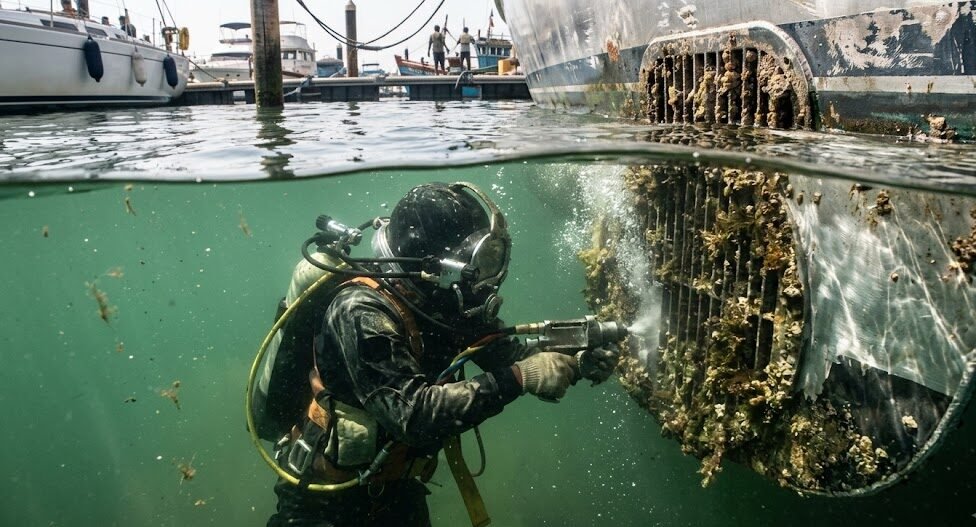
Few things get a captain’s attention faster than an engine temperature alarm. You check the gauges, open the engine room, and find the raw-water flow has dropped. A clogged sea strainer, barnacle-covered intake grate, or blocked seawater passage may be the reason. Sea strainer cavitation can be used as part of a professional underwater cleaning approach to remove stubborn marine growth from suitable intake areas without relying on aggressive scraping that can damage coatings or hardware.
For yachts, sportfishing boats, commercial vessels, and other craft that depend on continuous seawater flow for cooling, keeping intakes clear is a basic reliability issue. The key is knowing where the blockage is, what caused it, and which cleaning method is appropriate for the component.
What Is Sea Strainer Cavitation?
Sea strainer cavitation is a controlled underwater cleaning technique that uses cavitation-generated cleaning action to help remove marine growth and deposits from suitable seawater intake components, grates, and other submerged surfaces. When performed by trained technicians with equipment appropriate for the surface, it can help restore water flow while reducing the need for aggressive mechanical scraping.
The technique is not a substitute for opening and servicing an onboard strainer when its basket, gasket, cover, or internal components require inspection. It is an underwater cleaning method that can address fouling at the external intake side of the system.
Why Boat Water Intakes Become Clogged
A seawater intake is an easy place for marine growth and debris to accumulate. The intake grate sits in continuously submerged water, while the flow of seawater can create an attractive attachment point for algae, barnacles, mussels, slime, and other organisms.
Common causes of restricted flow include:
- Barnacle growth across intake grates
- Algae and slime buildup
- Shell organisms attached to the intake
- Floating debris becoming trapped
- Paint or coating deterioration
- Accumulated sediment in some operating environments
The International Maritime Organization’s biofouling guidance recognizes niche areas and submerged structures as locations where marine organisms can accumulate. For smaller recreational vessels, the same basic principle applies: the underwater components that are difficult to see often need the most deliberate inspection and maintenance.
How a Clogged Intake Can Contribute to Engine Overheating
An obstructed raw-water intake can reduce the amount of seawater available to the engine cooling system, heat exchanger, air-conditioning system, generator, or other seawater-cooled equipment. If flow falls below the level required by the system, cooling performance can suffer and an engine may run hotter than intended.
Manufacturers specify different cooling-system arrangements and service procedures, so the exact symptoms depend on the engine and installation. For example, a current Yanmar marine operation manual instructs operators to monitor seawater discharge and investigate low or intermittent flow rather than continuing operation.
If your engine is overheating, do not assume the intake is the only possible cause. A blocked strainer basket, damaged impeller, restricted hose, heat exchanger fouling, air leak, or another cooling-system problem can create similar symptoms.
Boat Water Intake Cleaning: What Should Be Checked?
Effective boat water intake cleaning starts with inspection. Cleaning without first identifying the restriction can waste time and may leave the actual problem unresolved.
Inspect the External Intake
Look for barnacles, shells, algae, debris, damaged grates, and coating failure. A professional Underwater Inspection can document the intake’s condition before cleaning.
Check the Sea Strainer
An underwater intake can be completely clear while the onboard strainer basket remains packed with debris. If the system design allows access, the basket should be inspected and serviced according to the engine or equipment manufacturer’s instructions.
Check Water Discharge
Reduced or intermittent seawater discharge is an important warning sign. If flow changes during operation, investigate the cooling system rather than continuing to run an overheating engine.
Clearing a Marine Intake Without Damaging It
Clear marine intake maintenance requires the cleaning method to match the material and coating. An intake grate may be stainless steel, bronze, composite material, or another marine-grade construction, and the surrounding hull may have a different coating system.
Before cleaning, determine:
- What the intake is made from
- Whether it has an antifouling or protective coating
- How severe the fouling is
- Whether the grate is damaged or loose
- Whether cleaning is permitted at the location
For suitable underwater surfaces, professional Cavitation Cleaning can provide a controlled cleaning option. The technician can work around the intake geometry while avoiding unnecessary scraping of adjacent hull surfaces.
When Cavitation Cleaning Makes Sense
Cavitation-based cleaning can be particularly useful when conventional access is difficult or when hard marine growth has accumulated around underwater components.
It may be considered for:
- Sea chest grates
- Raw-water intake grates
- Cooling-water intakes
- Underwater strainers
- Suitable metal running gear
- Other compatible submerged hardware
The method should not be treated as a universal solution for every intake. A qualified technician should first determine whether the surface, coating, and fouling condition are compatible with the cleaning process.
Where an intake is heavily damaged, loose, structurally compromised, or obstructed internally, cleaning alone will not solve the underlying problem.
Raw Water Intake Barnacles: Why Early Removal Helps
Raw water intake barnacles can become a bigger problem when they are allowed to mature. A small amount of early fouling may be relatively easy to remove, while established shell growth can restrict openings and require more aggressive intervention.
Regular inspection also gives you an opportunity to spot:
- Broken intake bars
- Loose fasteners
- Corrosion
- Damaged coatings
- Deformed grates
- Heavy fouling developing inside recessed areas
This is one reason a recurring Hull Cleaning program should include attention to intake grates and other underwater niche areas rather than concentrating only on broad hull surfaces.
Protecting Cooling Systems After Cleaning
Cleaning the external intake is only one part of restoring reliable seawater flow. Once the underwater work is complete, the onboard cooling system should be checked according to the equipment manufacturer’s procedures.
Depending on the vessel, maintenance may include:
- Cleaning the sea strainer basket
- Checking the strainer gasket
- Inspecting the seawater pump
- Checking the impeller
- Inspecting hoses and clamps
- Checking heat exchanger condition
- Confirming normal seawater discharge
A current Yanmar marine engine manual, for example, includes seawater-system checks and strainer cleaning within its maintenance procedures. Always use the service schedule and procedures specified for your own engine and equipment.
Environmental Considerations for Underwater Intake Cleaning
Removing marine growth underwater is not simply a mechanical maintenance task. Fouling organisms, coating particles, and other debris can enter the surrounding water during cleaning.
The IMO’s 2023 Biofouling Guidelines and subsequent guidance recognize the environmental risks associated with in-water cleaning. The organization specifically notes that cleaning can damage antifouling coatings or release harmful waste and invasive aquatic species.
The IMO’s MEPC 83 decisions also include approved guidance on in-water cleaning of ships’ biofouling. Local ports, marinas, and environmental authorities may have additional requirements, so confirm what is permitted before scheduling underwater cleaning.
For larger commercial operations, the ISO 6319 standard provides an international framework for planning, conducting, and documenting in-water cleaning operations.
DIY vs. Professional Intake Cleaning
There is a big difference between opening a sea strainer basket at the dock and cleaning a fouled intake underneath a vessel. If the problem is simply debris inside an accessible strainer, follow the equipment manufacturer’s service instructions. If the external intake is heavily fouled, difficult to reach, or connected to critical cooling equipment, professional underwater service is the safer choice.
Professional service is especially useful when:
- The intake is heavily covered in barnacles.
- The grate is recessed or difficult to access.
- The vessel cannot conveniently be hauled out.
- The intake coating is sensitive.
- Engine cooling performance has changed.
- You need photographic documentation.
- The vessel has multiple underwater intakes that need inspection together.
Professional Underwater Inspection can also identify whether what looks like fouling is actually corrosion, physical damage, or a failing component.
Common Mistakes When Cleaning Marine Intakes
- Continuing to run an overheating engine while investigating the problem.
- Assuming an external grate is clear because the onboard strainer looks clean.
- Using aggressive tools that damage intake coatings.
- Ignoring a damaged or loose intake grate.
- Cleaning the intake without checking the rest of the seawater cooling path.
- Waiting for a high-temperature alarm before inspecting marine growth.
- Ignoring local requirements for underwater cleaning and debris management.
Frequently Asked Questions
What is sea strainer cavitation?
Sea strainer cavitation is a controlled underwater cleaning approach that uses cavitation-generated action to help remove marine growth and deposits from suitable seawater intake components. It can reduce reliance on aggressive scraping, but the method must be matched to the intake material, coating, and fouling condition.
Can a clogged seawater intake cause an engine to overheat?
Yes. A restricted raw-water intake can reduce cooling-water flow and contribute to overheating. However, clogged strainers, damaged impellers, restricted hoses, heat exchangers, and other cooling-system faults can cause similar symptoms and should also be checked.
Can barnacles block a boat’s water intake?
Yes. Barnacles and other hard marine growth can accumulate across intake grates and reduce the opening available for seawater flow. Regular inspection and timely cleaning help prevent heavy fouling from becoming a cooling-system problem.
Is cavitation cleaning safe for marine intakes?
It can be appropriate for compatible underwater surfaces when performed by trained professionals using suitable equipment. The technician should first assess the intake material, coating, condition, and surrounding hull to determine whether cavitation cleaning is suitable.
Should the sea strainer be cleaned after underwater intake cleaning?
It may need inspection or cleaning because debris can remain inside the onboard strainer even after the external intake has been cleared. Follow the engine or equipment manufacturer’s maintenance procedure and verify normal seawater flow before returning the system to regular operation.
For more practical guidance on underwater maintenance, hull care, and marine equipment protection, visit our blog and marine resources.
Conclusion
Sea strainer cavitation can be a valuable part of a professional strategy for restoring clogged seawater intakes and removing stubborn marine growth from compatible underwater components. The best results come from treating the intake as part of the entire cooling system: inspect the grate, check the onboard strainer, verify seawater flow, and investigate any overheating before returning the vessel to normal operation. Regular underwater maintenance can catch fouling early, protect critical equipment, and help keep your cooling system working reliably.
Ready to protect your vessel?
If you need expert help with this, our team of certified divers and marine technicians is ready to step in. Learn more about our specific services here.
Prefer to speak with an expert immediately? Contact us today to schedule a service or get a free quote!
