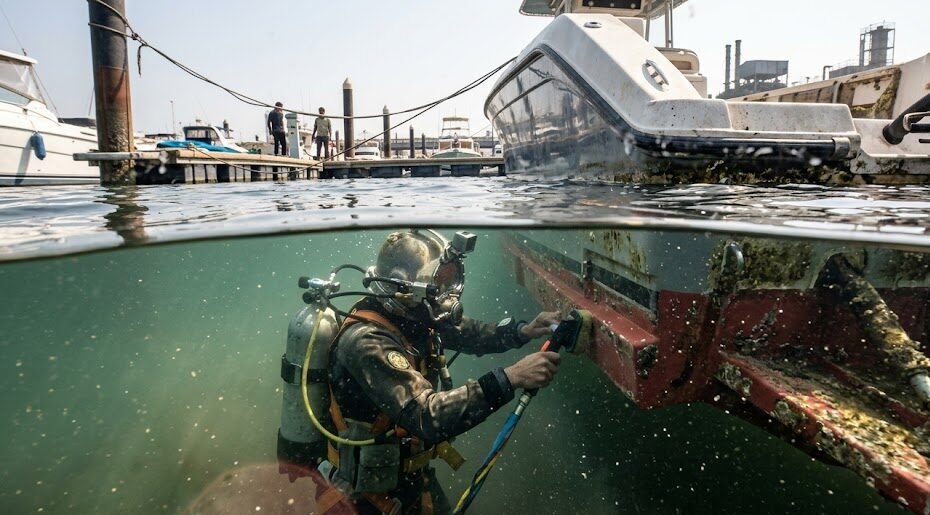
When you own a fast center console or performance boat, a small amount of fouling can become a noticeable headache. A layer of slime may seem harmless at the dock, but barnacles collecting around a hull step, strake, or running gear can add drag and make the boat feel different underway. That is why stepped hull cleaning requires more care than simply scrubbing every underwater surface as hard as possible.
Stepped hulls are designed around controlled water flow. Their recessed sections can improve high-speed performance, but those same areas can be harder to inspect and clean. The right maintenance approach removes marine growth while protecting the coatings, geometry, and underwater surfaces that your boat depends on.
What Is Stepped Hull Cleaning?
Stepped hull cleaning is the controlled removal of marine growth from a stepped hull’s running surfaces, recessed steps, chines, strakes, and underwater hardware without unnecessarily damaging protective coatings or altering the hull’s designed geometry. Unlike a conventional flat-bottom hull, a stepped hull has recessed sections that need careful attention because fouling can collect where a diver or cleaning tool has limited access.
The objective is not simply to make the bottom look clean. Proper cleaning should leave the underwater surfaces free of excessive fouling while preserving the coating system and the shape of the hull.
Why Stepped Hulls Need Specialized Cleaning
A stepped hull uses breaks or recessed sections in the running surface to influence water flow at speed. Depending on the design, the steps can reduce wetted surface and help a performance boat operate efficiently.
That geometry creates several maintenance challenges. Marine growth can collect around:
- Recessed hull steps
- Chines and strakes
- Transom corners
- Trim tabs
- Through-hull fittings
- Water intakes
- Propellers and other running gear
The International Maritime Organization’s biofouling guidance recognizes that organisms can accumulate on immersed vessel surfaces and that effective management helps maintain vessel performance while reducing the spread of invasive aquatic species.
How Stepped Hull Aerodynamics Relate to Fouling
Stepped hull aerodynamics depend on predictable water flow around the hull’s running surfaces. Marine growth changes the texture of those surfaces and adds resistance. Fouling concentrated around a step can also interfere with the clean movement of water through an area specifically designed to manage flow.
Not every patch of growth will produce an obvious change at the helm. The effect depends on the amount of fouling, where it is located, the vessel’s speed, hull design, loading, and operating conditions. But on a performance boat, maintaining a clean underwater profile is a sensible part of protecting the boat’s intended efficiency.
The IMO GreenVoyage2050 hull-cleaning guidance identifies marine fouling as a source of increased hydrodynamic resistance and recognizes hull cleaning as a way to manage fouling-related performance losses.
Safe Cleaning Techniques for High-Performance Boat Maintenance
High performance boat maintenance should focus on controlled cleaning rather than maximum force. A performance hull may have antifouling paint, gelcoat, specialized coatings, or other finishes that can be damaged by aggressive tools.
Inspect Before You Clean
Start by examining the complete underwater profile. Look closely at the steps, chines, strakes, transom, intakes, running gear, and any areas where the hull changes direction.
A professional Underwater Inspection can document existing coating damage, impact marks, corrosion, and unusual fouling before cleaning begins. This matters because a diver should be able to distinguish pre-existing damage from conditions exposed during the cleaning process.
Begin With the Least Aggressive Suitable Method
Soft slime and algae generally require less force than mature barnacles. Starting gently reduces unnecessary wear on the coating and gives the technician a better view of the surface underneath.
Cleaning tools should be selected according to the hull material, coating, and type of fouling. There is no universal tool that is appropriate for every stepped hull.
Work Carefully Inside the Steps
Recessed hull steps deserve particular attention. A tool that works safely on a broad flat surface may be unsuitable inside a narrow step. Excessive scraping can damage a coating, while careless positioning can leave fouling behind in areas that are difficult to see from the dock.
The technician should work methodically through each step rather than treating the entire bottom as one continuous surface.
Inspect Running Gear Separately
Propellers, shafts, rudders, trim tabs, and other underwater hardware require their own inspection. Fouling on these components can affect propulsion efficiency and may hide damage from previous impacts.
For suitable underwater metal components, professional Cavitation Cleaning can provide a controlled way to remove marine growth while limiting unnecessary mechanical abrasion.
Fast Boat Bottom Cleaning Without Surface Damage
Fast boat bottom cleaning should mean an efficient, controlled process—not an aggressive one. High-performance boats depend on carefully maintained surfaces, so removing a little extra coating today can create a much bigger maintenance problem later.
A practical cleaning sequence includes:
- Identify the hull material and coating system where possible.
- Inspect and document existing damage.
- Remove loose slime and soft growth first.
- Clean each recessed hull step carefully.
- Remove hard growth without gouging the coating.
- Inspect the cleaned surface for previously hidden damage.
- Check propellers, trim tabs, intakes, and other underwater hardware.
Professional Hull Cleaning is particularly useful when a boat has heavy fouling, multiple steps, sensitive coatings, or underwater components that require experienced handling.
Managing Stepped Hull Fouling Between Cleanings
Stepped hull fouling is easier to manage when you address it before hard growth becomes established. The correct interval depends on local water conditions, temperature, salinity, marina location, vessel use, and the performance of the antifouling system.
A boat kept in warm, nutrient-rich water may foul much faster than one operating in cooler water. Instead of relying on a universal calendar interval, inspect the hull regularly and adjust the maintenance schedule according to what you actually find.
Routine cleaning also gives you an opportunity to spot coating failure, corrosion, damaged hardware, and impact marks before they become larger problems.
In-Water Cleaning and Environmental Responsibility
In-water cleaning requires more consideration than simply removing growth from a boat. Marine organisms, coating debris, and cleaning residues can enter the surrounding water if the process is not properly controlled.
The IMO’s biofouling framework addresses the environmental risks associated with biofouling and in-water cleaning. Local marinas, ports, and environmental authorities may also impose their own restrictions or requirements.
Before scheduling underwater cleaning, confirm that the procedure is permitted in your location and ask whether specific containment, capture, or cleaning practices are required.
For vessels operating under formal environmental or commercial requirements, the ISO 6319 standard for in-water cleaning provides an international reference for planning, conducting, and documenting in-water cleaning operations.
DIY vs. Professional Stepped Hull Cleaning
Light fouling may be manageable for an experienced owner who understands the hull’s coating and has suitable equipment. The situation changes when fouling is heavy or the boat has complex steps and expensive underwater finishes.
Professional cleaning can be the better choice when:
- Hard barnacle growth is widespread.
- The hull has several recessed steps.
- The coating system is sensitive or specialized.
- There are unexplained performance changes.
- The boat has recently struck an object or grounded.
- Propellers or running gear need inspection.
- You need photographic documentation of underwater condition.
The benefit is not just cleaner paint. An experienced technician can recognize when a surface problem is actually a coating failure, corrosion issue, impact mark, or mechanical concern that needs further attention.
Common Mistakes With Stepped Hull Cleaning
- Using the most aggressive scraper available because the fouling is difficult to remove.
- Cleaning the flat running surfaces while overlooking recessed steps.
- Failing to inspect the hull before starting work.
- Scrubbing directly over loose or damaged coating.
- Assuming every antifouling system tolerates the same cleaning method.
- Ignoring propellers, intakes, trim tabs, and other underwater hardware.
- Waiting for heavy barnacle growth before scheduling maintenance.
- Ignoring local requirements for in-water cleaning.
Frequently Asked Questions
Why do stepped hulls require special cleaning?
Stepped hulls have recessed sections and changes in geometry that can collect marine growth and make some areas harder to reach. Cleaning must remove fouling without damaging coatings or disturbing the underwater surfaces that control water flow and high-speed performance.
Can marine growth affect stepped hull performance?
Yes. Marine growth increases surface roughness and hydrodynamic resistance, and fouling around steps or appendages can interfere with water flow. The actual performance effect varies with the amount and location of fouling, hull design, vessel speed, loading, and operating conditions.
Can I clean a stepped hull myself?
Light fouling can sometimes be managed by an experienced owner using suitable equipment and a method compatible with the hull coating. Professional cleaning is preferable when growth is heavy, access is difficult, or the coating and underwater hardware require specialized handling.
Can aggressive cleaning damage a high-performance hull?
Yes. Excessive scraping and abrasive tools can remove or damage antifouling paint, gelcoat, or other protective finishes. The cleaning method should match the hull material, coating system, and type of fouling rather than relying on maximum cleaning force.
How often should a stepped hull be cleaned?
There is no universal cleaning interval. Fouling rates vary with water temperature, salinity, marina conditions, vessel use, and antifouling performance. Regular underwater checks provide a better basis for scheduling cleaning than relying on a fixed calendar interval.
For more practical guidance on hull care, underwater inspections, and marine maintenance, visit our blog and marine resources.
Conclusion
Stepped hull cleaning is about protecting performance as much as appearance. Removing marine growth from recessed steps, running surfaces, and underwater hardware helps control drag while careful techniques protect the coatings and geometry of a high-performance hull. With regular inspections, appropriate cleaning methods, responsible in-water practices, and professional help when needed, you can keep your fast boat operating closer to the way its designers intended.
Ready to protect your vessel?
If you need expert help with this, our team of certified divers and marine technicians is ready to step in. Learn more about our specific services here.
Prefer to speak with an expert immediately? Contact us today to schedule a service or get a free quote!
