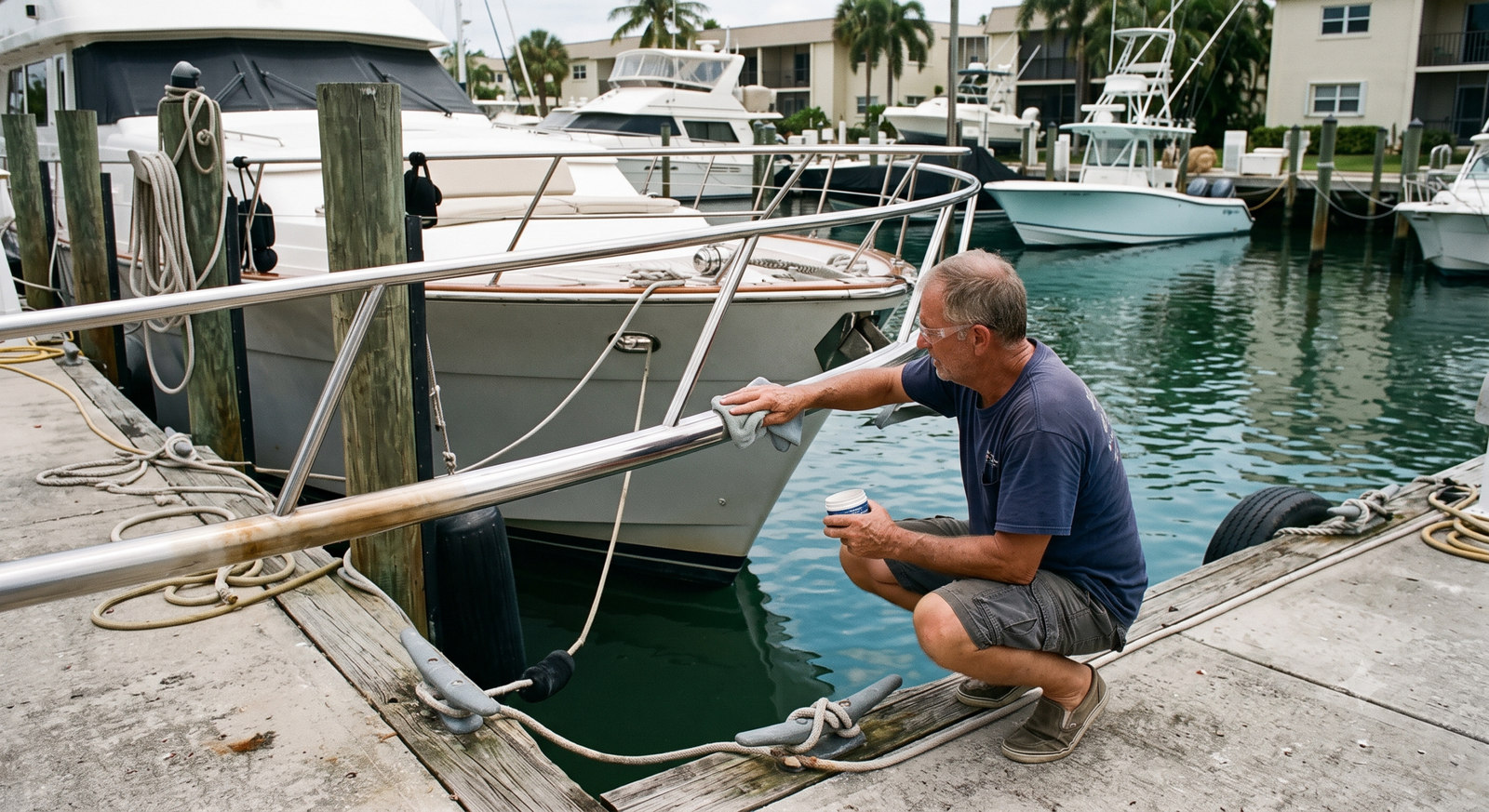
Few things make a well-kept yacht look neglected faster than brown discoloration appearing across a polished bow rail, swim platform fitting, cleat, or stainless-steel handrail. Owners often call it rust, but the underlying problem can be more complicated. In marine environments, even 316L stainless steel can develop superficial brown “tea staining” when salt deposits, contaminants, moisture, surface finish, and environmental exposure work together.
Marine stainless steel polishing helps remove light tea staining and surface contamination while restoring a smooth finish that is easier to maintain. However, polishing alone does not make 316L corrosion-proof. Regular freshwater cleaning, appropriate polishing methods, contamination control, and proper passivation when required are all important for long-term corrosion resistance.
This is particularly important for yachts operating around South Florida, where salt spray, humidity, intense sunlight, and warm coastal conditions can leave stainless-steel hardware exposed to aggressive deposits for extended periods.
What Is Tea Staining on Marine Stainless Steel?
Tea staining is a superficial brown discoloration that can develop on stainless steel exposed to corrosive atmospheric conditions, particularly coastal environments. It is usually associated with surface contamination and corrosion deposits rather than the stainless steel suddenly behaving like ordinary carbon steel.
316 and 316L stainless steels are widely used in marine applications because their molybdenum-containing composition provides better corrosion resistance than many lower-alloy stainless grades. But 316L is not completely corrosion-proof in seawater or severe coastal environments.
The British Stainless Steel Association notes that 316 grades remain susceptible to localized corrosion, particularly pitting and crevice corrosion, under certain seawater conditions. :contentReference[oaicite:0]{index=0}
The International Molybdenum Association also notes that superficial tea staining can occur on Type 316 in severe coastal environments, particularly where salt accumulates on surfaces that are not regularly washed by rain or freshwater. :contentReference[oaicite:1]{index=1}
Why Does 316L Stainless Steel Get Brown in Saltwater?
316L stainless steel can develop brown staining when salt, moisture, airborne contaminants, and surface deposits remain on the metal long enough to interfere with its corrosion-resistant surface condition. Sheltered areas, rough finishes, crevices, and surfaces that do not receive regular washing are especially vulnerable.
Stainless steel relies on a thin, chromium-rich passive oxide layer for much of its corrosion resistance. When the surface is clean and exposed to an oxygen-containing environment, that passive layer naturally forms and can continually regenerate.
The British Stainless Steel Association explains that stainless steel naturally self-passivates when a clean surface is exposed to an environment with sufficient oxygen. :contentReference[oaicite:2]{index=2}
Problems arise when corrosive deposits remain concentrated on the surface. Salt spray is particularly important around boats because water evaporates and leaves chlorides behind.
South Florida’s Marine Environment
South Florida creates several conditions that can accelerate visible stainless-steel staining:
- Salt spray from coastal water.
- High humidity.
- Strong sunlight and heat.
- Frequent wetting and drying cycles.
- Salt deposits beneath fittings and rail supports.
- Protected areas that do not receive natural rain washing.
- Contamination from nearby carbon-steel grinding or fabrication work.
- Marine deposits trapped around hardware and fasteners.
These conditions do not mean 316L is unsuitable. They mean that maintenance has to match the environment.
Marine Stainless Steel Polishing: The Correct Approach
Marine stainless steel polishing should begin with cleaning and identification of the stain, followed by the least aggressive method capable of restoring the surface. Light tea staining may respond to a non-scratching stainless-steel polish or cleaner, while heavier contamination or corrosion may require specialized chemical treatment or professional refinishing.
The British Stainless Steel Association recommends mild, non-scratching creams or polishes for light rust staining and discoloration, followed by rinsing and drying. It also warns against chloride-containing cleaning products and abrasive materials that can scratch polished surfaces. :contentReference[oaicite:3]{index=3}
A good maintenance sequence is:
- Rinse away salt and loose contamination.
- Wash the stainless steel with a mild detergent.
- Rinse thoroughly with clean water.
- Dry the surface.
- Evaluate the remaining discoloration.
- Use an appropriate non-scratching stainless-steel polish for light staining.
- Rinse away all residue.
- Dry and inspect the finish under good lighting.
How to Remove Tea Staining from 316L Boat Hardware
Before polishing a yacht’s stainless hardware, determine whether you are dealing with superficial staining or actual localized corrosion. Brown discoloration that wipes away with an appropriate cleaner is a very different problem from deep pits or corrosion concentrated around a fastener.
Step 1: Rinse Away Salt
Start with freshwater. Salt crystals and loose marine deposits should be removed before mechanical polishing begins.
Do not use a dry abrasive pad over a salt-contaminated surface. The objective is to remove contaminants without dragging them across the finish.
Step 2: Wash with Mild Detergent
Wash the stainless steel with a mild detergent and clean water. The British Stainless Steel Association states that soap or mild detergent followed by a clear-water rinse is generally adequate for routine stainless-steel cleaning. :contentReference[oaicite:4]{index=4}
Step 3: Dry the Surface
Drying makes the remaining discoloration easier to evaluate. Water spots can otherwise be mistaken for corrosion or tea staining.
Step 4: Polish Light Staining
For light staining, use a suitable non-scratching stainless-steel polish with a soft cloth or sponge. Work methodically rather than aggressively.
The goal is to remove the contaminant without creating a new pattern of scratches across the existing finish.
Step 5: Rinse and Inspect
Remove polishing residue with clean water and dry the surface. Inspect the metal from several angles.
If brown discoloration remains inside pits, crevices, weld areas, or around fasteners, the problem may require more than ordinary polishing.
316L Rust Prevention Starts with Clean Surfaces
The simplest form of 316L rust prevention is regular cleaning that prevents salt and other corrosive deposits from accumulating on the surface. Keeping marine stainless steel clean and dry reduces the time that concentrated chloride deposits remain in contact with the metal.
This is why regular freshwater rinsing is more important than waiting for stainless hardware to become visibly brown.
The International Molybdenum Association recommends maintenance strategies that encourage regular washing and prevent corrosive deposits from remaining on stainless-steel surfaces. :contentReference[oaicite:5]{index=5}
On a yacht, that means paying particular attention to:
- Bow rails.
- Stanchions.
- Handrails.
- Cleats.
- Swim-platform hardware.
- Ladder fittings.
- Rod holders.
- Hinges.
- Fasteners.
- Rail bases and mounting points.
Why Stainless Steel Finish Matters
The grade of stainless steel is only part of the corrosion-resistance equation. Surface finish, fabrication quality, geometry, contamination, and maintenance also influence performance.
A smoother, cleaner stainless-steel surface generally provides better resistance to the accumulation of corrosive deposits than a rough or contaminated surface.
The British Stainless Steel Association notes that surface finish and post-fabrication cleaning can be important factors in the successful marine use of 316 grades. :contentReference[oaicite:6]{index=6}
This is one reason a polished yacht rail should not be treated with an aggressive abrasive that leaves visible scratches. A surface that looks shiny immediately after polishing may be harder to maintain if the finish has been unnecessarily damaged.
Removing Rust from a Boat Bow Rail
Light rust staining on a 316L boat bow rail can often be removed with a mild, non-scratching stainless-steel cleaner or polish. Heavier staining caused by embedded iron contamination may require a specialized chemical treatment rather than increasingly aggressive abrasive polishing.
Iron contamination is an important distinction. Stainless steel can acquire particles of ordinary steel from grinding dust, tools, fabrication equipment, or nearby carbon-steel work. Those particles can rust while sitting on an otherwise corrosion-resistant stainless surface.
The British Stainless Steel Association identifies iron contamination as a common cause of rust staining and recommends removing the contamination without spreading it across the surface. :contentReference[oaicite:7]{index=7}
That means polishing harder is not always the answer.
Signs the Stain May Be More Than Surface Rust
- Deep pits remain after cleaning.
- Corrosion is concentrated around fasteners.
- Brown staining repeatedly returns immediately after cleaning.
- There is visible surface roughness.
- Weld areas show discoloration or corrosion.
- Crevices contain persistent deposits.
- The metal appears physically damaged rather than merely discolored.
When these conditions are present, the stainless steel should be evaluated rather than repeatedly polished.
Passivation vs. Polishing: What’s the Difference?
Polishing changes or restores the surface finish and can remove visible contamination, while passivation is a chemical treatment intended to promote the formation of the stainless steel’s protective passive surface after the metal has been properly cleaned.
The two processes are therefore not interchangeable.
Stainless steel naturally passivates when its surface is clean and exposed to oxygen, but specialized passivation may be specified after fabrication, contamination, or certain finishing operations.
The British Stainless Steel Association explains that stainless steel must first be clean and free from contamination and scale before chemical passivation can be effective. :contentReference[oaicite:8]{index=8}
For yacht hardware that has been heavily contaminated, welded, mechanically refinished, or chemically treated, professional evaluation may be appropriate before deciding whether passivation is required.
Should You Use an Abrasive on Marine Stainless Steel?
Abrasives should be used cautiously on polished 316L marine hardware because an inappropriate abrasive can scratch or alter the existing finish and may spread iron contamination across the surface.
Fine finishing materials may be appropriate for professional metal restoration, but the abrasive grade and direction of finishing need to match the existing surface.
The British Stainless Steel Association warns that abrasive cleaning can leave scratches on polished stainless-steel surfaces and emphasizes non-scratching products for light staining. :contentReference[oaicite:9]{index=9}
Never assume that a more aggressive pad produces a better result. On highly visible yacht hardware, maintaining the original finish is part of the restoration.
Cleaning Products to Avoid on Marine Stainless Steel
Some common household cleaning products can create corrosion problems rather than solving them.
- Chloride-containing cleaners.
- Bleach or sodium hypochlorite products unless specifically appropriate for the application.
- Hydrochloric-acid-based cleaners.
- Harsh abrasive powders on polished finishes.
- Contaminated steel-wool products.
- Tools previously used on carbon steel.
The British Stainless Steel Association specifically warns about chloride solutions, bleach, and hydrochloric-acid-based cleaning products because they can damage or stain stainless steel. :contentReference[oaicite:10]{index=10}
On a yacht, chemical runoff is another consideration. Cleaning products should never be allowed to enter the water unnecessarily.
Preventing Tea Staining on Yacht Stainless Steel
Preventing tea staining is easier than restoring badly stained stainless steel. Regular freshwater washing, prompt removal of salt deposits, clean tools, suitable surface finishes, and attention to sheltered areas can significantly reduce the conditions that encourage brown discoloration.
A practical maintenance routine includes:
- Rinse stainless hardware with freshwater after saltwater exposure.
- Wash regularly rather than waiting for visible staining.
- Dry surfaces where practical.
- Inspect rail bases and sheltered crevices.
- Remove bird droppings and organic deposits promptly.
- Use only stainless-compatible cleaning products.
- Never use carbon-steel tools on stainless surfaces.
- Address grinding dust or other iron contamination immediately.
- Inspect recurring stains for pitting or crevice corrosion.
- Use professional passivation when the application calls for it.
Professional Marine Metal Polish vs. DIY Cleaning
Routine freshwater washing and light polishing are reasonable maintenance tasks for many yacht owners. The situation changes when the stainless steel has widespread staining, scratches, pitting, contamination, or an inconsistent finish.
A professional Boat Wash & Detailing service can address stainless hardware as part of a broader exterior-maintenance program, particularly when the vessel has accumulated salt, organic contamination, and water spotting across multiple surfaces.
For heavily corroded or difficult-to-access hardware, an Underwater Inspection can also be useful when stainless components continue below the waterline or when corrosion appears associated with underwater fittings.
If corrosion is occurring alongside anode depletion or other underwater metal problems, Zinc Replacement may be part of the wider corrosion-maintenance process.
Common Marine Stainless Steel Polishing Mistakes
- Assuming 316L stainless steel cannot corrode.
- Using a harsh abrasive simply because the stain looks severe.
- Polishing before removing salt and loose contamination.
- Using carbon-steel brushes or contaminated tools.
- Applying bleach or chloride-containing products without considering corrosion risk.
- Ignoring pits hidden beneath brown staining.
- Confusing passivation with cosmetic polishing.
- Leaving cleaning chemicals on the stainless surface.
- Failing to rinse salt deposits after boating.
- Polishing in random directions and creating visible finishing patterns.
- Ignoring recurring staining around crevices and fasteners.
DIY vs. Professional Stainless Steel Restoration
Light tea staining is often manageable with appropriate stainless-steel cleaner, a soft cloth, freshwater, and patience. The important limitation is knowing when the problem has moved beyond cosmetic maintenance.
Professional restoration is worth considering when the metal has pitting, significant iron contamination, deep scratches, weld discoloration, recurring corrosion, or a highly visible polished finish that needs to be preserved.
For yacht owners who want the surrounding vessel cleaned at the same time, professional Boat Wash & Detailing can combine stainless-steel maintenance with the broader exterior cleaning process.
If the staining is concentrated around underwater components, a professional Underwater Inspection can help determine whether the visible corrosion is isolated to the stainless surface or associated with another underwater issue.
Frequently Asked Questions
What causes tea staining on 316L stainless steel?
Tea staining occurs when stainless steel develops superficial brown discoloration under corrosive environmental conditions. On boats, salt deposits, humidity, surface contamination, sheltered areas, and inadequate cleaning can contribute. Even 316L stainless steel can develop tea staining in severe coastal environments because 316 grades are corrosion-resistant rather than completely corrosion-proof.
Can you polish tea staining off stainless steel?
Yes, light tea staining can often be removed with an appropriate non-scratching stainless-steel cleaner or polish. Heavier staining, iron contamination, pitting, or corrosion around crevices may require specialized chemical cleaning or professional restoration rather than increasingly aggressive polishing.
Does 316L stainless steel rust in saltwater?
316L has strong corrosion resistance and is widely used in marine environments, but it is not immune to corrosion in seawater. The British Stainless Steel Association notes that 316 grades can experience localized pitting and crevice corrosion under certain seawater conditions. Regular cleaning, suitable design, surface finishing, and maintenance remain important.
What is the difference between polishing and passivation?
Polishing primarily addresses the physical surface finish and visible contamination, while passivation is a chemical process intended to promote the stainless steel’s protective passive surface after appropriate cleaning. Polishing does not automatically constitute passivation, and specialized passivation is not necessary for every routine cleaning job.
How do you prevent rust stains on a stainless steel boat rail?
Rinse the rail regularly with freshwater, remove salt deposits and organic contamination promptly, use stainless-compatible cleaners, avoid carbon-steel tools, and address iron contamination quickly. Inspect recurring brown areas for pitting or crevice corrosion instead of repeatedly polishing them without investigating the cause.
Conclusion
Marine stainless steel polishing is most effective when it is part of a broader maintenance routine rather than a last-minute attempt to remove severe corrosion. 316L remains an excellent marine material, but South Florida’s salt, humidity, and coastal exposure can produce tea staining when deposits and contaminants remain on the surface.
Start with freshwater cleaning and the least aggressive appropriate polish. Protect the existing finish, avoid chloride-based products and contaminated tools, and distinguish superficial staining from genuine pitting or crevice corrosion. When the problem goes beyond cosmetic discoloration, professional cleaning, restoration, or passivation may be the better solution.
For more practical marine maintenance guidance and vessel-care information, read more of our marine maintenance articles and resources.
Ready to protect your vessel?
If you need expert help with this, our team of certified divers and marine technicians is ready to step in. Learn more about our specific services here.
Prefer to speak with an expert immediately? Contact us today to schedule a service or get a free quote!
