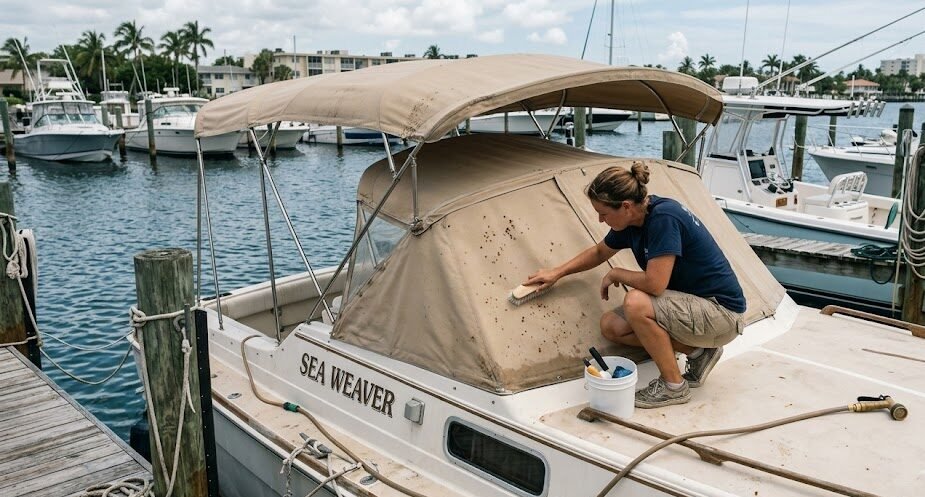
You clean the deck, rinse the hull, wipe the stainless steel, and then notice the same ugly brown spots on the bimini top again. Spiders, birds, leaves, pollen, salt, and other organic debris can turn otherwise clean marine canvas into a collection of stubborn stains. If those deposits sit in the fabric through a hot Florida summer, they can become much harder to remove.
To remove spider droppings from boat canvas, first brush away loose debris, rinse the fabric with clean water, then clean the affected area with a mild soap solution and a soft-bristle brush. For Sunbrella marine canvas, Sunbrella specifically recommends a mild soap-and-white-vinegar solution for bird droppings and similar organic messes, followed by thorough rinsing and air drying.
The key is using enough cleaning action to remove the organic residue without damaging the fabric, stitching, protective finish, or surrounding materials.
Why Spider Droppings Become Difficult Boat Canvas Stains
Fresh spider droppings are usually much easier to remove than deposits that have dried and baked into marine canvas. The longer organic material remains on a bimini or boat cover, the more opportunity dirt and other contaminants have to become embedded in the fabric.
Sunbrella recommends regular rinsing of marine canvas because routine freshwater washing helps prevent dirt from becoming deeply embedded. Monthly rinsing is one of the simplest ways to reduce the need for aggressive deep cleaning later.
This matters especially on boats kept in South Florida marinas. Warm temperatures, humidity, salt residue, insects, birds, and spiders can create a constant stream of organic contamination on canvas tops and covers.
How to Remove Spider Droppings from Boat Canvas
The safest starting point for removing spider droppings from boat canvas is gentle cleaning rather than aggressive scrubbing. Remove loose material, rinse thoroughly, apply mild soap, gently work the stain with a soft brush, rinse away all residue, and allow the canvas to air dry completely.
1. Remove Loose Debris First
Don’t immediately attack a dry stain with a brush. First remove loose spider webs, dried droppings, leaves, pollen, and other surface debris.
A soft hand brush works well for this step. The goal is to lift contamination away from the fabric instead of grinding it deeper into the weave.
2. Rinse the Canvas
Use clean freshwater to thoroughly wet the affected area. Rinsing helps loosen dried organic material before you introduce soap.
For Sunbrella marine canvas, the manufacturer’s cleaning instructions begin with brushing off loose dirt and hosing the fabric down before applying a cleaning solution.
Sunbrella’s marine canvas cleaning instructions provide the manufacturer’s recommended process for routine and deeper cleaning.
3. Apply Mild Soap
Mix mild soap with clean water according to the fabric manufacturer’s instructions. Apply the solution to the stained section and allow it to soak into the canvas.
Don’t immediately reach for a strong degreaser. Spider droppings are organic contamination, not an oil spill, and a harsh chemical can create a new problem by affecting the fabric finish or nearby materials.
4. Use a Soft-Bristle Brush
Gently work the cleaning solution into the stain with a soft-bristle brush. Avoid aggressive back-and-forth scrubbing, particularly on older canvas where the fibers and stitching may already have experienced years of UV exposure.
Work from the outside of the stain toward the center when dealing with a small isolated spot. This reduces the chance of spreading dissolved residue into a larger area.
5. Rinse Thoroughly
Flush the canvas with clean water until all soap and loosened contamination have been removed. Leftover cleaning solution can attract dirt or leave visible residue after the fabric dries.
Sunbrella specifically recommends thorough rinsing after cleaning and allowing the fabric to air dry.
6. Air Dry Completely
Leave the canvas open and allow it to dry naturally. Don’t put wet canvas back into a tightly folded cover bag or compress it while moisture remains trapped inside.
Proper drying also gives you an opportunity to inspect the canvas again. A stain that looks gone while wet can sometimes become visible again once the fabric dries.
How to Remove Stubborn Organic Stains from Marine Canvas
Stubborn organic stains may require a targeted cleaning solution, but the correct treatment depends on the canvas manufacturer and the type of stain. For Sunbrella fabric, the manufacturer’s cleaning guide lists a mixture of mild dishwashing liquid and white vinegar for bird droppings, urine, and vomit.
That same approach can be useful when dealing with similar organic contamination, but always verify that the fabric you have is actually compatible with the treatment.
For Sunbrella fabric, the manufacturer’s cleaning guide specifies:
- 1 teaspoon of dishwashing liquid per 1 cup of water.
- 1 teaspoon of white vinegar per 1 cup of water.
- Thorough rinsing after cleaning.
- Air drying after treatment.
Sunbrella’s stain cleaning guide provides the manufacturer’s recommendations for bird droppings and other common stains.
Don’t assume this formula is appropriate for every marine canvas product. Acrylic canvas, coated fabrics, vinyl-backed materials, and specialty enclosure fabrics can have different cleaning requirements.
Cleaning a Sunbrella Bimini Top Without Damaging It
For a Sunbrella bimini top, routine cleaning should start with freshwater, mild soap, a soft-bristle brush, thorough rinsing, and air drying. Sunbrella advises against abrasive cleaning methods and recommends protecting surrounding materials when stronger treatments such as bleach are used.
One of the most common mistakes is treating a canvas bimini like fiberglass. A pressure washer may quickly blast away visible contamination, but high-pressure cleaning can be unnecessarily aggressive for fabric and seams.
Sunbrella’s marine canvas instructions recommend a soft-bristle brush rather than aggressive mechanical cleaning. Sunbrella’s cleaning resources also provide stain-specific guidance for its fabric products.
For general maintenance, the best approach is often less dramatic: rinse the top regularly, remove contamination before it becomes established, and perform a deeper cleaning when needed.
What About Bird Poop on Boat Covers?
Bird droppings can be more noticeable than spider residue because birds often leave larger deposits on horizontal canvas surfaces. The cleaning principle is similar: remove the bulk of the contamination, rinse first, then use an appropriate fabric-safe cleaning solution.
Don’t scrape dried droppings aggressively across the fabric. Soaking and loosening the material first is gentler on the canvas.
For Sunbrella fabric specifically, the manufacturer’s cleaning guide groups bird droppings with other organic messes and recommends mild dishwashing liquid combined with white vinegar.
If the cover is heavily contaminated, professional Boat Wash & Detailing can be a better option than repeatedly attacking the fabric yourself, particularly when the canvas is part of a larger yacht-cleaning project.
How to Deal with Spider Webs on a Bimini
Spider webs themselves are usually easier to remove than the droppings left behind. The mistake is using a stiff brush or pressure washer to chase every web out of the stitching and seams.
Start with a soft brush or gentle rinse. Pay attention to:
- Undersides of bimini frames
- Canvas seams
- Corner pockets
- Zipper areas
- Frame-to-canvas contact points
- Areas beneath radar arches or hardtops
- Boat-cover folds
These locations give spiders sheltered areas where webs and organic debris can accumulate unnoticed.
Can You Use Bleach on Marine Canvas?
Bleach can be appropriate for certain stubborn Sunbrella stains under the manufacturer’s instructions, but it should not be treated as a universal marine-canvas cleaner. Bleach can affect surrounding materials, sewing thread, and the environment, and Sunbrella specifically advises against using bleach when the runoff could enter surrounding water.
That last point matters on a boat. A cleaning solution that might be acceptable in a controlled cleaning area can create a very different problem when it runs directly into a marina.
Sunbrella’s marine canvas guidance provides specific bleach instructions for stubborn spills and mildew but also warns about environmental effects and the need for thorough rinsing.
When stronger cleaning is necessary, move removable canvas to a suitable dockside cleaning area whenever practical. For permanently installed canvas, control the runoff and protect adjacent surfaces.
Why Pressure Washing Boat Canvas Is a Bad Shortcut
Pressure washing can make a dirty bimini look dramatically cleaner in minutes, which is exactly why some owners are tempted to use it. The problem is that cleaning power isn’t the same thing as fabric care.
Marine canvas contains woven fibers, seams, stitching, and protective finishes. Excessive mechanical force can stress those components, particularly on older canvas.
For Sunbrella marine canvas, Sailrite’s cleaning guidance specifically recommends against pressure or power washing and emphasizes mild soap, soft brushing, thorough rinsing, and air drying.
Sailrite’s Sunbrella cleaning guide provides additional practical guidance for marine tops, covers, and other Sunbrella applications.
Restoring Water Repellency After Deep Cleaning
Deep cleaning can remove more than visible dirt. Over time, repeated cleaning and exposure can reduce the effectiveness of a fabric’s water-repellent finish.
Sunbrella recommends considering an appropriate fabric retreatment after repeated thorough cleanings or extended exposure. The fabric should be completely clean and dry before a retreatment product is applied.
Sunbrella’s boat-top retreatment guidance explains the cleaning and retreatment process for its marine fabrics.
Don’t apply a protectant over a dirty canvas surface. That can trap contamination and make future cleaning more difficult.
Common Boat Canvas Cleaning Mistakes
- Scrubbing dried spider droppings aggressively before soaking them.
- Using a pressure washer directly on marine canvas.
- Applying household bleach without checking fabric compatibility.
- Using strong degreasers on a fabric that doesn’t require them.
- Failing to rinse cleaning chemicals completely.
- Leaving canvas damp after cleaning.
- Cleaning only the visible stain and ignoring surrounding contamination.
- Using the same chemical treatment on every type of marine fabric.
- Ignoring seams and stitching during inspection.
- Waiting until organic stains have become deeply embedded before cleaning.
DIY vs. Professional Boat Canvas Cleaning
Fresh spider droppings and light organic staining are reasonable DIY cleaning jobs when you know the fabric and follow its care instructions. A hose, mild soap, soft brush, and patience can solve many routine problems.
Professional cleaning becomes more attractive when the canvas has extensive staining, years of accumulated contamination, fragile stitching, water-repellency problems, or multiple different materials that need different treatments.
If the canvas is part of a larger vessel-cleaning job, professional Boat Wash & Detailing can address the surrounding exterior without treating every surface as if it were the same material.
For stubborn stains that remain after proper cleaning, don’t keep escalating the chemical strength blindly. A fabric professional can determine whether the remaining discoloration is removable contamination, permanent staining, or damage to the material itself.
How to Prevent Organic Stains on Boat Canvas
Prevention is much easier than restoring a heavily stained bimini.
- Rinse marine canvas regularly with clean freshwater.
- Remove spider webs as soon as you see them.
- Clean bird droppings promptly.
- Don’t allow leaves and organic debris to remain on covers.
- Keep canvas properly ventilated when stored.
- Inspect folds, seams, and protected corners regularly.
- Follow the fabric manufacturer’s cleaning instructions.
- Consider retreatment when the fabric’s water repellency has noticeably declined.
Sunbrella recommends regular freshwater rinsing of marine canvas, noting that monthly rinsing can help prevent dirt from becoming deeply embedded and reduce the need for more frequent vigorous cleaning.
Frequently Asked Questions
How do you remove spider droppings from boat canvas?
Brush away loose debris, rinse the canvas with clean water, then clean the affected area using mild soap and a soft-bristle brush. For Sunbrella fabric, the manufacturer recommends mild dishwashing liquid and white vinegar for bird droppings and similar organic messes. Rinse thoroughly and allow the canvas to air dry.
Can you use vinegar on Sunbrella boat canvas?
Yes, Sunbrella’s stain guide specifically recommends a diluted mixture of mild dishwashing liquid and white vinegar for bird droppings, urine, and vomit. Use the manufacturer’s specified dilution, rinse the fabric thoroughly afterward, and allow it to air dry.
Can you pressure wash a bimini top?
Pressure washing is not the preferred method for Sunbrella marine canvas. High-pressure cleaning can be unnecessarily aggressive toward fabric, seams, stitching, and protective finishes. A hose, mild soap, and soft-bristle brush provide a safer starting point for routine cleaning.
How do you remove bird poop from a boat cover?
Remove the bulk of the dried material without aggressively scraping the fabric, rinse with clean water, then apply the cleaning solution recommended for the specific canvas. Sunbrella’s guide recommends diluted dishwashing liquid and white vinegar for bird droppings. Thoroughly rinse the cover and allow it to air dry.
How often should boat canvas be cleaned?
Routine rinsing should be much more frequent than deep cleaning. Sunbrella recommends hosing marine fabrics with clean water about monthly to prevent dirt from becoming deeply embedded. A thorough cleaning may only be necessary every two to three years in many environments, although heavily exposed boats may need it sooner.
Conclusion
Removing spider droppings from boat canvas doesn’t require the strongest chemical or the most powerful cleaning equipment. The better approach is prompt removal, freshwater rinsing, mild fabric-safe cleaning, gentle brushing, thorough rinsing, and complete air drying. For Sunbrella canvas, following the manufacturer’s stain-specific instructions is the safest way to protect both the appearance and long-term performance of the fabric.
Regular rinsing also makes a difference. When you prevent spider webs, bird droppings, salt, pollen, and other organic debris from accumulating, you spend less time fighting stubborn stains later.
For more practical marine maintenance and boat-care guidance, read more of our marine maintenance articles and resources.
Ready to protect your vessel?
If you need expert help with this, our team of certified divers and marine technicians is ready to step in. Learn more about our specific services here.
Prefer to speak with an expert immediately? Contact us today to schedule a service or get a free quote!
