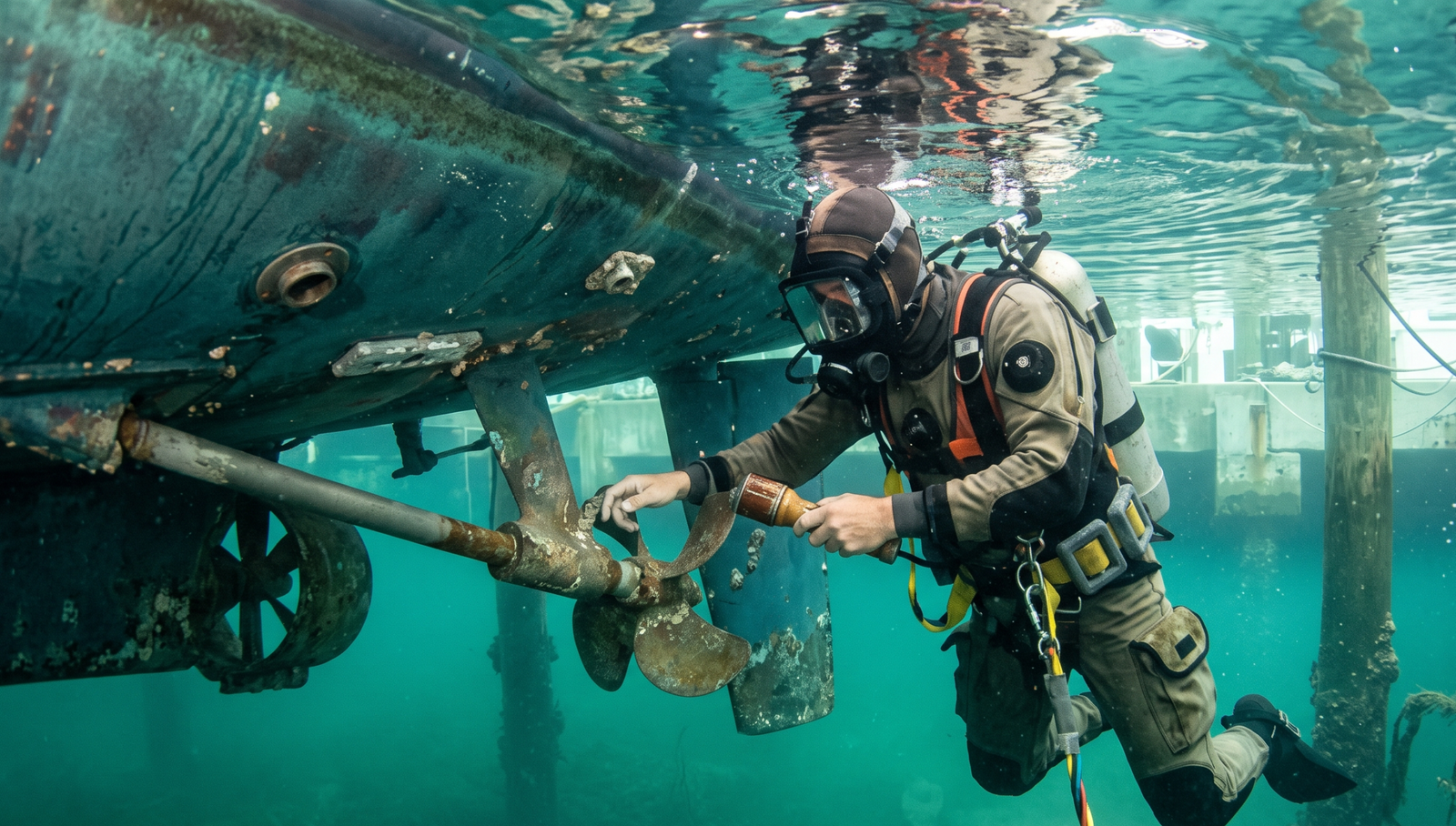
You have spent months planning an international cruise, checking charts, provisioning the boat, and arranging paperwork. Then, just before departure, someone looks underwater and finds a fouled sea chest, damaged anode, line around the propeller, or a layer of marine growth you had not noticed from the dock.
A pre-transit hull inspection is a structured underwater check performed before an international voyage or canal transit to identify fouling, corrosion, anode depletion, underwater damage, and problems with hull appendages before they become transit or passage issues.
For a yacht crossing oceans or preparing for a canal such as the Panama Canal, the inspection is not simply about making the bottom look clean. It is about knowing exactly what condition the vessel is in before entering a new waterway, marina, or country.
Why a Pre-Transit Hull Inspection Matters
International cruising exposes a vessel to changing water temperatures, salinity, fouling organisms, marinas, anchorage conditions, and maintenance standards. A hull that looked acceptable in one region can develop significant fouling or corrosion before the next major passage.
The International Maritime Organization’s biofouling guidance identifies hull fouling as a pathway for transferring invasive aquatic species between regions. The IMO’s 2023 Biofouling Guidelines are intended to provide a globally consistent approach to managing that risk. :contentReference[oaicite:0]{index=0}
There is also a performance reason to inspect before a long passage. Marine growth increases hull roughness and resistance, while heavier hard fouling can affect hydrodynamic performance and underwater equipment.
A pre-transit inspection gives you the opportunity to correct underwater problems while you still have time, rather than discovering them after departure.
What Is Checked During a Pre-Transit Hull Inspection?
A pre-transit hull inspection examines the underwater areas that can affect safety, performance, corrosion protection, and biosecurity during an international voyage. The exact scope depends on the vessel, route, destination requirements, and condition of the hull.
A typical inspection can include:
- Hull condition and visible damage
- Antifouling coating condition
- Marine growth and hard fouling
- Propellers and shafts
- Rudders and steering components
- Trim tabs and stabilizers
- Bow thruster tunnels
- Sea strainers and intake grates
- Through-hulls and seacocks
- Sacrificial anodes
- Signs of galvanic corrosion
- Fishing line, rope, or debris around running gear
- Other underwater appendages and niche areas
The IMO specifically identifies niche areas such as sea chests, bow thrusters, hull appendages, and protrusions as locations that can contribute to biofouling accumulation. :contentReference[oaicite:1]{index=1}
Pre-Transit Hull Inspection for Panama Canal Passage
A Panama Canal passage should be treated as a formal transit preparation exercise, but a general assumption that the Panama Canal Authority requires every recreational yacht to meet one universal “biofouling-free” hull standard would be misleading.
The Panama Canal Authority publishes specific vessel inspection and transit requirements, including inspection services for small vessels that pay tolls based on length. Its current maritime information also provides procedures and documents for securing handline transits by smaller craft. :contentReference[oaicite:2]{index=2}
The Authority’s current Notices to Shipping include separate requirements covering vessel operations, transit reservations, communications, and small-craft operations. :contentReference[oaicite:3]{index=3}
Biofouling is a separate international and destination-waterway concern. The IMO recommends managing hull fouling to reduce the transfer of invasive aquatic species, while individual countries, ports, marinas, and coastal authorities may impose additional requirements.
Before a Panama Canal transit, check both the current Panama Canal Authority requirements and the biosecurity rules applicable to the countries and ports on your itinerary.
For a yacht owner, that distinction matters. A canal transit inspection is not the same thing as a biosecurity inspection, and passing one does not automatically satisfy every requirement at your next destination.
International Yacht Clearance and Biosecurity
When cruising internationally, the underwater hull becomes part of your biosecurity profile.
Marine organisms can attach to the hull, rudder, propeller, thruster tunnel, sea chest, and other submerged structures. Moving the boat to a different ecosystem can transport those organisms with it.
The IMO notes that biofouling is influenced by the vessel’s design, operating profile, locations visited, water temperature and salinity, antifouling system, maintenance history, and hull-cleaning practices. :contentReference[oaicite:4]{index=4}
That is why a yacht preparing for an international voyage should not focus only on the flat bottom.
The difficult areas are often the most important areas to inspect.
Check the Niche Areas
Pay particular attention to areas where water flow is limited or where marine growth can remain undisturbed:
- Bow thruster tunnels
- Sea chests
- Intake grates
- Propeller shafts
- Struts
- Rudders
- Trim tabs
- Stabilizer fins
- Through-hull fittings
- Recessed hull features
These locations can hold fouling even when the main hull appears relatively clean.
What We Look for During the Underwater Inspection
Marine Growth
We document slime, algae, barnacles, tube worms, mussels, weed, and other hard or soft fouling. The type and severity of growth help determine whether the boat needs routine cleaning or a more comprehensive maintenance operation.
The IMO explains that biofouling begins soon after a submerged surface enters the water and that the degree of fouling depends on the vessel and its operating environment. :contentReference[oaicite:5]{index=5}
Anodes and Corrosion
Sacrificial anodes are another major pre-transit checkpoint.
Look for:
- Excessive anode depletion
- Uneven anode wear
- Loose or damaged anodes
- Corrosion around underwater metals
- Pitting on aluminum components
- Unusual corrosion on shafts or running gear
If the anodes are approaching the end of their useful life, zinc replacement and anode service can be completed before departure rather than during an extended passage.
Propeller, Shaft, and Running Gear
A small piece of fishing line wrapped around a shaft may not be obvious from the dock. Neither is every piece of rope caught behind a propeller.
During the inspection, we look for debris, damage, corrosion, fouling, and anything that could interfere with propulsion or steering.
If the running gear is heavily fouled, underwater cavitation cleaning may be considered for suitable applications and surfaces.
Should You Clean the Hull Before an International Voyage?
If significant marine growth is present before an international voyage, cleaning before departure can improve hydrodynamic performance and reduce the amount of biofouling carried into another region.
IMO information explains that hull fouling increases resistance and can negatively affect vessel energy efficiency. :contentReference[oaicite:6]{index=6}
However, underwater cleaning is not automatically permitted everywhere. The IMO notes that in-water cleaning can damage antifouling coatings and release harmful waste substances or invasive aquatic species into the surrounding environment. In 2025, the IMO approved additional guidance addressing safe and environmentally responsible in-water cleaning. :contentReference[oaicite:7]{index=7}
That means the correct procedure depends on where the boat is located, what coating is installed, what type of fouling is present, and what local regulations allow.
For suitable vessels and locations, professional underwater hull cleaning can remove accumulated growth before departure while allowing the technician to document the underwater condition.
How Far Before Transit Should You Inspect?
There is no single international rule requiring every yacht to complete an underwater inspection a specific number of days before departure.
The practical approach is to inspect early enough that you still have time to correct problems, but close enough to departure that the inspection accurately represents the vessel’s condition.
For a major ocean passage, this may mean completing an initial inspection several weeks ahead and performing a final underwater check closer to departure if the yacht remains in the water.
If the vessel stays in a high-fouling marina between inspections, marine growth can continue developing. The longer the yacht remains stationary, the more useful a final check can become.
Pre-Transit Documentation to Keep
A good underwater inspection should produce useful information rather than simply a verbal “looks good.”
Depending on the voyage, keep:
- Inspection date
- Vessel location
- Photographs or video
- Fouling observations
- Anode condition
- Coating condition
- Running-gear condition
- Cleaning performed
- Repairs completed
- Relevant invoices and service records
- Coating and antifouling information
The IMO’s biofouling framework emphasizes management practices, maintenance history, inspections, and records as part of effective biofouling control. :contentReference[oaicite:8]{index=8}
For vessels making repeated international passages, maintaining this information creates a useful maintenance history rather than starting from scratch before every voyage.
Common Pre-Transit Hull Inspection Mistakes
- Inspecting only the visible waterline instead of the complete underwater hull.
- Ignoring bow thruster tunnels and sea chests.
- Assuming a clean-looking hull has no niche-area fouling.
- Replacing anodes without checking their actual condition.
- Waiting until the day before departure to discover underwater damage.
- Assuming Panama Canal transit requirements are identical to biosecurity requirements at the next destination.
- Cleaning underwater without checking local environmental restrictions.
- Using an aggressive cleaning method that damages the antifouling system.
- Failing to photograph or document the underwater condition.
- Ignoring fishing line or debris around the propeller and shaft.
DIY vs. Professional Pre-Transit Hull Inspection
You can inspect the parts of the boat visible from the dock. That is useful, but it does not replace an underwater inspection.
A professional underwater inspection is especially valuable before a long international passage because a diver can examine the entire submerged vessel, including areas that cannot be evaluated from the surface.
Our underwater inspection service can document hull condition, running gear, anodes, fouling, and underwater hardware before the vessel leaves South Florida.
If the inspection identifies extensive marine growth, we can determine whether professional hull cleaning is appropriate. If the growth is especially stubborn, cavitation cleaning may be suitable for selected surfaces.
The goal is not to sell you a cleaning job simply because the boat is underwater. The goal is to understand what condition the boat is actually in before you commit to a long passage.
Frequently Asked Questions
What is a pre-transit hull inspection?
A pre-transit hull inspection is an underwater examination performed before a major voyage or canal passage to identify marine growth, corrosion, anode depletion, underwater damage, debris, and problems with running gear or niche areas. It helps the owner correct issues before departure rather than discovering them during the voyage.
Does the Panama Canal require yachts to have a completely clean hull?
The Panama Canal Authority has vessel inspection and transit requirements, but the current ACP sources do not establish a universal rule stating that every recreational yacht must have a completely biofouling-free hull to transit. Biofouling is also governed by broader international and destination-specific biosecurity considerations, so owners should verify current requirements for their specific voyage.
Why should I inspect a yacht’s hull before crossing an ocean?
An underwater inspection can identify problems that are invisible from the dock, including fishing line around the propeller, damaged anodes, corrosion, fouled intakes, marine growth, and underwater damage. Finding these issues before departure gives you time to repair them without compromising the voyage schedule.
Can hull cleaning be done immediately before an international voyage?
It can be appropriate when local rules permit it and the cleaning method is compatible with the vessel’s coating and fouling condition. However, underwater cleaning can release organisms and coating debris, so the applicable local environmental requirements should be checked before work begins.
What underwater areas should be inspected before international cruising?
The inspection should cover the hull and niche areas, including bow thruster tunnels, sea chests, intake grates, shafts, propellers, rudders, trim tabs, stabilizers, through-hulls, and other submerged appendages. These areas can retain marine growth even when the main hull appears relatively clean.
Should I document my underwater inspection?
Yes. Photographs, video, inspection notes, cleaning records, anode condition, coating information, and repair records create a useful maintenance history. Documentation can also help demonstrate how the vessel was maintained when preparing for international voyages and destination-specific biosecurity requirements.
For more practical guidance before your next voyage, read our latest marine maintenance and underwater service articles.
Conclusion
A pre-transit hull inspection is one of the simplest ways to remove uncertainty before an international cruise or canal passage. It gives you a clear picture of the underwater hull, running gear, anodes, coating, fouling, and niche areas before the vessel enters a new region.
For Panama Canal passages and international cruising, think beyond basic clearance paperwork. Check the current canal requirements, understand the biofouling and biosecurity expectations of your destinations, and give yourself enough time to correct underwater problems before departure.
Ready to protect your vessel?
If you need expert help with this, our team of certified divers and marine technicians is ready to step in. Learn more about our specific services here.
Prefer to speak with an expert immediately? Contact us today to schedule a service or get a free quote!
