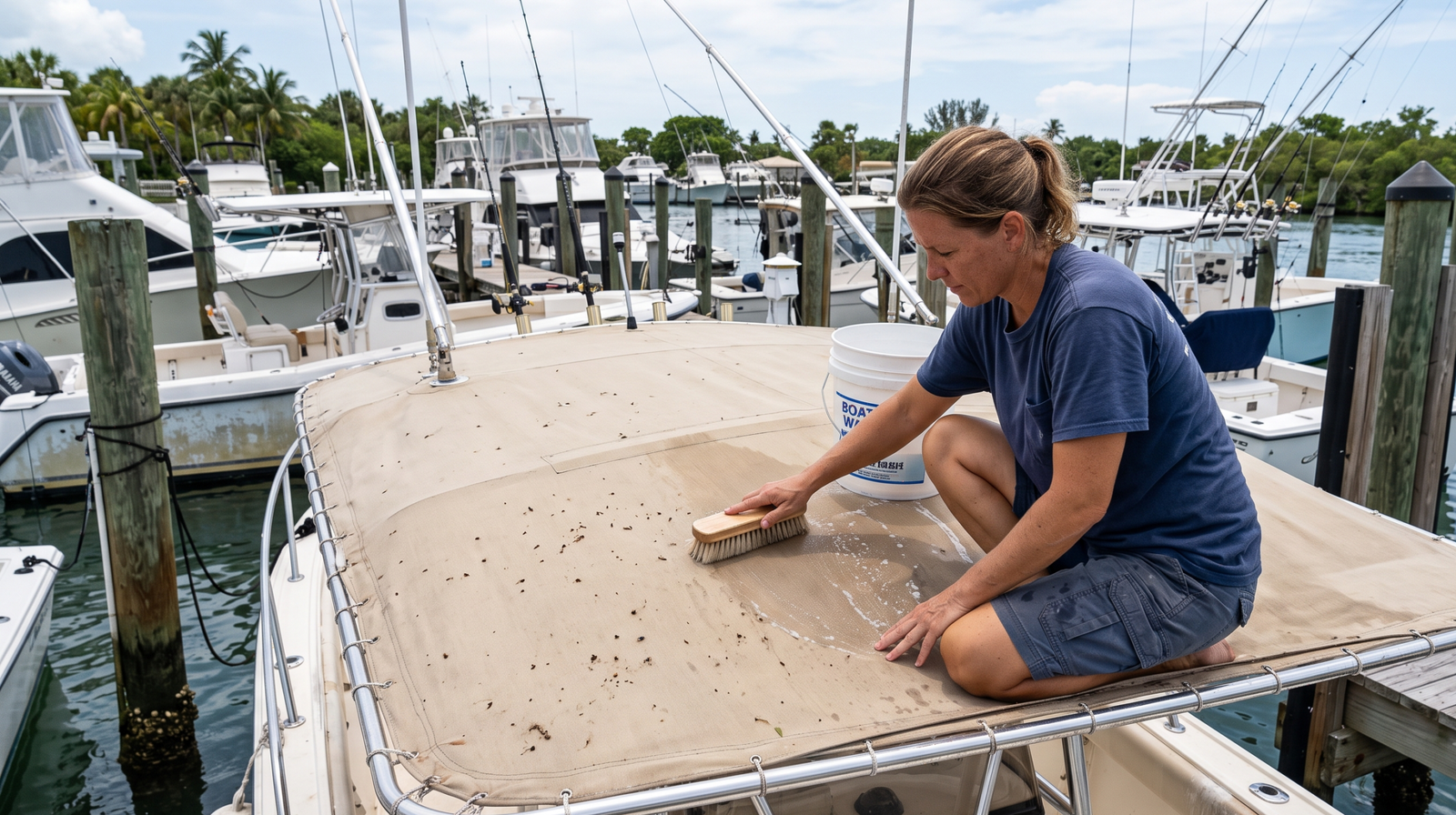
You uncover the boat after a few weeks away and find the bimini covered with spider droppings, bird residue, leaf debris, and dark organic stains. On a South Florida boat, warm temperatures, humidity, salt air, and shaded canvas can turn a few small spots into stubborn stains surprisingly quickly.
Removing spider droppings from boat canvas requires gentle cleaning that lifts the organic residue without unnecessarily damaging the fabric, stitching, coating, or water-repellent finish. The right method depends on the canvas material and the type of stain. For common marine fabrics such as Sunbrella, the manufacturer recommends removing loose debris first, using mild soap and water for routine cleaning, rinsing thoroughly, and allowing the fabric to air dry.
We also need to distinguish fresh organic residue from stains that have been sitting in the fabric for weeks. A fresh deposit is usually much easier to remove than set-in discoloration.
What Causes Spider Droppings and Organic Stains on Boat Canvas?
Spider droppings and other organic stains on boat canvas are usually a mixture of biological residue, dirt, moisture, and environmental debris that becomes embedded in the fabric over time. Spiders are especially common around boats because dock structures, canvas covers, lights, rails, and enclosed spaces provide places for insects and spiders to shelter.
Other common sources include:
- Bird droppings
- Spider droppings
- Leaf and plant debris
- Pollen
- Insect residue
- Food and drink spills
- Roof runoff
- Salt deposits mixed with dirt
- Mildew growing on accumulated organic debris
Sunbrella explains that its fabrics are mold- and mildew-resistant, but mildew can still develop on dirt and other foreign substances left on the fabric. Sunbrella’s marine canvas cleaning instructions recommend regular maintenance to prevent contaminants from becoming deeply embedded.
How to Remove Spider Droppings from Boat Canvas
The safest approach is to start with the least aggressive method and increase cleaning strength only when necessary.
1. Remove Loose Droppings and Debris
Before applying cleaner, remove dry debris from the canvas. Brush away loose material with a soft brush or rinse the surface with clean water.
Do not immediately scrub a dry, crusted deposit aggressively into the fabric. Doing so can spread the residue and grind particles deeper into the weave.
Sunbrella’s standard cleaning procedure begins by brushing off loose dirt and then hosing the fabric with clean water. Sunbrella’s general fabric-cleaning guidance follows the same basic approach.
2. Rinse the Canvas
Use clean water to loosen remaining residue. On a boat, this step is particularly useful because salt, dust, pollen, and organic material often accumulate together.
Let the water do some of the work before reaching for a stronger cleaner.
3. Use Mild Soap and Water
For routine cleaning of Sunbrella marine canvas, the manufacturer recommends a solution of water and mild soap, followed by gentle agitation with a soft-bristle brush and thorough rinsing.
Work in manageable sections instead of allowing dirty cleaning solution to dry across the entire bimini.
After cleaning, rinse until all soap residue has been removed and allow the fabric to air dry. Sunbrella’s marine canvas instructions specifically recommend air drying rather than using aggressive heat.
Removing Bird Droppings and Similar Organic Stains
Spider droppings are not the only organic mess boat owners deal with. Bird droppings, urine, and other biological residues can leave discoloration if they are allowed to sit.
Sunbrella’s cleaning guide lists bird droppings, urine, and vomit together and recommends a mild dishwashing-liquid and white-vinegar solution for those stains. The guide also emphasizes cleaning spills and messes as soon as possible because set-in residue may require more intensive treatment. See the Sunbrella Cleaning Guide for stain-specific recommendations.
For boat owners, the practical lesson is simple: the sooner organic contamination is removed, the less aggressive the cleaning process usually needs to be.
When Organic Stains Become Mildew
A brown or black stain does not automatically mean mildew. Organic residue, dirt, environmental staining, and mildew can look similar from a distance.
Sunbrella states that its fabrics do not themselves promote mildew growth, but mildew can grow on dirt and other foreign substances that remain on the fabric. That makes regular cleaning particularly important on boats that stay covered or sit in humid environments.
If mildew is confirmed and the fabric is compatible with the treatment, Sunbrella provides a stronger cleaning procedure using diluted bleach and mild soap. The manufacturer’s marine canvas instructions specify allowing the solution to soak for up to 15 minutes, gently removing the stain, rinsing thoroughly, and air drying.
Do not assume every marine canvas can safely receive the same bleach treatment. Fabric construction varies, and coated or specialized materials can have different care requirements.
Why You Should Be Careful with Bleach on Boat Canvas
Bleach can be effective against stubborn mildew and organic discoloration on compatible Sunbrella fabrics, but that does not mean it is the correct first choice for every stain or every canvas.
Sunbrella specifically warns that bleach should be used carefully around other fabrics and thoroughly rinsed away. It also advises considering the surrounding environment because bleach can harm natural environments around the boat. Sunbrella’s marine cleaning guidance provides additional precautions.
That matters on a dock. A concentrated cleaning solution running directly into surrounding water is not a responsible substitute for proper stain removal.
Can You Pressure Wash Boat Canvas?
High-pressure washing is generally not the first method we recommend for delicate marine canvas. The goal is to remove contamination without damaging the fabric surface, stitching, seams, coatings, or water-repellent treatment.
A soft brush and appropriate cleaning solution provide much more control than simply blasting the entire bimini with high pressure.
Pressure can also force dirty water into seams and surrounding areas. If the canvas is already weathered, excessive mechanical force can make an existing problem worse.
For a complete exterior cleanup, professional boat wash and detailing services can address the canvas alongside other exterior surfaces rather than treating the bimini as an isolated component.
How to Clean a Sunbrella Bimini Without Damaging It
Sunbrella recommends a straightforward process for general marine canvas cleaning:
- Brush away loose dirt and debris.
- Hose the fabric with clean water.
- Apply mild soap and water or an appropriate fabric cleaner.
- Gently agitate with a soft-bristle brush.
- Allow the solution to work into the fabric.
- Rinse thoroughly.
- Allow the canvas to air dry completely.
Sunbrella’s official marine canvas cleaning instructions recommend this general process for routine cleaning.
For recurring maintenance, Sunbrella also recommends hosing marine canvas regularly with clean water to prevent dirt from becoming deeply embedded. Its marine-care guidance notes that thorough cleaning may only be necessary every few years depending on use and conditions.
What About the Canvas Water-Repellent Finish?
Repeated deep cleaning can affect the water and stain resistance of some marine fabrics.
If your canvas still looks clean but water no longer beads as it used to, the problem may be a worn protective finish rather than dirty fabric.
Sunbrella recommends allowing the fabric to completely air dry before applying an appropriate retreatment product. The manufacturer notes that retreatment may become useful after repeated thorough cleanings or extended exposure.
Do not apply a fabric protector simply because the canvas has been cleaned. First determine whether the fabric actually needs retreatment and follow the manufacturer’s instructions for that specific material.
Common Mistakes When Cleaning Boat Canvas
- Scrubbing dry droppings aggressively into the fabric.
- Using harsh chemicals before trying mild soap and water.
- Leaving cleaning chemicals on the fabric without thorough rinsing.
- Using excessive pressure on old or weathered canvas.
- Assuming every marine canvas has identical cleaning requirements.
- Using bleach near the water without considering environmental effects.
- Allowing wet canvas to remain folded or covered.
- Ignoring organic debris until it becomes a larger mildew problem.
- Failing to test a cleaning product on an inconspicuous area when the manufacturer requires it.
- Cleaning the canvas but ignoring the rest of the boat’s accumulated organic debris.
DIY vs. Professional Boat Canvas Cleaning
Fresh spider droppings and light organic contamination are often manageable with routine care when the fabric manufacturer’s instructions are followed.
Professional cleaning becomes more useful when stains are widespread, heavily set, recurring, or combined with mildew, staining, and years of accumulated marine grime.
Before choosing a treatment, identify the fabric. Sunbrella canvas, acrylic marine fabric, coated canvas, clear vinyl, and other marine textiles can have different cleaning requirements.
Our boat wash and detailing service can be useful when the canvas is part of a broader exterior cleanup. If the boat has also accumulated heavy underwater growth while sitting at the dock, professional hull cleaning can address the underwater portion separately.
For boats that have been sitting for extended periods, an underwater inspection can also reveal problems that are invisible from the dock, including fouling, damaged anodes, and debris around running gear.
How to Prevent Spider Droppings on Boat Canvas
Prevention is easier than repeatedly treating set-in stains.
- Rinse marine canvas regularly with clean water.
- Remove spider webs and loose organic debris promptly.
- Do not leave food residue around covered areas.
- Keep surrounding cockpit and deck areas clean.
- Allow wet canvas to dry properly.
- Address stains before they become embedded.
- Inspect the underside of bimini tops and covers where spiders can shelter.
- Follow the fabric manufacturer’s recommended cleaning schedule.
Sunbrella specifically recommends regular rinsing to prevent dirt from becoming deeply embedded. Its marine canvas care recommendations make routine maintenance a key part of extending fabric performance.
Frequently Asked Questions
How do you remove spider droppings from boat canvas?
Remove loose material first, rinse the canvas with clean water, then use mild soap and water with a soft-bristle brush. Rinse thoroughly and air dry. For Sunbrella fabric, follow the manufacturer’s stain-specific guidance rather than automatically using bleach or aggressive chemicals.
Can vinegar remove bird and spider stains from boat canvas?
For Sunbrella fabric, the manufacturer’s cleaning guide recommends a mild dishwashing-liquid and white-vinegar solution for bird droppings, urine, and vomit. Always verify the fabric type and follow its manufacturer’s care instructions before applying a cleaning solution.
Can I use bleach on Sunbrella boat canvas?
Sunbrella permits diluted bleach solutions for certain stubborn stains and mildew on compatible fabrics. The solution must be used according to the manufacturer’s instructions, followed by thorough rinsing. Bleach should not automatically be used on every marine fabric or every type of stain.
How often should I clean a boat bimini?
Routine rinsing can be performed much more frequently than deep cleaning. Sunbrella recommends hosing marine canvas with clean water monthly to help prevent dirt from becoming embedded. A thorough cleaning schedule depends on the boat’s environment, use, and fabric condition.
Will cleaning remove old organic stains completely?
Not always. Fresh stains are generally easier to remove, while set-in discoloration may remain after cleaning. Sunbrella notes that set-in residue can require professional cleaning. The result also depends on the type of contaminant, how long it has been present, and the condition of the fabric.
How can I protect boat canvas after cleaning?
First allow the fabric to completely air dry. If cleaning has reduced water and stain resistance, use a retreatment product appropriate for the fabric and follow the manufacturer’s instructions. Do not assume every canvas requires retreatment after every routine wash.
For more practical boat-maintenance advice, read our latest marine maintenance and underwater service articles.
Conclusion
Removing spider droppings from boat canvas does not have to mean attacking the fabric with the strongest cleaner available. Start with loose-debris removal, clean water, mild soap, gentle agitation, and thorough rinsing. Escalate treatment only when the fabric and stain require it.
For Sunbrella and other marine fabrics, following the manufacturer’s cleaning instructions is the safest way to preserve the canvas while removing organic stains. Regular rinsing and prompt cleanup also prevent small spider or bird deposits from becoming stubborn, set-in stains.
Ready to protect your vessel?
If you need expert help with this, our team of certified divers and marine technicians is ready to step in. Learn more about our specific services here.
Prefer to speak with an expert immediately? Contact us today to schedule a service or get a free quote!
