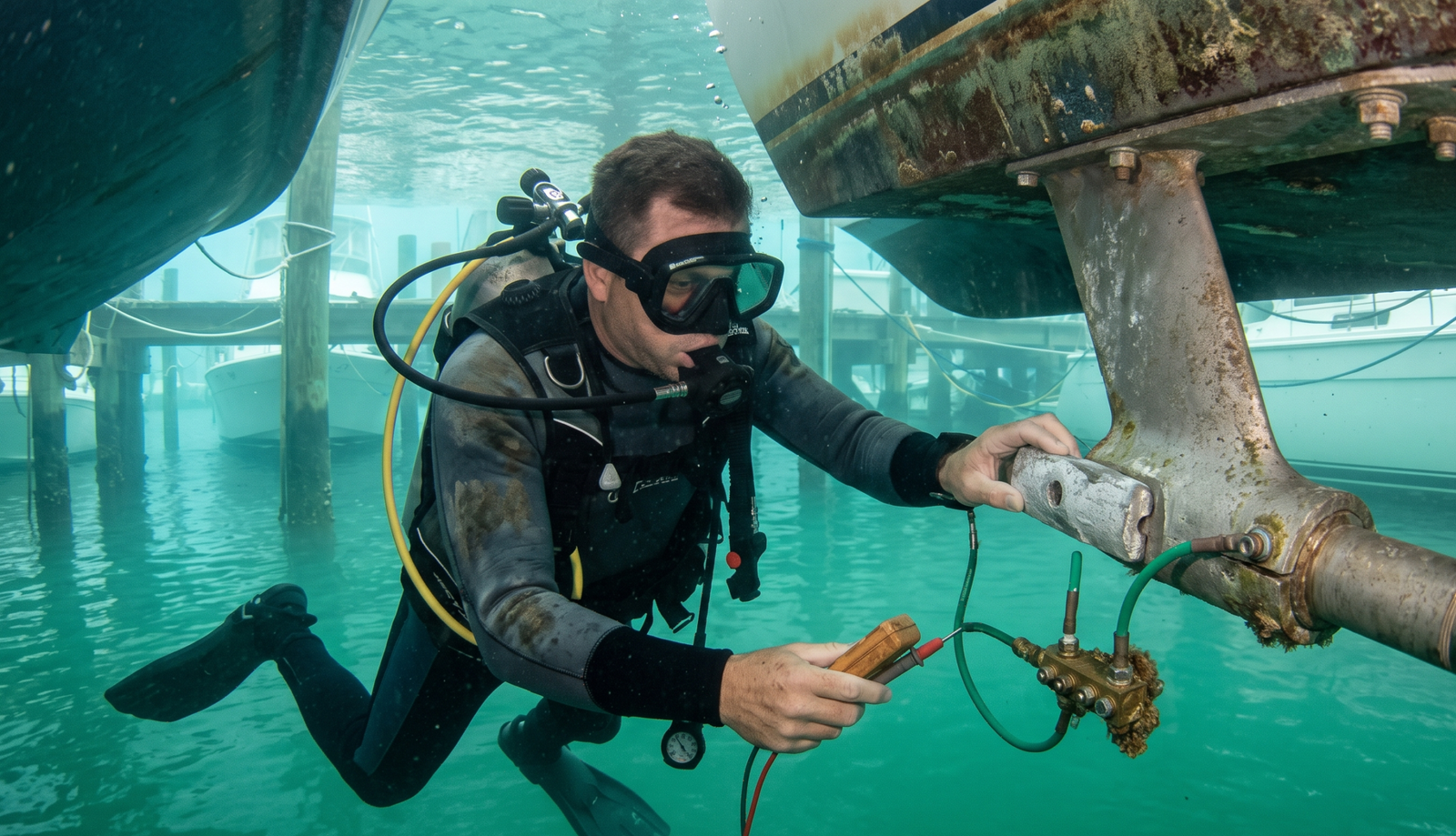
You check your boat’s zincs and something doesn’t look right. One anode is disappearing much faster than it used to, while another underwater component is beginning to show pitting or corrosion. You replace the zinc, but a few weeks later, the same thing happens again.
A boat bonding system failure can be one of the hidden reasons anodes disappear prematurely. The bonding system connects selected underwater metals to the vessel’s cathodic protection system so that sacrificial anodes can protect those components. When a bonding conductor is broken, corroded, poorly connected, or otherwise compromised, the intended protection path may no longer work as designed.
There is another side to the problem, too. A bonding system can also become part of a stray-current corrosion problem if the vessel is exposed to externally sourced DC current. That is why rapid zinc depletion should be treated as a diagnostic warning rather than simply a reminder to install another anode.
What Is a Boat Bonding System?
A boat bonding system is an electrical network that connects designated underwater metal components to a cathodic protection system so the sacrificial anode can provide corrosion protection to those components. ABYC’s current cathodic-bonding guidance explains that underwater metals receiving cathodic protection must be electrically connected to the cathodic protection system, with the required resistance kept within the applicable standard.
The American Boat & Yacht Council identifies cathodic bonding as the electrical interconnection of metal objects in common contact with water, the grounding bus, and the source of cathodic protection. On boats using such a system, that source is typically a sacrificial anode made from zinc, aluminum, or magnesium. ABYC’s cathodic bonding guidance provides additional detail on current requirements and conductor construction. :contentReference[oaicite:0]{index=0}
How a Bonding Wire Failure Can Affect Zinc Depletion
A failed bonding conductor can interrupt the intended electrical path between a protected underwater metal component and the sacrificial anode, leaving that component inadequately protected.
Think of the bonding conductor as part of the protection pathway. The anode can only protect components that are properly connected to the cathodic protection system.
ABYC’s guidance states that metals intended to receive cathodic protection must have a maximum resistance of one ohm to the cathodic bonding system anode. It also specifies marine-suitable bonding conductors, including oil-resistant, insulated, tinned, stranded copper wire or uninsulated copper strip. :contentReference[oaicite:1]{index=1}
That means a wire that looks physically intact can still deserve attention if its terminals, connections, or continuity are compromised.
Signs of Boat Bonding System Failure
There is no single symptom that proves a bonding wire has failed. Instead, we look for patterns that indicate the corrosion-protection system needs investigation.
- One anode wears dramatically faster than expected.
- Anodes show unusual or uneven depletion.
- Underwater metals develop unexpected pitting.
- A protected component appears to be corroding despite having a new anode.
- Bonding wires or terminals show corrosion.
- A bonding connection is loose or physically damaged.
- Continuity between designated underwater components is outside the applicable specification.
- Corrosion accelerates after the boat moves to a different marina.
- Anodes begin disappearing unusually quickly after shore-power connection.
Rapid anode wear is particularly worth investigating. BoatUS notes that unusually fast anode corrosion can indicate a stray-current problem in the boat or marina, while ABYC distinguishes cathodic bonding from other electrical grounding functions. BoatUS’s anode corrosion guidance discusses rapid zinc loss as a warning sign. :contentReference[oaicite:2]{index=2}
Bonding Wire Failure vs. Stray Current Corrosion
Rapid zinc depletion does not automatically mean a bonding wire has failed. Stray-current corrosion, galvanic corrosion, incorrect anode selection, poor anode contact, and marina electrical problems can produce similar symptoms.
This distinction matters because the solutions are very different.
Galvanic corrosion occurs naturally when dissimilar metals are electrically connected while immersed in an electrolyte such as seawater. Stray-current corrosion is driven by an external electrical source and can be substantially more aggressive.
West Marine’s current marine grounding guidance distinguishes these mechanisms and notes that stray DC current can originate from wiring faults, shore-power systems, or nearby equipment. West Marine’s marine grounding overview explains the distinction between galvanic and stray-current corrosion. :contentReference[oaicite:3]{index=3}
How to Test a Boat Bonding System
Testing a bonding system involves checking the electrical continuity and resistance of the intended bonding paths and comparing the results with the applicable vessel, equipment, and industry requirements.
A proper investigation should not consist of simply touching a multimeter to a random piece of metal and declaring the system good.
1. Establish What Is Supposed to Be Bonded
Start with the vessel’s wiring diagrams, equipment documentation, and applicable standards.
Not every piece of underwater metal should automatically be connected simply because it is made of metal. ABYC’s current cathodic-bonding guidance specifically describes requirements for components that are intended to receive cathodic protection. :contentReference[oaicite:4]{index=4}
2. Inspect the Bonding Conductors
Look for:
- Broken wires
- Loose terminals
- Corroded terminals
- Damaged insulation
- Improper splices
- Missing connections
- Evidence of overheating
- Connections contaminated by corrosion or moisture
ABYC identifies tinned, stranded copper conductors as an acceptable material for wire-based cathodic bonding and specifies minimum conductor requirements. :contentReference[oaicite:5]{index=5}
3. Check Continuity
A qualified technician can test the continuity between the relevant underwater components and the cathodic protection system.
The purpose is to determine whether the intended electrical path actually exists and whether its resistance is within the applicable requirement.
Do not confuse a continuity test with a complete corrosion diagnosis. A bonding circuit can test correctly while the vessel is still experiencing stray-current corrosion from another source.
4. Inspect the Anodes
Examine the anode itself and the area where it attaches to the protected structure.
Anodes require good electrical contact with the metal they are intended to protect. BoatUS recommends that the attachment surface be clean and unpainted and that the fasteners provide effective electrical contact. BoatUS’s corrosion-protection guidance covers anode contact and replacement considerations. :contentReference[oaicite:6]{index=6}
5. Inspect the Underwater Metal
After checking the electrical side, inspect the actual underwater components.
Look at:
- Through-hulls
- Propellers
- Shafts
- Rudders
- Trim tabs
- Outdrives
- Struts
- Seacocks
- Other bonded underwater fittings
Our underwater inspection services can help identify visible corrosion, anode condition, fouling, and underwater component problems without waiting for the next haul-out.
Why a New Zinc May Not Solve the Problem
You can replace a zinc that is disappearing quickly, but that only replaces the sacrificial material. It does not identify why the anode is being consumed so rapidly.
If a new anode starts disappearing unusually fast, replacing it repeatedly without diagnosing the electrical environment can allow the underlying corrosion problem to continue.
West Marine explains that sacrificial anodes are designed to corrode preferentially and protect more valuable underwater metals. But the same source also distinguishes normal galvanic protection from externally driven stray-current corrosion. :contentReference[oaicite:7]{index=7}
In other words, “I just replaced the zinc” is not the same as “the corrosion problem is fixed.”
Bonding Wires and Galvanic Corrosion
Bonding can help an installed cathodic protection system distribute protection to connected underwater metals. But bonding also changes the electrical relationships among the connected components.
That is why bonding should be designed and maintained as a complete system rather than adding wires between underwater metals without understanding the vessel’s corrosion-control arrangement.
ABYC’s current guidance explains that underwater components protected by a cathodic protection system are to be wired in parallel to the cathodic bonding system, while bonding buses themselves may be connected in series. :contentReference[oaicite:8]{index=8}
For that reason, random “grounding” modifications can create more problems than they solve.
Bonding System Failure and Hot Marinas
A boat that behaves normally in one location may suddenly begin consuming anodes rapidly after moving to another marina.
A sudden change in zinc depletion after relocating can be a reason to investigate the marina’s electrical environment, not simply replace the anodes more frequently.
West Marine describes a “hot marina” as an environment where measurable DC current is present in the water and explains that stray current can come from wiring faults, shore-power systems, industrial facilities, or other sources. :contentReference[oaicite:9]{index=9}
This is especially concerning because stray-current corrosion can progress much faster than ordinary galvanic corrosion.
If you suspect the marina environment, avoid making random changes to the vessel’s bonding system. A qualified marine electrician or corrosion specialist should investigate the source and determine the appropriate isolation and protection strategy.
Bonding Systems and Shore Power
Shore power introduces another layer of electrical complexity because the vessel becomes electrically connected to equipment and grounding systems outside the boat.
ABYC recognizes galvanic isolators as a separate standard area under A-28, while E-2 covers cathodic protection. ABYC’s current standards list identifies both A-28 Galvanic Isolators and E-2 Cathodic Protection Systems among its standards. :contentReference[oaicite:10]{index=10}
Do not assume a bonding wire repair, galvanic isolator, or anode replacement can independently solve every corrosion problem. The vessel’s complete electrical and cathodic-protection arrangement needs to be considered.
When Rapid Zinc Wear Requires Professional Investigation
Some anode wear is normal. A sudden or dramatic change is different.
Consider professional corrosion testing when:
- Anodes disappear much faster than their previous service life.
- Different underwater metals begin corroding unexpectedly.
- Corrosion appears shortly after moving to a new marina.
- A new anode provides little apparent improvement.
- Bonding conductors show visible corrosion or damage.
- There is suspected shore-power leakage.
- Aluminum underwater components begin pitting.
- Corrosion appears on components that previously remained stable.
ABYC’s marine corrosion program specifically covers galvanic corrosion, stray-current corrosion, shore-power systems, cathodic protection, and conducting corrosion surveys. ABYC’s Marine Corrosion Certification information provides an overview of these areas. :contentReference[oaicite:11]{index=11}
Common Boat Bonding Mistakes
- Replacing rapidly consumed zincs without investigating the cause.
- Assuming every underwater metal component should be bonded.
- Using unsuitable wire or hardware in a marine bonding system.
- Painting the contact surface between an anode and protected metal.
- Ignoring corroded bonding terminals.
- Assuming continuity alone proves the entire corrosion system is healthy.
- Confusing galvanic corrosion with stray-current corrosion.
- Ignoring the effect of a new marina or shore-power connection.
- Adding bonding wires without following the vessel’s design and applicable standards.
- Waiting until expensive underwater components show visible damage.
DIY vs. Professional Boat Bonding Testing
A basic visual inspection can reveal a broken wire or badly corroded terminal, but a complete corrosion investigation is more involved.
If rapid zinc depletion is accompanied by unexplained underwater corrosion, professional testing is the safer approach because the problem may involve bonding continuity, anode contact, galvanic couples, stray current, shore power, or the marina electrical environment.
Our zinc replacement and anode service can address the sacrificial-protection side of the problem, while an underwater inspection can document the condition of the components being protected.
If corrosion is discovered alongside significant marine growth, combining the inspection with professional underwater hull cleaning can make the condition of underwater metals easier to evaluate.
For more complex electrical corrosion problems, work with a qualified marine electrician or corrosion professional familiar with the vessel’s electrical architecture and applicable standards.
Frequently Asked Questions
What causes rapid zinc depletion on a boat?
Rapid zinc depletion can result from normal galvanic activity, stray electrical current, incorrect anode selection, poor electrical contact, bonding-system problems, or a combination of factors. A sudden change in anode consumption should be investigated rather than assuming the boat simply needs larger or more frequent zinc replacements.
Can a broken bonding wire cause corrosion?
Yes. If a bonding conductor is part of the cathodic protection path for a particular underwater component, a broken or high-resistance connection can prevent that component from receiving the intended protection from the sacrificial anode. The actual effect depends on the vessel’s bonding design and the component involved.
How do you test a boat bonding system?
A qualified technician identifies the components intended to be bonded, inspects conductors and connections, measures continuity and resistance along the intended bonding paths, checks anode connections, and inspects the underwater metals. Testing should be interpreted against the vessel’s design and applicable marine electrical and cathodic-protection requirements.
Can a bonding system cause zincs to wear faster?
Bonding itself is not automatically a cause of abnormal zinc consumption. A properly designed cathodic-protection system uses anodes to protect connected underwater metals. However, external stray current or an improperly configured electrical system can dramatically increase anode consumption, which is why unusually rapid wear deserves diagnosis.
Should all underwater metals on a boat be bonded together?
No. Do not assume that every underwater metal component should be bonded simply because it is submerged. The bonding arrangement should follow the vessel’s design, equipment requirements, and applicable standards. ABYC’s cathodic-bonding guidance specifically addresses which components are intended to receive protection and how they should be connected.
When should I replace a boat’s zinc anodes?
Anode replacement depends on the vessel, anode material, water conditions, corrosion environment, and manufacturer’s recommendations. BoatUS notes that anodes should generally be replaced when approximately half consumed, but unusually rapid depletion should prompt investigation for stray-current or other corrosion problems rather than simply shortening the replacement interval.
For more practical marine maintenance information, read our latest underwater service and boat maintenance articles.
Conclusion
Boat bonding system failure can remain hidden until anodes begin disappearing faster than expected or underwater metals start showing corrosion. The right response is not simply to install another zinc. Check the bonding path, anode connection, protected components, and the vessel’s electrical environment.
Rapid zinc depletion can have several causes, including galvanic activity and stray-current corrosion. A proper diagnosis separates those problems and identifies whether the bonding system is actually providing the protection it was designed to provide.
Ready to protect your vessel?
If you need expert help with this, our team of certified divers and marine technicians is ready to step in. Learn more about our specific services here.
Prefer to speak with an expert immediately? Contact us today to schedule a service or get a free quote!
