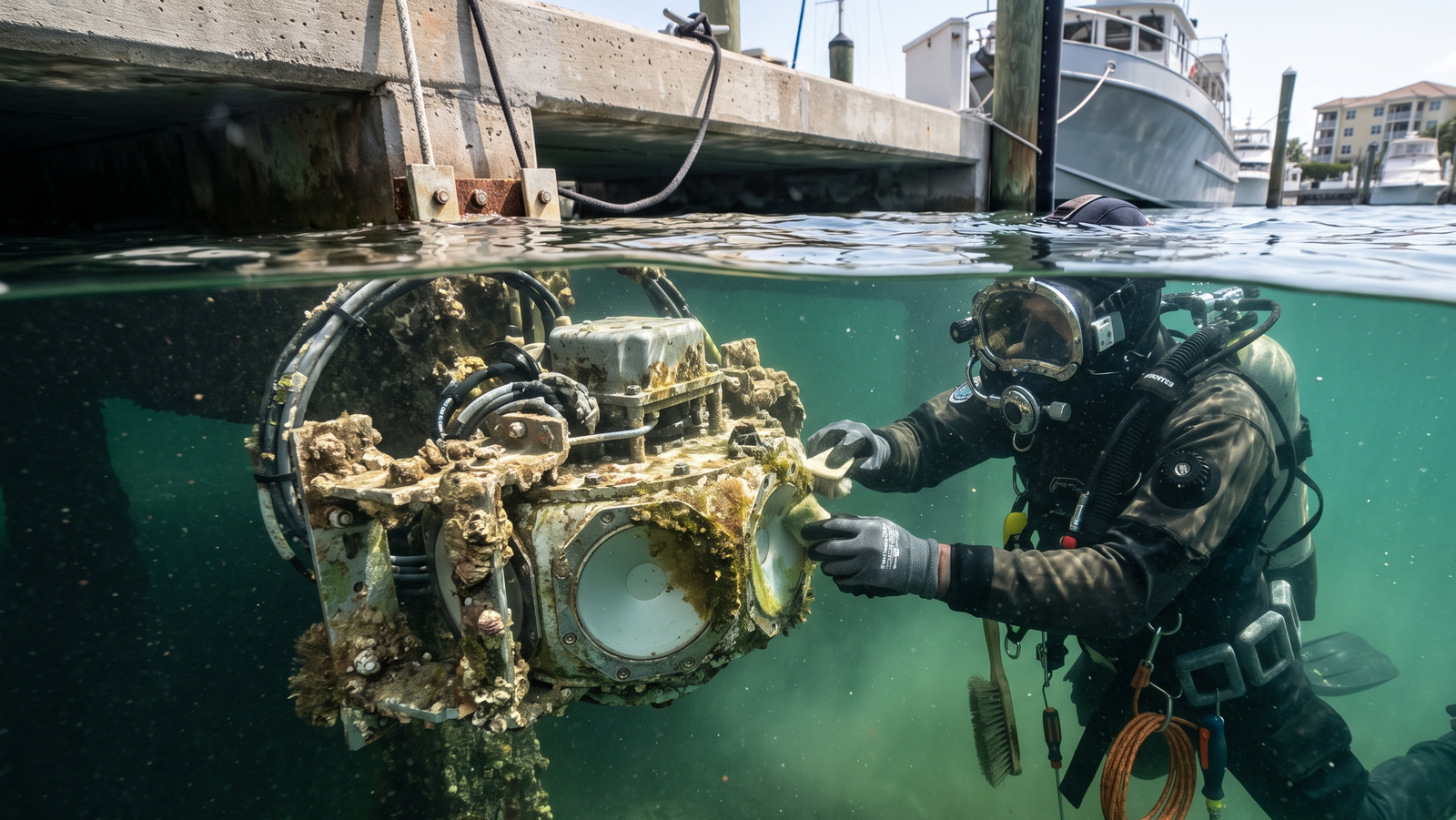
When an oceanographic instrument has been sitting underwater for weeks or months, marine growth is rarely just a cosmetic problem. Barnacles, algae, slime, tube worms, and other organisms can accumulate around sensor faces, housings, brackets, cables, and other exposed components. For research teams and offshore operators, subsea sensor cleaning must remove fouling without compromising the equipment that is there to collect accurate data.
This is where controlled underwater cavitation cleaning can become useful. Instead of treating a scientific instrument like a boat hull or propeller, the cleaning process has to account for sensitive transducers, optical windows, pressure ports, connectors, coatings, and calibration requirements.
That distinction matters. An Acoustic Doppler Current Profiler (ADCP), for example, uses acoustic transducers to measure water movement. NOAA explains how ADCPs use sound waves and the Doppler effect to measure current speed and direction. If fouling interferes with the instrument’s sensing surfaces, cleaning becomes part of protecting the quality of the measurements.
What Is Subsea Sensor Cleaning?
Subsea sensor cleaning is the controlled removal of marine fouling, sediment, debris, and other contamination from underwater scientific instruments while protecting sensitive sensing surfaces and maintaining the equipment’s intended operation.
Unlike conventional hull cleaning, the objective is not simply to remove as much growth as possible. A scientific instrument can contain delicate components that require careful handling and cleaning methods appropriate to the manufacturer’s specifications.
NOAA ocean-observing programs use a wide range of submerged instruments for temperature, conductivity, pressure, current, and other measurements. Their sensor inventories include acoustic Doppler instruments alongside conventional physical and chemical sensors. NOAA’s Ocean Climate Stations sensor specifications illustrate how varied these underwater systems can be.
Why Oceanographic Instrument Fouling Is a Serious Problem
Biofouling begins quickly after an object is placed in seawater. Over time, a thin biological film can develop into heavier growth, including algae, barnacles, tube worms, and other organisms.
The International Maritime Organization describes biofouling as the accumulation of aquatic organisms on submerged surfaces and recognizes it as both an operational and environmental concern. Its 2023 Biofouling Guidelines address the management of fouling and the risk of transferring invasive aquatic species.
For scientific instruments, the problem can be more specific. Fouling may:
- Obstruct acoustic transducer faces.
- Cover optical windows or sensor openings.
- Block small pressure ports.
- Change the exposure of a temperature or conductivity sensor to seawater.
- Increase the physical load on brackets and mounting hardware.
- Interfere with moving or exposed components.
- Make inspection and troubleshooting more difficult.
- Contribute to declining instrument performance over long deployments.
Manufacturer documentation demonstrates why this needs to be taken seriously. Teledyne RD Instruments’ H-ADCP manual notes that biofouling can affect transducer faces and that barnacles can damage the transducer face and contribute to instrument failure.
Why Cavitation Cleaning Requires a Different Approach for Scientific Equipment
Cavitation cleaning uses controlled water pressure to create and collapse microscopic bubbles at or near a surface. The resulting energy can help loosen marine growth and deposits.
That does not mean every subsea sensor should automatically be treated with high-intensity cavitation.
For scientific equipment, cavitation cleaning should be controlled around sensitive components, with the cleaning intensity and technique selected according to the instrument, fouling condition, and manufacturer’s limitations.
A propeller can tolerate a cleaning approach that would be inappropriate for an acoustic transducer, optical sensor, exposed diaphragm, cable termination, or precision pressure port.
The technician’s job is therefore not just to remove fouling. It is to understand where cleaning energy can safely be applied and where it should be reduced or avoided.
Which Subsea Equipment May Require Cleaning?
ADCPs and Acoustic Current Sensors
Acoustic Doppler Current Profilers are among the most recognizable scientific instruments affected by underwater fouling. They use acoustic transducers to send and receive sound signals through the water column.
NOAA describes ADCPs as instruments that can be installed on moorings, the seafloor, vessels, and underwater vehicles. Their transducers are therefore exposed to very different deployment environments. NOAA’s current-profiler overview provides further background on their operation.
Fouling on a transducer face can interfere with the instrument’s acoustic performance. Nortek has also documented biofouling on deployed ADCPs and notes that minimizing time spent cleaning around transducers is desirable because they are valuable instrument components. Nortek’s ADCP biofouling field report provides a practical example.
Optical and Water-Quality Sensors
Optical sensors can be particularly vulnerable to surface contamination. A layer of biological growth or sediment across an optical window can change what the instrument sees.
Cleaning may therefore involve much more care than removing visible barnacles. The technician must avoid scratching or damaging the optical surface while ensuring that fouling is actually removed.
Temperature, Conductivity, and Pressure Sensors
Subsea monitoring systems often combine several sensor types in a single deployment. Conductivity cells, temperature probes, pressure transducers, and other components may all have different maintenance requirements.
Small openings deserve particular attention. Teledyne’s H-ADCP documentation, for example, specifically discusses cleaning a pressure-sensor port and warns that the pressure-sensing diaphragm can be easily damaged.
That is why generic underwater cleaning methods should never be applied blindly to scientific equipment.
How a Professional Delicate Marine Cleaning Operation Should Work
1. Identify the Instrument Before Cleaning
Before a diver touches the equipment, the team should identify the instrument and understand its exposed components.
This includes determining:
- Manufacturer and model.
- Location of acoustic transducers.
- Optical windows and sensing surfaces.
- Pressure ports.
- Connectors and cable penetrators.
- Antifouling treatments.
- Mounting brackets.
- Areas where direct cleaning should be avoided.
2. Photograph and Document the Condition
Photographs provide a useful record of the instrument’s condition before cleaning.
Documenting fouling also helps research teams compare conditions between deployments. If a sensor is producing unusual data, the maintenance record can help establish whether significant biological growth was present.
3. Classify the Fouling
Not every deposit requires the same cleaning technique.
Soft slime and light biological films are very different from mature barnacles or thick calcareous growth. Sediment accumulation may also require a different approach from biological fouling.
The goal is controlled removal rather than maximum cleaning force.
4. Apply Cavitation Selectively
Where appropriate, cavitation can be used on suitable surfaces to loosen established marine growth while keeping the cleaning operation underwater.
For delicate instruments, the diver should work deliberately around sensitive components rather than directing aggressive cleaning energy indiscriminately across the entire assembly.
Sensor faces, seals, cable connections, pressure ports, and other vulnerable components should receive special consideration before cavitation is applied.
5. Hand-Finish Sensitive Areas
Some parts of an instrument may be better suited to controlled manual cleaning than cavitation.
A professional operation can use a combination of techniques depending on the equipment and fouling. The objective is to leave the sensing surfaces clean without creating a new problem through excessive mechanical contact.
6. Inspect and Verify After Cleaning
After cleaning, the diver should inspect the equipment again for remaining fouling, physical damage, loose hardware, cable problems, or other visible issues.
Where the operator’s procedures call for it, functional checks or post-maintenance data review should be completed by the scientific or technical team.
Delicate Marine Cleaning Is Not the Same as Hull Cleaning
One of the most common mistakes is treating every underwater surface as if it were a boat hull.
A hull coating is designed to withstand the marine environment and routine maintenance. A scientific instrument may have acoustic transducer faces, optical windows, exposed diaphragms, precision ports, or specialized coatings.
The correct cleaning method depends on the component, not simply on how heavy the fouling looks.
For vessel surfaces where conventional underwater cleaning is appropriate, professional hull cleaning in South Florida is a separate service from delicate scientific-equipment maintenance.
When Cavitation Cleaning Makes Sense
Cavitation cleaning can be useful when underwater equipment has accumulated stubborn fouling that cannot be removed efficiently through gentle manual cleaning alone.
It may be considered for suitable external surfaces such as:
- Instrument mounting structures.
- Heavy fouling around non-sensitive brackets.
- Appropriate external housings.
- Subsea structures surrounding scientific instruments.
- Other compatible underwater surfaces.
However, the presence of cavitation equipment does not mean the entire instrument should be subjected to the same treatment.
For delicate marine cleaning, controlled application is more valuable than maximum cleaning power.
Our cavitation cleaning service can be considered where the underwater surface and equipment are compatible with this type of cleaning.
Biofouling, Data Quality, and Maintenance Intervals
Scientific equipment is often deployed for long periods because researchers need continuous or repeated measurements. That creates a maintenance challenge: cleaning too frequently can be expensive and disruptive, while waiting too long can allow fouling to interfere with the instrument.
There is no universal cleaning interval for every sensor.
Deployment depth, water temperature, location, season, nutrient levels, instrument design, antifouling measures, and deployment duration can all influence fouling.
Nortek’s documentation notes that biological growth on current profilers can gradually reduce profiling range and that long-term trends in amplitude data can help monitor fouling. That makes the instrument’s own data useful as part of a maintenance strategy.
The best maintenance program combines physical inspection, cleaning records, instrument data, and manufacturer guidance rather than relying on an arbitrary calendar interval.
Environmental Considerations for In-Water Cleaning
Cleaning underwater equipment also raises an environmental question: where does the removed biological material go?
This matters because fouling organisms can potentially be transported between marine environments. The IMO identifies biofouling as a pathway for invasive aquatic species and has developed global guidance to improve its management.
Its more recent guidance also recognizes that in-water cleaning needs to address environmental risks associated with removed fouling, coatings, and other materials. IMO’s PPR 12 summary discusses guidance for safe planning and execution of in-water cleaning.
For scientific deployments that move between regions, operators should consider local environmental requirements and any restrictions on in-water cleaning or disposal of removed material.
Common Mistakes When Cleaning Subsea Sensors
- Using the same cleaning pressure on every component.
- Scraping directly across an acoustic transducer face.
- Using abrasive tools on optical windows.
- Ignoring small pressure ports.
- Cleaning without identifying the instrument model.
- Forgetting to photograph the equipment before maintenance.
- Removing protective antifouling materials without understanding their purpose.
- Assuming visible cleanliness means the sensor is functioning correctly.
- Ignoring cables, connectors, brackets, and mounting hardware.
- Failing to document the condition after cleaning.
DIY vs. Professional Subsea Sensor Cleaning
For basic recreational equipment, an owner may be comfortable handling routine underwater cleaning. Scientific instruments are different.
An oceanographic sensor can represent a significant investment, and its measurements may support research, navigation, environmental monitoring, engineering decisions, or long-term datasets.
If the consequences of damaging the sensing surface are greater than the cost of professional underwater maintenance, professional cleaning is the safer choice.
A qualified underwater team can work around the instrument while also inspecting adjacent infrastructure. If the sensor is mounted to a vessel or marine structure, an underwater inspection can provide a broader assessment of the installation.
If the equipment is mounted near a piling or marine support structure, piling cleaning and inspection services may also be relevant to the surrounding structure.
Frequently Asked Questions
What is subsea sensor cleaning?
Subsea sensor cleaning is the controlled removal of marine growth, sediment, and debris from underwater scientific instruments while protecting their sensitive sensing components. Unlike routine hull cleaning, the process must account for transducers, optical surfaces, pressure ports, connectors, coatings, and manufacturer-specific maintenance requirements.
Can cavitation be used to clean ADCPs?
Cavitation may be suitable for selected external areas of an ADCP installation, but it should not automatically be directed at every instrument component. Acoustic transducer faces and other sensitive surfaces require careful treatment based on the manufacturer’s instructions and the condition of the equipment.
How does biofouling affect oceanographic instruments?
Biofouling can cover sensing surfaces, obstruct openings, reduce acoustic performance, interfere with measurements, and increase the risk of component damage. The exact effect depends on the instrument type and where growth develops. Long-term deployments generally require a planned approach to fouling monitoring and maintenance.
What is an ADCP?
An Acoustic Doppler Current Profiler, or ADCP, is an instrument that uses acoustic signals and the Doppler effect to measure water-current speed and direction. ADCPs can be installed on vessels, moorings, underwater vehicles, and seafloor platforms, making them useful for many oceanographic applications.
Can barnacles damage subsea sensors?
Yes. Barnacles and other hard fouling can physically interfere with exposed sensor surfaces and, on some instruments, contribute to component damage. Teledyne RD Instruments specifically warns that barnacles can damage the urethane transducer face on certain H-ADCP systems, which demonstrates why fouling should not be ignored during long deployments.
How often should scientific equipment be cleaned underwater?
There is no single cleaning schedule for all subsea instruments. The appropriate interval depends on the deployment environment, instrument design, fouling rate, antifouling measures, deployment duration, and manufacturer guidance. Physical inspections and instrument performance data can help establish a sensible maintenance interval.
For more practical marine maintenance guidance and underwater-service insights, explore our latest marine maintenance stories and articles.
Conclusion
Subsea sensor cleaning requires a much more careful approach than ordinary underwater surface cleaning. Scientific instruments are built to measure the marine environment, but they are also exposed to the same fouling organisms that affect boats, offshore structures, and other submerged equipment.
Cavitation can be a valuable cleaning method for compatible surfaces, particularly when heavy fouling has accumulated. The key is controlled application. Sensitive transducers, optical surfaces, pressure ports, cables, seals, and other components should be treated according to their specific requirements rather than exposed to unnecessary cleaning force.
With proper inspection, documentation, manufacturer guidance, and condition-based maintenance, underwater teams can help keep oceanographic instruments clean while reducing the risk of turning a routine cleaning job into an expensive equipment problem.
Ready to protect your vessel?
If you need expert help with this, our team of certified divers and marine technicians is ready to step in. Learn more about our specific services here.
Prefer to speak with an expert immediately? Contact us today to schedule a service or get a free quote!
