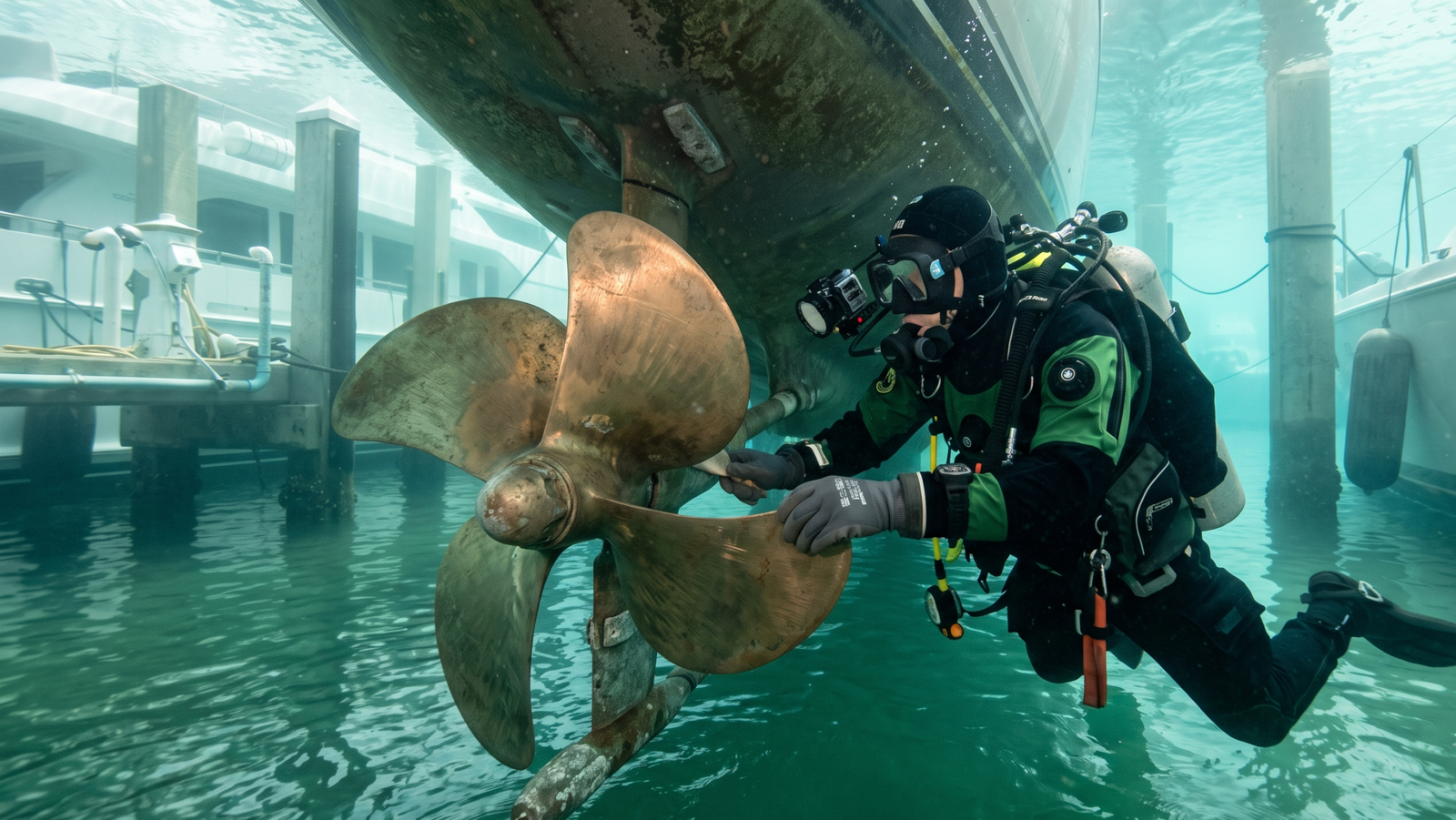
When a superyacht is moving through South Florida waters, the propellers are doing some of the hardest work beneath the surface. Yet they are also exposed to everything the water carries: marine growth, barnacles, slime, sediment, corrosion products, fishing line, and other debris.
Superyacht propeller polishing is more than a cosmetic service. Properly maintained propellers and running gear can help preserve the smooth underwater surfaces that support efficient propulsion and reduce unnecessary roughness caused by fouling and deposits.
For large yachts operating around Miami, Fort Lauderdale, Palm Beach, and the surrounding South Florida waterways, professional underwater prop cleaning can be an important part of routine running-gear maintenance. The objective is not simply to make bronze propellers look bright. It is to inspect, clean, and polish the underwater running gear carefully without damaging the propeller surface or nearby components.
Why Superyacht Propeller Polishing Matters
Propellers operate in a demanding environment. Unlike a hull, a propeller is constantly exposed to high-speed water flow, pressure changes, and the effects of cavitation. Even relatively small amounts of marine growth or surface roughness can affect the way water flows across the blades.
A clean, properly maintained propeller provides a better surface for water to flow across than one covered with hard fouling, slime, corrosion products, or other deposits.
For a superyacht, that matters because the underwater running gear represents a critical part of the vessel’s propulsion system. Propellers, shafts, struts, rudders, and related components all need to work together correctly.
Regular underwater inspections can also identify problems before they become expensive repairs. Our underwater inspection services can help document the condition of running gear while the yacht remains in the water.
What Is Superyacht Propeller Polishing?
Superyacht propeller polishing is the controlled removal of marine growth, deposits, staining, and surface roughness from a yacht propeller to restore a smoother underwater surface.
Professional polishing is different from simply scrubbing a propeller until it looks clean.
The technician needs to understand the propeller material, blade condition, fouling level, and surrounding running gear before choosing an appropriate cleaning and polishing approach.
Bronze propellers are common on larger vessels, but different propeller alloys and finishes can require different treatment. The objective should always be to remove unwanted material without unnecessarily altering the propeller surface.
Why Bronze Propellers Develop Fouling and Deposits
South Florida provides a particularly active marine environment for underwater growth. Warm water, sunlight, nutrients, marina structures, and long periods of vessel inactivity can contribute to fouling.
A propeller can develop:
- Slime
- Algae
- Barnacles
- Tube worms
- Shell growth
- Marine staining
- Oxidation products
- Debris accumulation
- Fishing line or rope
Even when the hull looks relatively clean, the propeller can carry a layer of fouling that is difficult to see from the dock.
This is one reason an underwater inspection should include the complete running gear rather than stopping at the hull.
How Marine Growth Affects a Yacht Propeller
Marine growth increases surface roughness and can interfere with the propeller’s intended hydrodynamic profile.
Hard growth can also become firmly attached to blade surfaces. As it accumulates, the propeller becomes less uniform and the water flow around the blades can become more disturbed.
Heavy fouling can contribute to reduced propulsion efficiency, increased vibration, and altered propeller performance.
These symptoms can have other causes, however. A vibration problem should not automatically be blamed on fouling. Bent blades, damaged shafts, alignment problems, bearing issues, and other mechanical conditions may require separate investigation.
The Superyacht Propeller Polishing Process
1. Inspect the Propeller Before Cleaning
The first step is determining the actual condition of the propeller.
The diver checks for:
- Marine growth
- Blade damage
- Nicks
- Corrosion
- Fishing line
- Rope or debris
- Unusual surface discoloration
- Visible distortion
- Condition of the hub
- Condition of nearby shaft and strut components
Polishing should never be used to hide a mechanical problem.
If a blade appears damaged or distorted, the appropriate next step may be a specialist propeller inspection rather than simply continuing with polishing.
2. Remove Loose Marine Growth
Loose slime, algae, and other surface growth can usually be removed before more detailed polishing begins.
This initial stage allows the technician to see the actual propeller surface instead of working through a layer of marine growth.
3. Remove Established Hard Fouling
Barnacles and other calcareous growth may require controlled mechanical removal or an appropriate underwater cleaning technology.
The goal is to remove the growth without gouging, aggressively abrading, or unnecessarily altering the propeller surface.
For suitable marine applications, underwater cavitation cleaning may provide an option for removing stubborn fouling while reducing direct mechanical contact.
4. Polish the Propeller Surface
Once the fouling has been removed, the propeller can be polished using a controlled process appropriate for the propeller material and condition.
The technician works across the blade surfaces and hub, paying attention to areas where deposits remain.
Professional polishing should produce a consistently clean and smooth surface rather than an artificially mirror-like finish at the expense of the propeller’s geometry.
5. Inspect the Running Gear Again
After polishing, the propeller and surrounding hardware should be inspected again.
This second look can reveal problems that were hidden underneath marine growth, including:
- Blade nicks
- Corrosion
- Fishing line
- Damaged hardware
- Abnormal wear
- Anode depletion
- Growth around the shaft or strut
This is one of the major advantages of combining propeller maintenance with an underwater running-gear inspection.
Propeller Polishing vs. Propeller Cleaning
The two terms are sometimes used interchangeably, but they describe different levels of maintenance.
| Service | Primary Objective | Typical Condition |
|---|---|---|
| Propeller cleaning | Remove slime, algae, and marine growth | Light to moderate fouling |
| Hard-fouling removal | Remove barnacles and calcareous deposits | Established hard growth |
| Propeller polishing | Improve and maintain the propeller surface | Cleaned propeller requiring surface treatment |
| Propeller repair | Correct physical or mechanical damage | Bent, damaged, or otherwise defective propeller |
Polishing cannot correct a bent blade, damaged hub, incorrect pitch, or shaft problem. Those conditions require specialized mechanical or propeller services.
How Often Should a Superyacht Propeller Be Polished?
There is no single polishing interval that applies to every superyacht.
Maintenance frequency depends on:
- Water temperature
- Marina location
- Fouling pressure
- Vessel usage
- Propeller material
- Time spent stationary
- Previous polishing
- Antifouling and underwater coating systems
- Operating profile
High-use yachts and vessels operating in warm South Florida waters may benefit from more frequent underwater inspections than vessels that regularly leave the water.
Condition-based maintenance is generally more useful than choosing an arbitrary polishing schedule. A diver can document the actual propeller condition and recommend cleaning when the running gear begins accumulating significant fouling.
Miami Superyacht Maintenance and Running Gear
Miami and the wider South Florida region have a large concentration of yachts that remain in the water for extended periods. That makes underwater running-gear maintenance an important part of yacht care.
For a superyacht, a running-gear inspection should extend beyond the propellers.
Depending on the vessel, the inspection may include:
- Propellers
- Shafts
- Struts
- Rudders
- Stabilizer fins
- Trim tabs
- Thruster tunnels
- Underwater anodes
- Through-hulls
- Intake grates
Our yacht underwater services can be incorporated into a broader maintenance program for vessels operating throughout South Florida.
Propeller Polishing and Anodes
Propeller maintenance should also include checking nearby sacrificial anodes.
Propellers and shafts are among the underwater components that can require cathodic protection. Anodes gradually sacrifice themselves to help protect more valuable underwater metals.
If an anode is heavily depleted, loose, poorly connected, or missing, polishing the propeller does not solve the underlying corrosion-protection problem.
During an underwater inspection, the condition of the anodes should therefore be documented alongside the propeller.
If replacement is required, our South Florida zinc replacement service can address depleted sacrificial anodes.
Why Fishing Line Around a Superyacht Propeller Is a Serious Problem
South Florida’s busy waterways expose yachts to fishing line, rope, and other floating debris.
A line wrapped around a propeller shaft can become tightly wound and difficult to see from the surface. Depending on the situation, it can damage shaft seals, create resistance, or contribute to mechanical problems.
If a yacht develops unexplained vibration or propulsion changes, an underwater inspection can help determine whether fouling or debris is involved.
Removing line should be treated as a separate underwater maintenance task rather than simply polishing over it.
Can Cavitation Cleaning Replace Propeller Polishing?
Not necessarily.
Cavitation cleaning and polishing can serve different purposes. Cavitation can help remove stubborn marine growth from suitable underwater surfaces, while polishing addresses the condition and smoothness of the propeller after fouling has been removed.
A combined cleaning and polishing program may be appropriate when a propeller has significant hard fouling, but the correct sequence depends on the propeller condition and material.
Not every propeller requires cavitation cleaning, and not every propeller requires polishing during every underwater maintenance visit.
Common Superyacht Propeller Maintenance Mistakes
- Waiting until heavy barnacle growth covers the propeller.
- Assuming a clean hull means clean running gear.
- Using aggressive tools that unnecessarily damage the propeller surface.
- Polishing without inspecting the propeller for physical damage.
- Ignoring fishing line around the shaft.
- Failing to check nearby anodes.
- Ignoring unusual vibration after cleaning.
- Assuming polishing can correct bent or damaged blades.
- Cleaning the propeller while overlooking the shaft, strut, rudder, and stabilizers.
- Using a fixed maintenance interval without considering actual fouling conditions.
DIY vs. Professional Propeller Polishing
A small recreational propeller can sometimes receive basic maintenance during a haul-out. A superyacht propeller is a different proposition.
Large bronze propellers can be expensive precision components, and underwater polishing should be performed with an understanding of the propeller’s geometry, material, nearby running gear, and corrosion-protection system.
Professional divers can also inspect areas that are impossible to evaluate effectively from the dock.
Our underwater inspection services can identify fouling, debris, corrosion, anode depletion, and visible running-gear issues before polishing begins.
When hard fouling is present, cavitation cleaning may be considered for compatible surfaces, followed by appropriate propeller cleaning or polishing.
Frequently Asked Questions
What is superyacht propeller polishing?
Superyacht propeller polishing is the controlled cleaning and surface treatment of a yacht’s propeller after marine growth, deposits, and other contamination have been removed. The objective is to maintain a smooth, clean propeller surface without unnecessarily altering the blade geometry.
Does propeller polishing improve yacht performance?
Maintaining a clean and appropriately smooth propeller can help preserve the surface conditions needed for efficient water flow. However, performance problems can have many causes, including fouling, blade damage, shaft issues, alignment, and mechanical problems. Polishing should not be considered a cure for every propulsion problem.
How often should a superyacht propeller be polished?
There is no universal schedule. Fouling rates vary with location, water temperature, vessel use, marina conditions, and time spent stationary. Regular underwater inspections can establish when cleaning or polishing is actually necessary.
Can bronze propellers be polished underwater?
Yes, underwater propeller maintenance can be performed on suitable bronze propellers, provided the cleaning and polishing technique is appropriate for the propeller and its condition. A professional should inspect the propeller before deciding how aggressively it can be cleaned.
Can barnacles be removed before polishing a propeller?
Yes. Established hard fouling should generally be removed before detailed polishing. The removal method should be selected based on the propeller material and surrounding underwater components so that the cleaning process does not cause unnecessary surface damage.
Should propeller anodes be checked during polishing?
Yes. Propeller and shaft anodes are part of the vessel’s underwater corrosion-protection system. An underwater running-gear inspection should document their condition, particularly if anodes are approaching depletion or showing unusual wear.
For more marine maintenance information, read our latest underwater service and yacht-maintenance articles.
Conclusion
Superyacht propeller polishing is an important part of maintaining underwater running gear in South Florida’s warm, fouling-prone waters. A clean propeller is easier to inspect, provides a smoother working surface, and allows technicians to identify problems that may otherwise remain hidden beneath marine growth.
The best approach is not simply to polish as aggressively as possible. Inspect the propeller first, remove the appropriate fouling, protect the propeller’s surface and geometry, check the surrounding running gear, and verify the condition of the anodes.
For Miami and South Florida superyachts that remain in the water, combining regular underwater inspections with condition-based running-gear maintenance can help identify small problems before they become expensive propulsion repairs.
Ready to protect your vessel?
If you need expert help with this, our team of certified divers and marine technicians is ready to step in. Learn more about our specific services here.
Prefer to speak with an expert immediately? Contact us today to schedule a service or get a free quote!
