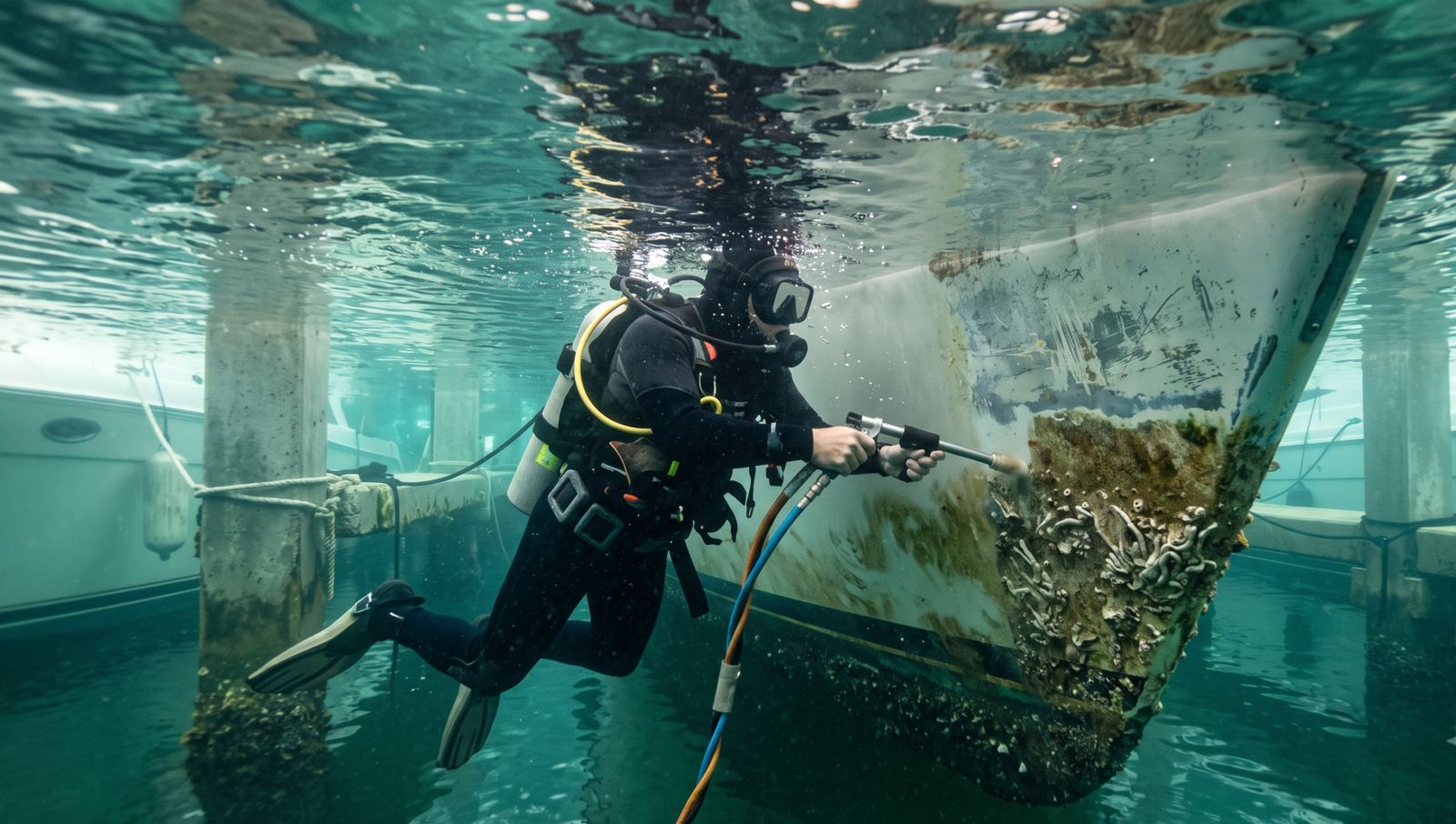
You clean the hull, rinse it, and think you’ve finally got the boat looking right—then you run your hand across the bottom and feel that rough, gritty layer of hard tube worms. In warm coastal waters, these calcareous structures can become surprisingly difficult to remove, especially when they have bonded tightly to an antifouling or foul-release coating.
Tube worm removal boat maintenance requires a controlled approach because hard calcareous fouling can damage the coating while it is being removed. Underwater cavitation cleaning can provide an efficient option for suitable hulls and surfaces, but the cleaning system, pressure, stand-off distance, coating condition, and local environmental requirements all need to be considered before work begins.
What Is Hard Tube Worm Fouling?
Hard tube worm fouling is the accumulation of calcareous tubes produced by marine worms that attach to submerged boat surfaces and form a hard, abrasive layer that can be difficult to remove without damaging the underlying coating.
Tube worms such as Hydroides can establish dense colonies on submerged surfaces. NOAA research has documented Hydroides among problematic fouling organisms and notes that their calcium-carbonate tubes can scratch hull coatings during cleaning.
This is why a hull covered in tube worms should not automatically be attacked with the most aggressive scraper or brush available.
Why Tube Worm Removal Can Damage a Boat Hull
The frustrating part of hard fouling is that the growth and the coating underneath it can have very different levels of durability.
The tube may be hard enough to resist gentle cleaning, while the coating beneath it can be damaged by the same aggressive tool used to remove the tube.
NOAA’s Integrated Pest Management guidance specifically warns that removing hardened tube-worm structures can damage hull coatings and that the calcareous tubes can scratch coatings during cleaning.
This becomes especially important with specialized coatings, including smooth foul-release systems. The coating may depend on maintaining a particular surface texture, so unnecessary abrasion can reduce its intended performance.
Why Underwater Cavitation Can Help With Hard Fouling
Underwater cavitation cleaning uses controlled water flow to create microscopic vapor bubbles that collapse near the surface. The resulting localized energy can help break the bond between marine growth and the underlying surface.
For suitable applications, cavitation cleaning can remove hard marine growth with less direct mechanical contact than conventional scraping or aggressive brushing.
The advantage is not that cavitation makes every hull coating impossible to damage. It is that the cleaning process can be controlled through the equipment, operating pressure, distance from the surface, and technician technique rather than relying entirely on physical scraping.
Our underwater cavitation cleaning service is designed for marine applications where controlled removal of stubborn underwater fouling is needed.
Tube Worm Removal Boat Cleaning Process
1. Inspect the Hull Before Cleaning
Before cleaning begins, determine what is actually attached to the hull and what is underneath it.
A pre-cleaning inspection should identify:
- Tube worm density
- Barnacles and other hard growth
- Soft algae and slime
- Coating condition
- Existing scratches or coating loss
- Hull material
- Running gear
- Intakes and through-hulls
- Strainers and grates
- Niche areas where fouling is concentrated
IMO guidance recommends pre-cleaning and post-cleaning considerations as part of responsible in-water cleaning practices.
2. Identify the Hull Coating
Knowing the coating matters.
A hard epoxy barrier coating, conventional antifouling system, copper-free coating, or silicone foul-release coating should not automatically receive the same cleaning treatment.
The cleaning objective is to remove the fouling while preserving as much of the intended coating system as possible.
If the coating history is unknown, an underwater inspection can help establish the condition before aggressive cleaning is considered. You can learn more about our underwater inspection services.
3. Establish a Controlled Cleaning Setting
Cavitation equipment should be operated according to the surface being cleaned rather than simply at maximum power.
The technician considers factors such as:
- Surface material
- Coating type
- Coating age
- Fouling thickness
- Distance from the hull
- Water conditions
- Visibility
- Location of fittings and appendages
A setting that is appropriate for bare metal may be inappropriate for a delicate coating.
4. Break Down the Hard Growth
The cavitation stream is worked across the fouled area in controlled passes.
Instead of digging underneath individual tube structures with a metal scraper, the technician works systematically across the surface, allowing the cavitation effect to loosen and remove the fouling.
Slow, controlled passes are preferable to holding the cleaning head aggressively against one spot.
5. Pay Attention to Edges and Niche Areas
Tube worms rarely distribute themselves perfectly evenly across a boat.
They can accumulate around:
- Waterline areas
- Transom sections
- Through-hulls
- Sea chests
- Bow thruster tunnels
- Trim tabs
- Struts
- Rudders
- Intake grates
- Other underwater appendages
IMO identifies niche areas such as sea chests, bow thrusters, hull appendages, and protrusions as locations that can influence biofouling management.
6. Perform a Post-Cleaning Inspection
Once the growth is removed, inspect the surface again.
Look for:
- Exposed substrate
- Coating loss
- Scratches
- Blistering
- Peeling
- Existing corrosion
- Remaining hard fouling
- Damage around fittings
A clean hull is not necessarily a healthy hull. The post-cleaning inspection tells you what condition was underneath the fouling.
Florida Tube Worms and Warm-Water Fouling
Florida’s warm coastal waters can create favorable conditions for rapid marine fouling, making regular monitoring especially useful for boats that remain in the water for extended periods.
Fouling rates vary with water temperature, salinity, nutrient availability, vessel movement, marina location, coating condition, and time spent stationary.
NOAA research on boat fouling has documented Hydroides and other fouling organisms and found that recruitment can vary significantly between harbor environments.
That means a cleaning interval that works for one South Florida marina may not work for another vessel only a short distance away.
Why Hard Tube Worms Should Not Be Left on the Hull
Marine growth creates more than an appearance problem.
IMO notes that biofouling increases biological roughness and can negatively affect vessel hydrodynamic performance. Heavy hard or shell fouling such as barnacles and tubeworm can create turbulence, cavitation, and noise.
As tube worms and other hard growth accumulate, the hull becomes rougher, increasing resistance and potentially affecting vessel performance and efficiency.
For boats where speed, fuel economy, range, or underwater equipment performance matters, controlling hard fouling becomes a functional maintenance issue rather than a cosmetic one.
Cavitation Cleaning vs. Scraping Tube Worms
| Cleaning Method | Best Use | Main Consideration |
|---|---|---|
| Manual scraping | Localized hard growth and accessible areas | Tool can scratch or gouge the coating |
| Brush cleaning | Soft growth and light fouling | May be ineffective against mature calcareous tubes |
| Cavitation cleaning | Suitable hard fouling and controlled underwater cleaning | Requires correct equipment settings and trained operation |
| Haul-out cleaning | Heavy fouling, coating repairs, or uncertain coating condition | Requires removing the vessel from the water |
The right method depends on the coating, fouling level, vessel, location, and environmental rules. No single cleaning technology is appropriate for every hull.
Environmental Considerations for Underwater Tube Worm Removal
Removing tube worms underwater can release fouling material and organisms into the surrounding water, so environmental controls are an essential part of the cleaning decision.
IMO’s current biofouling guidance specifically recognizes that in-water cleaning can physically damage antifouling coatings and release harmful waste substances and invasive aquatic species. The organization has also developed guidance for safer and more environmentally responsible in-water cleaning.
Some ports and marinas restrict or prohibit in-water hull cleaning because of the risk of releasing biological material and coating debris.
Before beginning work, verify the requirements that apply to the specific marina, port, waterway, and vessel.
Common Mistakes When Removing Hard Tube Worms
- Using a metal scraper across the entire hull without identifying the coating.
- Assuming tube worms are harmless because they are small.
- Waiting until hard fouling becomes a thick continuous layer.
- Using maximum cleaning pressure unnecessarily.
- Holding a cleaning tool against one area for too long.
- Ignoring niche areas such as intakes and thruster tunnels.
- Skipping the pre-cleaning inspection.
- Failing to inspect the coating after cleaning.
- Ignoring local restrictions on in-water cleaning.
- Assuming one cleaning method works equally well on every coating.
DIY vs. Professional Tube Worm Removal
Light slime is one thing. Mature calcareous tube worms are another.
Professional tube worm removal is worth considering when hard growth has become established, the coating is specialized, underwater visibility is limited, or the hull contains valuable appendages and fittings that could be damaged by aggressive cleaning.
A trained underwater technician can adjust the cleaning approach as the surface changes instead of treating the entire hull with one aggressive setting.
For routine fouling control, professional underwater hull cleaning can also help prevent soft growth from developing into more difficult hard fouling.
If the hull has been sitting in a South Florida marina for an extended period, an inspection can determine whether the problem is limited to surface growth or whether the coating and underwater hardware also require attention.
Frequently Asked Questions
What are hard tube worms on a boat hull?
Hard tube worms are marine worms that build rigid calcareous tubes on submerged surfaces. These calcium-carbonate structures can form dense fouling and become difficult to remove. Their rough, abrasive surfaces can also scratch hull coatings during cleaning, which is why removal needs to be controlled.
Can cavitation remove tube worms from a boat hull?
Yes. Underwater cavitation cleaning can be used for suitable hard marine fouling, including calcareous growth, when the equipment and operating parameters are appropriate for the hull and coating. The goal is controlled removal rather than maximum cleaning force.
Do tube worms damage boat bottom paint?
They can. The organisms themselves create hard, abrasive calcareous structures, and removing mature growth can scratch or abrade the underlying coating. NOAA specifically documents damage to hull coatings associated with removing hardened tube-worm structures.
How often should tube worms be removed from a boat?
There is no universal interval. Fouling rates depend on water temperature, location, vessel use, marina conditions, coating type, and time spent stationary. Regular inspections allow owners to remove early fouling before it develops into a more difficult hard-growth problem.
Is underwater tube worm removal allowed everywhere?
No. Some ports and marinas restrict or prohibit in-water cleaning because cleaning can release organisms and coating debris into the surrounding water. Always check local requirements before scheduling underwater cleaning.
Should tube worms be scraped off a fiberglass boat?
They can be removed from fiberglass, but aggressive scraping can damage the gelcoat or antifouling system. The appropriate method depends on the surface and coating. For established calcareous growth, controlled professional cleaning may reduce the risk of unnecessary surface damage.
For more marine maintenance guidance, read our latest underwater service and boat maintenance articles.
Conclusion
Tube worm removal boat maintenance should focus on removing hard calcareous fouling without turning a cleaning job into a coating repair. Mature tube worms can be surprisingly abrasive, and NOAA research confirms that their hard calcium-carbonate tubes can scratch hull coatings during removal.
Underwater cavitation offers a controlled option for suitable hulls and fouling conditions, but the technique still requires proper inspection, coating identification, equipment settings, and environmental planning. In South Florida, where warm-water fouling can develop quickly, catching tube worms early can make the entire maintenance process easier.
Ready to protect your vessel?
If you need expert help with this, our team of certified divers and marine technicians is ready to step in. Learn more about our specific services here.
Prefer to speak with an expert immediately? Contact us today to schedule a service or get a free quote!
