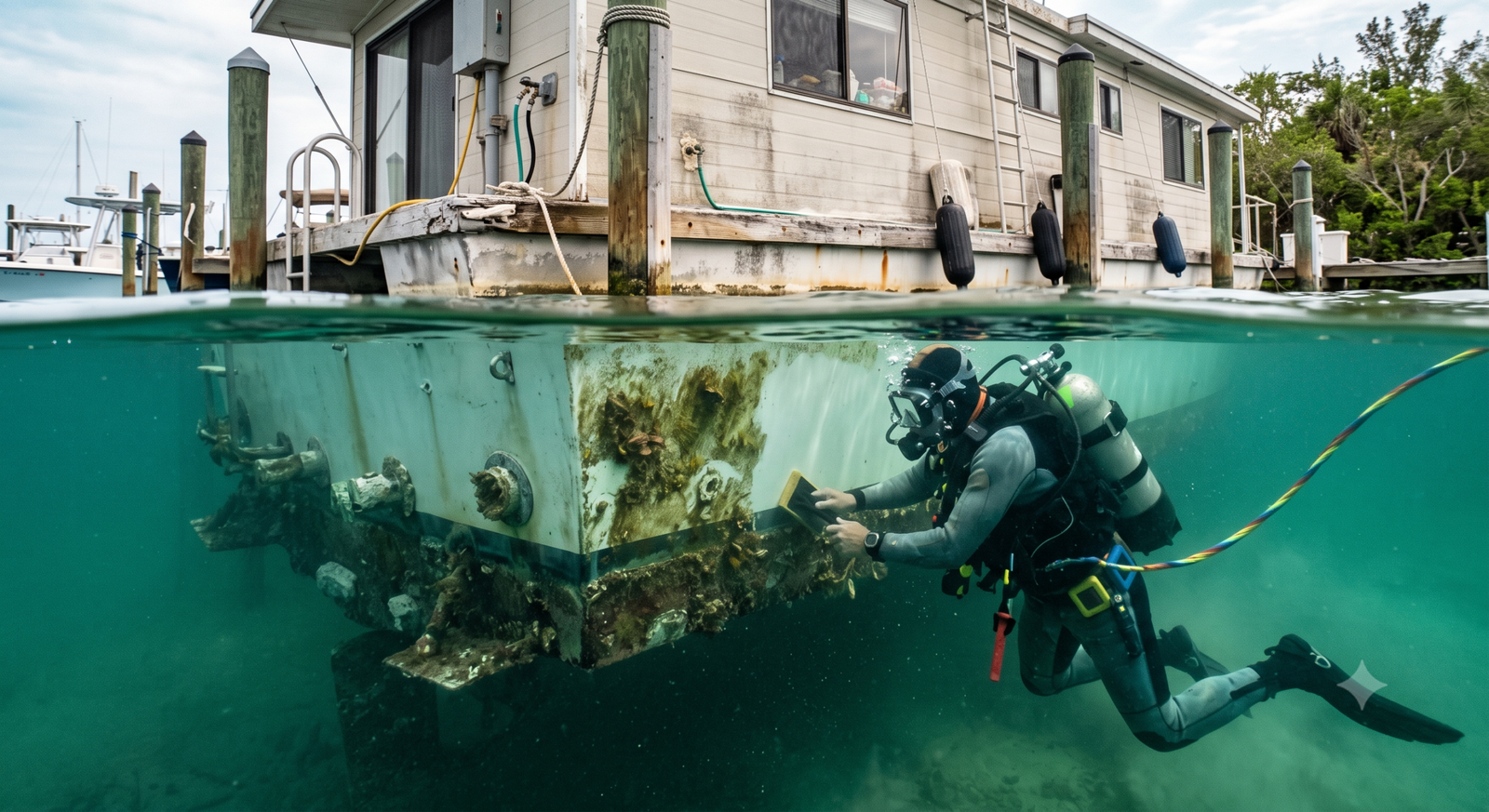
Floating homes and houseboats have a unique maintenance problem: they remain in the water continuously, often in relatively sheltered locations where marine growth can accumulate quickly. Unlike a conventional boat that may be hauled out periodically, a stationary floating residence can spend years exposed to the same underwater environment.
Eco-friendly biofouling removal for floating homes and houseboats focuses on controlling marine growth while minimizing unnecessary disturbance to the hull, coating, surrounding water, and aquatic environment.
The challenge is finding the right balance. A neglected hull can develop slime, algae, barnacles, mussels, tube worms, and other organisms that increase drag and can interfere with underwater components. But aggressive underwater cleaning can release organisms and coating debris into the water.
That makes the cleaning method, location, fouling type, hull material, and local environmental requirements important considerations before work begins.
What Is Biofouling on a Floating Home?
Biofouling is the accumulation of aquatic organisms on submerged surfaces. On a floating home or houseboat, this can include microorganisms, algae, weeds, barnacles, mussels, tube worms, and other organisms that attach to the hull and underwater structures.
Floating structures can be particularly susceptible because they often remain stationary for extended periods. Continuous immersion gives organisms more opportunity to colonize the underwater surfaces, while low vessel movement can reduce the natural disturbance that helps limit some forms of growth.
The International Maritime Organization identifies biofouling as an important pathway for transferring invasive aquatic species between locations. Its Biofouling Management guidance addresses minimizing the transfer of invasive aquatic species through ships and other submerged surfaces.
Why Floating Homes Develop Heavy Fouling
Houseboats and floating homes often have several characteristics that encourage persistent fouling:
- They remain in the water year-round.
- They may spend long periods in one location.
- Protected dock areas can have relatively limited water movement.
- Shaded underwater areas can retain moisture and organic material.
- Intakes, recesses, and other niche areas provide sheltered attachment points.
- Owners may have limited opportunities for conventional haul-out maintenance.
The longer a floating structure stays submerged without inspection, the more difficult biofouling can become to manage.
Light slime is very different from thick calcareous growth. A hull covered in soft algae may require a substantially different approach from one carrying mature barnacles or mussels.
Why Eco-Friendly Biofouling Removal Matters
Underwater cleaning can solve a maintenance problem while potentially creating an environmental problem if organisms, sediment, or coating material are released directly into the surrounding water.
The IMO explains that in-water cleaning can create environmental risks by releasing invasive aquatic species and potentially harmful substances from antifouling coatings. Its guidance emphasizes responsible biofouling management and environmentally sound cleaning practices.
Eco-friendly hull cleaning therefore means more than using a product advertised as “green.” It means considering what is being removed, where it is being removed, what the hull is coated with, and what happens to the material after it leaves the hull.
Inspect Before You Clean
A proper floating-home hull cleaning should begin with an assessment rather than immediately applying mechanical force.
An underwater inspection can determine:
- How much biofouling is present
- Whether the growth is soft or hard
- What type of hull or coating is present
- Whether underwater components are accessible
- Whether anodes are depleted
- Whether there is visible corrosion
- Whether debris is trapped around propulsion equipment
- Whether the hull appears damaged
- Whether local restrictions affect the proposed cleaning method
Our underwater inspection services can provide a condition check before cleaning begins.
This first step is particularly important for floating homes because the underwater structure may not receive regular haul-out inspections.
Soft Fouling vs. Hard Fouling
Not all marine growth should be treated the same way.
Soft Biofouling
Soft growth can include slime, algae, and other loosely attached organisms. Depending on the coating and local rules, relatively gentle cleaning may be sufficient.
Using the least aggressive effective method helps reduce unnecessary wear on the hull coating.
Hard Biofouling
Hard growth includes organisms such as barnacles, tube worms, and mussels that attach firmly to submerged surfaces.
Removing established hard fouling requires more care because aggressive scraping or abrasive cleaning can damage the underlying coating.
It can also create a greater risk of releasing biological material into the surrounding water.
Can You Clean a Floating Home Hull Underwater?
In many situations, underwater cleaning can be performed without hauling the entire floating structure out of the water. However, whether it is appropriate depends on the structure, hull material, coating, fouling condition, location, and applicable environmental rules.
The IMO’s biofouling guidance recognizes in-water cleaning as a potential biofouling-management measure but emphasizes that cleaning methods need to address the risk of releasing organisms and harmful substances.
Before underwater cleaning, determine whether the marina, waterway, municipality, state, or environmental authority has restrictions on in-water cleaning.
This is especially important for floating homes located in environmentally sensitive waterways or freshwater systems where invasive species are a concern.
Eco-Friendly Cleaning Methods for Houseboats
The best cleaning method depends on the specific structure. There is no single underwater technique that is appropriate for every floating home.
Controlled Mechanical Cleaning
Soft brushes and appropriately selected underwater cleaning tools can remove lighter growth while giving the technician control over the amount of force applied to the surface.
The objective should be effective fouling removal with the minimum necessary aggression.
Cavitation Cleaning
For suitable hulls and fouling conditions, controlled cavitation cleaning can help remove marine growth using cavitation bubbles generated in water.
Our underwater cavitation cleaning service can be considered for appropriate marine surfaces and fouling conditions.
Cavitation is not automatically the correct solution for every floating structure. The hull coating, substrate, fouling type, and environmental conditions should be evaluated first.
Targeted Cleaning
Sometimes a complete hull cleaning is unnecessary. A floating home may have concentrated fouling around an intake, rudder, propeller, or other underwater feature.
Targeted cleaning can reduce unnecessary disturbance by addressing the areas that actually require attention.
Houseboat Intakes and Underwater Equipment
A floating home may have more underwater equipment than its appearance suggests.
Depending on the structure, inspect:
- Raw-water intakes
- Sea strainers
- Discharge outlets
- Thrusters
- Propellers
- Rudders
- Through-hulls
- Seacocks
- Underwater lighting fixtures
- Protective anodes
Marine growth around an intake can restrict water flow. Fouling around running gear can affect propulsion. Growth around anodes can also make it harder to evaluate their condition.
Our underwater hull cleaning service can address suitable underwater areas while documenting conditions that may need additional attention.
Freshwater Floating Homes Have a Different Fouling Problem
Not every floating home operates in saltwater. Freshwater structures can develop their own forms of biofouling, including algae, aquatic weeds, mussels, and invasive species such as zebra mussels.
Freshwater fouling should not automatically be treated like marine fouling. Local invasive-species regulations can affect whether organisms may be removed, transported, or disposed of in a particular manner.
The U.S. Fish & Wildlife Service provides Aquatic Invasive Species information covering the ecological risks associated with invasive aquatic organisms.
If a floating home is located in freshwater, identify the species and check applicable local requirements before cleaning or moving the structure.
Why Antifouling Coating Condition Matters
The condition of the underlying coating determines how aggressively a fouled hull can safely be cleaned.
A relatively new antifouling system may respond differently from an older, heavily weathered coating. Excessive mechanical action can remove coating material along with the fouling.
Cleaning should remove unwanted growth without unnecessarily stripping away the protection the coating was installed to provide.
If the coating is already failing, cleaning alone may not solve the long-term problem. A coating specialist may need to evaluate whether the structure requires recoating or another maintenance solution.
How Often Should a Floating Home Hull Be Cleaned?
There is no universal cleaning interval for every houseboat or floating home.
Fouling rates depend on:
- Water temperature
- Salinity
- Nutrient levels
- Water movement
- Season
- Hull coating
- Time spent stationary
- Local fouling organisms
- Maintenance history
Rather than choosing an arbitrary calendar interval, monitor the actual condition of the underwater hull.
Regular inspections can identify growth while it is still relatively easy to manage.
Signs Your Floating Home Needs an Underwater Inspection
- Visible slime or algae around the waterline
- Reduced propulsion performance
- Restricted water intake
- Unusual vibration
- Rapid anode depletion
- Visible barnacle or tube-worm accumulation
- Persistent underwater odors or discharge concerns
- Long periods without underwater maintenance
- Moving the houseboat to another waterway
- Preparing a floating structure for extended relocation
If you are unsure what is growing underneath the structure, an underwater inspection is a better starting point than guessing from the dock.
Environmental Considerations Before Underwater Cleaning
Never assume that because a cleaning method is gentle on the hull, it is automatically environmentally acceptable.
The organisms being removed can themselves create a biosecurity concern. Coating particles, sediment, and chemical residues can also affect the surrounding water.
Before cleaning, determine:
- Whether in-water cleaning is permitted
- Whether capture or containment is required
- Whether the antifouling coating is suitable for in-water cleaning
- How removed organisms must be handled
- Whether the waterway has invasive-species restrictions
- Whether special disposal procedures apply
The IMO’s current biofouling framework emphasizes environmentally responsible management rather than treating hull cleaning as a simple cosmetic service.
Common Mistakes When Cleaning Floating Homes
- Waiting until heavy hard fouling has completely covered the hull.
- Using aggressive scraping without identifying the coating.
- Cleaning without inspecting the underwater structure first.
- Ignoring intakes and other niche areas.
- Assuming a freshwater houseboat has the same fouling risks as a saltwater yacht.
- Ignoring invasive-species requirements.
- Using chemicals without checking their suitability for the fabric or hull coating.
- Failing to document anode condition.
- Allowing removed organisms to spread into the surrounding waterway.
- Treating underwater cleaning as purely cosmetic maintenance.
DIY vs. Professional Floating Home Hull Cleaning
A floating home is not an ordinary boat-cleaning project. The structure may have unusual dimensions, limited access, permanent utility connections, residential equipment, and underwater systems that require careful inspection.
Professional underwater cleaning is particularly useful when the structure has heavy fouling, difficult underwater access, valuable coatings, or sensitive underwater equipment.
Our underwater inspection team can first assess the condition of the submerged structure and identify areas that need attention.
When cleaning is appropriate, professional hull cleaning can remove suitable marine growth while minimizing unnecessary disturbance to the surface.
For harder fouling and compatible surfaces, cavitation cleaning provides another potential option.
Frequently Asked Questions
What is biofouling on a houseboat?
Biofouling is the accumulation of aquatic organisms on submerged surfaces. On a houseboat, it can include algae, slime, barnacles, tube worms, mussels, weeds, and other organisms that attach to the hull and underwater equipment.
How do you remove biofouling from a floating home?
The appropriate method depends on the hull, coating, fouling type, location, and local environmental requirements. Options can include controlled mechanical cleaning or other specialized underwater methods for suitable surfaces. An inspection should come first so the cleaning technique does not unnecessarily damage the hull or coating.
Is underwater hull cleaning environmentally friendly?
It can be performed responsibly in appropriate circumstances, but underwater cleaning is not automatically environmentally friendly. Cleaning can release organisms, coating material, and other debris into the surrounding water. Local requirements and the condition of the hull should therefore be considered before work begins.
Can cavitation cleaning be used on a houseboat?
Cavitation cleaning can be appropriate for certain underwater surfaces and fouling conditions, but it is not universally suitable. The hull material, coating condition, fouling type, and surrounding environment should be evaluated before selecting the method.
How often should a floating home be inspected underwater?
There is no single interval that applies to every floating home. Fouling rates vary significantly with water temperature, salinity, water movement, coating condition, and location. Regular condition-based inspections are preferable to waiting for severe fouling to become visible from the surface.
Do freshwater houseboats have different biofouling risks?
Yes. Freshwater structures can develop different fouling communities and may face invasive-species concerns such as zebra mussels. Owners should identify the organisms present and check applicable local requirements before removing or transporting them.
For more practical marine maintenance information, read our latest underwater service and boat maintenance articles.
Conclusion
Eco-friendly biofouling removal for floating homes and houseboats starts with inspection, not aggressive cleaning. Understanding the type of growth, the condition of the hull coating, the underwater equipment, and the surrounding waterway makes it possible to choose a more controlled maintenance strategy.
For stationary vessels and floating residences, regular underwater inspections can catch fouling before it becomes a major maintenance problem. When cleaning is appropriate, the objective should be to remove unwanted growth effectively while protecting the hull and minimizing unnecessary release of organisms and coating material into the surrounding environment.
Ready to protect your vessel?
If you need expert help with this, our team of certified divers and marine technicians is ready to step in. Learn more about our specific services here.
Prefer to speak with an expert immediately? Contact us today to schedule a service or get a free quote!
